
Building robust software requires more than just writing functional logic. It demands a structured approach to thinking about problems and solutions before a single line of code is committed. This process lies at the heart of Object-Oriented Analysis and Design (OOA/OOD). By adhering to established best practices, developers create systems that are resilient, extensible, and easy to understand over time. This guide explores how to construct high-quality software architectures that stand the test of time without relying on temporary fixes.
Understanding the Foundation: OOA vs. OOD 🔍
Before diving into code, it is crucial to distinguish between analysis and design. While often used interchangeably, they serve distinct phases in the software development lifecycle.
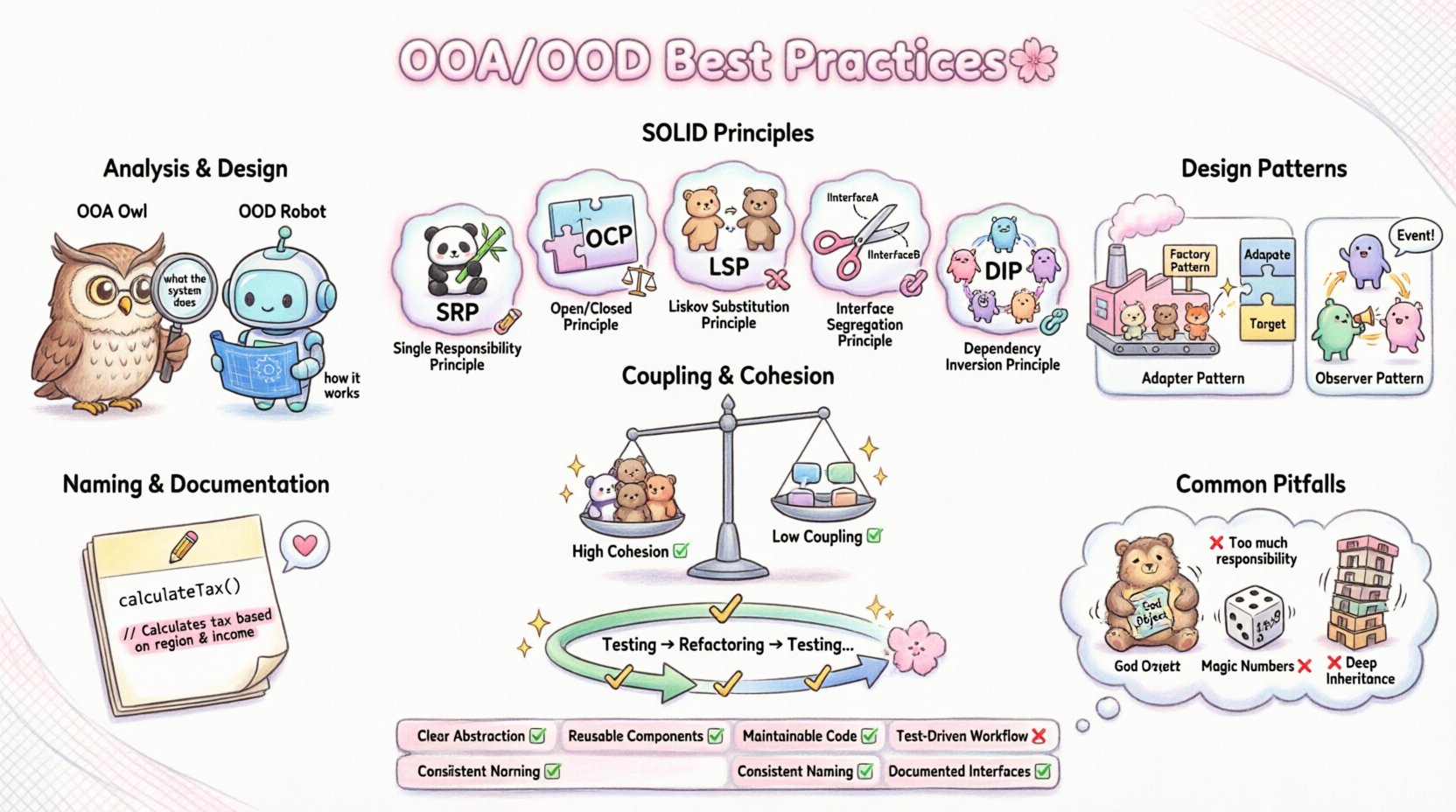
- Object-Oriented Analysis (OOA): This phase focuses on what the system needs to do. It involves identifying actors, use cases, and the domain model. The goal is to understand the problem space without worrying about implementation details.
- Object-Oriented Design (OOD): This phase addresses how the system will do it. Here, you translate requirements into classes, interfaces, and relationships. It involves selecting algorithms and data structures to satisfy the analysis findings.
Skipping the analysis phase often leads to premature optimization or incorrect abstractions. A clear model ensures that the design aligns with business logic. When teams rush from requirements to implementation, technical debt accumulates rapidly.
Core Principles for Maintainability 🛡️
Maintainability is the ease with which a system can be modified to correct faults, improve performance, or adapt to a changed environment. To achieve this, specific design principles must be integrated into the workflow. The following principles are foundational to object-oriented programming.
1. Single Responsibility Principle (SRP) 🎯
A class should have one, and only one, reason to change. If a class handles both database operations and user interface rendering, it becomes fragile. Changes to the UI logic might break the database logic, and vice versa. By separating concerns, you isolate changes to specific modules. This reduces the risk of unintended side effects.
- Identify Responsibilities: Ask why a class exists. If there are two reasons, split it.
- Focus on Functionality: Ensure each class performs a specific task well.
- Reduce Coupling: Dependencies should be minimized to related functionalities only.
2. Open/Closed Principle (OCP) 🚪
Software entities should be open for extension but closed for modification. This allows developers to add new functionality without altering existing source code. When you modify existing code, you introduce the risk of breaking existing features. Extending behavior through inheritance or composition preserves the integrity of the original system.
- Use Interfaces: Define contracts that implementations can adhere to.
- Leverage Polymorphism: Allow different behaviors to be swapped at runtime.
- Avoid Hardcoding: Do not write specific logic for every new requirement.
3. Liskov Substitution Principle (LSP) ⚖️
Objects of a superclass should be replaceable with objects of its subclasses without breaking the application. If a subclass changes the expected behavior of the parent, the system becomes unstable. This principle ensures that inheritance is used correctly to model ‘is-a’ relationships rather than just code reuse.
- Preconditions: Subclasses should not strengthen preconditions of the parent.
- Postconditions: Subclasses should not weaken postconditions of the parent.
- Invariants: Subclasses must preserve the invariants of the parent class.
4. Interface Segregation Principle (ISP) ✂️
Clients should not be forced to depend on interfaces they do not use. Large, monolithic interfaces create unnecessary dependencies. If a class implements an interface it only partially uses, it becomes burdened with empty or dummy methods. Smaller, targeted interfaces lead to more flexible and robust designs.
- Split Interfaces: Break down large interfaces into smaller, cohesive ones.
- Role-Based Design: Design interfaces based on specific client needs.
- Avoid Bloat: Do not include methods that are irrelevant to a specific implementation.
5. Dependency Inversion Principle (DIP) 🔗
High-level modules should not depend on low-level modules. Both should depend on abstractions. Furthermore, abstractions should not depend on details; details should depend on abstractions. This decouples the system, making it easier to swap out underlying implementations without affecting the high-level logic.
- Inject Dependencies: Pass required objects into constructors or methods.
- Program to an Interface: Rely on abstract types rather than concrete ones.
- Loose Coupling: Minimize direct connections between components.
Design Patterns: Solving Recurring Problems 🧩
Design patterns are proven solutions to common problems in software design. They provide a template for how to solve issues that occur repeatedly. While not a silver bullet, they offer a shared vocabulary and structure.
Creational Patterns
These patterns deal with object creation mechanisms, trying to create objects in a manner suitable to the situation. The basic form of object creation could result in design problems or added complexity to the design.
- Factory Method: Defines an interface for creating an object, but lets subclasses decide which class to instantiate.
- Singleton: Ensures a class has only one instance and provides a global point of access to it.
- Builder: Constructs complex objects step by step, allowing the same construction process to create different representations.
Structural Patterns
These patterns ease the design by identifying a simple way to realize relationships between entities.
- Adapter: Allows incompatible interfaces to work together.
- Decorator: Attaches additional responsibilities to an object dynamically.
- Facade: Provides a simplified interface to a complex subsystem.
Behavioral Patterns
These patterns are specifically concerned with algorithms and the assignment of responsibilities between objects.
- Observer: Defines a dependency between objects so that when one changes state, all its dependents are notified.
- Strategy: Defines a family of algorithms, encapsulates each one, and makes them interchangeable.
- Command: Encapsulates a request as an object, thereby letting you parameterize clients with different requests.
Coupling and Cohesion: The Balance Scale ⚖️
Two metrics define the quality of a design: coupling and cohesion. Understanding the relationship between them is essential for maintainability.
| Metric | Definition | Goal |
|---|---|---|
| Cohesion | How closely related the responsibilities of a module are. | High Cohesion is desired. |
| Coupling | How dependent one module is on another. | Low Coupling is desired. |
High cohesion means a class does one thing well. Low coupling means a class doesn’t rely heavily on other classes. Achieving this balance makes the system modular. When you need to change a feature, you only need to touch the relevant module without rippling effects across the entire codebase.
Characteristics of Good Cohesion
- Functional Cohesion: All elements contribute to a single task.
- Sequential Cohesion: Output of one element is input to another.
- Communicational Cohesion: All elements operate on the same data.
Characteristics of Bad Coupling
- Content Coupling: One module modifies data in another.
- Common Coupling: Multiple modules access the same global data.
- Path Coupling: Modules are connected via a long chain of dependencies.
Documentation and Naming Conventions 📝
Code is read much more often than it is written. Clear naming and documentation reduce the cognitive load on developers. This practice is vital for onboarding new team members and for future maintenance.
Naming Best Practices
- Descriptive Names: Avoid abbreviations unless they are industry standard. Use
CustomerOrderinstead ofCO. - Intent Revealing: The name should explain the purpose of the variable or method.
calculateTax()is better thancalc(). - Consistent Style: Follow a consistent naming convention throughout the project (e.g., PascalCase for classes, camelCase for methods).
- Meaningful Booleans: Boolean variables should imply a true/false state (e.g.,
isActive,hasPermission).
Documentation Standards
- API Comments: Document public interfaces, parameters, and return values.
- Architecture Diagrams: Visualize high-level components and their interactions.
- README Files: Include setup instructions, build processes, and environment variables.
- Code Reviews: Use peer reviews to ensure documentation matches the implementation.
Common Pitfalls to Avoid 🚫
Even experienced developers fall into traps that degrade code quality. Recognizing these patterns early can save significant effort later.
- God Objects: A single class that knows too much and does too much. Break these down into smaller units.
- Magic Numbers: Hardcoded numeric values obscure meaning. Replace them with named constants.
- Deep Inheritance Hierarchies: Deep trees are hard to navigate. Prefer composition over inheritance where possible.
- Global State: Shared mutable state makes testing difficult and introduces race conditions.
- Long Methods: Methods with many lines of code are hard to understand. Extract logic into smaller helper methods.
Testing and Refactoring as a Continuous Process 🔄
Maintainability is not a one-time setup; it is a continuous practice. Testing and refactoring must be integrated into the development cycle.
Automated Testing
- Unit Tests: Verify the behavior of individual components in isolation.
- Integration Tests: Ensure different modules work together correctly.
- Regression Tests: Confirm that new changes do not break existing functionality.
Refactoring Techniques
- Rename: Change names to improve clarity.
- Extract Method: Move code into a new method to reduce duplication.
- Pull Up / Push Down: Move methods up or down the class hierarchy to improve organization.
- Replace Conditional Logic: Use polymorphism or strategy patterns to simplify complex if-else blocks.
Summary of Best Practices 📋
| Area | Key Action |
|---|---|
| Design | Apply SOLID principles consistently. |
| Structure | Maximize cohesion, minimize coupling. |
| Code Quality | Use descriptive names and avoid duplication. |
| Testing | Maintain high coverage for critical paths. |
| Documentation | Keep docs synchronized with code changes. |
Implementing Object-Oriented Analysis and Design best practices creates a foundation for long-term success. It shifts the focus from short-term delivery to sustainable engineering. By prioritizing structure, clarity, and modularity, teams can adapt to changing requirements with confidence. The effort invested in the early stages of analysis and design pays dividends throughout the lifecycle of the software.
Remember that these principles are guidelines, not rigid rules. Context matters. Sometimes a trade-off is necessary to meet business deadlines. However, always be aware of the technical debt being incurred. Plan to address it when capacity allows. A maintainable codebase is an asset that grows in value over time.
Start with small changes. Refactor one module at a time. Introduce tests before adding new features. These incremental steps build a culture of quality. Over time, the system becomes easier to modify and less prone to errors. This is the true essence of writing maintainable code from day one.