
Mastering Product Management Data Models with VPasCode
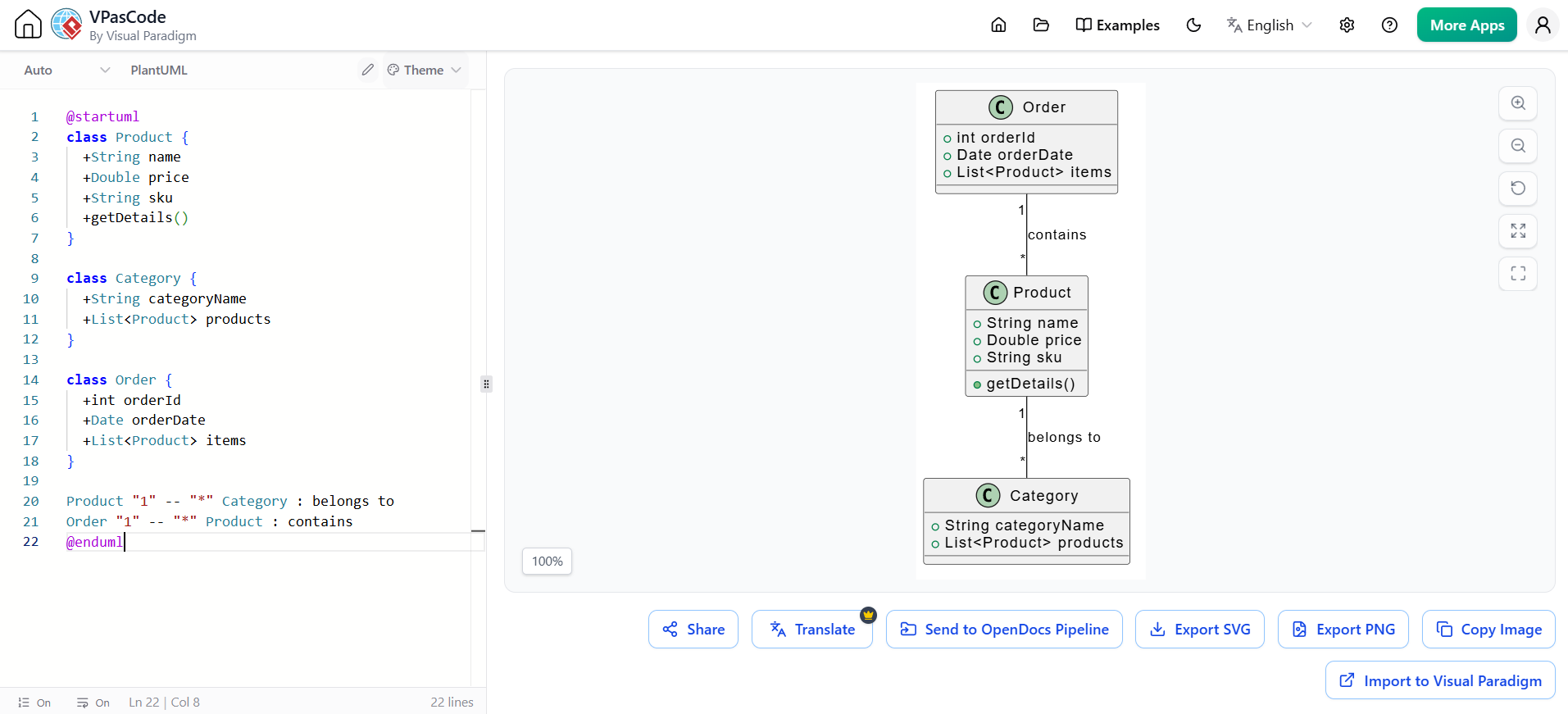
In modern software architecture, maintaining a visual representation of your data model is as critical as writing the code itself. This tutorial explores the concept of Modeling as Code using Visual Paradigm’s VPasCode environment. We will deconstruct a real-world example: a Product Management System.
By the end of this guide, you will understand how to define complex class structures, manage relationships between entities, and visualize your domain logic instantly using PlantUML syntax.
Understanding the Domain: The Product Hierarchy
Before writing a single line of code, it is essential to understand the entities involved in a typical e-commerce or inventory management system. In our example, we are building a model that connects three core entities:
- Product: The fundamental item being sold (e.g., a “Leather Wallet”).
- Category: A classification for products (e.g., “Accessories”).
- Order: A transaction record that aggregates multiple products.
The relationships are hierarchical and relational. A Category groups many Products, and an Order contains a collection of Products.
Step-by-Step: Defining the Class Structure
VPasCode allows us to define these entities using standard PlantUML class syntax. The left pane of the tool acts as a code editor, providing real-time syntax highlighting and validation.
1. Defining the Product Class
We start with the most granular entity. Notice how the class definition includes attributes (fields) and methods.
@startuml
class Product {
  +String name
  +Double price
  +String sku
  +getDetails()
}
Key Concept: The + symbol indicates public visibility. This is standard object-oriented notation where + means public, - means private, and # means protected.
2. Defining the Category Class
Next, we define the Category. A crucial architectural pattern here is the Self-Referencing Association or One-to-Many relationship.
class Category {
  +String categoryName
  +List<Product> products
}
Notice the attribute List<Product> products. This implies that a Category object holds a collection (array or list) of Product objects. This is a database-friendly design for organizing inventory.
3. Defining the Order Class
Finally, the Order class represents a transaction. It requires temporal data and a reference to the items involved.
class Order {
  +int orderId
  +Date orderDate
  +List<Product> items
}
By defining orderId as an int and orderDate as a Date, we are setting strict data types that will influence the database schema generation later.
Step-by-Step: Mapping Relationships
Defining classes is only half the battle. In a real system, these classes must interact. VPasCode allows us to define these relationships declaratively using association syntax.
The syntax generally follows this pattern: ClassA "1" -- "" ClassB : Label.
1. The “Belongs To” Relationship
We need to link a Product to a Category. A single product belongs to one category, but a category can contain many products.
Product "1" -- "*" Category : belongs to
- “1”: The cardinality on the Product side. One product instance belongs to exactly one category.
- ““: The cardinality on the Category side. One category instance contains zero or more products.
- : belongs to: The semantic label for the relationship line.
2. The “Contains” Relationship
An Order contains multiple products. This is a classic “One-to-Many” or “One-to-Many-to-Many” relationship depending on if products can appear in multiple orders.
Order "1" -- "*" Product : contains
This line tells the diagram engine that an Order object has a reference to a List of Product objects.
The Power of “Modeling as Code”
Why use VPasCode instead of dragging and dropping boxes in a GUI?
- Version Control: You can save your model in Git. You can track changes to your architecture just like you track changes to your source code.
- Speed: Typing
class Product { ... }is significantly faster than navigating a menu to add a class, adding fields, and drawing lines. - Consistency: Code enforces strict formatting, reducing the likelihood of messy diagrams.
Conclusion
By defining the Product Management model as code, we bridge the gap between abstract design and concrete implementation. Whether you are a software architect planning a new microservice or a developer setting up a database schema, starting with a clear, code-based diagram ensures your data integrity from day one.