

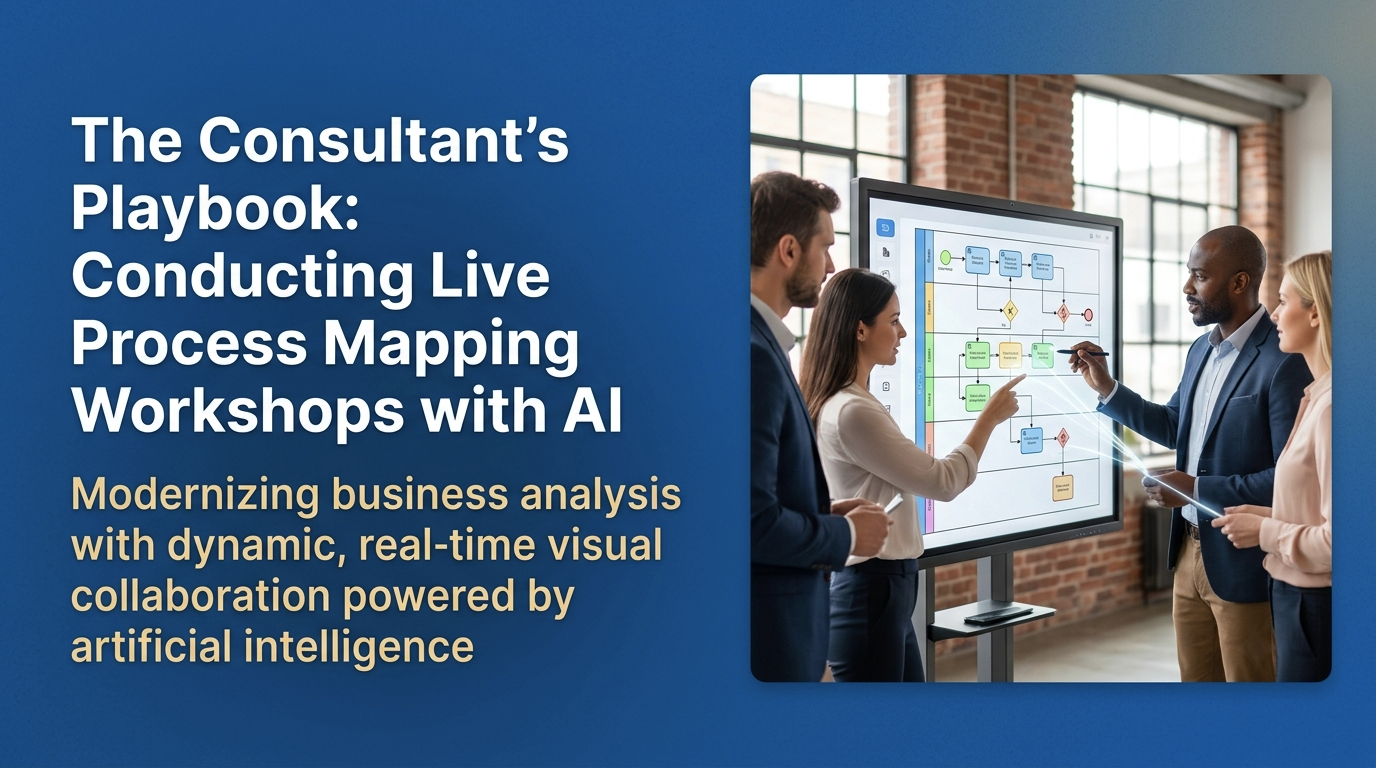
For management consultants and business analysts, leading process discovery workshops is both an art and a science. Gathering cross-functional stakeholders into a single room—or virtual call—to capture “As-Is” operational realities and design “To-Be” optimized workflows is one of the fastest ways to drive enterprise transformation. However, traditional workshop facilitation often suffers from severe friction: slow whiteboard drawing, post-meeting transcription delays, and misaligned client expectations.
To deliver maximum value and maintain momentum, modern consultants are revolutionizing how live process mapping is conducted. By integrating a real-time AI BPMN tool like Visual Paradigm into discovery sessions, facilitators can convert spoken client discussions directly into formal, standard-compliant Business Process Model and Notation (BPMN) diagrams on the fly. This transforms static interviews into dynamic, collaborative design experiences powered by Visual Paradigm’s advanced generative AI capabilities.
The Pitfalls of Traditional Process Mapping Workshops
Historically, process discovery sessions relied on physical whiteboards, sticky notes, or basic canvas drawing applications. While these methods allow for quick brainstorming, they introduce major inefficiencies into consulting engagements:
- The Post-Workshop Documentation Lag: Facilitators often spend hours or days after a workshop manually digitizing sticky notes into formal diagramming tools, delaying project deliverables.
- Loss of Context and Nuance: Important decision logic or exception paths discussed verbally during the workshop can be lost or misremembered during post-meeting transcription.
- Delayed Client Feedback Loops: Clients only see the finalized process map days after the meeting, requiring additional review sessions to fix misinterpretations that could have been resolved instantly.
How Real-Time AI Generation Transforms the Workshop Experience with Visual Paradigm
Leveraging generative artificial intelligence fundamentally alters workshop dynamics. Instead of a consultant spending half the meeting drawing lines and positioning boxes while stakeholders watch passively, the consultant acts as an active facilitator while an intelligent engine handles the visual modeling in real time.
Using a conversational Visual Paradigm AI BPMN Tool during live client discovery sessions provides three game-changing advantages:
1. Live Process Synthesis with Visual Paradigm
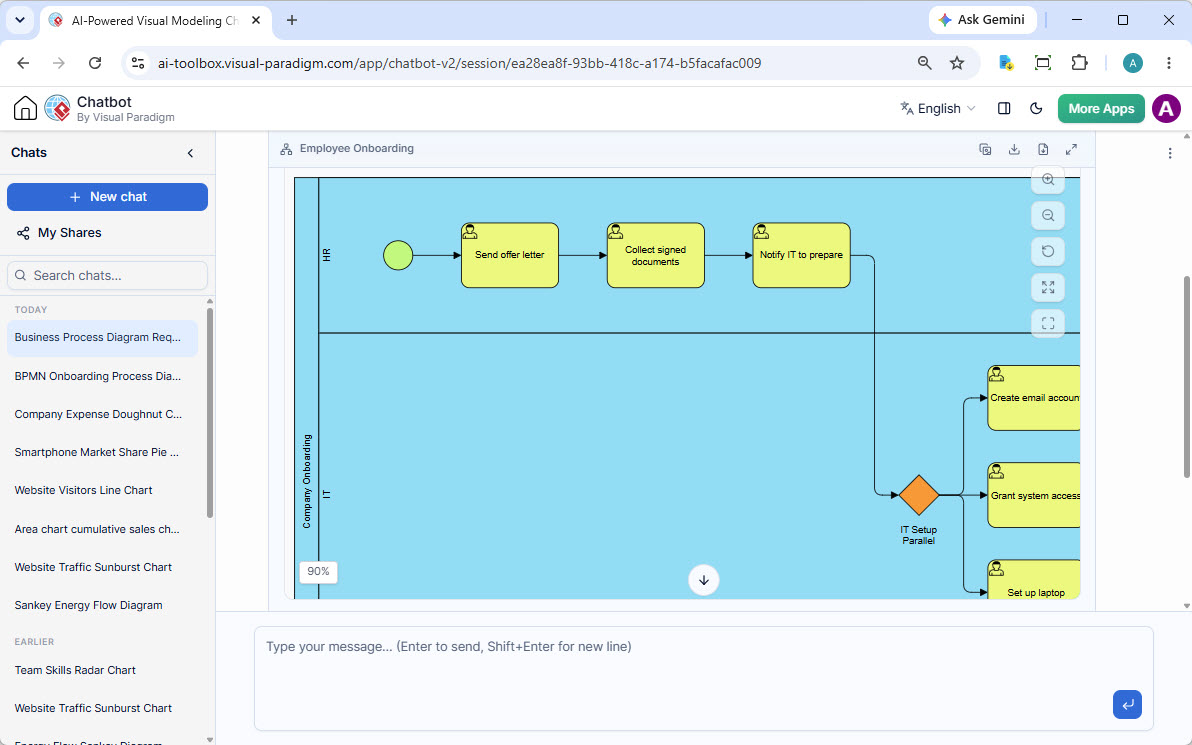
As stakeholders describe their daily responsibilities, the facilitator can feed structured meeting notes or direct spoken summaries into the Visual Paradigm AI BPMN Tool. The engine instantly analyzes the narrative, creates designated swimlanes for each department, and generates the core sequence flow before the group’s eyes. Unlike generic chatbots, Visual Paradigm ensures the output is not just a rough sketch, but a syntactically correct BPMN 2.0 model ready for immediate analysis.
2. Instant “What-If” Scenario Exploration
When clients debate operational edge cases—such as “What happens if a high-value invoice is rejected by compliance?”—the consultant can prompt the Visual Paradigm AI assistant to insert conditional decision gateways and alternative handling branches immediately. Stakeholders see their logic validated in real time within the robust modeling environment of Visual Paradigm.
3. Immediate Stakeholder Consensus
By reviewing a syntactically correct BPMN diagram together before ending the call, participants can confirm that the visual model accurately reflects their operational reality. With Visual Paradigm, the client walks away from the workshop with a finalized, validated process baseline rather than a promise of a draft next week, thanks to the tool’s ability to bridge the gap between conversation and formal documentation instantly.
A Consultant’s 4-Step Playbook for AI-Powered Discovery
To run seamless, highly productive process discovery workshops using Visual Paradigm’s AI BPMN Tool, follow this practical four-step playbook:
Step 1: Frame the Scope and Key Objectives
Begin the session by defining clear process boundaries. Establish the trigger (Start Event) and desired operational outcomes (End Events) with the client team before diving into intermediate steps. Ensure your Visual Paradigm workspace is set up with the appropriate industry templates to align with these objectives.
Step 2: Facilitate Narrative Storytelling
Guide participants through a structured conversation asking “Who does what, when, and why?” Record key operational steps, role responsibilities, and system interactions as a structured text narrative. This narrative will serve as the precise input for the Visual Paradigm AI engine.
Step 3: Generate the Baseline Model with Visual Paradigm AI
Input the summarized narrative directly into the Visual Paradigm AI BPMN Tool. Allow the AI engine to build the initial multi-lane BPMN diagram, establishing gateway conditions and task sequences automatically. Visual Paradigm‘s engine understands complex process logic, ensuring that swimlanes, events, and gateways are placed correctly according to international standards.
Step 4: Refine Logic and Bridge to Enterprise Architecture
Walk through the generated diagram with the client team, making real-time conversational tweaks to refine specific tasks using the intuitive interface of Visual Paradigm. Finally, leverage the platform’s integration capabilities to import the validated model into an enterprise modeling environment where process tasks can be linked directly to underlying software applications, data models, and strategic organizational goals—all within the same ecosystem.
Frequently Asked Questions
Can an AI BPMN tool replace the need for an experienced workshop facilitator?
No. An AI BPMN tool like Visual Paradigm accelerates the technical drawing and syntax structuring phases, but human facilitators remain vital for managing stakeholder dynamics, asking probing questions, and uncovering unstated operational realities. Visual Paradigm empowers the facilitator, it does not replace them.
How does real-time AI mapping handle non-standard industry terminology used by clients?
Advanced generative AI engines excel at contextual translation. You can describe processes using your client’s internal jargon, and the Visual Paradigm AI BPMN Tool will accurately map those concepts into standardized BPMN tasks, swimlanes, and events, ensuring global compatibility while respecting local terminology.
What happens if a client’s process is too complex for a single live prompt?
Best practices dictate breaking complex workflows into modular sub-processes. Generate the high-level (Level 1) process map first with your Visual Paradigm AI assistant, and then run dedicated mini-sessions to expand specific collapsed sub-processes in detail. Visual Paradigm‘s hierarchical modeling features make this expansion seamless.
Conclusion
For modern business consultants, speed, accuracy, and client engagement are critical differentiators. Moving away from manual whiteboard drawing to an interactive, real-time Visual Paradigm AI BPMN Tool transforms process discovery from a tedious administrative task into an agile, high-value consulting experience. By capturing, visualizing, and validating complex client workflows instantly with Visual Paradigm, consultants can accelerate project timelines and deliver superior strategic outcomes.
Related posts:
 Hands-On Review: Automating Inventory Management with BPMN Conditional Start Events
 The Comprehensive Guide to BPMN: Enhancing Efficiency and Productivity with Visual Paradigm BPMN + AI
 AI Deployment Diagram Tools: A Skeptic’s Guide to Seeing Is Believing
Mastering Business Process Modeling: A Review of Visual Paradigm’s BPMN Capabilities
AI Deployment Diagram Tools: A Skeptic’s Guide to Seeing Is Believing
Mastering Business Process Modeling: A Review of Visual Paradigm’s BPMN Capabilities
