
Mastering AI-Assisted UML CRC Modeling: From Natural Language to Enterprise Architecture
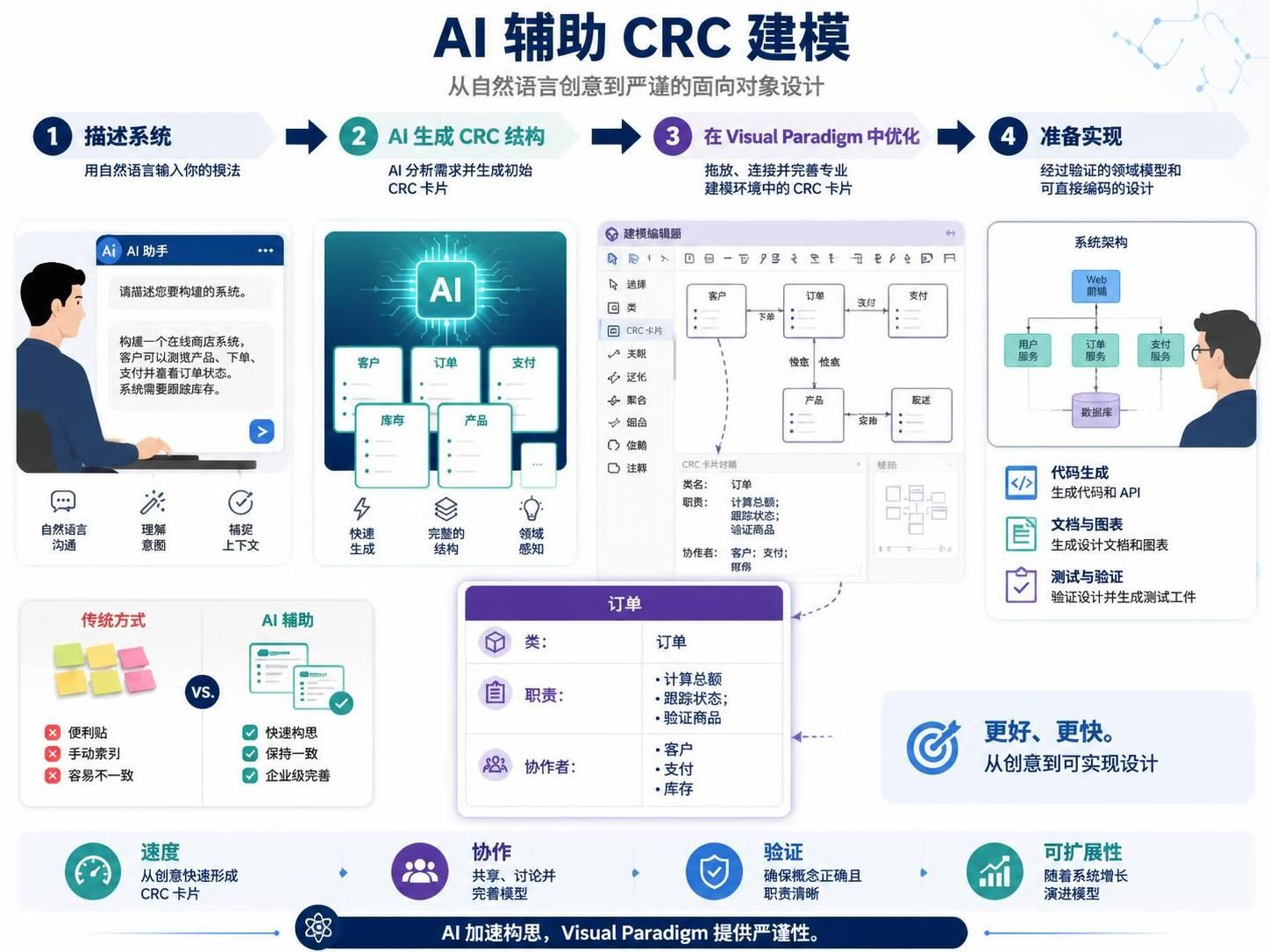
Object-Oriented Design (OOD) has long relied on the Class-Responsibility-Collaborator (CRC) card technique as a rapid, low-fidelity method to brainstorm system architecture. However, the traditional workflow of using physical sticky notes or basic drawing tools often becomes a bottleneck as systems grow in complexity. Visual Paradigm has revolutionized this process by integrating Artificial Intelligence directly into the modeling lifecycle, allowing architects to transition seamlessly from natural language prompts to rigorous, code-ready designs.
1. The Paradigm Shift: From Sticky Notes to AI
For decades, the CRC method was a manual exercise. Teams would write class names on cards, list responsibilities, and identify collaborators using physical sticky notes. While effective for high-level ideation, this approach suffers from:
- Lack of Consistency: Hand-drawn cards vary in notation and clarity.
- Version Control Issues: Physical cards cannot be easily tracked or updated collaboratively.
- Scalability: Managing hundreds of classes across a large system becomes unmanageable without a digital backbone.
AI-assisted modeling solves these problems by acting as a bridge between abstract ideas and structured data. By leveraging Natural Language Processing (NLP), developers can describe their system vision in plain text, and the AI engine parses this input to generate a structured Class Diagram or CRC Matrix.
Step 1: Describing the System (Natural Language Input)
The process begins with the “Prompt.” Instead of drawing boxes, you define the scope. As illustrated in the workflow, the user inputs a description of the domain. For example, describing an online store:
“Build an online store system where customers can browse products, place orders, make payments, and the system needs to track inventory.”
This input triggers the AI’s understanding of the domain context, identifying key entities and their relationships.
Step 2: AI Generation of CRC Structure
Once the prompt is processed, the AI analyzes the requirements and generates the initial CRC cards. It identifies:
- Classes: The primary entities (e.g.,
Customer,Order,Payment,Product,Inventory). - Responsibilities: What each class must do (e.g.,
Ordercalculates totals,Inventorytracks stock). - Collaborators: Which other classes a specific class interacts with to fulfill its duties.
2. Refinement within Visual Paradigm
The true power of this workflow lies in the transition from “AI Draft” to “Professional Model.” Visual Paradigm provides an enterprise-grade environment where the AI-generated structure can be manipulated.
Step 3: Optimization and Structuring
In this stage, the architect validates the AI’s output. The interface allows for dragging, dropping, and connecting the generated classes to form a coherent Class Diagram. You can:
- Verify Relationships: Ensure associations (e.g., Customer places Order) are correctly typed.
- Refine Responsibilities: Split broad responsibilities into atomic methods if necessary.
- Apply Design Patterns: The tool can suggest structural improvements, such as inheritance hierarchies or interfaces.
Step 4: Preparation for Implementation
The final phase bridges the gap between design and code. Visual Paradigm ensures that the conceptual model is rigorous enough for implementation by enabling:
- Code Generation: Automatically generating boilerplate code in Java, C#, or Python based on the CRC classes.
- Documentation: Producing technical design documents and API specifications.
- Testing Artifacts: Generating test cases to verify the logic defined in the CRC cards.
Conclusion
The evolution from manual sticky notes to AI-assisted modeling represents a significant leap in software engineering efficiency. By automating the initial structuring of classes and responsibilities, Visual Paradigm allows teams to focus on high-level architectural decisions rather than tedious syntax entry.
Whether you are designing a microservices architecture or a monolithic application, the combination of Visual Paradigm TOGAF ADM & AI Assisted modeling ensures that your design process is not only faster but also more consistent and aligned with industry standards. This approach guarantees that your system architecture is robust from the very first line of generated code.