Architecting Digital Transformation: Applying TOGAF ADM to FreshMart
In the rapidly evolving landscape of enterprise technology, organizations must align their IT capabilities with their strategic business goals. One of the most robust frameworks for achieving this alignment is TOGAF (The Open Group Architecture Framework). Specifically, the Architecture Development Method (ADM) provides a step-by-step process for designing and improving enterprise architecture.
This tutorial explores the application of the TOGAF ADM using a practical, fictional case study: FreshMart, a small grocery store chain.
1. Understanding the Four Pillars of Enterprise Architecture
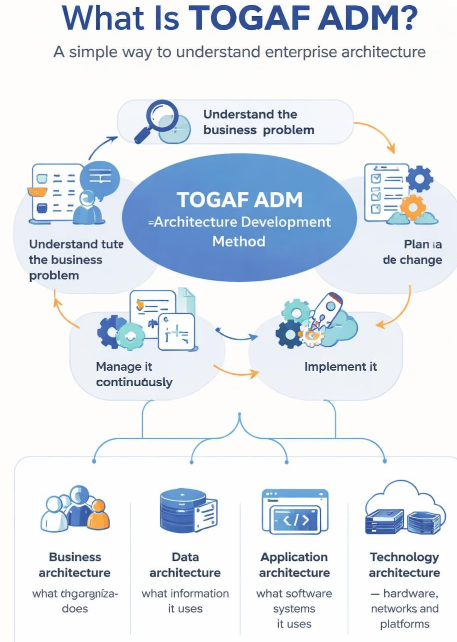
Before diving into the development method, it is essential to understand the four core components that make up an organization’s architecture. TOGAF views these as interdependent layers that must work together:
- Business Architecture: This defines what the organization does. It includes business processes, organizational structure, and governance.
- Data Architecture: This describes what information it uses. It covers data models, data governance, and data flows.
- Application Architecture: This details what software systems it uses. It maps out the applications, their interactions, and their relationship to business processes.
- Technology Architecture: This specifies what hardware, networks, and technical platforms support the software. It includes servers, databases, cloud infrastructure, and network security.
2. The Case Study: FreshMart’s Challenge
To illustrate the ADM process, we examine FreshMart, a chain of five grocery stores. Currently, FreshMart operates in a fragmented environment:
- Current State: Customers must visit physical stores to buy products.
- Siloed Systems: Employees use separate systems for Sales, Inventory, Accounting, and Supplier orders that do not communicate well.
- Manual Processes: Reports are generated manually, supplier orders are sent via email, and sales data is entered manually into accounting systems.
The Business Problems:
- Inability to take online orders.
- Selling out-of-stock items due to lack of real-time inventory visibility.
- Lack of real-time reporting for senior managers.
The Business Goal:
FreshMart wants to launch an Online Grocery Ordering Service. This new service must integrate seamlessly with inventory, payments, suppliers, and accounting systems to increase sales, improve customer service, and reduce manual work.
3. The TOGAF ADM Process
The TOGAF Architecture Development Method (ADM) is the engine that drives this transformation. It is a cyclical, iterative process. We can visualize the ADM as a journey through five key phases:
Phase A: Understand the Business Problem
At this stage, the architect analyzes the current state. For FreshMart, the analysis reveals that the lack of integration between the sales system and the inventory system is the root cause of stock errors. The goal is clearly defined: create an online ordering channel.
Phase B: Design a Better Future
Here, we define the Target Architecture. This involves designing how the Business, Data, Application, and Technology architectures will look in the future. We plan to replace manual emails with automated data flows and introduce a central database to unify sales and inventory.
Phase C: Plan the Change
Once the future state is designed, we create an Implementation and Migration Plan. We must decide the order of operations. For FreshMart, we must first modernize the database infrastructure before building the customer-facing web application.
Phase D: Implement It
This phase involves the actual construction. Developers build the web portal, integrate the API with the inventory system, and configure the payment gateways. This is where the theoretical architecture becomes reality.
Phase E: Manage it Continuously
Architecture is not a one-time event. Once the system is live, FreshMart must monitor its performance. If a new supplier is added, the architecture must be reviewed and updated. This phase ensures the system evolves with the business.
4. Visualizing the Architecture
To effectively communicate these complex changes, architects use modeling tools. Diagrams such as Context Diagrams and Data Flow Diagrams are crucial for visualizing how data moves between the “Customers,” the “Online System,” and the “Inventory System.”
For the most efficient modeling experience, we recommend using Visual Paradigm TOGAF Tool. This enterprise-grade software allows architects to:
- Automate Modeling: Generate diagrams directly from model data.
- Ensure Compliance: Validate that the architecture adheres to TOGAF standards.
- Visualize Flows: Create clear visual representations of the integration points required for FreshMart’s new online service.
Conclusion
The TOGAF ADM provides a structured roadmap for transforming fragmented businesses like FreshMart into agile, digitally integrated enterprises. By understanding the four pillars of architecture and following the iterative ADM cycle, organizations can ensure that their technology investments directly support their strategic goals.
To successfully execute this transformation, it is vital to leverage powerful modeling tools. We highly recommend the Visual Paradigm TOGAF Tool for its ability to streamline the design, documentation, and management of complex enterprise architectures, ensuring FreshMart’s online transition is seamless and successful.