
From Business Language to Executable Logic: AI-Driven BPMN with VPasCode & VP OpenDocs
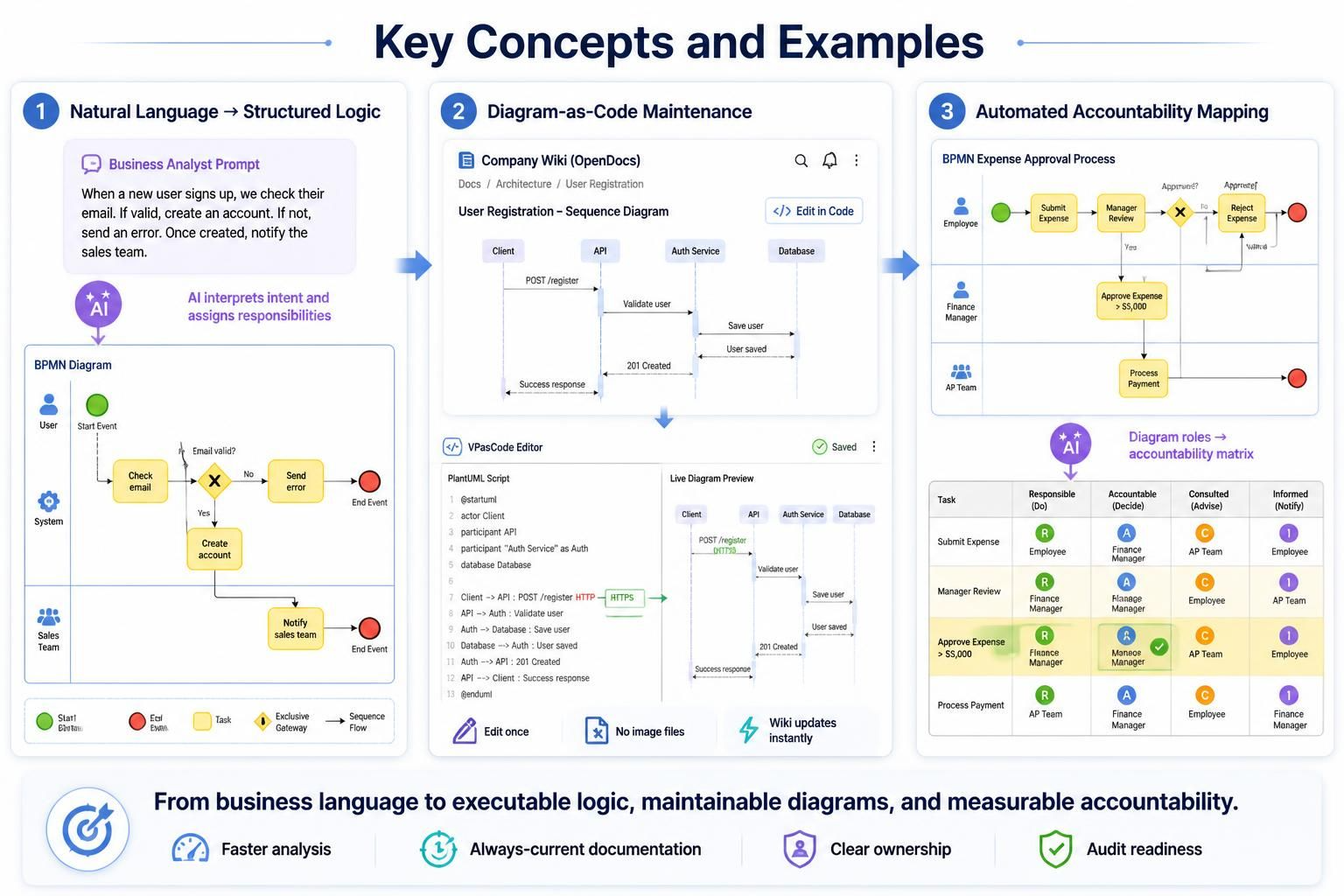
In modern enterprise architecture, the gap between high-level business strategy and technical execution is often bridged by documentation. However, traditional documentation is frequently static, difficult to update, and prone to becoming obsolete the moment it is published. This tutorial explores a transformative workflow demonstrated in the provided diagram: a seamless pipeline that translates natural language into structured logic, maintains diagrams as code, and automatically maps accountability.
We will analyze the three core concepts illustrated in the visual guide: Natural Language to Structured Logic, Diagram-as-Code Maintenance, and Automated Accountability Mapping. By the end of this article, you will understand how this architecture eliminates friction between business analysts, developers, and compliance officers.
1. Natural Language to Structured Logic
The first step in this modern workflow addresses the bottleneck of manual diagramming. Traditionally, a Business Analyst (BA) might describe a process verbally or in text, and a modeler would have to manually recreate it in a tool. Visual Paradigm’s AI-driven architecture changes this paradigm.
The Transformation Process
- Input: The BA provides a natural language description of a process.
Example: "When a new user signs up, we check their email. If it's valid, we create an account. If not, we send an error. Once the account is created, we notify the sales team." - AI Interpretation: The system parses the intent, identifying key entities (User, System, Sales Team), events (Sign up), decisions (Email valid?), and tasks (Create account).
- Structured Output: The AI automatically generates a BPMN (Business Process Model and Notation) diagram. It intelligently assigns swimlanes to separate concerns and uses standard flow objects (start events, exclusive gateways, tasks).
Technical Implementation
The resulting model is not just a static image but a structured representation of logic. In the diagram, you can see the logic flow:
- Start Event: Triggered by the user.
- Gateway: An exclusive gateway checks the condition “Email valid?”.
- Paths:
- Yes Path: Proceeds to “Create Account” and then “Notify Sales Team.”
- No Path: Redirects to “Send Error” and terminates.
This automation ensures that the technical model perfectly matches the business requirement without manual drawing errors.
2. Diagram-as-Code Maintenance
The second concept addresses the “maintenance debt” of technical documentation. In traditional environments, diagrams are stored as image files (PNG/JPG). If a protocol changes (e.g., switching from HTTP to HTTPS), an architect must open the image in a graphics editor, redraw the text, and re-upload the file. This is prone to errors and version control issues.
The OpenDocs & VPasCode Solution
Visual Paradigm integrates with documentation platforms like OpenDocs to enable Diagram-as-Code. This approach treats diagrams as text files (scripts) rather than images.
How It Works
- Embedded Script: The diagram is rendered from a script (in this case, PlantUML) directly within the wiki.
- Edit in Code: When a developer needs to update the authentication protocol, they click the “Edit in Code” button. This opens the VPasCode editor.
- Code Modification: The developer modifies the text script. For example, changing the line
POST /register HTTPtoPOST /register HTTPS. - Instant Update: Upon saving, the wiki renders the new script instantly. No image files are exchanged.
The PlantUML Script
The power of this method lies in the underlying code, which is version-controllable and readable. Here is the logic structure used in the “Diagram-as-Code” example:
@startuml
actor Client
participant API
participant "Auth Service" as Auth
database Database

Client -> API : POST /register HTTP
API -> Auth : Validate user
Auth -> Database : Save user
Database --> Auth : User saved
Auth --> API : 201 Created
API --> Client : Success response
@enduml
By maintaining diagrams this way, organizations ensure that documentation remains “living” assets that are always in sync with the current system architecture.
3. Automated Accountability Mapping
The final stage of this workflow focuses on governance and compliance. Once a process is modeled and documented, the organization must ensure that roles and responsibilities are clearly defined. This is often captured in a RACI matrix (Responsible, Accountable, Consulted, Informed).
From Model to Matrix
Instead of manually extracting names from a diagram to fill out a spreadsheet, the system utilizes the “Automatic Matrix Generation” feature.
- Scanning: The tool scans the BPMN model, specifically looking for tasks (e.g., “Approve Expense > $5,000”).
- Context Extraction: It identifies the actor assigned to that task within the corresponding swimlane (e.g., “Finance Manager”).
- Matrix Generation: The tool populates the RACI matrix, automatically assigning the “Accountable” status to the actor in the swimlane.
The Resulting Accountability Matrix
The output provides a clear audit trail. For example, regarding the “Approve Expense” task:
| Task | Responsible (Do) | Accountable (Decide) | Consulted (Advise) | Informed (Notify) |
|---|---|---|---|---|
| Approve Expense > $5,000 | Finance Manager | Finance Manager | AP Team | Employee |
Conclusion
The workflow illustrated above represents a significant leap forward in enterprise architecture and process management. By automating the translation of natural language into structured BPMN diagrams and maintaining those diagrams as living, code-backed assets, organizations can drastically reduce friction between business and IT teams.
This approach ensures documentation accuracy, as the source of truth is the code itself rather than a static image. Furthermore, the automated generation of accountability matrices ensures that governance is not an afterthought but an integral part of the modeling process.
Whether you are a business analyst looking to clarify workflows or a developer aiming to keep technical documentation in sync with code, this pipeline offers a robust, scalable solution for modern enterprise challenges. To achieve this level of efficiency and integration, the Recommended tooling of Visual Paradigm BPMN and AI is the optimal choice for organizations seeking to future-proof their process documentation.