

In agile software development, the integrity of the delivery pipeline is often determined before the first line of code is written. The user story serves as the fundamental unit of work, acting as a contract between stakeholders and the development team. When this contract is vague, incomplete, or ambiguous, the consequences extend far beyond the immediate task. The impact of poor user stories on delivery speed is profound, creating bottlenecks that ripple through the entire project lifecycle.
Teams often mistake speed for velocity. They count stories completed per sprint without accounting for the friction required to understand what was actually being built. This section explores the mechanics of how requirement quality directly influences throughput, quality, and team morale.
💸 The Direct Cost of Ambiguity
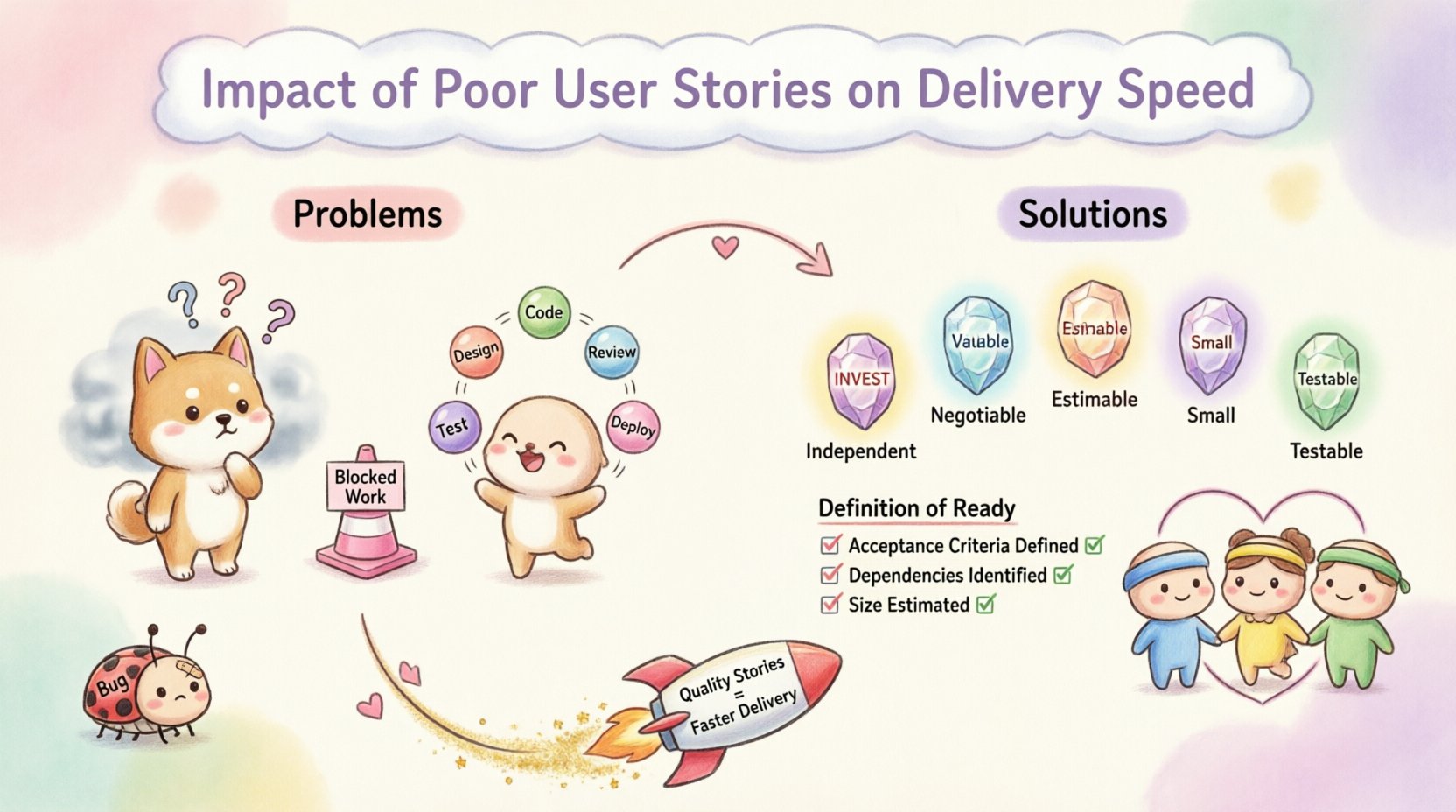
Ambiguity is not merely a semantic issue; it is a financial and temporal liability. When a user story lacks clarity, the engineering team cannot begin implementation immediately. Instead, they enter a state of investigation. This investigation phase consumes resources that should be allocated to value creation.
Clarification Sessions: Developers must pause coding to ask questions. These interruptions break flow state.
Assumption Making: Without clear guidance, engineers make assumptions. If these assumptions are wrong, the work must be discarded.
Estimation Errors: Vague stories lead to wide variance in time estimates. Planning becomes a guessing game rather than a calculated forecast.
The cost of fixing a requirement error during the coding phase is exponentially higher than during the planning phase. This phenomenon is known as the Cost of Change Curve. When stories are poorly defined, the team effectively pays a premium for every line of code they write, as much of that work may need to be rewritten.
🌊 The Ripple Effect on Sprints
Sprints are designed to be self-contained cycles of delivery. However, a single poorly defined story can destabilize the entire sprint. This is because modern development relies on parallel processing. While one engineer works on the frontend, another might be building the backend API.
If the API contract is not clearly defined in the user story, the frontend developer cannot build the interface. They must wait. This creates a dependency bottleneck. The work that was supposed to be done in parallel becomes sequential, extending the timeline.
Blocked Work: Team members sit idle waiting for clarification on a specific story.
Carry Over: Work that cannot be finished due to unclear requirements spills into the next sprint.
Velocity Fluctuation: Inconsistent story quality leads to unpredictable velocity, making long-term planning impossible.
Integration Delays: If stories do not account for integration points, merging code becomes a source of conflict and regression.
This ripple effect is not linear; it is exponential. One ambiguous story can delay the integration of three other stories, delaying the release by an entire iteration.
🔄 Developer Friction and Context Switching
Software engineering requires deep concentration. Complex logic, architectural decisions, and debugging demand sustained attention. Poor user stories force developers to switch contexts frequently.
When a developer encounters a gap in the requirements, they must stop their current train of thought to seek clarification. This is known as context switching. Research in cognitive psychology suggests that it takes significant time to regain full focus after an interruption. In a development environment, this accumulation of interruptions degrades the quality of the code.
Key Friction Points
Code Reviews: Reviewers spend time asking “Why was this done this way?” instead of “Is this correct?”.
Testing: QA engineers cannot write test cases if the expected behavior is not documented in the story.
Refactoring: Without clear boundaries, developers are afraid to refactor code because they do not understand the full scope of the original intent.
Morale: Constantly working with incomplete information leads to frustration and burnout among technical staff.
High-performing teams prioritize clarity to protect their flow. They treat the user story as a tool for communication, not just a task list item.
🐞 Quality and Defect Rates
There is a direct correlation between the quality of requirements and the defect rate. If the definition of “done” is fuzzy, the definition of “working” becomes subjective. Different team members may interpret the same story differently.
This leads to inconsistencies in the user experience. One feature might work perfectly in the staging environment but fail in production due to edge cases not covered in the initial story. These defects require hotfixes, which further delay delivery and introduce instability.
Functional Gaps: Features that do not meet the actual user needs because the needs were not captured.
Performance Issues: Performance requirements are often overlooked in poor stories, leading to slow applications.
Security Risks: Security constraints are frequently omitted, requiring later remediation that is costly and risky.
Accessibility Failures: Standards for accessibility are often forgotten unless explicitly stated in the acceptance criteria.
🚩 Identifying Symptoms of Weak Stories
Teams can often recognize when a story is of poor quality by observing patterns in their workflow. The following table outlines the differences between high-quality and low-quality user stories.
Attribute | High-Quality Story ✅ | Poor Quality Story ❌ |
|---|---|---|
Clarity | Specific, measurable, and unambiguous | Vague, subjective, or open to interpretation |
Acceptance Criteria | Complete list of conditions for completion | Missing or generic (e.g., “works correctly”) |
Dependencies | Dependencies are identified and managed | Hidden dependencies discovered during coding |
Size | Small enough to complete in a sprint | Epics disguised as stories (too large) |
Value | Clear benefit to the end user or business | Technical tasks without user value |
Testability | Can be verified by QA without ambiguity | Cannot be verified objectively |
Observing these symptoms early allows a team to intervene before the work begins, preventing wasted effort.
📋 The INVEST Framework Application
To mitigate the impact of poor user stories, teams should apply the INVEST principle. This acronym provides a checklist for evaluating the health of a story before it enters the sprint.
Independent
Stories should be as independent as possible. If Story B relies entirely on Story A being finished first, they should be linked. High dependency increases risk and reduces scheduling flexibility.
Negotiable
The details of the story should be open to discussion. If the story is a fixed list of rigid specifications, it stifles innovation. The team should be able to negotiate the best technical approach to solve the user problem.
Valuable
Every story must deliver value to the stakeholder or user. Technical debt reduction or infrastructure updates must be framed in terms of the benefit they provide, such as improved stability or faster load times.
Estimable
The team must be able to estimate the effort required. If a story is too vague to estimate, it is not ready. Estimation is a proxy for understanding; if you cannot estimate, you do not understand the scope.
Small
Stories should be small enough to be completed within a single iteration. Large stories hide complexity and risk. Breaking them down allows for faster feedback loops and earlier value delivery.
Testable
This is the most critical factor for delivery speed. If a story cannot be tested, it cannot be verified. Acceptance criteria must be clear enough that a test case can be written for every condition.
✅ Definition of Ready (DoR)
To enforce quality, teams should implement a Definition of Ready. This is a checklist that a user story must pass before it is accepted into a sprint backlog. It acts as a gatekeeper to prevent ambiguity from entering the development phase.
Who: Is the user persona defined?
What: Is the functional requirement clear?
Why: Is the business value stated?
How: Are there technical constraints or guidelines?
Criteria: Are acceptance criteria defined and agreed upon?
Mockups: Are design assets or wireframes attached?
Dependencies: Are external dependencies identified?
Enforcing a DoR requires discipline. It may slow down the initial intake of stories, but it accelerates the actual delivery by ensuring that work starts only when the team is prepared to finish it.
📊 Metrics for Story Health
Management can track the impact of user story quality by monitoring specific metrics. These metrics provide data-driven evidence of where the process is breaking down.
Carryover Rate: The percentage of stories that are not completed in the sprint. A high rate often indicates poor sizing or unclear requirements.
Reopen Rate: Stories returned to the backlog after being marked as done. This indicates the acceptance criteria were not met.
Clarification Time: The time spent in refinement meetings or asking questions during the sprint.
Cycle Time: The time from “In Progress” to “Done”. Long cycle times suggest blockers or rework due to ambiguity.
Defect Escape Rate: The number of bugs found by users after release that could have been caught with better acceptance criteria.
By analyzing these metrics, teams can identify trends. For example, if the Reopen Rate is high for a specific team member, it may indicate a need for better collaboration with product owners on requirements.
🛠 Strategies for Improvement
Improving story quality is a continuous process. It requires cultural shifts and practical adjustments to the workflow.
Refinement Sessions
Hold regular backlog refinement sessions. These are dedicated meetings where the team reviews upcoming stories. The goal is to ask questions and add detail before the sprint planning meeting. This ensures that when the sprint starts, the work is ready.
Three Amigos
Involve three perspectives in the review: Business, Development, and Testing. This “Three Amigos” approach ensures that the story is valuable, buildable, and testable. It catches edge cases early.
Visual Aids
Use diagrams, flowcharts, or mockups to supplement text. Text can be misinterpreted, but a visual representation of a user flow is often unambiguous.
Living Documentation
Treat the acceptance criteria as living documentation. If requirements change during the sprint, update the story immediately. This keeps the source of truth accurate.
📈 Long-Term Benefits of Quality
Investing time in better user stories yields compounding returns. Over time, the team builds a repository of clear patterns and expectations. New team members can onboard faster because the stories are self-documenting.
Furthermore, technical debt accumulates less rapidly. When requirements are clear, developers do not need to write “quick and dirty” code to guess at the future intent. They can build robust solutions that align with the actual vision.
Ultimately, the goal is not just to ship faster, but to ship with confidence. When a team knows exactly what they are building, they move with purpose. The friction of ambiguity is removed, allowing velocity to increase naturally rather than through forced pressure.
Teams that prioritize the clarity of their input will consistently outperform those that focus solely on the speed of their output. The impact of poor user stories on delivery speed is a measurable drag on performance. By addressing the root cause, organizations can achieve sustainable growth and higher quality software.