

In the landscape of software development, the gap between what is built and what is needed often stems from a single source: misalignment. While technical teams focus on implementation, the true value of a project lies in solving the right problem. This is where the validation of requirement cards becomes critical. These cards, often serving as the digital representation of user stories, act as the primary contract between the business vision and technical execution. Without rigorous validation, assumptions harden into code that delivers little value.
Validating requirement cards with stakeholders is not merely a formality; it is a strategic exercise in risk management. It ensures that every line of code written traces back to a verified need. This process requires discipline, clear communication, and a structured approach to engagement. Below, we explore the methodology, techniques, and necessary rigor required to validate requirement cards effectively.
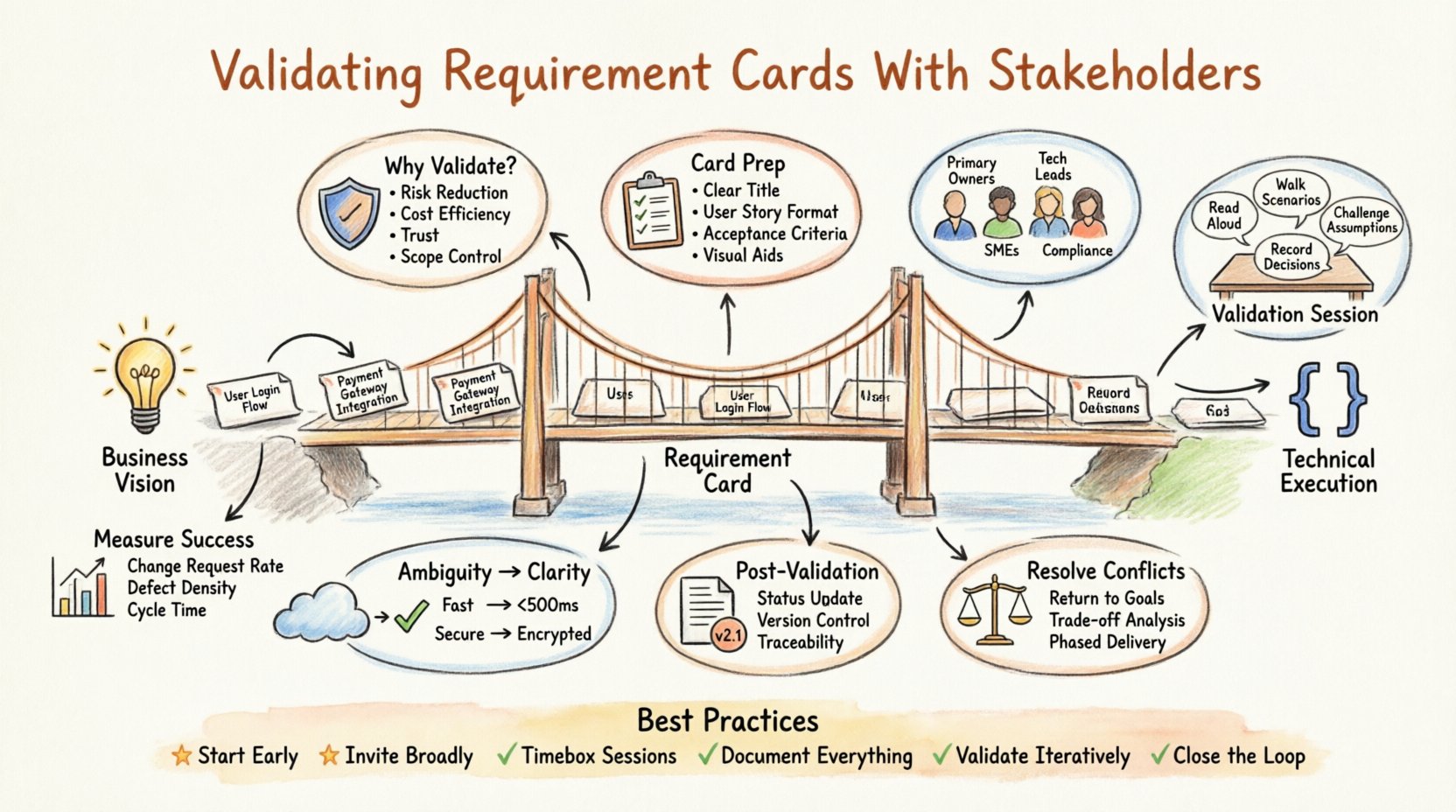
Why Validation Matters in Requirement Engineering 🛡️
The cost of fixing an error increases exponentially as the project progresses. An ambiguity found during the requirement phase costs significantly less to resolve than one found after deployment. Validation serves as a checkpoint to catch these ambiguities early. It transforms vague ideas into actionable instructions.
- Risk Reduction: Identifies logical flaws before development begins.
- Cost Efficiency: Prevents rework and wasted engineering hours.
- Stakeholder Trust: Builds confidence that the business needs are understood.
- Scope Control: Helps define boundaries to prevent feature creep.
When stakeholders validate a requirement card, they are confirming that the proposed solution addresses the identified problem. They are not just approving text; they are approving the direction of the product.
Preparing the Requirement Cards for Review 📝
Before engaging stakeholders, the requirement cards must be in a state that invites scrutiny. A poorly prepared card invites confusion and delays the validation process. Preparation involves ensuring clarity, completeness, and context.
Key Elements of a Validatable Card
A robust requirement card contains specific attributes that allow for verification. These attributes serve as the checklist for the validation session.
- Clear Title: A concise summary of the functionality.
- User Story Format: “As a [role], I want [feature], so that [benefit].”
- Contextual Background: Information explaining why this feature is needed.
- Acceptance Criteria: Specific conditions that must be met for the story to be complete.
- Visual Aids: Sketches, wireframes, or data models to clarify complex flows.
The Role of Acceptance Criteria
Acceptance criteria are the most critical component of validation. They define the boundary of the work. Without them, a “done” state is subjective. During validation, stakeholders must agree on what success looks like.
| Element | Purpose | Example |
|---|---|---|
| Functional Requirement | Describes what the system must do | System must calculate tax based on location. |
| Non-Functional Requirement | Describes how the system performs | Page load time must be under 2 seconds. |
| Constraint | Limits on the solution | Must support legacy database schema. |
When reviewing these criteria, stakeholders should ask “What happens if…?” to test edge cases. This proactive questioning reveals hidden requirements that were not initially considered.
Identifying the Right Stakeholders 👥
Validation is only effective if the right people are in the room. Including too many voices can dilute the decision-making process, while excluding key decision-makers leads to rework later. Identifying stakeholders requires mapping the influence and interest of various groups.
Categories of Stakeholders
- Primary Owners: Those who directly benefit from the feature. They have the most to lose if the feature fails.
- Subject Matter Experts: Individuals with deep knowledge of the domain or process.
- Technical Leads: Those who can assess feasibility and architectural impact.
- Compliance and Security: Necessary for regulatory and safety checks.
It is common for the primary owner to delegate validation to a proxy. While efficient, this introduces risk. If the proxy does not fully understand the nuance of the business need, the validation is superficial. Whenever possible, the decision-maker should participate directly.
Conducting the Validation Session 🗣️
The validation session is a structured meeting designed to review, discuss, and sign off on requirement cards. It is not a brainstorming session; it is a confirmation exercise. The goal is to reach a consensus on the content.
Pre-Session Preparation
Send materials at least 24 hours in advance. This allows stakeholders to review the content without time pressure. During the meeting, do not rush through the cards. Allocate sufficient time for discussion on each item.
During the Session
- Read Aloud: Have the author read the card. Hearing the text often reveals awkward phrasing or logical gaps.
- Walk Through Scenarios: Discuss the “Happy Path” and the “Unhappy Path.” How does the system behave when a user makes a mistake?
- Challenge Assumptions: If a stakeholder says “This should be easy,” ask for clarification on the complexity involved.
- Record Decisions: Document every change requested during the session. Ambiguity often hides in the notes.
If a card cannot be validated due to missing information, mark it as “Blocked” and assign an owner to resolve the gap. Do not proceed with development until the blocker is removed.
Navigating Conflicting Stakeholders 🤝
Different stakeholders often have competing priorities. The sales team may want a feature that the engineering team finds too costly. The operations team may want security that slows down the user experience. Conflict is natural; unmanaged conflict is destructive.
Strategies for Resolution
- Return to Goals: Remind the group of the primary business objective. Which option best serves this goal?
- Trade-off Analysis: Explicitly list the pros and cons of each approach. Make the cost visible.
- Phased Delivery: If two requirements conflict, propose delivering them in separate iterations to balance risk and value.
- Escalation: If consensus cannot be reached, escalate to a higher authority for a final decision.
The facilitator must remain neutral. The goal is to validate the requirement, not to advocate for a specific technical solution. Keep the focus on the “what” and the “why,” not the “how.”
Handling Ambiguity and Edge Cases 🧩
Ambiguity is the enemy of validation. Words like “fast,” “secure,” or “easy” are subjective. They mean different things to different people. Validation requires translating these subjective terms into objective measures.
Techniques for Clarification
| Subjective Term | Objective Measure |
|---|---|
| Fast | Response time < 500ms |
| Secure | Data encrypted at rest and in transit |
| Easy | User completes task in < 3 clicks |
| Accessible | WCAG 2.1 Level AA compliance |
When an edge case is identified that was not previously considered, it must be captured. If it is too complex for the current iteration, it should be moved to a backlog for future consideration. Do not let it block the current validation.
Post-Validation Documentation 📄
Validation does not end when the meeting adjourns. The output must be documented and accessible. This record serves as the single source of truth for the development team and future auditors.
- Status Updates: Mark the card as “Validated” in the tracking system.
- Version Control: Ensure any changes made during validation are saved as a new version of the card.
- Notification: Inform the development team that the card is ready for implementation.
- Traceability: Link the card to the business goal it supports.
Documentation ensures that if a stakeholder leaves the organization, the context of the requirement remains. It preserves institutional knowledge.
Measuring Validation Effectiveness 📊
To improve the process, you must measure its outcomes. How often do requirements change after validation? How many defects are traced back to requirement errors? These metrics indicate the health of your validation process.
Key Performance Indicators
- Change Request Rate: Percentage of requirements changed after validation.
- Defect Density: Number of bugs found in production related to requirements.
- Validation Cycle Time: Average time taken to validate a card.
- Stakeholder Satisfaction: Feedback from business owners on the clarity of requirements.
High change request rates suggest that validation is not catching issues early. High defect density indicates that acceptance criteria were insufficient. Use these metrics to adjust your approach.
Common Pitfalls to Avoid ⚠️
Even experienced teams fall into traps during validation. Awareness of these pitfalls helps maintain quality.
- Skipping the Details: Focusing only on the big picture and missing specific logic flows.
- Ignoring Non-Functional Needs: Validating features but ignoring performance, security, and reliability.
- Assuming Consensus: Assuming everyone agrees without explicit confirmation.
- Overloading the Card: Putting too much information on one card, making it difficult to review.
- Lack of Technical Input: Validating without a technical lead present to spot feasibility issues.
Summary of Best Practices ✅
Successful validation is a blend of preparation, engagement, and rigor. It requires a culture where questions are encouraged and ambiguity is challenged. By following the steps outlined above, teams can ensure that their requirement cards are robust and ready for implementation.
- Prepare cards with clear acceptance criteria before the meeting.
- Invite the right stakeholders who have decision-making authority.
- Use structured sessions to review and challenge assumptions.
- Resolve conflicts by returning to business goals.
- Document all changes and decisions for traceability.
- Measure outcomes to continuously improve the process.
Ultimately, validating requirement cards is about respect. It respects the time of the development team by ensuring they build the right thing. It respects the business by ensuring investment is not wasted. It respects the end user by delivering a product that actually solves their problem. This alignment is the foundation of successful delivery.
Final Considerations for Long-Term Success 🔮
As projects scale, the validation process must scale with them. A process that works for a small team may become a bottleneck for a large organization. Adaptability is key. Regularly review the validation workflow to ensure it remains efficient. Solicit feedback from both the stakeholders and the technical teams to identify friction points.
Remember that validation is not a one-time event. It is a continuous loop. As the product evolves, requirements may need re-verification. Stakeholders may change their minds based on market conditions. The system must allow for this flexibility without losing the rigor that ensures quality.
By treating requirement validation as a core discipline rather than an administrative task, organizations can achieve higher predictability and better outcomes. The effort invested in these cards pays dividends in reduced rework, higher quality software, and happier stakeholders.
Start with the basics. Ensure every card has a clear purpose. Engage the right people. Be specific about success. Over time, these habits compound to create a culture of clarity and precision.