


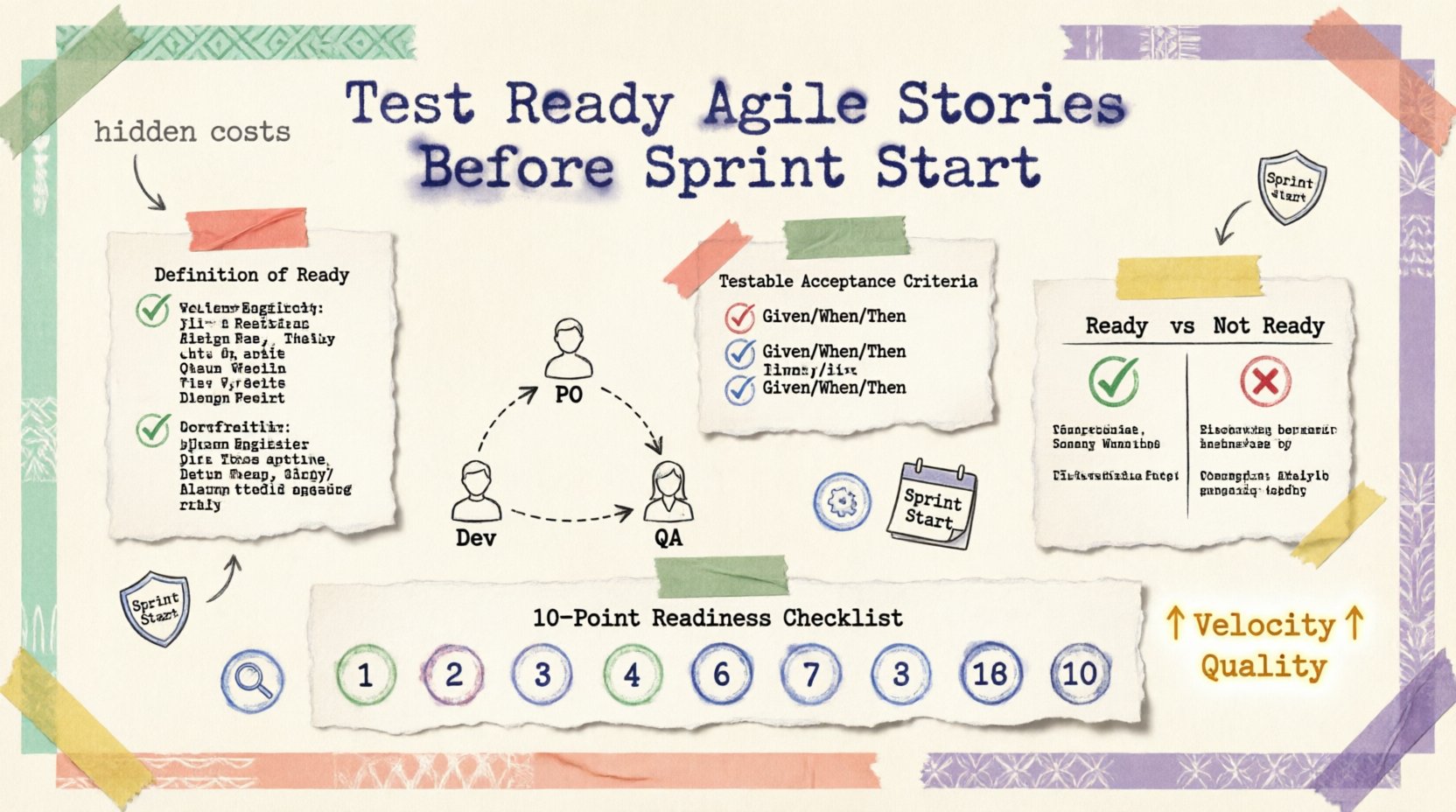
In the fast-paced world of software development, the rhythm of the sprint is critical. Yet, a common friction point disrupts this flow: stories that arrive at sprint planning without clear criteria for success. When a team begins development on a vague requirement, the cost of change increases exponentially. By ensuring user stories are test ready before the sprint starts, teams can maintain a steady velocity and high quality.
This guide explores the mechanics of preparing stories for testing prior to sprint execution. We will examine the definition of ready, the architecture of acceptance criteria, and the collaborative practices that enable teams to ship value consistently without technical debt accumulation.
📉 The Hidden Cost of Late Testing
Many teams operate under the assumption that testing happens after the code is written. While this is traditional, it creates a bottleneck during the sprint. Defects found late in the cycle are significantly more expensive to fix than those identified during the refinement phase.
Consider the following impacts of starting a sprint with untested stories:
- Context Switching: Developers must stop coding to clarify requirements mid-sprint.
- Unfinished Work: Stories may remain in “In Progress” because they cannot be verified.
- Quality Erosion: Technical debt accumulates when shortcuts are taken to meet the deadline.
- Team Frustration: Constant interruptions break the flow state required for complex problem solving.
By shifting the testing discussion to the refinement stage, you move the complexity out of the sprint execution window. This ensures that when work begins, the path forward is clear.
🛠️ The Definition of Ready (DoR)
The Definition of Ready is a shared agreement among the team that a user story meets the necessary conditions to be pulled into a sprint. It is not a gatekeeper, but a quality filter. If a story does not meet the DoR, it remains in the backlog for further refinement.
A story is not ready if:
- The business value is unclear.
- Acceptance criteria are missing or vague.
- Dependencies on other teams or systems are unresolved.
- The technical approach has not been considered.
- Test data requirements are not defined.
Ensuring the Definition of Ready is met reduces the cognitive load on developers. They do not need to act as detectives to find out what needs to be built; they act as builders because the blueprint is complete.
📝 Crafting Testable Acceptance Criteria
Acceptance criteria are the specific conditions that a software product must satisfy to be accepted by a user or stakeholder. For these criteria to be effective, they must be testable. Vague statements like “The system should be fast” or “The UI should look good” cannot be verified objectively.
To make criteria testable, use the following strategies:
- Be Specific: Instead of “fast,” use “loads within 2 seconds.”
- Define Edge Cases: What happens if the input is empty? What if the user has no permissions?
- Use Scenario-Based Language: Adopt formats like Given/When/Then to describe behavior.
- Identify Data Needs: Specify what data is required to execute the test (e.g., “Requires a user with Admin role”).
When acceptance criteria are written with precision, the testing phase becomes a verification exercise rather than a discovery mission.
📊 Ready vs. Not Ready: A Comparison
The following table illustrates the difference between a story that is ready for development and one that is not. This comparison highlights the tangible differences in clarity and testability.
| Feature | Not Ready Story | Test Ready Story |
|---|---|---|
| Clarity | “Improve login security.” | “Add multi-factor authentication to login.” |
| Criteria | “Make it safer.” | “User must enter code sent to email after password.” |
| Dependencies | “Depends on Auth team.” | “Auth API endpoint available at /api/v2/auth/mfa.” |
| Test Data | “Use a test user.” | “Use user ID 123 with [email protected] enabled.” |
| Outcome | Clarification needed during sprint. | Verification starts immediately after build. |
🤝 Collaboration and Communication
Test readiness is not the sole responsibility of the quality assurance team. It requires a collaborative effort involving the product owner, developers, and testers. This is often referred to as the “Three Amigos” approach, where these three roles discuss a story before it is committed to a sprint.
Product Owner Responsibilities:
- Clarify the business value and user intent.
- Ensure priority is aligned with sprint goals.
- Confirm that the story fits the current release plan.
Developer Responsibilities:
- Assess technical feasibility.
- Identify potential performance or security risks.
- Confirm access to necessary environments or tools.
QA/Tester Responsibilities:
- Identify missing edge cases.
- Define test data requirements.
- Estimate the effort required for testing.
When these roles engage in early dialogue, they prevent misunderstandings. A developer might realize a feature is technically impossible within the sprint, while a tester might notice a requirement lacks a rollback strategy.
🧩 Managing Dependencies and Constraints
One of the primary reasons stories are not test ready is the presence of unresolved dependencies. A story might be complete in isolation but unusable if it relies on an external system that is not yet deployed.
Before a story enters the sprint, verify the following constraints:
- External APIs: Are the endpoints live? Is the documentation updated?
- Third-Party Services: Do we have valid credentials for testing?
- Database Changes: Are the necessary schema migrations scheduled?
- Infrastructure: Is the deployment pipeline configured for the new feature?
If a dependency is missing, the story should be split or deferred. It is better to deliver a smaller, complete slice of functionality than to carry a large story that cannot be verified due to external blockers.
🤖 Automation Readiness
In modern agile practices, testing is often automated. However, automation scripts cannot be written if the story requirements are fluid. To support continuous integration and delivery, stories must be stable enough to be automated.
Consider these factors for automation readiness:
- Stable Identifiers: Are the UI elements or API endpoints likely to change frequently?
- Test Environment: Is there a stable environment for running automated suites?
- Mocking Strategy: If external services are unavailable, can they be mocked reliably?
- Regression Impact: Does this change affect existing automated tests?
Writing automation scripts before the sprint starts can actually improve the speed of delivery. When the code is merged, the tests run automatically, providing immediate feedback on stability.
🧪 The Testing Strategy
Even with test-ready stories, a robust testing strategy is required. This strategy should be defined during the refinement phase and approved by the team.
Key Components of the Strategy:
- Unit Testing: Ensures individual components function correctly.
- Integration Testing: Verifies that different modules work together.
- End-to-End Testing: Validates the complete user journey.
- Performance Testing: Checks system behavior under load.
- Security Testing: Identifies vulnerabilities in the implementation.
By defining this strategy early, the team knows what to expect. There are no surprises during the sprint about whether a performance test is required or if security validation is needed.
📉 Metrics and Measurement
To ensure the process of making stories test ready is effective, teams should track specific metrics. These metrics help identify bottlenecks and areas for improvement.
Key Metrics to Monitor:
- Refinement Rate: How many stories are refined per week?
- Carryover Rate: How many stories are carried over to the next sprint due to lack of readiness?
- Defect Escape Rate: How many bugs are found after deployment?
- Sprint Velocity: Is the team consistently delivering planned work?
If the carryover rate is high, it indicates that stories are being accepted into the sprint without meeting the Definition of Ready. The team should pause and refine the intake process.
🛡️ Handling Edge Cases and Failure Modes
A test-ready story accounts for success paths and failure paths. Developers often build for the happy path, but users frequently encounter errors. A story is not ready if it does not specify how errors should be handled.
Examples of failure modes to define:
- What happens if the network connection drops?
- What happens if the user submits invalid data?
- What happens if the server returns a 500 error?
- What is the user-facing message for each error?
By defining these scenarios upfront, the team avoids the ambiguity of “fixing it later.” This leads to a more resilient product and a better user experience.
🔄 Continuous Feedback Loops
Test readiness is not a one-time event. It is part of a continuous feedback loop. As the sprint progresses, new information may emerge that changes the requirements. The team must be agile enough to adapt while maintaining the quality standards established during refinement.
During the sprint, if a blocker is found that was not anticipated during refinement:
- Pause the work immediately.
- Engage the necessary stakeholders.
- Update the acceptance criteria.
- Re-evaluate the test readiness.
This agility prevents the team from building something that is technically correct but functionally wrong.
🌱 Building a Culture of Quality
Ultimately, test readiness is about culture. It requires a mindset shift where quality is not an afterthought but a prerequisite. When the team values test readiness, they value the product they are building.
Encouraging a Quality Culture:
- Leadership Support: Management must prioritize quality over speed.
- Shared Ownership: Everyone is responsible for the quality of the release.
- Psychological Safety: Team members should feel safe to say “not ready” without fear of retribution.
- Rewarding Quality: Recognize teams that maintain high standards and low defect rates.
When quality is embedded in the culture, the Definition of Ready becomes a natural part of the workflow rather than a bureaucratic hurdle.
🚦 Final Checklist for Story Readiness
Before a story is committed to a sprint, verify the following checklist:
- ✅ Is the story written in user-centric language?
- ✅ Are acceptance criteria specific and measurable?
- ✅ Are all edge cases identified and documented?
- ✅ Are dependencies resolved or clearly understood?
- ✅ Is test data available or can it be generated?
- ✅ Is the technical approach agreed upon by developers?
- ✅ Is the environment accessible for testing?
- ✅ Are the automation scripts ready or scheduled?
- ✅ Does the story fit within the sprint capacity?
- ✅ Has the Definition of Ready been signed off by the team?
Using this checklist ensures that every story entering the sprint is primed for success. It minimizes risk and maximizes the team’s ability to deliver value consistently.
🏁 Conclusion
Prioritizing test readiness before the sprint start is a strategic decision that pays dividends in velocity and stability. It transforms the development process from a reactive cycle of fixing bugs into a proactive flow of delivering verified features. By adhering to a strong Definition of Ready, crafting precise acceptance criteria, and fostering a collaborative culture, teams can achieve predictable delivery without sacrificing quality.
The goal is not to slow down, but to remove friction. When stories are test ready, the team moves with purpose and confidence. This approach builds a sustainable foundation for long-term success in agile software development.