

Building software is an exercise in managing complexity. When features grow in scope, the risk of misalignment increases exponentially. A vague requirement leads to rework. A missing edge case leads to bugs. A misunderstood dependency leads to delays. The foundation of clarity in any development lifecycle is the user story. However, standard templates often fail when applied to intricate systems. This guide explores how to construct robust, actionable narratives for high-complexity functionality without relying on hype or vague terminology.
🧩 Understanding the Scale: Epics vs. Stories
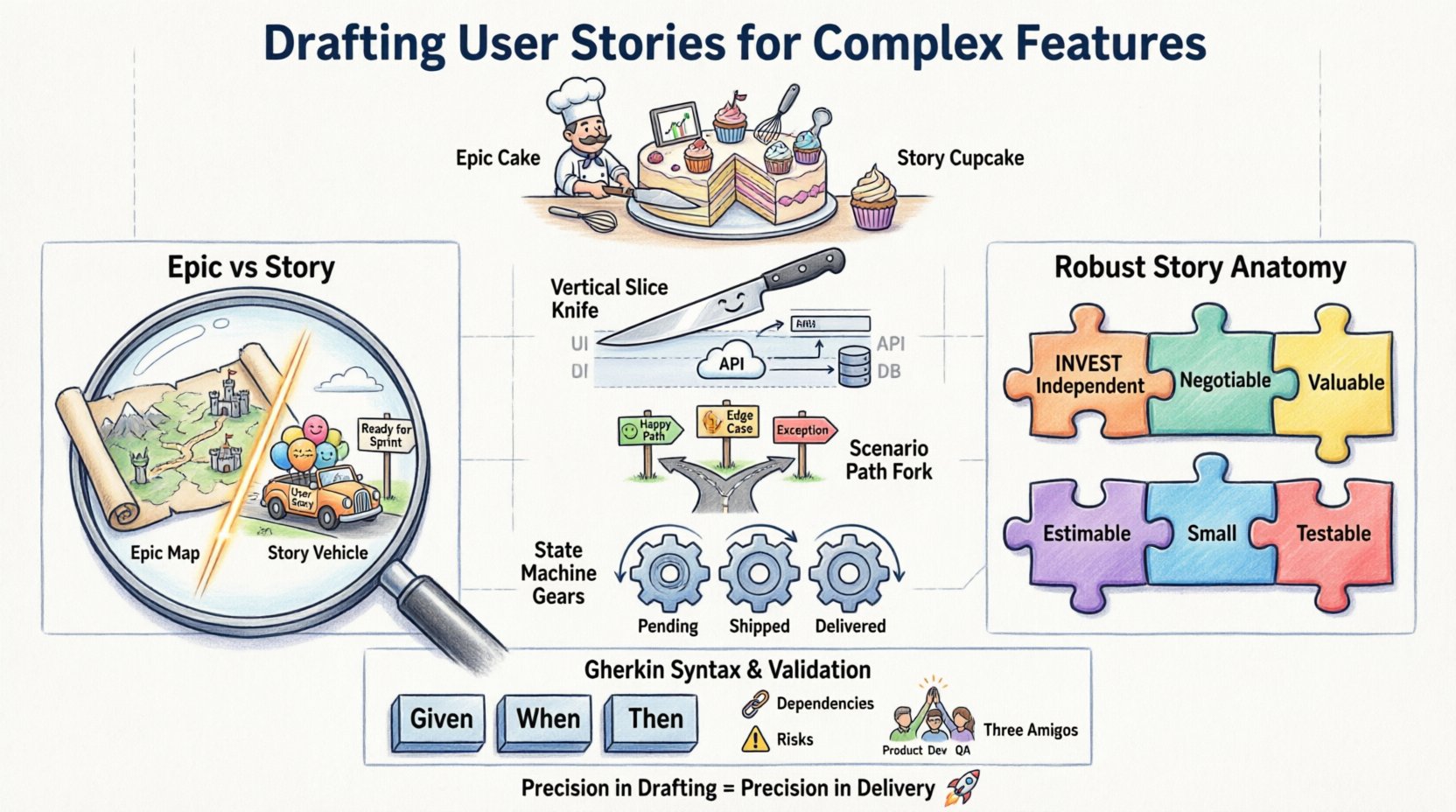
Before drafting begins, one must define the container. In agile frameworks, large bodies of work are often categorized as epics. An epic is a collection of stories that share a common goal or capability. It is too large to be completed in a single iteration. A user story, conversely, is a small unit of work that delivers value and fits within a sprint. The transition from epic to story is where complexity is managed.
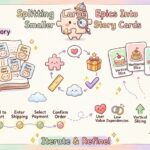
Complex features often span multiple epics or contain nested dependencies. To handle this, teams must avoid the trap of treating a complex feature as a single story. Instead, the feature must be decomposed. This decomposition is not merely about cutting work into smaller pieces; it is about isolating specific value propositions.
- Epic Level: Defines the strategic goal. Example: “Implement Secure Authentication System.”
- Story Level: Defines a specific, testable outcome. Example: “As a user, I can reset my password via email.”
When drafting for complex features, the epic serves as a map, but the story is the vehicle. If the vehicle is too heavy, it stalls. The goal is to ensure every story delivers a slice of vertical value, meaning it can be tested and deployed independently if necessary.
🔍 Deconstructing Complexity: Techniques for Breakdown
Complexity often hides in the details of data flow, state management, and user interaction. To draft stories that are clear, you must break the feature down using specific techniques. Relying on intuition is insufficient for technical depth. Use the following methods to isolate work items.
1. Vertical Slicing
Vertical slicing involves cutting through the entire stack to deliver a thin layer of functionality. This is preferred over horizontal slicing (e.g., “Build the database layer,” then “Build the API,” then “Build the UI”). Horizontal slices often result in non-functional software until the final step. Vertical slices ensure that every story results in a working increment.
For a complex payment feature, a vertical slice might be: “As a user, I can complete a purchase using a credit card.” This includes the UI, the API call, the database transaction, and the email confirmation. A horizontal slice would be: “Create the payment gateway schema,” which is not valuable to a user on its own.
2. Scenario-Based Decomposition
Complex features often have multiple paths. A simple login is one path. A login with two-factor authentication and a compromised account recovery is many paths. Drafting stories for complex features requires mapping these scenarios.
- Happy Path: The standard flow where everything works as intended.
- Edge Cases: What happens if the network fails? What if the token expires?
- Exceptional Flows: What happens if the user cancels mid-process?
Each significant variation should be its own story or a clear set of acceptance criteria within a larger story. This prevents developers from having to guess about error states.
3. State Machine Modeling
For features involving data transitions (like an order moving from “Pending” to “Shipped” to “Delivered”), the state logic is critical. Drafting stories that ignore state management leads to race conditions and data corruption. Explicitly define the states and the triggers for transition.
A story might focus on the transition itself: “As a system, I must update the order status to ‘Shipped’ when the carrier scans the package.” This isolates the logic from the UI presentation, allowing for cleaner testing.
📝 The Anatomy of a Robust Story
A standard user story follows the “Who, What, Why” format. However, for complex features, this template is insufficient. You need a structure that supports technical precision and testing rigour.
1. The Narrative Statement
Keep the persona clear. Avoid generic terms like “the user” if multiple personas are involved. Specify the role.
- Bad: “I want to save data.”
- Good: “As an Administrator, I want to export audit logs so that I can review security compliance.”
The persona dictates the permissions and the context. The “I want” part defines the action. The “So that” part defines the value. If the value is missing, the work is likely technical debt disguised as a feature.
2. INVEST Criteria
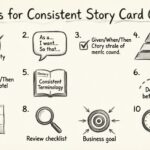
Every story should ideally adhere to the INVEST model. This ensures the story is viable for planning.
- Independent: Can it be developed without blocking other stories?
- Negotiable: Are the details open for discussion, or is the scope fixed?
- Valuable: Does this deliver business value?
- Estimable: Can the team size the effort accurately?
- Small: Can it be completed in a sprint?
- Testable: Are there clear criteria for success?
When drafting complex features, the “Small” criterion is often the hardest to meet. If a story is too large, it fails the “Estimable” and “Testable” criteria. Break it down further.
✅ Defining Acceptance Criteria
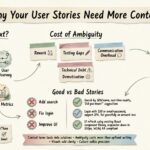
Acceptance criteria are the contract between the product owner and the development team. They define the boundaries of the story. For complex features, these criteria must be precise. Vague language like “fast,” “secure,” or “user-friendly” is unacceptable.
1. Use Gherkin Syntax
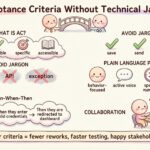
The Given-When-Then structure provides a logical framework for testing. It reads like a scenario and can often be automated.
| Component | Purpose | Example |
|---|---|---|
| Given | Establishes the context and preconditions. | “Given a user is logged in as an Admin” |
| When | Describes the action or event. | “When they navigate to the Settings page” |
| Then | Describes the expected outcome. | “Then they should see the ‘Delete Account’ option” |
2. Non-Functional Requirements
Complex features often have constraints that are not part of the user flow but are critical to the system. These should be listed explicitly.
- Performance: “The search results must load in under 200ms.”
- Security: “Data must be encrypted at rest using AES-256.”
- Accessibility: “All interactive elements must be navigable via keyboard.”
🔗 Handling Dependencies and Risks
Complex features rarely exist in a vacuum. They often depend on other systems, external APIs, or legacy infrastructure. Identifying these dependencies early is part of the drafting process.
1. Internal Dependencies
If Story A cannot start until Story B is complete, this must be noted. Use tags or links to reference the blocking story. However, try to minimize dependencies. If Story A depends entirely on Story B, they might be candidates for merging into a larger epic.
2. External Dependencies
Third-party services introduce risk. Draft stories that include fallback mechanisms. If the external API is down, what does the user see? A polite error message or a broken page? This decision should be part of the story.
Include a “Risk Mitigation” section in the story notes if the feature relies on unproven technology or high-latency services.
🚧 Common Pitfalls in Complex Story Drafting
Even experienced teams make mistakes when scaling complexity. Recognizing these patterns helps avoid rework.
- Assumption of Knowledge: Assuming the developer knows the business context without it being written down. Always document the “Why” and the “Who.”
- Over-Specification: Writing code in the story. The story should define the behavior, not the implementation. “Use a binary search” is a constraint. “Find items quickly” is a requirement.
- Ignoring Data: Focusing only on the UI flow and ignoring the database changes. Complex features often require schema migrations. These should be tracked.
- Testing Ambiguity: Leaving acceptance criteria open to interpretation. “Test the error handling” is not enough. “When the server returns 500, show a ‘Service Unavailable’ modal” is testable.
🔄 The Refinement Process
Drafting is not a one-time event. It is an iterative process known as refinement or grooming. This is where the story is stress-tested before development begins.
1. The Three Amigos
The most effective refinement involves three perspectives: Product, Development, and Quality Assurance. Each brings a unique lens.
- Product: Does this meet the user need?
- Development: Is this technically feasible and performant?
- QA: How will we test this edge case?
Disagreements during this phase are valuable. They reveal gaps in the draft. Resolve them before the sprint starts.
2. Story Mapping
For very large features, a list of stories is insufficient. Use story mapping to visualize the user journey horizontally and the stories vertically.
- Top Row: User activities (e.g., “Browse Catalog”, “Add to Cart”, “Checkout”).
- Below: Specific stories that support the activity.
This visualization helps identify the “Minimum Viable Product” slice. It ensures that the most critical path is prioritized over nice-to-have features.
🛠 Technical Considerations for Writers
While product managers and writers often lead story drafting, technical awareness is essential for complex features. Understanding the backend constraints prevents the creation of impossible stories.
- API Versioning: If the feature requires a new API endpoint, specify if it needs to be backward compatible.
- Caching Strategies: Does the feature invalidate cache? This impacts performance.
- Data Volume: Does the feature involve processing large datasets? This affects time limits.
- Concurrency: Can two users edit the same record simultaneously? Define the locking mechanism.
These points should be discussed during the refinement phase and documented in the story notes or technical design documents linked to the story.
📊 Complexity Indicators Checklist
Use this checklist to evaluate a draft story before it enters the sprint backlog. If multiple items are “Yes”, the story likely needs further decomposition.
| Indicator | Yes/No | Implication |
|---|---|---|
| Does it involve multiple systems? | High integration risk | |
| Does it change existing data structures? | Migration required | |
| Are there multiple user roles involved? | Permission logic needed | |
| Are there significant performance constraints? | Benchmarks needed | |
| Is the logic non-linear? | State machine needed |
If the answer is “Yes” to more than two items, consider splitting the story. Complexity compounds when multiple high-risk factors are combined.
🔗 Collaboration and Feedback Loops
Once a story is drafted, it must be communicated effectively. Documentation alone is not enough. The story should be a living document that evolves with the project.
- Visual Aids: Include wireframes, flowcharts, or sequence diagrams. A diagram can replace 500 words of text.
- Link to Design Specs: Connect the story to the design system or UI kit.
- Link to Tech Docs: Connect to the API documentation or database schema.
Feedback loops should be short. If a developer finds the story ambiguous during implementation, they should pause and clarify, not assume. The story owner must be available for questions.
🎯 Final Thoughts on Precision
The quality of the software output is directly correlated to the clarity of the input. Drafting user stories for complex features is not about writing long documents; it is about reducing ambiguity. Every word should serve a purpose. Every criterion should be testable. Every dependency should be known.
By adhering to structured decomposition, clear acceptance criteria, and collaborative refinement, teams can navigate complexity without losing direction. The goal is not to eliminate all risk, but to make the risk visible and manageable. This approach builds a culture of transparency and reliability, where the work speaks for itself through its clarity and execution.
Remember, a story is a placeholder for a conversation. The draft is the starting point, not the final word. Use it to align the team, test the assumptions, and ensure that the value delivered matches the intent defined. Precision in drafting leads to precision in delivery.