


Introduction: Why I Turned to BMM for Strategic Clarity
As a strategic planning consultant who’s worked with dozens of enterprises navigating digital transformation, I’ve seen countless frameworks come and go. But few have delivered the practical, traceable structure that the Business Motivation Model (BMM) provides. When a client recently asked how to document why they were pursuing a new market strategy—and how to ensure every tactical decision laddered up to their vision—I knew BMM was the answer. This guide shares my hands-on experience implementing BMM, along with an exciting update: Visual Paradigm’s new AI-Ready BMM Guide-Through that’s transforming how teams build and maintain strategic models. Whether you’re a product leader, enterprise architect, or strategy consultant, you’ll find actionable insights here on making BMM work in the real world.
What Is the Business Motivation Model? A User’s Perspective
If your organization prescribes a certain approach for its business activity, you ought to be able to articulate why and what results that approach is meant to achieve. That’s precisely where the Business Motivation Model (BMM) shines. Developed by the Object Management Group (OMG), BMM is a modeling notation designed to support business decisions about how to react to a changing world.
In practice, an enterprise adopts BMM by acquiring a modeling tool (like Visual Paradigm) and populating the model with business-specific information. From my experience implementing BMM across three client organizations, its value crystallizes around two purposes:
-
Capturing decisions and rationale: Making strategic choices shareable, increasing clarity, and improving future decision-making by learning from experience.
-
Providing traceability: Linking strategic decisions to their operational impact—showing exactly how an influencer (like a new regulation) leads to changes in business processes or organizational responsibilities.
Critically, BMM is designed to stand alone. It connects to operational business elements via “placeholders”—text references or URIs—so you don’t need to rebuild your entire process library to get started.

A Brief History: How BMM Evolved from Practice to Standard
Understanding BMM’s lineage helps appreciate its practicality. This isn’t an academic exercise—it’s a model forged in real-world use:
-
November 2000: The Business Rules Group (BRG) published “Organizing Business Plans: The Standard Model for Business Rule Motivation.” Used in practice ever since, with varying tool support.
-
2004: BRG invited by OMG to submit for “Request for Comment” process (adoption as existing de-facto standard).
-
January 2005: BRG Version 1.1 published as “The Business Motivation Model” (BMM).
-
September 2005: BRG Version 1.2 published.
-
Dec 2005: BMM accepted by OMG for RFC.
-
June 2007: Finalization completed for OMG publication.
-
September 2007: BRG Version 1.3 published.
-
August 2008: Formal OMG publication of Version 1.0.
-
December 2008: First revision completed—BMM 1.1.
This iterative, practice-driven evolution is why BMM feels so applicable to real strategic challenges today.
Core Concepts: What Actually Goes Into a BMM Model?
Scope: Start Where You Are
One of BMM’s greatest strengths is flexibility. The scope of your enterprise BMM can be the entire organization—or just a single department. Higher-level units can appear as “influencing organizations” to lower-level units, with their directives treated as regulations.
My tip: Don’t boil the ocean. I recommend starting with a partial view relevant to a specific initiative (e.g., “Digital Customer Experience Transformation”). Reference only the business parts relevant to your decision-making authority. You can expand later.
Ends: Defining What You Want to Achieve
Ends define what an enterprise wants to be—the states it desires to reach. There are three levels:

-
Vision (optional): An easily-understood summary of what the enterprise considers itself to be or aspires to be. Example: “To be the most trusted financial partner for small businesses in North America.” All objectives and goals should support (or at least not contradict) this vision.
-
Desired Results:
-
Goal: An enterprise state to be maintained or approached in the medium to long term. Example: “To be one of the top three suppliers (by turnover) in our market.”
-
Objective: A measurable, time-targeted step towards one or more goals. Example: “To increase year-on-year turnover by 2% in the current financial year.” KPI targets are recorded as objectives, though not all objectives are KPI-based.
-
Pro insight: BMM entries for desired results include references to supporting detail (like your OKR system or performance dashboards), not the detail itself. This keeps the model lean and maintainable.
Means: Defining What You’ll Do to Get There
Means define what an enterprise has decided it needs to do to achieve its ends. Three kinds:

-
Mission (optional): The enterprise’s primary activity. How it’s carried out is defined in courses of action.
-
Course of Action: Defines what the enterprise will do to support its goals. Two subtypes:
-
Strategy: A major, long-term part of the plan with significant operational impact. Example: “Focus on repeat business from corporate customers.”
-
Tactic: A narrower, potentially short-term action supporting one or more strategies. Example: “Provide personal incentives for corporate bookings.”
Note: The line between strategy and tactic varies by organization. BMM entries summarize the action and reference where it’s realized operationally (processes, roles, resources).
-
-
Directive: Governs what courses of action can/should be adopted:
-
Business policy: A broad directive needing interpretation via business rules. Example: “Loans must be repayable.”
-
Business rule: A reference to an operational rule. Example: “A home mortgage must not exceed 4x the borrower’s salary.” Rules make policies practicable and guide processes.
-
Influencers: What Might Affect Your Plans
An influencer is something an enterprise decides might affect it. Two broad types:

-
Internal Influencer: From within the enterprise (e.g., resource quality, infrastructure, organizational culture).
-
External Influencer: From outside (e.g., customer behavior, regulation, competition).
-
Influencers may originate from recognized influencing organizations (regulators, competitors, industry bodies).
Real-world lesson: In one client engagement, we initially overlooked an internal influencer—legacy system technical debt. Adding it to the BMM triggered a crucial reassessment of our digital transformation timeline.
Assessments: Evaluating Impact and Making Decisions
When an influencer causes significant change, the enterprise assesses its impact—identifying risks and potential rewards. Multiple assessments from different stakeholders are common.

Assessments consider:
-
Relevant earlier assessments and decisions recorded in the BMM
-
Other related influencers
Implementation tip: BMM entries for assessments reference supporting detail (reports, studies, simulations) rather than containing it. This leverages your existing business intelligence and risk analysis systems.
The outcome? Decisions about Ends (what we want) and Means (what we’ll do).
BMM in Action: A Methodology-Neutral Decision Cycle
What I appreciate most about BMM is its methodology neutrality. It doesn’t prescribe how you make decisions—only that you document them traceably. The cycle looks like this:
-
Monitor influencers that could cause changes affecting the enterprise
-
Assess significant changes, considering prior assessments, decisions, and related influencers
-
Record decisions as Ends (desired states) and Means (actions to achieve them)
All elements—influencers, assessments, changes to ends/means—are recorded in the enterprise’s BMM. Entries for ends and means include references to affected operational business parts. This creates a living, auditable strategic narrative.
The Game Changer: AI-Ready Business Motivation Guide-Through
Announced March 25, 2026
Just when I thought BMM couldn’t get more practical, Visual Paradigm announced a major enhancement: making their BMM Guide-Through feature fully AI-Ready. As someone who’s used Visual Paradigm for enterprise modeling for years, I tested the beta—and it’s transformative.
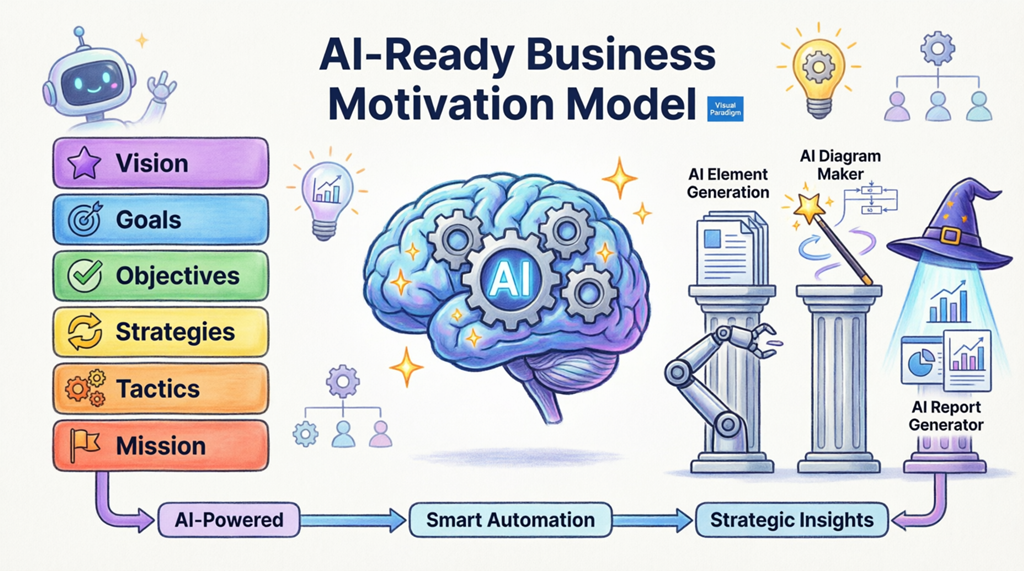
This isn’t just automation—it’s intelligent assistance that accelerates strategy development, deepens insights, and ensures execution alignment. Here’s what stood out in my hands-on review:
Pillar 1: AI-Powered BMM Element Generation
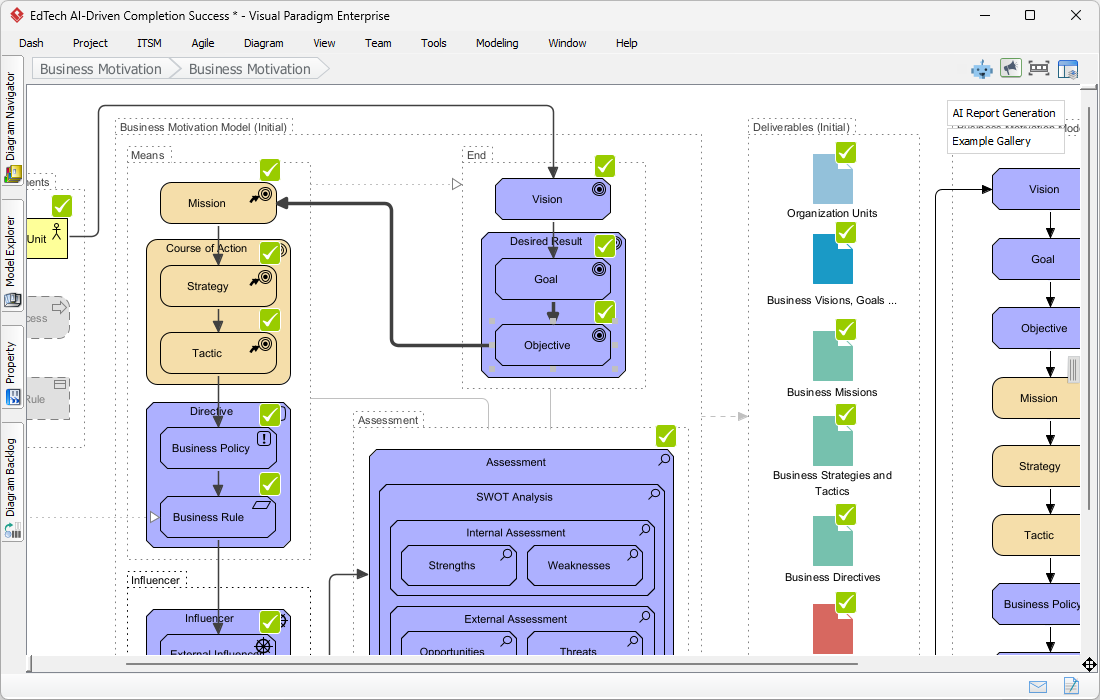
Every core BMM element now supports intelligent content generation. Simply describe your business context, and the AI proposes relevant, structured content:
-
Organization Units: AI suggests structural types (Corporation, Department, Team) aligned with your operations.
-
Influencers: The AI analysis assistant identifies relevant forces (Competitor, Regulation, Corporate Culture) impacting your strategy.
-
Assessments: Automatically generate SWOT-style evaluations and impact analysis (Risk/Reward).
-
Vision, Goals, Objectives: Receive aspirational statements and SMART objectives crafted contextually.
-
Missions, Strategies, Tactics: Get concise mission statements and actionable tactics proposed by the AI planning engine.
-
Business Policies & Rules: Generate guiding principles and enforceable rules.
How I used it: In the BMM Guide-Through Diagram, I double-clicked an “Objectives” element, opened the artifact at the bottom, clicked the AI Generation button, described my client’s fintech context, and watched as AI populated SMART objectives aligned with their regulatory environment. Note: Existing form data is replaced, so review carefully.
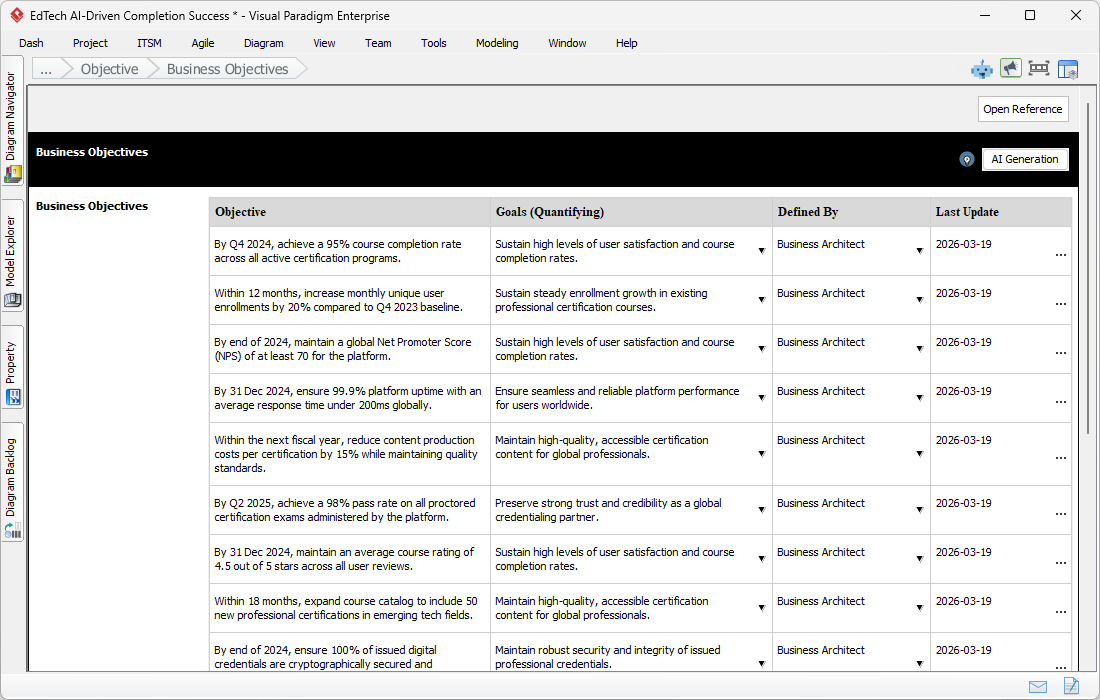
This eliminates “blank-page syndrome” and jumpstarts strategic modeling with intelligent, context-aware suggestions.
Pillar 2: AI-Driven Diagram Generation
Transform model data into insightful visualizations instantly. The AI diagram maker mines your input to produce meaningful visuals:
-
Goal Realization Diagram: Visualize how Goals decompose into Objectives, Strategies, and Tactics.
-
Mission-Goal-Objective Alignment Diagram: Show how daily purpose fuels tangible progress.
-
Outcome Realization Diagram: Connect measurable Objectives to broader Goals for OKR tracking.
-
Strategy Viewpoint & Cascade Diagrams: Present strategic dependencies and execution paths.
-
Tactical Plan & Realization Diagrams: Break Strategies into actionable Tactics linked to Processes and Actors.
-
Vision-to-Strategy Diagrams: Create end-to-end traceability from aspiration to action.
My workflow: Right-clicked the Vision element in the BMM diagram, selected “Vision to Strategy Realization Diagram,” and let AI auto-generate a traceability view. The result wasn’t just a pretty picture—it revealed a gap in how our customer retention tactic laddered to the overarching vision.
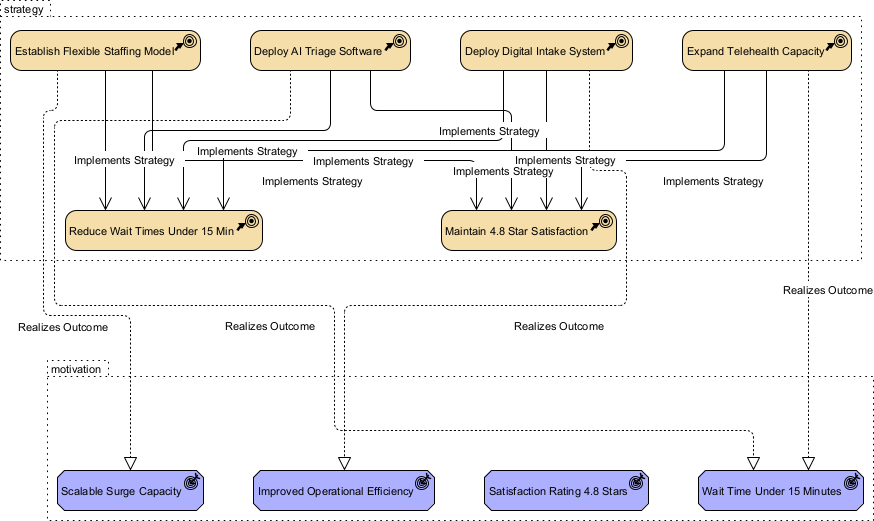
These diagrams become analytical assets that reveal alignment, gaps, and opportunities.
Pillar 3: AI-Generated Strategic Reports
Gain executive-level insights with automated report generation. The AI report generator synthesizes your BMM model into actionable intelligence:
-
Alignment & Coverage Heatmap: Calculate coverage scores to highlight strategic strengths and gaps.
-
Governance & Constraint Map: Visualize policy/rule distribution to identify over- or under-governed areas.
-
Influencer & Assessment Implications: Prioritize business implications from SWOT assessments.
-
Model Consistency Check: AI performs holistic reviews and suggests improvements.
-
Organization Ownership Overview: Map responsibilities to uncover bottlenecks.
-
Strategy-to-Execution Storyline: Generate executive narratives connecting Vision to Tactics.
-
Top Priorities & Focus Areas: Receive a ranked short-list of 6–10 highest-priority actions.
-
SWOT Analysis: Produce classic quadrant views directly from Influencer Assessments.
How I used it: Clicked the AI Report Generation button, selected “SWOT Analysis,” and received a polished, editable report linking each quadrant to specific BMM elements. Exported to PDF for the steering committee in minutes.
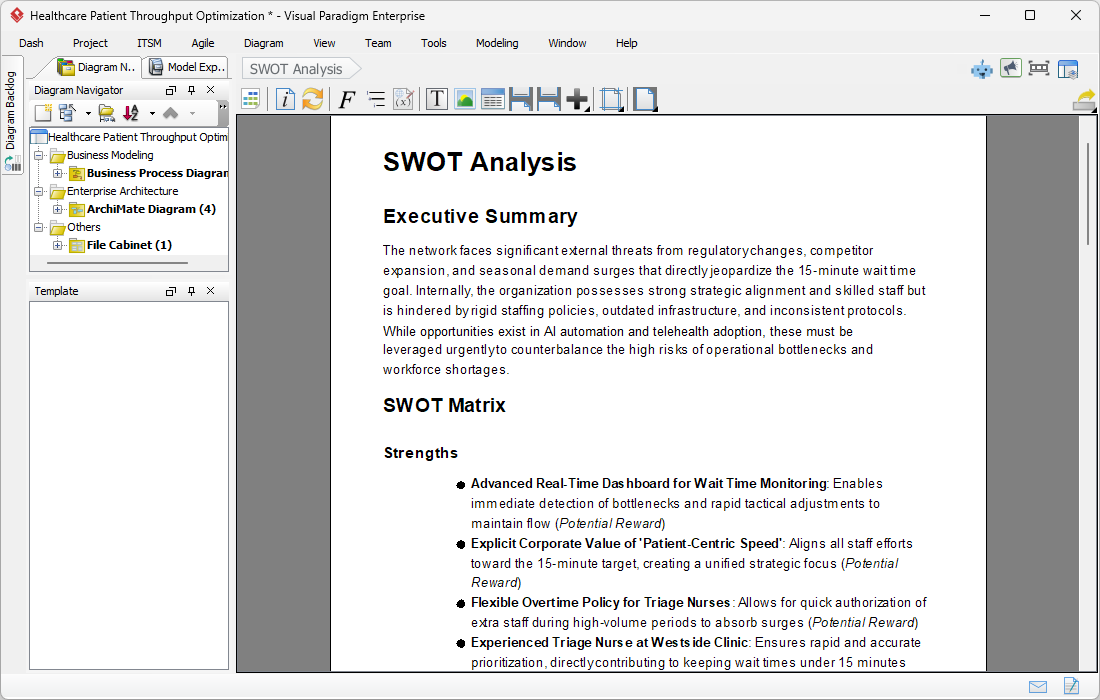
These reports empower leadership with clear, data-driven perspectives for strategic decision-making.
Why This Matters: My Takeaways for Practitioners
After implementing BMM traditionally and now with AI enhancements, here’s what I’ve learned:
✅ Start small, think traceable: Don’t model the entire enterprise upfront. Focus on one initiative, ensure every element references operational reality, and expand iteratively.
✅ Leverage placeholders: BMM’s power isn’t in containing all details—it’s in linking strategic decisions to where work actually happens. Use URIs, document IDs, or process names as references.
✅ AI is a catalyst, not a replacement: The new AI features accelerate drafting and analysis, but human judgment remains essential for validating context, prioritizing trade-offs, and ensuring ethical alignment.
✅ Collaboration is built-in: Because BMM makes rationale explicit and shareable, it naturally improves cross-functional alignment. Add AI-generated visuals, and stakeholder buy-in accelerates.
✅ Maintain model health: Schedule quarterly reviews of your BMM. Use AI’s model validator to check consistency, and update assessments as influencers evolve.
Conclusion: BMM as Your Strategic Compass in an AI-Augmented World
The Business Motivation Model has long been my go-to framework for bringing clarity to complex strategic decisions. Its strength lies not in rigid prescription, but in providing a flexible, traceable structure that adapts to any organization’s context. What excites me most about the new AI-Ready BMM Guide-Through is how it preserves BMM’s core philosophy while removing traditional friction points: the blank page, the time-intensive diagramming, the manual report compilation.
For teams navigating rapid change—whether digital transformation, market disruption, or regulatory shifts—BMM offers a disciplined way to document why you’re choosing a path and how you’ll know it’s working. Augmented with intelligent automation, it becomes even more accessible to practitioners who need strategic rigor without strategic overhead.
If you’re responsible for strategy, product, or enterprise architecture, I encourage you to explore BMM. Start with a pilot initiative. Leverage the AI enhancements to accelerate your modeling. And remember: the goal isn’t a perfect model—it’s better decisions, clearer communication, and traceable execution. In my experience, that’s exactly what BMM delivers.
References
- OMG Business Motivation Model (BMM) Specification: The official OMG specification defining the Business Motivation Model notation and semantics for capturing business decisions and rationale.
- Object Management Group (OMG): The international technology standards consortium responsible for developing and maintaining the BMM specification alongside other modeling standards like UML and BPMN.
- The Business Rules Group (BRG): The original creators of the Business Motivation Model, providing foundational resources, publications, and community support for business rules and motivation modeling practices.
- Strategic planning with BMM tool: Visual Paradigm’s feature page detailing their Business Motivation Model Guide-Through capability, including tutorials, use cases, and implementation guidance for strategic planning.
- Try Visual Paradigm FREE: Download page for Visual Paradigm’s community edition and free trial, enabling users to experience BMM modeling and the new AI-Ready Guide-Through features firsthand.
- What is Business Motivation Model?: A comprehensive guide explaining the core concepts of the Business Motivation Model (BMM), including its purpose in strategic planning, key elements like Stakesholders and Goals, and how it bridges the gap between business strategy and execution.
- Business Motivation Model Guide Through: An overview of the BMM features within Visual Paradigm, detailing how users can leverage the tool to create, manage, and visualize motivation models for better organizational alignment.
- Business Motivation Model Documentation (PDF): Official documentation available in PDF format, providing detailed technical specifications, modeling standards, and step-by-step instructions for implementing BMM using the Visual Paradigm platform.
- Business Motivation Model Guide Through: A repeated entry focusing on the practical application of BMM, offering insights into best practices for mapping business drivers, goals, and objectives to ensure successful project outcomes.
- AI-Ready Business Motivation Model Tool: An announcement regarding the integration of Artificial Intelligence into the BMM tool, highlighting new capabilities that allow for automated analysis, suggestion generation, and enhanced strategic planning workflows.
- 🎯 AI-Powered Strategic Planning Guide Through BMM: An article exploring how modern AI tools are transforming traditional strategic planning via the Business Motivation Model, emphasizing efficiency, data-driven decision-making, and future-proofing business strategies.
- The Complete Guide to the Business Motivation Model (BMM): A detailed resource covering the full spectrum of the BMM framework, from foundational theory to advanced implementation strategies, serving as a definitive handbook for architects and business analysts.
- AI-Ready Business Motivation Model Tool: A duplicate listing for the release notes concerning the AI-enhanced BMM tool, reiterating the update’s focus on leveraging machine learning to streamline complex business modeling tasks.
- AI-Ready Business Motivation Model Tool: Another reference to the same AI release, underscoring the industry shift toward intelligent modeling solutions that reduce manual effort in defining business motivations and constraints.
- AI Chatbot Feature: Information about the integrated AI chatbot feature within Visual Paradigm, which assists users in generating BMM diagrams, answering queries about modeling standards, and automating routine documentation tasks.
- Canvas Tool Feature: A description of the Canvas tool functionality, which provides a flexible workspace for creating collaborative diagrams, mind maps, and BMM models without strict grid constraints, enhancing creative strategic thinking.
- The Complete Guide to the Business Motivation Model (BMM): Reiteration of the comprehensive guide from Archimetric, offering deep dives into case studies, common pitfalls in BMM adoption, and strategies for aligning stakeholder interests effectively.
- 🎯 AI-Powered Strategic Planning Guide Through BMM: The synergy between AI technologies and the Business Motivation Model, illustrating real-world scenarios where AI accelerates the path from vision to actionable strategy
Related posts:
 How to Create Use Case Diagrams with AI: A Step-by-Step Tutorial
 Why Most TOGAF Tools Fail (And What to Use Instead)
Mastering BPMN Black Box Pools: A Comprehensive Guide to Modeling External Interactions
Why Most TOGAF Tools Fail (And What to Use Instead)
Mastering BPMN Black Box Pools: A Comprehensive Guide to Modeling External Interactions
 Architecting Clarity: A Comprehensive Guide to C4 Container Diagrams with Visual Paradigm and AI