


In the world of software development, managing complexity is the single most critical challenge. As systems grow in size and functionality, the methods used to structure them become increasingly important. Object-Oriented Analysis and Design (OOAD) stands as a foundational methodology for organizing these systems. It provides a structured approach to modeling real-world problems within a digital environment. This guide explores the core principles, processes, and terminology associated with OOAD, offering a clear path for beginners seeking to understand this essential discipline.
Understanding OOAD is not about learning a specific tool or programming language. It is about adopting a mindset. It is about viewing a system as a collection of interacting objects rather than a sequence of actions. This shift in perspective allows developers to create systems that are modular, maintainable, and scalable. Whether you are building a small utility or a massive enterprise platform, the principles remain consistent.
What is Object-Oriented Analysis and Design? 🧩
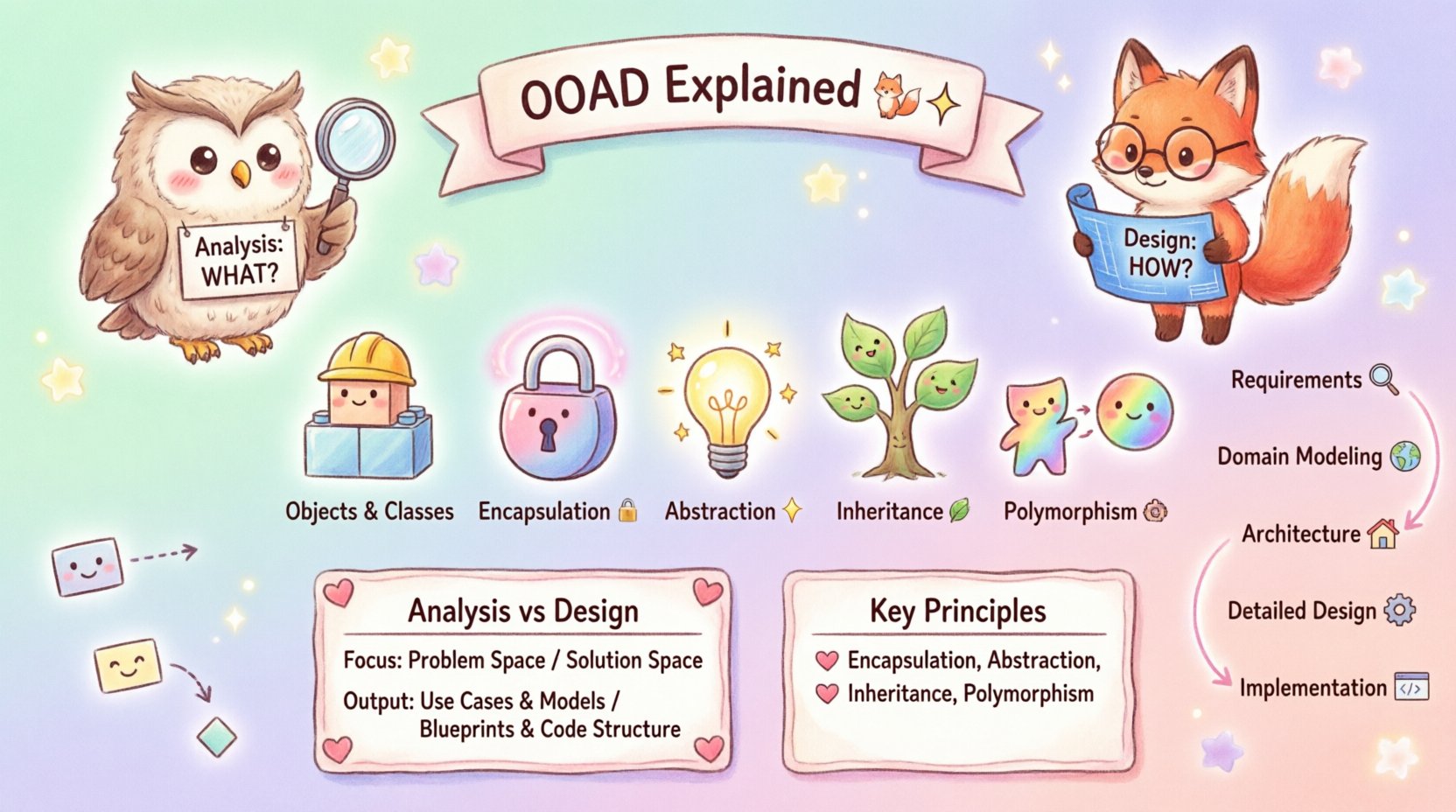
Object-Oriented Analysis and Design is a software development methodology. It focuses on identifying objects and the relationships between them to define the structure of a system. The process is typically divided into two main phases: Analysis and Design.
- Object-Oriented Analysis (OOA): This phase focuses on the “What” of the system. It involves understanding the requirements and identifying the objects that exist within the problem domain. The goal is to create a conceptual model that represents the business logic without worrying about implementation details.
- Object-Oriented Design (OOD): This phase focuses on the “How”. It takes the model from the analysis phase and translates it into a technical solution. This includes defining the classes, methods, and data structures that will be used to implement the requirements.
By separating the analysis from the design, teams can ensure that the solution actually solves the problem before writing any code. This reduces the risk of building the wrong thing efficiently.
Core Concepts and Terminology 🔑
To navigate OOAD effectively, one must understand the fundamental building blocks. These concepts form the vocabulary of object-oriented thinking. They are universal and apply regardless of the specific technology used.
1. Objects and Classes 🏗️
An Object is an instance of a real-world entity. It contains both data and behavior. For example, a specific car in a parking lot is an object. It has attributes like color, make, and model, and it has behaviors like starting, accelerating, and braking.
A Class is a blueprint or template for creating objects. It defines the structure that all objects of that type will share. If a car is an object, the “Car” class defines what makes a car a car. It specifies that all cars will have a color and an engine, even if the specific values differ.
- Attributes: The data stored within an object. Also known as properties or fields.
- Methods: The actions an object can perform. Also known as functions or operations.
2. Encapsulation 🔒
Encapsulation is the practice of bundling data and methods together within a single unit (the class). More importantly, it restricts direct access to some of the object’s components. This is often achieved through visibility modifiers.
By hiding the internal state of an object, you prevent external code from modifying it in invalid ways. This protects the integrity of the data. For instance, a bank account object might hide the balance value and only allow changes through specific methods like deposit or withdraw. This ensures the balance cannot become negative without proper validation logic.
3. Abstraction 🧠
Abstraction involves hiding complex implementation details and showing only the essential features of an object. It allows developers to interact with high-level concepts without needing to understand the underlying complexity.
When you use a car, you do not need to know how the fuel injection system works internally. You simply need to know that pressing the pedal increases speed. In OOAD, abstraction is achieved through interfaces and abstract classes. These define a contract that implementing classes must follow, ensuring consistency across the system.
4. Inheritance 🌿
Inheritance allows a new class to be based on an existing class. The new class inherits the attributes and methods of the parent class but can also define its own unique features. This promotes code reuse and establishes a hierarchical relationship.
For example, consider a system for a zoo. You might have a base class called Animal. You can then create classes like Lion and Eagle that inherit from Animal. Both will share common behaviors like eating and sleeping, but the Lion class can define a specific roar method, while the Eagle class defines a fly method.
5. Polymorphism 🎭
Polymorphism allows objects of different classes to be treated as objects of a common superclass. It enables a single interface to represent different underlying forms (data types). This flexibility is crucial for creating extensible systems.
In the zoo example, a method called makeSound can be called on any Animal object. If the object is a Lion, it roars. If it is an Eagle, it screeches. The calling code does not need to know the specific type of animal; it just knows that the animal makes a sound.
The OOAD Process Steps 🚀
Executing OOAD requires a disciplined approach. Skipping steps often leads to fragile code that is difficult to modify later. The process generally follows a lifecycle that aligns with the system development life cycle.
Phase 1: Requirement Analysis
This is the foundation. The team gathers information about what the system needs to do. This involves talking to stakeholders, reviewing documentation, and observing current workflows. The output is a set of requirements that are clear, measurable, and achievable.
Phase 2: Domain Modeling
Here, the analysis phase truly begins. The team identifies the key concepts in the problem domain. These concepts become candidates for classes. Relationships between these concepts are also identified. For example, in an e-commerce system, there is a relationship between a Customer and an Order.
Phase 3: Design Architecture
The high-level structure of the system is defined. This includes deciding on the layers of the application (presentation, logic, data) and how they interact. The goal is to ensure separation of concerns, where each part of the system handles a specific responsibility.
Phase 4: Detailed Design
This phase involves refining the classes and methods identified in the previous steps. It includes defining the specific signatures of methods, data types, and error handling strategies. Design patterns may be applied here to solve common recurring problems.
Phase 5: Implementation
Finally, the design is translated into code. While this is a coding phase, the OOAD principles guide the developer to write clean, organized code that reflects the design models.
Visualizing the Design: Diagrams 📊
Text descriptions are often insufficient for complex systems. Visual models help stakeholders and developers understand the structure and behavior of the system. The Unified Modeling Language (UML) is the standard for creating these diagrams.
| Diagram Type | Purpose | Key Focus |
|---|---|---|
| Use Case Diagram | Functional requirements | Actors and their interactions with the system |
| Class Diagram | Static structure | Classes, attributes, methods, and relationships |
| Sequence Diagram | Dynamic behavior | Interaction between objects over time |
| State Machine Diagram | Object lifecycle | States and transitions of an object |
Using these diagrams ensures that everyone involved in the project has a shared understanding of the system. It serves as a communication tool between technical and non-technical stakeholders.
Key Principles for Effective Design ⚙️
While OOAD provides the framework, specific principles guide the quality of the implementation. Adhering to these guidelines helps create robust software.
- Single Responsibility Principle: A class should have only one reason to change. If a class handles both database operations and user interface logic, it is doing too much. Splitting these responsibilities makes the code easier to test and modify.
- Open/Closed Principle: Software entities should be open for extension but closed for modification. You should be able to add new functionality without changing existing code. This is often achieved through inheritance or interfaces.
- Dependency Inversion: High-level modules should not depend on low-level modules. Both should depend on abstractions. This reduces coupling and allows components to be swapped out without breaking the entire system.
Analysis vs Design: A Comparison 🆚
It is common to confuse the analysis phase with the design phase. While they are closely related, they serve distinct purposes. Understanding the difference is vital for project management.
| Aspect | Analysis | Design |
|---|---|---|
| Focus | Problem Space | Solution Space |
| Question | What does the system do? | How does the system do it? |
| Technology | Independent | Dependent |
| Output | Conceptual Models | Technical Specifications |
| Stakeholders | Business Users | Developers |
By keeping these phases distinct, teams can validate the requirements before committing resources to the technical implementation. If a requirement is flawed, it is easier to fix it on paper than in code.
Common Challenges in OOAD ⚠️
Despite its benefits, OOAD is not without challenges. Beginners often encounter obstacles that can hinder progress. Recognizing these early allows for better planning and mitigation.
1. Over-Engineering
It is tempting to create a highly abstract and flexible architecture for a simple problem. This leads to complex code that is difficult to understand and maintain. The principle of YAGNI (You Aren’t Gonna Need It) suggests only adding functionality when it is actually needed.
2. Tight Coupling
Coupling refers to the degree of interdependence between software modules. If one class relies heavily on the internal details of another, they are tightly coupled. This makes it hard to change one without breaking the other. Loose coupling is the goal, achieved through interfaces and dependency injection.
3. Poor Abstraction
Creating abstractions that are too generic or too specific can cause issues. If an abstraction is too specific, it lacks reusability. If it is too generic, it becomes confusing. Finding the right level of abstraction requires experience and context.
4. Learning Curve
OOAD requires a shift in thinking. Developers accustomed to procedural programming may find the object model counter-intuitive at first. Patience and practice are necessary to internalize concepts like polymorphism and encapsulation.
Benefits of Adopting OOAD 🌟
When applied correctly, the methodology offers significant advantages. These benefits justify the effort required to learn and implement it.
- Maintainability: Code is organized into logical units. Fixing a bug in one object rarely affects others.
- Reusability: Classes can be reused across different projects or modules. This saves time and reduces errors.
- Scalability: The modular nature of OOAD allows systems to grow. New features can be added by creating new classes rather than modifying existing ones.
- Collaboration: Different teams can work on different objects simultaneously without interfering with each other’s work.
Practical Application: A Simple Scenario 💡
Let us look at a simplified example to tie these concepts together. Imagine a library management system.
During Analysis, the team identifies the following key concepts: Book, Member, Loan, and Library. They determine that a Member can borrow a Book, and the Library manages the collection.
During Design, these concepts become classes. The Book class has attributes like title and ISBN. It has methods like checkAvailability. The Member class tracks borrowed items. The Library class coordinates the interactions.
Encapsulation ensures that the Member cannot directly modify the Book status. They must go through a checkout method. Inheritance might be used if there are different types of members, such as Student or Faculty, with different loan limits.
This structured approach ensures that the system is robust. If the library decides to add fines, it can be done by modifying the Loan class without touching the Book class.
Moving Forward 🛤️
Object-Oriented Analysis and Design is a powerful tool for building complex software systems. It provides a structured way to think about problems and translate them into solutions. While it requires discipline and a shift in mindset, the long-term benefits in terms of maintainability and scalability are substantial.
For beginners, the best approach is to start small. Practice modeling simple systems. Draw diagrams. Define classes. Understand the relationships between objects. As you gain experience, you will find that these concepts become second nature. The goal is not to force every problem into an object-oriented mold, but to use the tools available to create software that serves its purpose effectively.
By mastering the fundamentals of OOAD, you equip yourself with the ability to navigate the complexities of modern software development. This foundation supports growth and adaptation as technology evolves. Continue to explore, practice, and refine your understanding of these core principles.
Related posts:
 Real-World Case Study: How to Apply Object-Oriented Analysis and Design to a Complex E-commerce App
 Component Breakdown of Object-Oriented Analysis and Design: How to Model Real Entities into Classes
 Object-Oriented Analysis and Design Primer: The Core Concepts Every Aspiring Developer Must Know
 Object-Oriented Analysis and Design Essentials: Building a Strong Foundation for Any Programming Language