


Entering the field of software engineering often feels like standing at the base of a massive mountain. The terrain is complex, the vocabulary is dense, and the path to proficiency is rarely linear. For junior engineers, the transition from writing scripts to designing systems is a critical milestone. This transition relies heavily on a disciplined approach to Object-Oriented Analysis and Design (OOAD). OOAD is not merely a set of diagrams; it is a cognitive framework for modeling real-world problems into software structures.
This guide outlines a strategic roadmap for junior engineers. It focuses on the core competencies required to move from writing isolated code blocks to architecting maintainable, scalable systems. By understanding the flow from analysis to design, you build a foundation that supports long-term career growth.
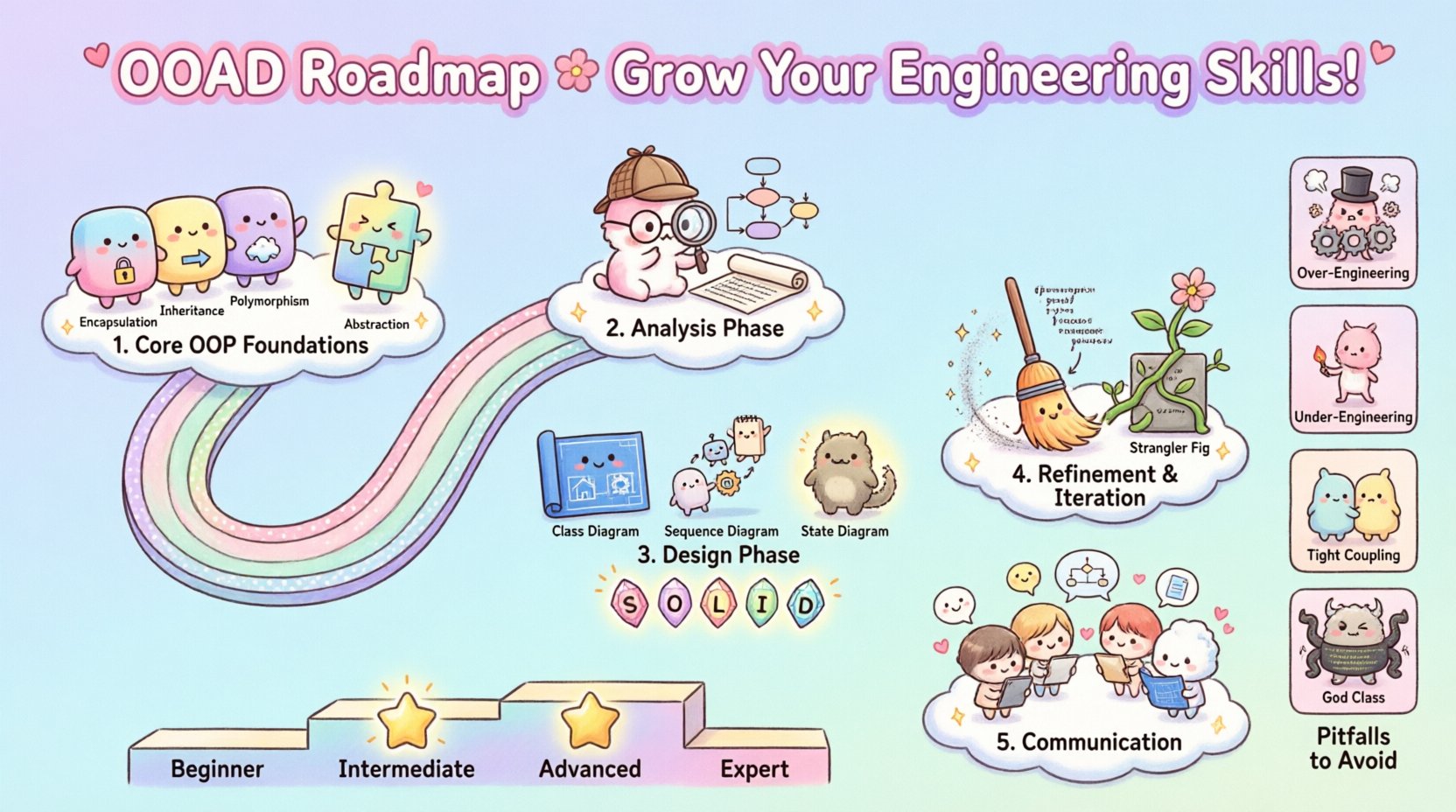
🧠 Phase 1: Strengthening the Core OOP Foundations
Before diving into high-level architecture, one must master the fundamental building blocks of object-oriented programming. Analysis and design are futile if the underlying constructs are weak. This phase focuses on internalizing the principles that govern how objects interact.
- Encapsulation: Understanding how to bundle data and methods together while restricting access to internal details. This protects state integrity and reduces coupling.
- Inheritance: Using base classes to share behavior. However, caution is required to avoid deep hierarchies that become brittle.
- Polymorphism: The ability of different objects to respond to the same message in different ways. This enables flexible interfaces and easier testing.
- Abstraction: Hiding complex implementation details and showing only the necessary features. This allows you to manage complexity.
Junior engineers often struggle with the difference between inheritance and composition. A common pitfall is creating deep inheritance trees. A robust design strategy favors composition, where objects contain instances of other classes to build functionality. This approach adheres to the “favor composition over inheritance” principle, leading to more flexible code.
📐 Phase 2: Mastering the Analysis Phase
Analysis is the bridge between user needs and technical implementation. It answers the question: “What must the system do?” rather than “How will we build it?”. Skipping this step often leads to rework later. Effective analysis requires rigorous documentation and clear communication.
🔍 Gathering Requirements
The first step involves understanding the problem space. You must engage with stakeholders to define functional and non-functional requirements.
- Functional Requirements: Specific behaviors the system must exhibit (e.g., “The user can reset their password”).
- Non-Functional Requirements: Constraints such as performance, security, and scalability (e.g., “The system must handle 1000 requests per second”).
📝 Creating Use Cases
Use cases describe how different actors interact with the system. They help visualize the flow of data and actions.
- Actors: Users or external systems interacting with the software.
- Scenarios: Specific paths through the system, including normal flows and exception flows.
When documenting use cases, focus on clarity. Avoid technical jargon in the initial analysis phase. The goal is to ensure everyone agrees on the scope before writing code.
🛠️ Phase 3: Transitioning to Design
Once the requirements are clear, the design phase begins. This answers “How will the system do it?”. Design translates abstract requirements into concrete structures. For object-oriented systems, this involves defining classes, interfaces, and their relationships.
🎨 Visualizing with UML
Unified Modeling Language (UML) is the standard for visualizing system design. While you do not need to draw every diagram, knowing when to use them is vital.
- Class Diagrams: Show the static structure of the system, including attributes, methods, and relationships.
- Sequence Diagrams: Illustrate how objects interact over time to perform a specific task.
- State Diagrams: Depict how an object changes state in response to events.
⚙️ Applying SOLID Principles
Designing robust software requires adherence to five core principles known as SOLID. These guidelines help prevent code from becoming rigid and difficult to change.
- Single Responsibility Principle (SRP): A class should have only one reason to change. Keep concerns separated.
- Open/Closed Principle (OCP): Software entities should be open for extension but closed for modification.
- Liskov Substitution Principle (LSP): Subtypes must be substitutable for their base types without altering correctness.
- Interface Segregation Principle (ISP): Clients should not be forced to depend on interfaces they do not use.
- Dependency Inversion Principle (DIP): High-level modules should not depend on low-level modules. Both should depend on abstractions.
Violating these principles often results in “God Objects” that try to do everything. By adhering to SOLID, you create modular components that can be tested and maintained independently.
📊 Strategic Skill Progression Table
To track your growth as a junior engineer, use this table to assess your current proficiency in OOAD. Regular self-assessment ensures you are progressing systematically.
| Level | Focus Area | Key Competency |
|---|---|---|
| Beginner | Basic Syntax & Logic | Writing functional code using standard classes. |
| Intermediate | Design Patterns | Identifying when to apply common patterns like Factory or Observer. |
| Advanced | System Architecture | Designing high-level structures that meet scalability requirements. |
| Expert | Refactoring & Optimization | Improving existing codebases without breaking functionality. |
🔄 Phase 4: Refinement and Iteration
Software design is rarely a one-time event. It is an iterative process. As requirements change or new edge cases emerge, the design must evolve. This phase focuses on maintaining the health of the codebase over time.
🧹 Refactoring
Refactoring is the process of improving the internal structure of code without changing its external behavior. It is essential for keeping the design clean.
- Identify Smells: Look for duplicated code, long methods, or large classes.
- Small Steps: Make incremental changes. Commit frequently to maintain a safe history.
- Test Coverage: Ensure you have automated tests before refactoring. This provides a safety net.
🔒 Handling Legacy Code
Junior engineers often inherit codebases that were not designed with modern standards. Dealing with legacy code requires patience and strategy.
- Understand First: Do not change code until you understand what it currently does.
- Strangler Fig Pattern: Gradually replace old functionality with new services rather than rewriting everything at once.
- Document Decisions: Record why certain compromises were made to help future maintainers.
🤝 Phase 5: Communication and Collaboration
Technical skills are only half the equation. A successful engineer must communicate their design decisions effectively. OOAD relies on shared understanding among team members.
🗣️ Design Reviews
Participating in design reviews is crucial for growth. It exposes you to different perspectives and helps you identify blind spots in your logic.
- Prepare Visuals: Use diagrams to explain complex flows during meetings.
- Listen Actively: Understand the concerns of peers. Feedback is a tool for improvement, not criticism.
- Defend with Logic: When proposing a solution, explain the trade-offs involved.
📚 Documentation Standards
Documentation ensures that the design survives beyond the original author. It serves as a reference for onboarding and maintenance.
- API Documentation: Clearly define input parameters, return values, and error codes.
- Architecture Decision Records (ADR): Document why a specific technology or pattern was chosen.
- README Files: Include setup instructions and context for the project.
🎯 Common Pitfalls to Avoid
Even with a solid roadmap, mistakes happen. Recognizing these common anti-patterns early can save significant time and effort.
| Pitfall | Description | Correction Strategy |
|---|---|---|
| Over-Engineering | Building features that are not currently needed. | Apply YAGNI (You Ain’t Gonna Need It) principle. |
| Under-Engineering | Failing to plan for future growth or changes. | Identify potential scaling needs early. |
| Tight Coupling | Classes depend too heavily on each other. | Use interfaces and dependency injection. |
| God Class | A class that knows too much or does too much. | Split functionality into smaller, focused classes. |
📈 Long-Term Growth Strategies
Advancing in software engineering is a marathon, not a sprint. Continuous learning is necessary to stay relevant in a rapidly changing industry.
- Read Design Literature: Study books and articles on software architecture. Understand the history of design patterns.
- Code Review Participation: Reviewing others’ code teaches you what good design looks like in practice.
- Open Source Contributions: Contributing to public projects exposes you to diverse coding styles and architectural decisions.
- Mentorship: Seek mentors who can guide your career path. Conversely, mentor others to solidify your own knowledge.
🏁 Final Thoughts on System Design
Building software is an act of problem-solving. Object-Oriented Analysis and Design provides the tools to solve these problems systematically. By following the roadmap outlined above, junior engineers can develop the confidence to tackle complex challenges.
Remember that no design is perfect forever. The goal is to create systems that are adaptable and understandable. Focus on clarity and maintainability over cleverness. As you gain experience, you will develop an intuition for when to apply specific patterns and when to keep things simple.
Start small. Apply these principles to your daily tasks. Over time, the accumulation of these small improvements will result in significant professional growth. The path to expertise is paved with consistent effort and a commitment to quality.
Continue to analyze, design, and refine. Your career will benefit from the discipline you instill today.
Related posts:
 Object-Oriented Analysis and Design Quick Start: From Concept to Class Diagram in One Day
 Object-Oriented Analysis and Design Best Practices: Writing Maintainable Code from Day One
 Object-Oriented Analysis and Design in Action: Transforming Abstract Ideas into Working Software Modules
 The Role of Object-Oriented Analysis and Design in Agile Teams: Balancing Speed and Structure