


In the landscape of software architecture, few patterns are as insidious as the God Class. Also known as the Spaghetti Class or Smart Controller, this anti-pattern represents a single object that knows too much and does too little. It becomes the central hub of an entire subsystem, pulling logic from every corner of the application into one massive file. While it might seem efficient in the early stages of development to consolidate functionality, this approach inevitably leads to brittle, unmaintainable codebases. 🛑
Object-Oriented Analysis and Design (OOAD) provides the theoretical framework to prevent such structural decay. By adhering to established principles, developers can construct systems that are modular, testable, and adaptable. This guide explores the anatomy of the God Class, the consequences of its existence, and the specific design strategies required to eliminate it from your codebase. We will focus on high-level principles, structural patterns, and practical refactoring techniques without relying on specific tooling or frameworks.
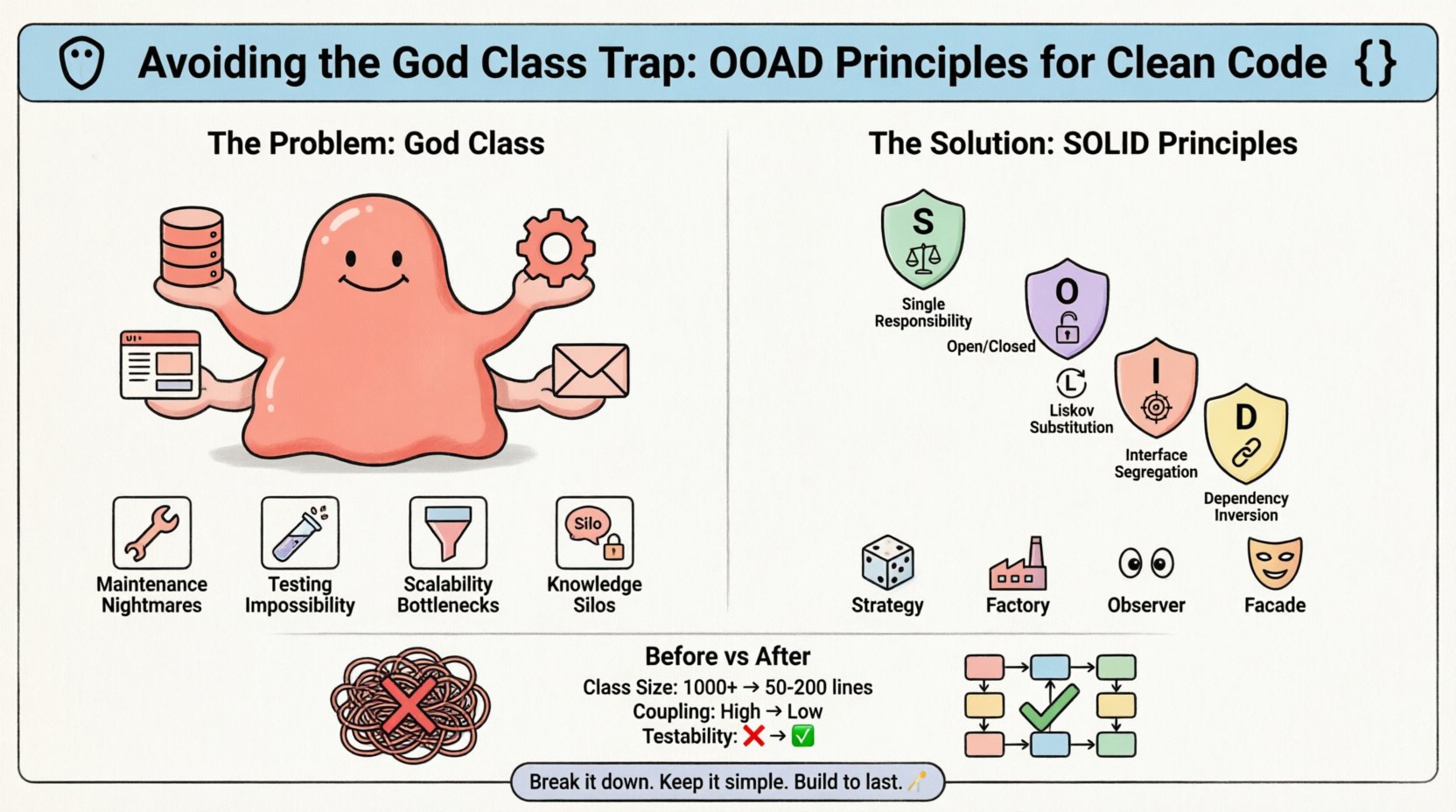
🧩 What Exactly Is a God Class?
A God Class is an object that monopolizes the responsibilities of a system. It acts as a universal handler, possessing knowledge about other classes, managing data access, performing business logic, and handling user interface concerns all at once. It is the software equivalent of a single person trying to manage every department in a corporation alone. 🏢
When a class grows beyond a certain threshold, it violates the fundamental tenets of encapsulation. Instead of interacting with specialized peers, the God Class becomes the only interface to the system. Other classes become mere data holders or helpers, passing their work to the God Class for execution. This creates a dependency bottleneck where any change in the system requires modification of the central class.
Common Characteristics of a God Class:
- Excessive Methods: A single file contains hundreds of methods, often with hundreds of lines of code each.
- High Coupling: It references almost every other class in the project directly.
- Global State: It holds static variables or singletons that manage global application state.
- Violation of Boundaries: It mixes presentation logic, business rules, and data persistence into one unit.
- Difficulty in Testing: Unit tests become integration tests because the class cannot be isolated from its dependencies.
📉 The Consequences of Structural Decay
Allowing a God Class to persist in a codebase creates a ripple effect of technical debt. The initial convenience of a single file quickly transforms into a nightmare of complexity. Understanding the specific risks helps justify the effort required to refactor.
1. Maintenance Nightmares 📉
When a new developer joins the project, the first thing they encounter is a monolithic file. They cannot understand the flow of logic because everything is in one place. Modifying a single feature requires navigating through thousands of lines of code, increasing the risk of introducing regressions. The fear of breaking something stops teams from making necessary improvements.
2. Testing Impossibility 🧪
Effective testing relies on isolation. A God Class is inherently coupled to the entire system. To test a specific method within it, you often need to instantiate the entire application context or mock hundreds of dependencies. This makes unit testing impractical and leads to a reliance on brittle end-to-end tests that are slow and flaky.
3. Scalability Bottlenecks 🚧
As the system grows, the God Class grows with it. There is no logical point to stop adding features because the class is already designed to handle everything. However, performance degrades as the object becomes bloated with logic. Concurrent modifications by different developers become impossible without constant merge conflicts, as everyone edits the same central file.
4. Knowledge Silos 🧠
The person who originally wrote the God Class becomes the sole authority on that part of the system. If they leave the team, that knowledge vanishes with them. This creates a single point of failure in the human resources layer, not just the code layer.
🛡️ Core OOAD Principles for Prevention
To avoid creating a God Class, developers must adhere to specific design principles. These principles act as guardrails, ensuring that responsibility is distributed correctly across the system. The most prominent framework for this is the SOLID set of principles, though others apply as well.
1. Single Responsibility Principle (SRP) ⚖️
This is the most critical defense against God Classes. SRP states that a class should have only one reason to change. If a class handles database connections, calculates tax, and sends emails, it has three reasons to change. When a requirement changes regarding tax calculation, the class needs to change. If the database schema changes, the class needs to change. If the email provider changes, the class needs to change.
Application:
- Split large classes into smaller, focused classes.
- Ensure each class has a clear, specific purpose.
- Ask: "If I change this requirement, will I need to touch any other part of this class?" If yes, it might violate SRP.
2. Open/Closed Principle (OCP) 🔓
Software entities should be open for extension but closed for modification. A God Class often requires modification to add new features. Instead, the design should allow new functionality to be added by creating new classes that implement existing interfaces.
Application:
- Use interfaces to define behavior.
- Implement new behaviors via new classes rather than modifying existing logic.
- Prevent the central class from growing with every feature request.
3. Liskov Substitution Principle (LSP) 🔄
Objects of a superclass should be replaceable with objects of its subclasses without affecting the correctness of the program. A God Class often tries to do everything, leading to complex conditional logic (if-else blocks) that violates type safety. Subclasses allow for specific behaviors without bloating the parent.
4. Interface Segregation Principle (ISP) 🎯
Clients should not be forced to depend on methods they do not use. A God Class often implements a large interface that includes methods for features unrelated to its primary function. Splitting large interfaces into smaller, client-specific ones prevents the need for a universal handler.
5. Dependency Inversion Principle (DIP) 🔗
High-level modules should not depend on low-level modules. Both should depend on abstractions. A God Class typically depends on every concrete class in the system. By inverting this dependency, the God Class relies on interfaces, allowing it to be decoupled from specific implementations.
📊 Comparing Good Design vs. God Class
To visualize the difference, consider the following comparison between a well-structured system and one plagued by a God Class.
| Feature | Well-Structured System | System with God Class |
|---|---|---|
| Class Size | Small, focused (50-200 lines) | Large, bloated (1000+ lines) |
| Coupling | Low, depends on interfaces | High, depends on concrete classes |
| Cohesion | High, all methods relate to one purpose | Low, methods are unrelated |
| Testability | High, easy to mock dependencies | Low, requires full system setup |
| Parallel Dev | Multiple teams can work on different modules | One team, merge conflicts common |
| Refactoring | Safe, localized changes | Risky, global impact |
🔧 Refactoring Strategies for Existing Code
What happens when you inherit a codebase that already contains a God Class? Panic is not the answer. Systematic refactoring can dismantle the anti-pattern without rewriting the entire application. Here is a step-by-step approach.
1. Identify Boundaries 📏
First, analyze the methods within the class. Group them by functionality. Do they all relate to user authentication? Do they handle file I/O? Do they calculate reports? Identify these logical clusters. These clusters will become the new classes.
2. Extract Classes 📂
Use the Extract Class refactoring technique. Move a group of related fields and methods from the God Class into a new class. Ensure the new class has its own constructor and lifecycle. This step should be done incrementally to avoid breaking the build.
3. Introduce Interfaces 🛣️
Once the logic is moved, define an interface that represents the behavior of the extracted class. The original God Class should now depend on this interface rather than the concrete implementation. This decouples the central logic from the specific details of the extracted functionality.
4. Remove Static State 🗑️
God Classes often rely on static variables to share state across the application. Replace these with dependency injection. Pass the necessary state or service instances into the constructor of the classes that need them. This makes dependencies explicit and easier to track.
5. Split Methods 🔪
Long methods within the God Class are a sign of responsibility creep. Extract these methods into separate classes or helper methods. If a method performs a distinct task, it should ideally belong to a different class entirely.
🎨 Design Patterns to Prevent God Classes
Certain design patterns are specifically useful for distributing responsibility and preventing the centralization of logic.
1. Strategy Pattern 🎲
When a class has multiple algorithms for the same task, use the Strategy Pattern. Instead of having a large class with many conditional branches, define a family of algorithms, encapsulate each one, and make them interchangeable. This keeps the main class focused on coordination rather than implementation.
2. Factory Pattern 🏭
Use a Factory to handle object creation. If a God Class is creating instances of various objects, move that logic to a Factory. The God Class should only request the objects it needs, not manage their creation.
3. Observer Pattern 👀
Decouple the sender of a message from the receiver. Instead of the God Class calling every listener directly, it can publish events. Listeners subscribe to these events. This reduces the coupling between the central controller and the rest of the system.
4. Facade Pattern 🎭
If you must have a single point of entry for a subsystem, use a Facade. This simplifies the interface for the client but hides the complexity of the underlying system. The Facade delegates to the appropriate specialized classes, preventing the Facade itself from becoming a God Class.
📈 Metrics to Monitor
To ensure you are not drifting back towards a God Class, track specific metrics. These provide objective data about the health of your codebase.
- Cyclomatic Complexity: Measures the number of linearly independent paths through a program. High complexity in a single class indicates too many decision points and logic branches.
- Lines of Code (LOC): While not a perfect metric, a class exceeding 500 lines should trigger a review.
- Coupling Between Objects (CBO): Measures how many other classes a class depends on. A high CBO score suggests the class is a hub of dependencies.
- Depth of Inheritance Tree (DIT): Excessive inheritance can sometimes mask God Classes. Keep hierarchies shallow.
- Afferent/Efferent Coupling: Monitor how many classes depend on the class (Afferent) versus how many it depends on (Efferent). A God Class typically has high Afferent coupling.
🤝 The Human Element of Design
Technical principles are useless without team discipline. Even the best architecture can fail if the team does not understand the why behind it.
- Code Reviews: Use reviews to catch God Classes early. Ask: "Does this class do too much?" during the review process.
- Documentation: Document the responsibilities of each class clearly. If a class claims to do one thing but does five, it is a red flag.
- Training: Ensure all developers understand OOAD principles. The God Class often arises from a lack of understanding of encapsulation and separation of concerns.
- Incremental Refactoring: Don’t try to fix everything at once. Refactor one module at a time to reduce risk.
⚠️ Common Pitfalls in Refactoring
Avoid these mistakes when attempting to decompose a God Class.
- Pseudo-Refactoring: Simply renaming variables or moving code without changing the structure. This gives the illusion of improvement without solving the coupling problem.
- Over-Abstraction: Creating interfaces for every single method. This adds complexity without benefit. Only abstract what needs to vary.
- Ignoring Tests: Refactoring without tests is dangerous. If you do not have a safety net, you may break functionality while trying to improve structure.
- Premature Optimization: Trying to design a perfect system before writing any code. Start with the simplest solution and refactor as requirements evolve.
🌱 Long-Term Sustainability
Building a system free of God Classes is not a one-time task. It is a continuous practice of maintenance and vigilance. The goal is to create a codebase that breathes, where changes are localized and predictable.
When a new requirement arrives, the team should be able to identify which class needs to change. If the answer is "the main controller" or "the manager class," the architecture has failed. If the answer is "the payment processor" or "the user service," the design is holding.
Embrace the discomfort of refactoring. It feels like work, but it is an investment. A clean architecture reduces the cost of future development. It allows the team to move faster because they are not fighting against the codebase. It reduces the cognitive load on developers who are reading and writing the code.
Ultimately, the quality of the software is a reflection of the design decisions made at the beginning. By resisting the temptation to consolidate everything into one convenient class, you build a foundation that can support growth. The God Class is a trap for the impatient. The modular, principle-driven approach is the path for the committed. 🚀
Remember that clean code is not just about syntax. It is about communication. Classes should communicate their intent clearly. If you have to read the entire class to understand what it does, it is too complex. Break it down. Split it up. Keep it simple.
By following these guidelines, you ensure that your software remains flexible, robust, and understandable. The God Class is a symptom of poor design, but with the right tools and mindset, it is a problem you can solve. Focus on the principles, watch the metrics, and maintain the discipline required to keep your architecture healthy. This is how you build software that lasts. 🏗️✅
Related posts:
 Common Mistakes in Object-Oriented Analysis and Design and How to Fix Them Before They Break Your Code
 Troubleshooting Weak Designs: When Object-Oriented Analysis and Design Fails and How to Rescue Your Project
 Future Outlook of Object-Oriented Analysis and Design: How Modern Trends Are Shaping the Classic Method
 Object-Oriented Analysis and Design Roadmap: A Strategic Plan for Junior Engineers to Advance Their Skills