


Object-Oriented Analysis and Design (OOAD) stands as a cornerstone of modern software development. It provides a structured approach to modeling systems, focusing on objects that contain both data and behavior. However, there is a fine line between robust architecture and unnecessary complexity. Many teams fall into the trap of creating designs that are difficult to maintain, hard to understand, and rigid in the face of change. This phenomenon is known as over-engineering.
When you find yourself spending more time designing than coding, or when a simple feature requires modifying ten different classes, you are likely facing over-engineering. This guide explores the symptoms, root causes, and practical strategies to bring your OOAD back to a state of healthy simplicity. We will look at how to balance flexibility with practicality without sacrificing the core benefits of object-oriented principles.
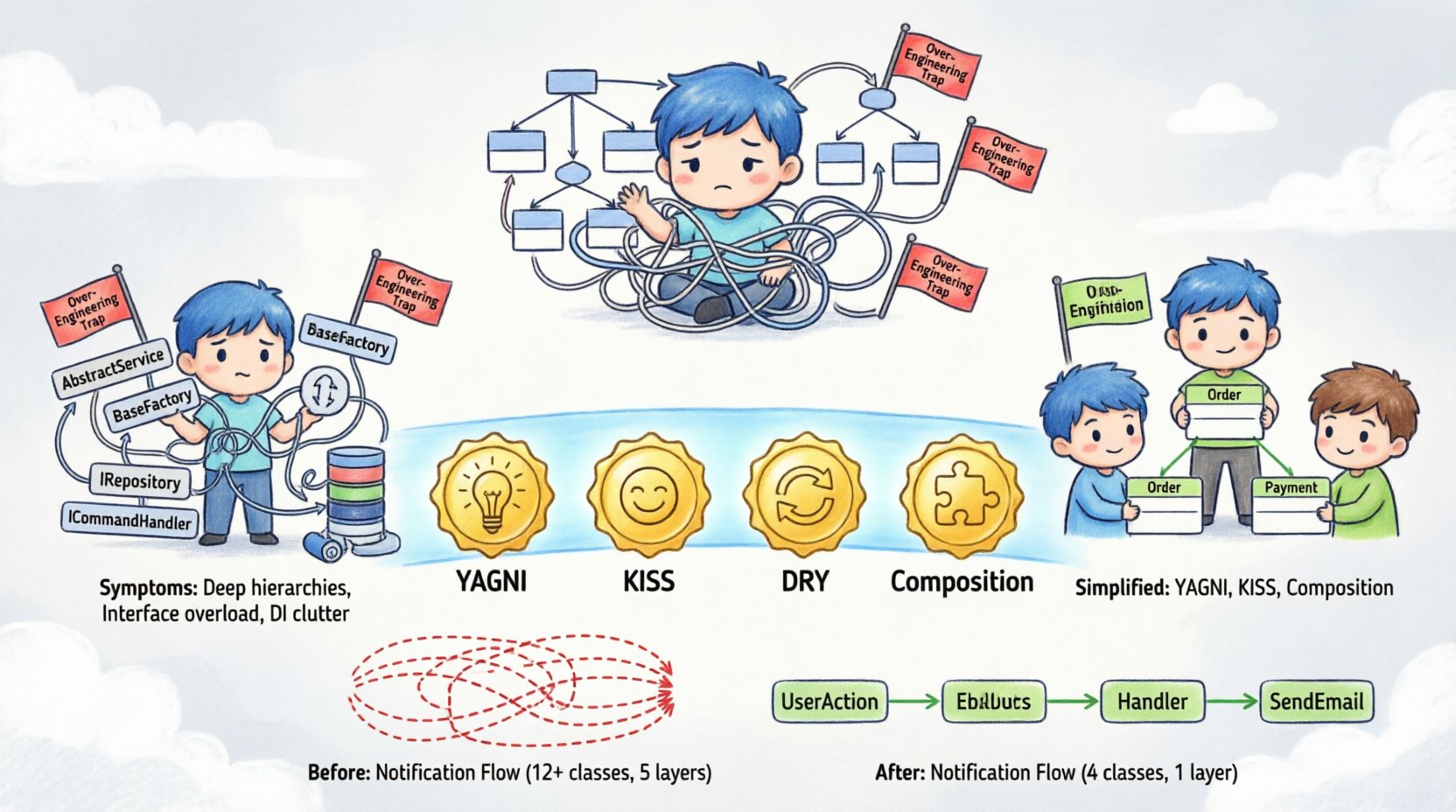
🚩 Recognizing the Symptoms of Over-Engineering
Before you can fix a problem, you must identify it. Over-engineering often hides behind a facade of “best practices.” It is easy to mistake complexity for sophistication. Here are the key indicators that your design has gone too far:
- Excessive Inheritance Hierarchies: If you find yourself creating five or more levels of abstract base classes just to handle a specific variation, the hierarchy is likely too deep. Deep hierarchies make it hard to trace behavior and understand the state of an object.
- Proliferation of Interfaces: While interfaces promote decoupling, having a separate interface for every single method or variation creates noise. If your codebase contains more interface files than implementation files, reconsider the design.
- Generalized Classes: Classes that try to handle every possible scenario for a domain are often too broad. A
Userclass that manages authentication, billing, and social networking within a single entity is a classic sign of scope creep. - Dependency Injection Overload: While dependency injection is a good practice, injecting every single dependency into every constructor creates clutter. If a class requires ten parameters to be instantiated, the cohesion is likely low.
- Abstract Factory Patterns for Simple Data: Using complex factory patterns to create simple data objects adds layers of indirection that yield no tangible benefit for the business logic.
- Design Patterns as Dogma: Applying design patterns because they are popular, rather than because they solve a specific problem, leads to bloat. A simple script that uses the Strategy pattern is often overkill.
🧠 Understanding the Root Causes
Why do good intentions lead to bad designs? Understanding the psychology and process behind over-engineering helps prevent it in the future.
1. The Fear of Change
Developers often over-engineer to anticipate future requirements that do not exist. This is driven by the fear that the system will break if a requirement changes. Instead of building for the known future, teams build for a hypothetical one. This leads to generic abstractions that obscure the actual logic.
2. Intellectual Showboating
Sometimes, the desire to demonstrate technical prowess leads to complex solutions. Designing a system that looks impressive on paper but is hard to use in practice is a common pitfall. Simplicity is often harder to achieve than complexity, but it is more valuable.
3. Lack of Context
Designing without understanding the business domain results in generic structures. If the team does not understand the specific needs of the application, they default to complex, reusable structures that are not actually reusable in this context.
4. Perfectionism
Striving for a “perfect” design before writing a single line of code slows down delivery. Software is iterative. A perfect design today is often obsolete tomorrow because requirements shift. Aggressive optimization early in the lifecycle often yields diminishing returns.
⚖️ The Golden Principles of Simplification
To reduce complexity, you must adhere to specific principles that prioritize clarity and utility over theoretical purity.
YAGNI (You Ain’t Gonna Need It)
This principle suggests that you should not add functionality until it is necessary. If a feature is not required for the current version, do not build it. This prevents the accumulation of unused code that complicates maintenance.
KISS (Keep It Simple, Stupid)
Systems should be as simple as possible. If a solution can be achieved with a straightforward class structure, do not introduce interfaces or abstract classes. Simplicity reduces the cognitive load on developers and reduces the surface area for bugs.
DRY (Don’t Repeat Yourself)
While DRY is essential, it must be applied judiciousally. Extracting code into a common base class is only useful if the duplication is real. Premature abstraction creates coupling where there should be none.
Composition Over Inheritance
Inheritance is a powerful tool, but it is rigid. Composition allows you to build objects by combining behaviors at runtime. This is generally more flexible and easier to test than deep inheritance trees.
📊 Comparing Over-Engineered vs. Simplified Designs
Visualizing the difference between a bloated design and a simplified one helps clarify the concepts. Below is a comparison of how two different approaches might handle a similar requirement: managing a notification system.
| Aspect | Over-Engineered Approach | Simplified Approach |
|---|---|---|
| Structure | Multiple abstract classes: NotificationSender, EmailSender, SMSSender, PushSender. Each extends a base with complex state management. |
Single concrete classes for each channel. A factory selects the correct sender based on configuration. |
| Dependency | High coupling between the sender and the message format. Changes to the message format require changes to all senders. | Loose coupling. The message object is passed to the sender. The sender handles its own formatting logic. |
| Extensibility | Adding a new channel requires modifying the base class and all subclasses. | Adding a new channel requires creating a new class. Existing code remains untouched. |
| Maintainability | Hard to debug due to deep call stacks and polymorphic behavior. | Direct calls make debugging straightforward and logic transparent. |
| Testability | Requires complex mocks to simulate the inheritance chain. | Unit tests can target individual classes directly without heavy setup. |
🛠️ Practical Strategies for Refactoring
If you recognize that your current system is over-engineered, you can take steps to simplify it. Refactoring is a continuous process, not a one-time event.
1. Audit Your Classes
Review every class in your codebase. Ask yourself: “Does this class have a single responsibility?” If a class handles multiple unrelated tasks, split it. If a class has too many methods, consider grouping them into a helper object.
2. Reduce Abstraction Levels
Look for layers of abstraction that do not add value. Can you remove an interface? Can you replace an abstract class with a concrete one? Remove the indirection if the behavior is not expected to change.
3. Embrace Concrete Implementations
It is okay to write concrete code. If a specific behavior is unlikely to change, do not abstract it. Concrete code is faster to read and faster to execute than polymorphic code.
4. Simplify Dependency Injection
Review your constructors. Are you injecting dependencies that are only used in one method? Move them to method arguments or local variables. This reduces the surface area of the class.
5. Prioritize Readability
Code is read more often than it is written. If a complex pattern makes the code harder to read than a simple loop, choose the simple loop. Clarity trumps cleverness.
🔄 Balancing Flexibility and Cost
There is a cost to every design decision. Flexibility comes with a cost in terms of complexity and development time. You must weigh the cost of change against the cost of the current design.
If you are building a prototype, prioritize speed over flexibility. If you are building a platform with hundreds of potential integrations, prioritize flexibility. Over-engineering happens when you apply platform-level rigor to a prototype.
The Evolution of Design
Design evolves. A simple design that works today might need to change tomorrow. Do not try to predict the future perfectly. Build a simple design that is easy to modify when the need arises. This is often more efficient than building a complex design that anticipates every possibility.
🧩 The Role of Domain-Driven Design
Domain-Driven Design (DDD) can help prevent over-engineering by keeping the focus on the business logic. When you align your object structure with the business domain, you reduce the need for technical abstractions that do not map to real-world concepts.
Entities, value objects, and aggregates should reflect the language of the business. If your code uses technical terms like “Adapter” or “Factory” frequently, you might be forcing a technical solution onto a business problem. Simplify by using the language of the domain.
🚀 Conclusion on Simplicity
Simplicity is not the absence of complexity; it is the mastery of it. In Object-Oriented Analysis and Design, the goal is to model the world, not to impress with technical wizardry. By recognizing the signs of over-engineering, understanding the root causes, and applying principles like YAGNI and KISS, you can build systems that are robust, maintainable, and understandable.
Remember that code is a living artifact. It will change. Design for the change you know you will face, not the change you fear might happen. Keep your structures flat, your dependencies clear, and your focus on the value delivered to the user. When you strip away the unnecessary, you are left with the essential.
Take a look at your current project today. Identify one class that feels too complex. Ask yourself what it is really trying to do. Chances are, you can simplify it. Start small, refactor often, and let the design emerge from the requirements, not from a preconceived notion of how it should look.
Related posts:
 Real-World Case Study: How to Apply Object-Oriented Analysis and Design to a Complex E-commerce App
 Component Breakdown of Object-Oriented Analysis and Design: How to Model Real Entities into Classes
 Object-Oriented Analysis and Design in Action: Transforming Abstract Ideas into Working Software Modules
 Object-Oriented Analysis and Design Essentials: Building a Strong Foundation for Any Programming Language