


In the landscape of software development, few concepts carry as much weight as polymorphism. It is the mechanism that allows objects to be treated as instances of their parent class rather than their actual class. This capability is fundamental to creating systems that can adapt, scale, and evolve without requiring extensive refactoring. When applied correctly within Object-Oriented Analysis and Design (OOAD), polymorphism transforms rigid code structures into dynamic ecosystems capable of handling complex business logic with minimal friction.
This guide explores the technical nuances of polymorphism, its role in architectural flexibility, and practical strategies for implementation. We will examine how this principle reduces coupling, enhances testability, and supports the long-term maintenance of software products.
🧩 Defining Polymorphism in OOAD
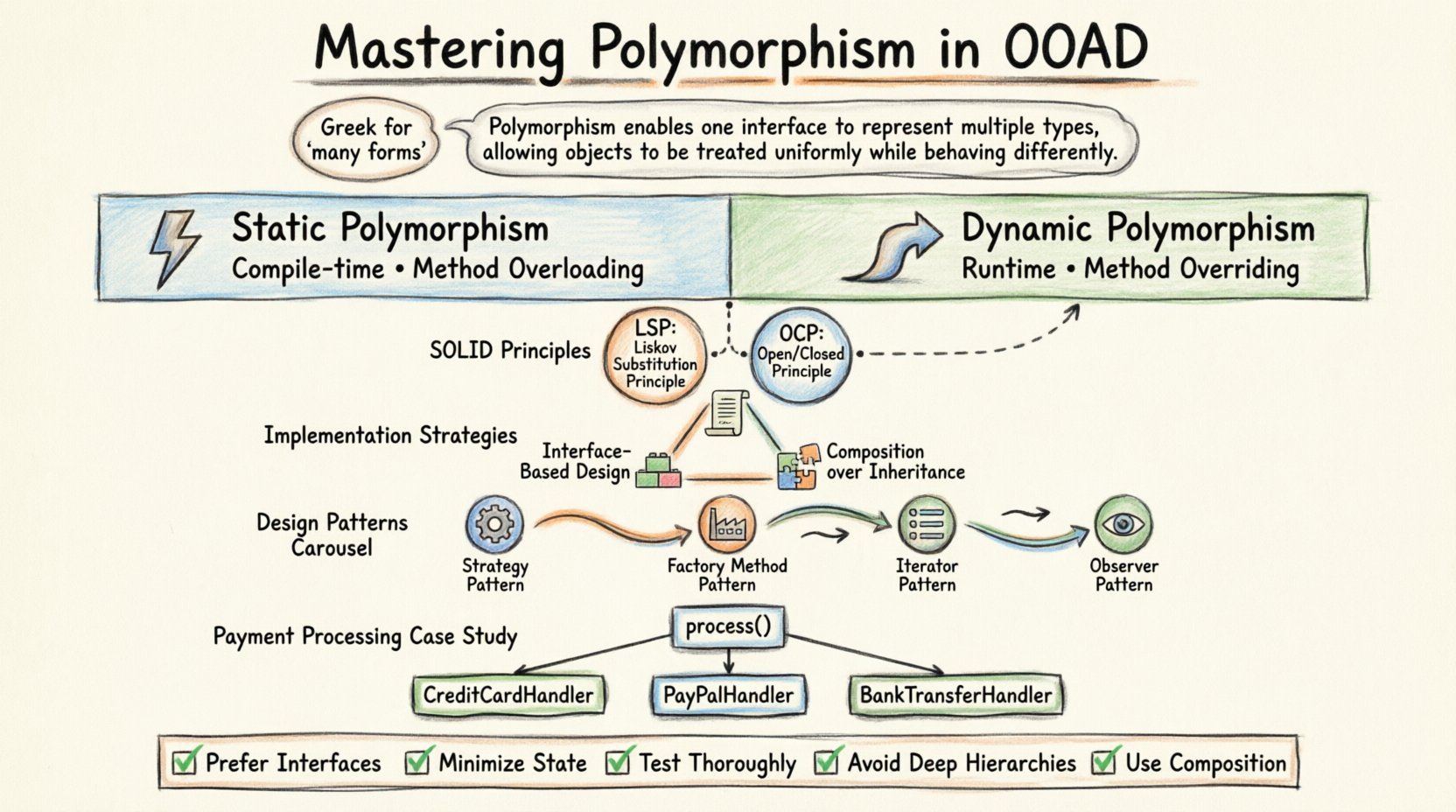
Polymorphism derives from Greek roots meaning “many forms.” In programming, it refers to the ability of different classes to respond to the same method call in distinct ways. This is not merely a syntactic feature; it is a design philosophy that dictates how components interact.
When analyzing a system, identifying opportunities for polymorphism helps decouple the invocation of behavior from the implementation of that behavior. This separation is critical for maintaining flexibility.
- Interface Abstraction: Defining contracts that multiple implementations must satisfy.
- Behavioral Flexibility: Allowing runtime decisions on which specific logic to execute.
- Code Reusability: Writing logic once that works across various data types.
Consider a scenario where a system processes payments. Without polymorphism, you might create specific methods like processCreditCard() and processPayPal(). With polymorphism, you define a single interface processPayment() that handles all types uniformly.
🔄 Types of Polymorphism
Understanding the distinction between compile-time and runtime polymorphism is essential for making informed architectural decisions. Each type serves different purposes and carries different trade-offs regarding performance and clarity.
1. Static (Compile-Time) Polymorphism
Static polymorphism is resolved before the program runs. It typically involves method overloading, where multiple methods share the same name but differ in parameter lists. The compiler determines which method to invoke based on the arguments provided.
- Use Case: Utility functions where behavior varies slightly based on input types.
- Performance: Generally faster due to direct binding.
- Risk: Can lead to code clutter if overused.
2. Dynamic (Runtime) Polymorphism
Dynamic polymorphism is resolved while the program executes. This is achieved through method overriding and inheritance. The decision of which method to call is deferred until runtime based on the actual object type.
- Use Case: Plugin architectures, strategy patterns, and user interface components.
- Performance: Slight overhead due to virtual function table lookups.
- Benefit: Maximum flexibility and extensibility.
📊 Comparison of Polymorphism Approaches
| Feature | Static Polymorphism | Dynamic Polymorphism |
|---|---|---|
| Resolution Time | Compile Time | Runtime |
| Mechanism | Overloading, Templates | Overriding, Interfaces |
| Flexibility | Low (Fixed at build) | High (Decided at run) |
| Performance | High (Direct Call) | Medium (Virtual Dispatch) |
| Extensibility | Requires Recompilation | Requires New Class Implementation |
🔗 Integration with SOLID Principles
Polymorphism is the backbone of several SOLID principles, specifically the Liskov Substitution Principle (LSP) and the Open/Closed Principle (OCP). Adhering to these guidelines ensures that polymorphic designs remain robust.
Liskov Substitution Principle (LSP)
Subtypes must be substitutable for their base types without altering the correctness of the program. If a class B inherits from class A, any code using A should work seamlessly with B. Violating LSP often leads to fragile polymorphic hierarchies where adding a new subclass breaks existing functionality.
Open/Closed Principle (OCP)
Software entities should be open for extension but closed for modification. Polymorphism enables extension by allowing new classes to implement existing interfaces without changing the code that utilizes them. This reduces regression risks significantly.
🛠️ Implementation Strategies
There are multiple ways to implement polymorphism in code. Choosing the right strategy depends on the complexity of the domain and the stability of the requirements.
1. Interface-Based Design
Interfaces define a contract without implementation details. They are ideal for systems where behavior needs to be interchangeable. This approach promotes loose coupling.
- Define a clear set of methods.
- Ensure implementations are consistent.
- Use dependency injection to pass concrete implementations.
2. Abstract Classes
Abstract classes provide a middle ground between interfaces and concrete classes. They can offer default implementations and shared state. This is useful when multiple subclasses share common code but require specific variations.
- Encapsulate common logic.
- Prevent instantiation of base classes.
- Allow partial implementation reuse.
3. Composition over Inheritance
While inheritance is a form of polymorphism, composition often provides better flexibility. By composing objects of different types, you can achieve polymorphic behavior without the rigid hierarchy of inheritance.
- Inject behaviors as objects.
- Swap behaviors at runtime.
- Avoid deep inheritance trees.
🧱 Design Patterns Leveraging Polymorphism
Certain design patterns rely heavily on polymorphic behavior to solve recurring architectural problems. Understanding these patterns helps in recognizing when to apply polymorphism.
- Strategy Pattern: Defines a family of algorithms, encapsulates each one, and makes them interchangeable. The client selects the strategy at runtime.
- Factory Method: Creates objects without specifying the exact class. The subclass decides which class to instantiate.
- Iterator Pattern: Provides a way to access elements sequentially without exposing underlying representation.
- Observer Pattern: Allows objects to subscribe to events. When an event occurs, all observers react polymorphically.
🧪 Testing and Verification Strategies
Polymorphic code introduces specific challenges for testing. Because behavior is determined at runtime, static analysis alone is insufficient. You must verify that all concrete implementations adhere to the expected contract.
Unit Testing Polymorphism
- Test the Interface: Write tests against the interface or abstract class to ensure common behavior holds.
- Test Subclasses Individually: Verify that specific implementations handle edge cases unique to them.
- Mock Dependencies: Use mocks to simulate polymorphic dependencies during testing.
Integration Testing
Integration tests ensure that different polymorphic components work together correctly. This is where Liskov Substitution violations often surface. You must test the system with various concrete implementations to ensure stability.
⚠️ Common Pitfalls to Avoid
While powerful, polymorphism can introduce complexity if misused. Recognizing anti-patterns helps maintain a clean architecture.
- Over-Abstraction: Creating interfaces that are too broad or too narrow. Interfaces should reflect the needs of the client, not just the structure of the implementation.
- Deep Inheritance Trees: Deep hierarchies make it difficult to trace behavior changes. Favor composition or flat hierarchies where possible.
- Type Checking: Avoid using explicit type checks (
if (type == X)) to determine behavior. This bypasses the polymorphic mechanism entirely. - Breaking Encapsulation: Ensure that protected members in base classes are not accessed directly by subclasses in a way that exposes internal state.
📈 Impact on Maintenance and Evolution
The long-term value of polymorphism lies in its impact on maintenance. Systems designed with strong polymorphic principles are easier to evolve.
- New Features: Adding a new feature often requires creating a new class rather than modifying existing code.
- Refactoring: Changing the internal logic of a class does not affect the code that uses it, provided the interface remains stable.
- Team Collaboration: Different teams can work on different implementations of an interface without stepping on each other’s toes.
🔍 Case Study: Payment Processing
To illustrate these concepts, consider a payment processing system. The core requirement is to process transactions. Different payment methods require different logic.
Without Polymorphism:
- You write specific methods for every payment type.
- Adding a new payment method requires modifying the main processor class.
- Code duplication increases as new types are added.
With Polymorphism:
- Define a
PaymentProcessorinterface with aprocess()method. - Implement
CreditCardProcessor,BankTransferProcessor, etc. - The main system calls
process()on anyPaymentProcessorinstance. - Adding a new method requires only a new class implementation.
🌐 Language Specific Considerations
Different programming languages implement polymorphism differently. Understanding these nuances is crucial for cross-platform development.
- Java: Uses interfaces and abstract classes. Does not support multiple inheritance of state.
- C++: Uses virtual functions. Supports multiple inheritance but requires careful management of virtual destructors.
- Python: Duck typing allows polymorphism without explicit inheritance or interfaces.
- JavaScript: Prototypal inheritance and interfaces via type checking.
🚀 Optimizing for Performance
Dynamic dispatch has a cost. In high-performance systems, this overhead can be significant.
- Virtual Call Overhead: Indirect calls are slower than direct calls.
- Inlining: Compilers may struggle to inline virtual functions.
- Memory Access: Virtual function tables can cause cache misses.
To mitigate this, consider using static polymorphism (templates) for performance-critical paths, or ensure that polymorphic calls are not in tight loops.
📝 Best Practices Checklist
- ✅ Prefer Interfaces: Use interfaces to define behavior contracts.
- ✅ Minimize State: Keep base classes stateless when possible.
- ✅ Test Thoroughly: Verify all implementations of an interface.
- ✅ Document Contracts: Clearly define expectations for subclasses.
- ✅ Avoid Deep Hierarchies: Keep inheritance depth shallow.
- ✅ Use Composition: Favor composition over inheritance for flexibility.
🔮 Future Considerations
As software systems grow in complexity, the role of polymorphism evolves. New language features like structural typing and protocol-oriented programming are changing how we think about interfaces. These trends emphasize behavior over class hierarchy, offering new ways to achieve polymorphism with less boilerplate.
Staying updated with these developments ensures that architectures remain modern and adaptable. The core principle remains the same: decouple the invocation of behavior from the implementation.
🔑 Key Takeaways
- Polymorphism enables flexible, scalable software architectures.
- Dynamic polymorphism supports runtime extensibility.
- SOLID principles guide the correct application of polymorphism.
- Design patterns like Strategy and Factory rely on polymorphic behavior.
- Testing strategies must account for runtime behavior resolution.
- Performance trade-offs exist and must be managed.
Mastering these concepts allows architects to build systems that withstand change. By focusing on interfaces and clear contracts, teams can ensure that their software remains robust over time. The goal is not just to write code that works today, but to design a system that adapts to tomorrow’s requirements with minimal effort.
Related posts:
 Real-World Case Study: How to Apply Object-Oriented Analysis and Design to a Complex E-commerce App
 Component Breakdown of Object-Oriented Analysis and Design: How to Model Real Entities into Classes
 Object-Oriented Analysis and Design in Action: Transforming Abstract Ideas into Working Software Modules
 Object-Oriented Analysis and Design Essentials: Building a Strong Foundation for Any Programming Language