


📚 Introduction to Object-Oriented Analysis and Design
In the landscape of software architecture, maintaining clarity and scalability is paramount. Object-Oriented Analysis and Design (OOAD) provides a framework for breaking down complex systems into manageable, interacting components. At the heart of this methodology lies the concept of Inheritance. This mechanism allows developers to create new classes based on existing ones, fostering a hierarchical structure that mirrors real-world relationships.
When implemented correctly, inheritance streamlines the development process. It reduces redundancy and ensures that core logic remains consistent across different parts of a system. However, applying this concept without a solid analytical foundation can lead to rigid structures that are difficult to modify. This guide explores the mechanics of inheritance within OOAD, examining how it shapes code structure and influences long-term maintainability.
🔍 Core Concepts of Inheritance
To grasp the utility of inheritance, one must first understand the relationship between classes. In object-oriented programming, a class defines the blueprint for objects. Inheritance introduces a parent-child relationship where the child class acquires the attributes and behaviors of the parent.
🌳 The Class Hierarchy
A class hierarchy is a tree-like structure where classes are arranged by their relationships. The top of the tree typically contains a general or abstract class, often referred to as a superclass or base class. Classes below it are subclasses or derived classes.
- Superclass: Defines common properties and methods shared by a group of related objects.
- Subclass: Inherits from the superclass but may also define unique properties or override existing methods.
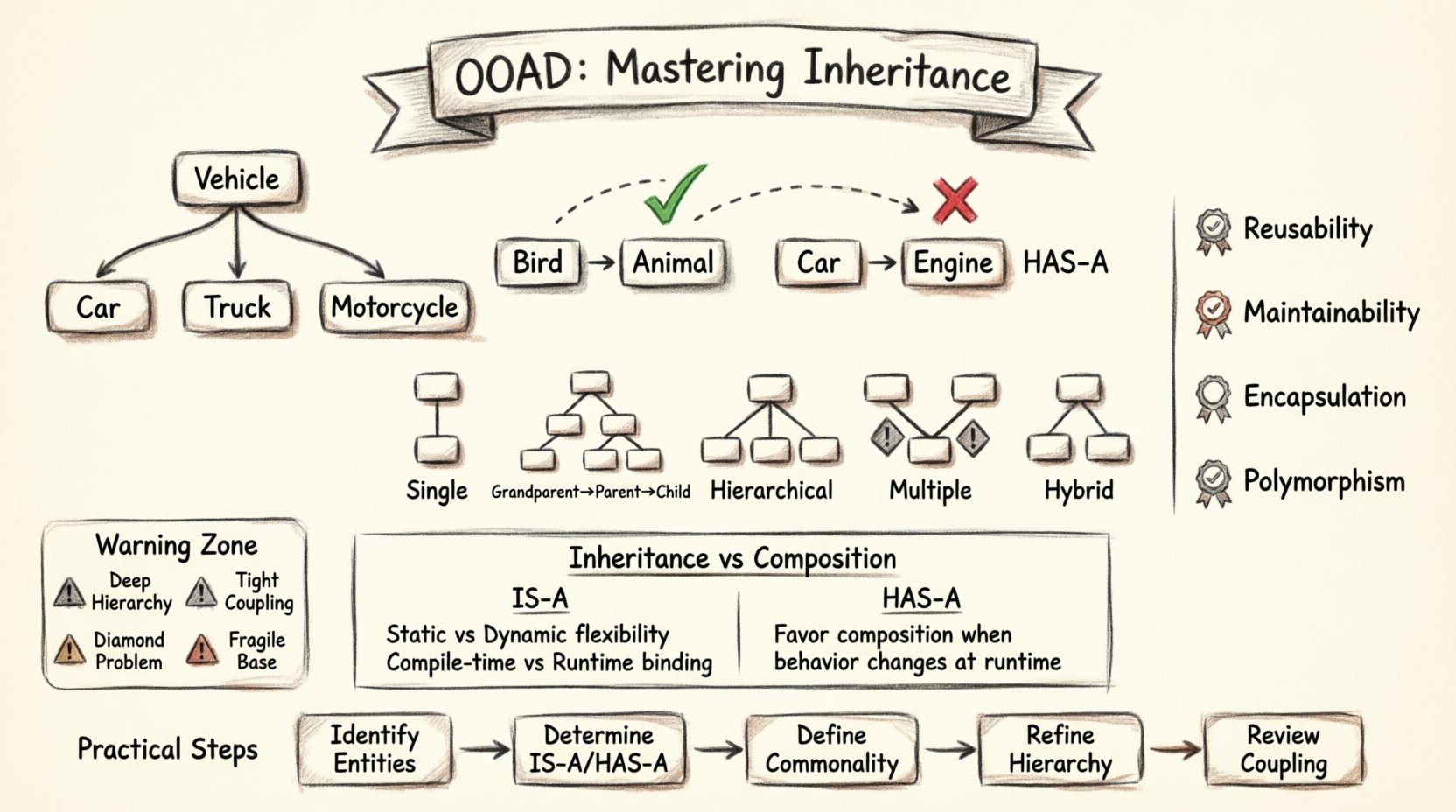
This hierarchy allows for logical grouping. For instance, a generic Vehicle class might define properties like speed and fuel_type. Specific vehicles like Car or Truck inherit these traits while adding specific features like number_of_doors.
🔗 The IS-A Relationship
Inheritance fundamentally represents an IS-A relationship. If a Car class inherits from a Vehicle class, then a Car IS-A Vehicle. This semantic link is crucial for polymorphism, allowing objects to be treated as instances of their parent type.
- True Positive: A Bird IS-A Animal. (Valid Inheritance)
- False Positive: A Car IS-A Engine. (Invalid Inheritance – A Car HAS-A Engine)
Recognizing this distinction prevents structural errors. Composition (HAS-A) should be used when the relationship is not one of type, but of ownership or association.
🏗️ Types of Inheritance Models
Different architectural needs require different inheritance patterns. Understanding the available models helps in selecting the right approach for a specific project scope.
1️⃣ Single Inheritance
This is the simplest form where a subclass inherits from exactly one superclass. It creates a clear, linear hierarchy.
- Pros: Easy to understand, minimal complexity, reduced risk of conflict.
- Cons: Limited flexibility, may require multiple base classes to cover all needs.
2️⃣ Multilevel Inheritance
Here, a class inherits from a class that itself inherits from another. It creates a chain of dependency.
- Structure: Grandparent → Parent → Child.
- Use Case: Useful for progressive specialization where each level adds specific constraints.
3️⃣ Hierarchical Inheritance
Multiple subclasses inherit from a single superclass. This is common in taxonomy-based systems.
- Example: A base class Shape having subclasses Circle, Square, and Triangle.
- Benefit: Centralizes common logic in the base class.
4️⃣ Multiple Inheritance
A class inherits from more than one superclass. While powerful, this introduces significant complexity regarding method resolution.
- Complexity: Requires careful handling of name collisions.
- Language Support: Not all languages support this natively due to the Diamond Problem.
5️⃣ Hybrid Inheritance
A combination of two or more types of inheritance. This model attempts to balance the benefits of multiple inheritance with the clarity of hierarchical structures.
💡 Strategic Benefits for Architecture
Why invest the effort in designing inheritance hierarchies? The advantages extend beyond simple code repetition.
♻️ Code Reusability
The primary driver is reusability. By defining logic in a superclass, that logic is available to all subclasses without rewriting. This reduces the lines of code and minimizes the surface area for bugs.
🛠️ Maintainability
When a change is required in common behavior, updating the superclass propagates the change to all subclasses. This centralization makes maintenance predictable.
🔒 Encapsulation and Abstraction
Inheritance supports abstraction by hiding implementation details of the parent class. Subclasses interact with the public interface of the parent, ensuring internal data remains protected.
🧩 Polymorphism Foundation
Polymorphism relies on inheritance. It allows a single interface to represent different underlying forms (data types). This is essential for flexible system design where different objects can be processed uniformly.
⚠️ Risks and Anti-Patterns
While inheritance is powerful, misuse can degrade system quality. Understanding these pitfalls is as important as understanding the benefits.
🚫 Over-Inheritance
Creating deep hierarchies (more than 3-4 levels) makes the system fragile. Changes in a base class can have unintended cascading effects throughout the entire tree.
🔗 Tight Coupling
Subclasses become tightly coupled to their parents. If the parent class changes its internal implementation, the child class may break even if the public interface remains the same.
🐍 The Diamond Problem
In multiple inheritance, if a class inherits from two classes that both inherit from a common ancestor, ambiguity arises regarding which ancestor’s method to call. Resolving this requires specific language features or design patterns.
🧱 Fragile Base Class
A base class that is too complex or changes frequently becomes a bottleneck. Subclasses depend on the stability of this base. If the base shifts, the entire hierarchy suffers.
📊 Inheritance vs. Composition
A critical decision in OOAD is choosing between inheritance and composition. Composition is often preferred for flexibility.
| Feature | Inheritance | Composition |
|---|---|---|
| Relationship | IS-A | HAS-A |
| Flexibility | Low (Static at compile time) | High (Dynamic at runtime) |
| Encapsulation | Lower (Protected members often exposed) | Higher (Internal details hidden) |
| Reusability | High for behavior, Low for state | High for both state and behavior |
| Complexity | Increases with depth | Increases with object count |
Guideline: Use inheritance when the relationship is strictly IS-A. Use composition when the relationship is HAS-A or when behavior needs to change dynamically.
🛠️ Implementation Guidelines
Following established principles ensures the inheritance structure remains robust.
1. The Liskov Substitution Principle (LSP)
Subtypes must be substitutable for their base types. If a program is designed to use a Vehicle object, replacing it with a Car object should not break the system. This principle prevents subclasses from violating the contract of the superclass.
2. Interface Segregation
Many small, specific interfaces are better than one large, general interface. Subclasses should not be forced to implement methods they do not use. This reduces bloat and confusion.
3. Favor Composition Over Inheritance
As noted earlier, deep hierarchies are often a code smell. If a class needs behavior from multiple sources, consider composing objects rather than inheriting from multiple classes.
4. Abstract Base Classes
Use abstract classes to define a contract that subclasses must fulfill. This ensures consistency across the hierarchy without implementing concrete logic for every possible scenario.
5. Avoid Public Protected Members
Minimize the use of protected members in the superclass. This forces subclasses to interact through well-defined public methods, preserving encapsulation.
📝 Practical Analysis Steps
Applying this theory requires a structured approach during the analysis and design phases.
- Identify Entities: List the nouns in the problem domain. Which ones are related?
- Determine Relationships: Are they IS-A or HAS-A? Draw a diagram to visualize.
- Define Commonality: What attributes and methods are truly shared?
- Refine Hierarchy: Limit the depth. Ask if a subclass needs to be a direct child of the base or if an intermediate layer is needed.
- Review for Coupling: Check if changes in the base will ripple too widely.
🚀 Moving Forward with Structure
Effective code structure is the backbone of sustainable software. Inheritance, when understood and applied with discipline, offers a powerful tool for organizing logic. It allows systems to evolve as requirements change, provided the foundational relationships remain sound.
Developers must remain vigilant against the temptation to force inheritance where it does not fit. The goal is not to maximize the use of inheritance, but to minimize complexity while maximizing clarity. By balancing inheritance with composition and adhering to design principles, architects can build systems that are robust, scalable, and easier to maintain over time.
Ultimately, the choice of structure defines the lifespan of the software. A well-considered hierarchy reduces technical debt. A haphazard one creates it. Careful analysis at the design phase pays dividends during the development and maintenance phases.
Related posts:
 Object-Oriented Analysis and Design Quick Start: From Concept to Class Diagram in One Day
 Future Outlook of Object-Oriented Analysis and Design: How Modern Trends Are Shaping the Classic Method
 Avoiding the “God Class” Trap: Key Object-Oriented Analysis and Design Principles for Clean Code
 The Role of Object-Oriented Analysis and Design in Agile Teams: Balancing Speed and Structure