


Entering the world of software engineering often feels like stepping into a dense forest with no map. Among the many paths, Object-Oriented Analysis and Design (OOAD) stands out as a well-trodden route, yet it is surrounded by significant confusion. Many new developers approach OOAD with a mix of curiosity and apprehension, often influenced by exaggerated claims about its necessity and complexity. This guide aims to cut through the noise. We will examine the actual mechanics of OOAD, distinguish fact from fiction, and provide a grounded perspective for those building their first robust systems.
🏗️ Understanding the Foundation
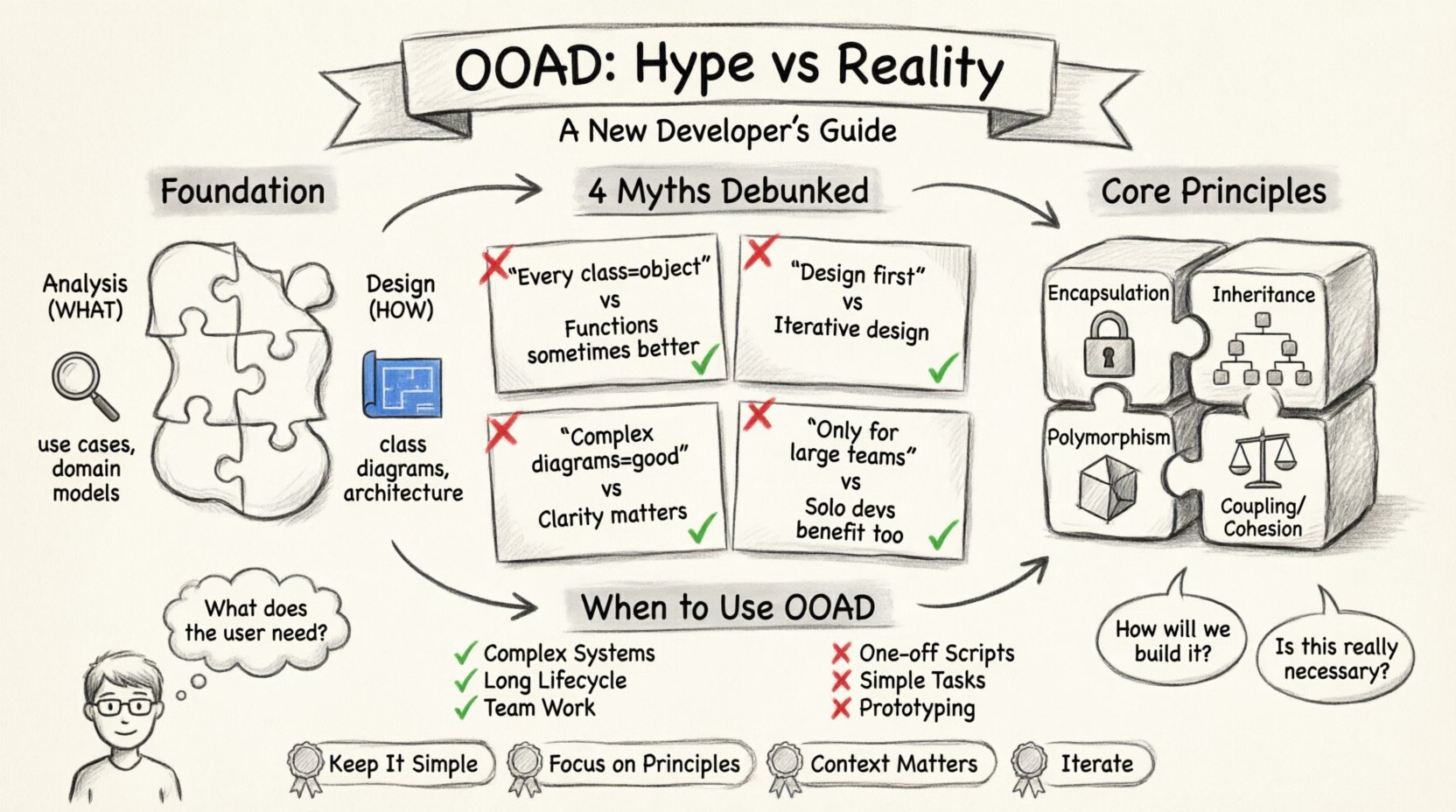
Before debunking myths, it is essential to define what we are discussing. Object-Oriented Analysis and Design is a process used to model and construct software systems. It focuses on identifying objects, their attributes, and behaviors. The goal is to create a structure that mirrors the problem domain as closely as possible.
This approach is not merely about writing code. It is about thinking. It involves breaking down complex requirements into manageable components. When done correctly, the resulting system is easier to maintain, extend, and understand. However, this benefit is not automatic. It requires discipline and a clear understanding of the principles involved.
For a new developer, the jump from writing scripts to designing systems can be daunting. The terminology alone—encapsulation, inheritance, polymorphism—can seem intimidating. Yet, these are not magical incantations. They are practical tools for organizing logic. The reality is that OOAD is a framework for managing complexity, not a requirement for every single line of code written.
🕵️♂️ The Big Four OOAD Myths
Several persistent beliefs circulate within the developer community regarding this discipline. These misconceptions often lead to wasted effort or unnecessary frustration. Let us look at the most common claims and contrast them with practical reality.
| Myth | Reality |
|---|---|
| Every class must be an object. | Not every logical entity needs a class. Sometimes a function or a simple data structure is more appropriate. |
| Design must be finished before coding starts. | Design is iterative. It evolves alongside the code through refactoring and feedback. |
| Complex diagrams equal good design. | Clarity is key. A messy diagram does not mean a messy system, but a clear diagram helps communication. |
| OOAD is only for large teams. | Solo developers benefit from structure just as much as large teams to prevent technical debt. |
Understanding these distinctions helps in applying the right amount of rigor to a project. Over-engineering a small script is a common error. Under-engineering a large platform is another. The balance lies in understanding the scale and lifespan of the software.
🧐 Analysis vs. Design: Where the Confusion Lies
A frequent source of misunderstanding is the distinction between Analysis and Design. While they are often grouped together, they serve different purposes in the development lifecycle.
📋 The Analysis Phase
Analysis is concerned with what the system needs to do. It is independent of technology. During this phase, you gather requirements and model the domain. You identify the nouns (entities) and verbs (actions) within the problem space.
- Goal: Define the problem scope accurately.
- Output: Use cases, domain models, and requirement specifications.
- Key Question: “What does the user need?”
For example, if you are building a library system, analysis involves identifying books, members, and loans. It does not decide whether the book is stored in a database or a text file. That decision belongs to the design phase.
🛠️ The Design Phase
Design shifts the focus to how the system will achieve those goals. This is where technology choices, architecture, and implementation details come into play. You translate the analysis models into a technical blueprint.
- Goal: Create a blueprint for implementation.
- Output: Class diagrams, sequence diagrams, and interface definitions.
- Key Question: “How will we build it?”
Continuing the library example, design decides how the “Book” class interacts with the “Database” class. It determines how data is persisted and retrieved. It is the bridge between abstract requirements and concrete code.
🧱 Core Principles Without the Fluff
There are foundational concepts that underpin successful object-oriented work. You do not need to memorize every acronym, but understanding the intent behind these principles is vital.
1. Encapsulation
Encapsulation is about hiding internal details. It means an object controls access to its own data. This prevents external code from relying on internal implementation details that might change. By restricting access, you protect the integrity of the object.
- Benefit: Reduces unintended side effects.
- Practice: Use private fields and public methods to interact with data.
2. Inheritance
Inheritance allows a class to derive properties and behaviors from another class. This promotes code reuse. However, it is often overused. Deep inheritance hierarchies can become fragile and difficult to understand.
- Benefit: Reduces duplication of common logic.
- Practice: Use inheritance only when there is a clear “is-a” relationship. Prefer composition when possible.
3. Polymorphism
Polymorphism allows objects to be treated as instances of their parent class rather than their actual class. This enables flexibility in how code interacts with different types. It allows you to write generic code that works with specific implementations.
- Benefit: Increases flexibility and reduces coupling.
- Practice: Define interfaces or abstract classes that specific implementations adhere to.
4. Coupling and Cohesion
These two concepts are the heartbeat of good design. Coupling refers to how dependent one module is on another. Low coupling is desirable. Cohesion refers to how closely related the responsibilities of a single module are. High cohesion is desirable.
Imagine a module that handles user login, sends emails, updates the database, and logs errors. This is high coupling and low cohesion. It is hard to change the email service without breaking the login logic. A better design separates these concerns into distinct modules.
🚧 Common Pitfalls for Beginners
Even with good intentions, mistakes happen. Recognizing these pitfalls early can save hours of debugging and refactoring later.
🔧 Over-Engineering
It is tempting to build a system that can handle every possible future scenario. This leads to complex structures that are difficult to use for the current requirements. The KISS principle (Keep It Simple, Stupid) often applies here. Build for the problem at hand, not the hypothetical one.
🗺️ Ignoring Requirements
Designing without a clear understanding of requirements leads to a system that solves the wrong problem. Analysis is not optional. Skipping the analysis phase to start coding immediately often results in a system that requires a complete rewrite once the true needs are understood.
🧩 Premature Optimization
Optimizing for performance before the system is functional is a common trap. Focus on correctness and clarity first. Performance tuning comes later, once the bottlenecks are identified. Design for readability and maintainability first.
📐 Diagram Overload
Creating massive diagrams that no one reads is a waste of time. Diagrams are communication tools, not artifacts for compliance. Keep them simple and up-to-date. If a diagram is not used to discuss the system, it is likely not adding value.
⚖️ When OOAD Fits and When It Doesn’t
Object-Oriented Analysis and Design is a powerful tool, but it is not a silver bullet. There are scenarios where it fits perfectly and others where it adds unnecessary overhead.
✅ When to Use OOAD
- Complex Systems: When the domain has many interacting entities and rules.
- Long Lifecycle: When the software is expected to evolve over several years.
- Team Collaboration: When multiple developers need to work on different parts of the system simultaneously.
- High Maintainability Needs: When the code must be easily understood and modified by others.
❌ When to Consider Alternatives
- One-Off Scripts: For a quick data processing task, a script might be faster.
- Simple Data Processing: If the logic is linear and stateless, functional approaches might be cleaner.
- Prototyping: When speed is the only priority and the code will be discarded.
The key is to assess the context. Do not apply heavy design patterns to a simple command-line tool. Conversely, do not treat a banking application like a throwaway script. Match the approach to the scale of the challenge.
🚀 Moving Forward with Confidence
Learning to think in objects takes time. It is not a switch you flip overnight. It involves practice, review, and reflection on past projects. As you gain experience, you will develop an intuition for when to create a new class and when to reuse an existing one.
Focus on the principles rather than the rules. Principles like low coupling and high cohesion are timeless. Specific patterns may change as technology evolves. Understanding the why behind a design decision is more valuable than knowing the what.
Remember that the goal of design is to reduce cognitive load. Whether for yourself or your team, a well-structured system should be easy to navigate. If you find yourself constantly fighting the code, it is likely time to revisit the design.
Start small. Model a small part of your domain. Refactor it. See how the changes affect the rest of the system. This iterative process builds the muscle memory needed for larger projects. There is no rush to adopt every pattern immediately. Steady progress is better than rushed complexity.
By separating the hype from the reality, you can approach Object-Oriented Analysis and Design with a clear head. Use it as a tool to solve problems, not as a requirement to prove your knowledge. This mindset shift is often the first step toward becoming a proficient software engineer.
📝 Summary of Key Takeaways
- OOAD is a process: It involves both analysis (what) and design (how).
- Keep it simple: Avoid over-engineering and premature optimization.
- Focus on principles: Encapsulation, inheritance, polymorphism, and cohesion are the core pillars.
- Context matters: Apply OOAD where it adds value, not everywhere.
- Iterate: Design evolves with the code.
Armed with this knowledge, you are ready to tackle your next project with a balanced perspective. The path to expertise is long, but the destination—a maintainable, robust system—is well worth the effort.
Related posts:
 Object-Oriented Analysis and Design Quick Start: From Concept to Class Diagram in One Day
 Future Outlook of Object-Oriented Analysis and Design: How Modern Trends Are Shaping the Classic Method
 Avoiding the “God Class” Trap: Key Object-Oriented Analysis and Design Principles for Clean Code
 The Role of Object-Oriented Analysis and Design in Agile Teams: Balancing Speed and Structure