


Building a scalable online retail platform requires more than just writing functional code. It demands a structured approach to software architecture that can withstand growth, changing business rules, and complex user interactions. Object-Oriented Analysis and Design (OOAD) provides the framework for this. By modeling the system as a collection of interacting objects, developers can create maintainable, flexible, and robust applications. This guide details the practical application of OOAD principles within a complex e-commerce context.
When approaching a large-scale project, the initial phase involves understanding the problem space without getting bogged down in implementation details. The goal is to identify the core entities, their behaviors, and the relationships between them. This process ensures that the final software aligns with business requirements while adhering to software engineering best practices.
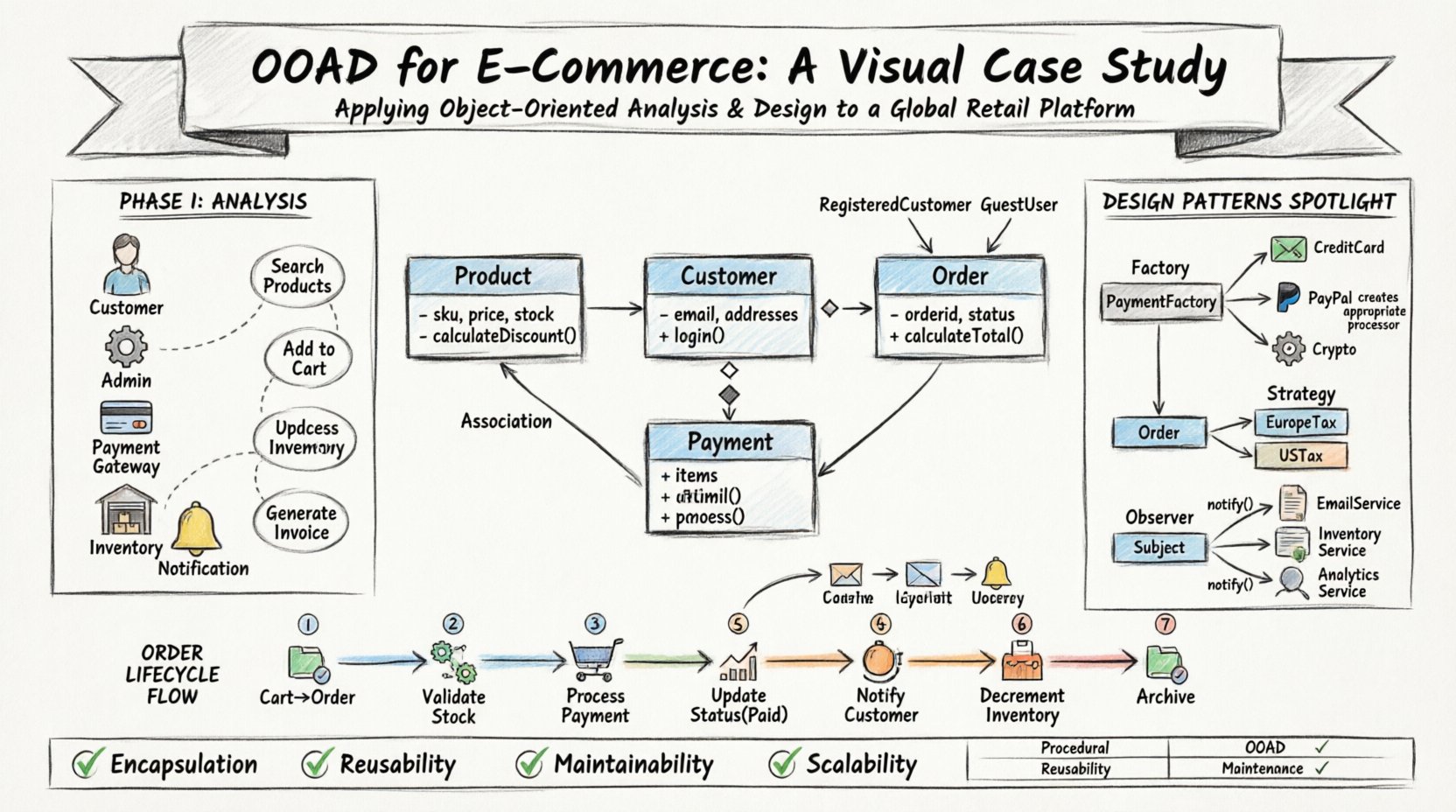
📋 The Scenario: A Global Retail Platform
Imagine a company launching a new e-commerce storefront intended for international markets. The system must handle multiple currencies, diverse product catalogs, complex inventory management, and secure payment processing. The requirements are not static; the business frequently adds new sales channels, such as mobile applications and third-party marketplaces.
In this environment, a procedural approach often leads to spaghetti code where business logic is scattered across different functions. OOAD addresses this by encapsulating data and behavior together. The following sections break down how to apply OOAD to this scenario.
🔍 Phase 1: Object-Oriented Analysis
Analysis focuses on defining what the system needs to do, not how it will do it. This phase relies heavily on identifying actors and use cases.
1. Identifying Actors
Actors represent roles that interact with the system. In an e-commerce context, these typically include:
- Customer: Browses products, manages a shopping cart, and completes purchases.
- Admin: Manages product listings, inventory levels, and user accounts.
- Payment Gateway: An external entity responsible for processing financial transactions securely.
- Inventory System: Tracks stock levels across multiple warehouses.
- Notification Service: Sends emails or SMS regarding order status.
2. Defining Use Cases
Use cases describe specific interactions between actors and the system. A comprehensive list ensures no functionality is overlooked. Key use cases for this platform include:
- Search for Products: Users filter results by category, price, and availability.
- Add to Cart: Items are placed in a temporary holding area before checkout.
- Process Payment: Validates card details and charges the user.
- Update Inventory: Reduces stock count upon successful order completion.
- Generate Invoice: Creates a receipt for the customer.
During this stage, the focus remains on capturing requirements. Diagrams such as Use Case Diagrams help visualize these interactions. The analysis phase ensures that the design team understands the boundaries of the system and the expectations of the users.
🏗️ Phase 2: Object-Oriented Design
Design translates the requirements from the analysis phase into a blueprint for the code. This involves identifying classes, defining their attributes and methods, and establishing relationships. The core principles guiding this phase are Encapsulation, Abstraction, Inheritance, and Polymorphism.
1. Identifying Classes and Objects
Classes are blueprints for objects. In the e-commerce scenario, the following core classes emerge from the analysis:
- Product: Represents an item available for sale.
- Customer: Represents a registered user.
- Order: Represents a transaction initiated by a customer.
- Cart: Represents the collection of items selected for purchase.
- Payment: Represents the financial transaction details.
- ShippingAddress: Represents the delivery location.
2. Defining Attributes and Methods
Each class must encapsulate the data relevant to its domain and expose methods to manipulate that data.
Class: Product
- Attributes: productId, sku, name, description, price, stockQuantity, category, images.
- Methods: calculateDiscount(), updateStock(), validateAvailability().
Class: Order
- Attributes: orderId, orderDate, totalAmount, status, customerReference, itemsList.
- Methods: calculateTotal(), addTax(), processRefund(), updateStatus().
Class: Customer
- Attributes: customerId, email, passwordHash, shippingAddresses, orderHistory.
- Methods: register(), login(), addAddress(), viewOrderHistory().
3. Establishing Relationships
Understanding how classes interact is critical. OOAD distinguishes between different types of relationships:
- Association: A general link between two classes. For example, a
Customeris associated with multipleOrders. - Aggregation: A “has-a” relationship where the child can exist independently of the parent. A
CartcontainsProducts, but if the cart is deleted, the products still exist in the database. - Composition: A stronger “has-a” relationship where the child depends on the parent. An
Orderis composed ofOrderItems. If theOrderis cancelled, theOrderItemsspecific to that order instance are no longer valid. - Inheritance: A class acquires properties and behaviors from a parent class.
RegisteredCustomerandGuestUsermight inherit from a baseUserclass.
🧩 Design Patterns in Action
Design patterns are proven solutions to recurring problems. Applying them in OOAD reduces coupling and increases flexibility. Here is how specific patterns apply to the e-commerce architecture.
1. Factory Pattern
When creating objects, the system often needs to decide which specific class to instantiate based on configuration. The Factory Pattern handles this logic.
- Scenario: Different payment methods require different processing logic (e.g., Credit Card vs. PayPal).
- Application: A
PaymentFactoryclass creates the appropriatePaymentobject. The rest of the system interacts with the factory, not the specific payment classes.
2. Strategy Pattern
This pattern defines a family of algorithms, encapsulates each one, and makes them interchangeable.
- Scenario: Tax calculation rules vary by region (e.g., VAT in Europe, Sales Tax in US).
- Application: Create a
TaxStrategyinterface. Implementations includeEuropeTaxStrategyandUSTaxStrategy. TheOrderclass selects the correct strategy based on the shipping address.
3. Observer Pattern
Defines a dependency between objects so that when one object changes state, all its dependents are notified.
- Scenario: When an order status changes to “Shipped,” multiple systems need to react.
- Application: The
Orderclass acts as the Subject. TheEmailService,InventoryService, andAnalyticsServiceact as Observers. WhenOrder.setStatus("Shipped")is called, all observers receive a notification and execute their specific logic.
📊 Mapping Business Logic to Code
To visualize the transition from requirements to code, consider the following table mapping business rules to class structures.
| Business Rule | Analysis Concept | Design Implementation | Pattern Used |
|---|---|---|---|
| Customers can have multiple shipping addresses. | Association | Customer class holds a list of ShippingAddress objects. |
Composition |
| Tax rates vary by location. | Algorithm Variation | Order delegates tax calculation to a specific strategy object. |
Strategy |
| Discounts can be applied based on promotion codes. | Behavior Modification | Cart checks for valid PromotionCode objects before finalizing total. |
Decorator |
| Payment methods differ in processing logic. | Object Creation | PaymentFactory instantiates the correct payment processor. |
Factory |
| Order updates must notify external systems. | State Change | Order notifies registered Observer services. |
Observer |
🔒 Encapsulation and Data Integrity
One of the primary benefits of OOAD is encapsulation. This principle restricts direct access to some of an object’s components, which is essential for data integrity.
- Private Attributes: Sensitive data like credit card numbers or password hashes should be private. They cannot be accessed directly from outside the class.
- Public Methods: Interaction with private data must occur through public methods. For example, a
Customerclass might have asetPassword()method that hashes the input before storing it. - Validation: Logic that ensures data validity resides within the class methods. A
Productclass ensures thatpriceis never negative before saving.
This approach prevents external code from putting the system into an invalid state. If a developer modifies the internal logic of the Order class, the external code interacting with it does not need to change, provided the public interface remains consistent.
🔄 Maintenance and Extensibility
Software is rarely finished. It evolves. A well-designed OOAD system makes evolution easier. Consider the following maintenance scenarios.
1. Adding a New Product Type
If the business decides to sell digital downloads alongside physical goods, the existing Product class might need adjustment.
- Inheritance: Create a
PhysicalProductand aDigitalProductclass that inherit from a baseProductclass. - Polymorphism: Methods like
calculateShipping()can be overridden.PhysicalProductcalculates weight-based shipping, whileDigitalProductreturns zero.
2. Changing the Payment Gateway
If the company switches from one payment provider to another, the internal logic of the Payment class changes.
- Abstraction: Because the rest of the system interacts with an interface (e.g.,
IPaymentProcessor), the underlying implementation can be swapped without affecting theOrderclass.
3. Scaling the Inventory
As the catalog grows, performance becomes a concern.
- Caching: The
Productclass might integrate with a caching layer for frequently accessed data. - Database Design: The object model informs the database schema. A normalized design supports the relationships defined in the OOAD phase.
⚖️ Challenges and Considerations
While OOAD offers significant advantages, it is not without challenges. Understanding these helps in making informed architectural decisions.
1. Coupling vs. Cohesion
The goal is low coupling and high cohesion.
- High Cohesion: A class should have a single, well-defined responsibility. If a class handles both user authentication and order processing, it has low cohesion and should be split.
- Low Coupling: Classes should not depend heavily on the internal details of other classes. Use interfaces or abstract classes to define dependencies.
2. Object Overhead
In high-performance systems, creating millions of objects can impact memory usage. While rare in standard web applications, it is a consideration for real-time trading or gaming platforms. In e-commerce, the trade-off between flexibility and performance usually favors flexibility for business logic.
3. Complexity of Design
Over-engineering is a risk. Sometimes, a simple procedural script suffices for a small feature. OOAD is most beneficial for complex systems with many interacting components. Always assess the complexity before introducing heavy design patterns.
📈 Comparison: OOAD vs. Procedural Approaches
To clarify the value proposition, compare the two approaches in the context of e-commerce.
| Feature | Procedural Approach | Object-Oriented Approach |
|---|---|---|
| Data Handling | Data and functions are separate. | Data and functions are bundled in classes. |
| Reusability | Code reuse is difficult; often copy-paste. | Inheritance and composition promote reuse. |
| Maintenance | Changes can break unrelated functions. | Encapsulation isolates changes to specific classes. |
| Scalability | Becomes complex as system grows. | Structured hierarchy supports growth. |
| Modeling | Focuses on processes and data flow. | Focuses on real-world entities and behaviors. |
🛠️ Implementation Considerations
When moving from design to implementation, several technical decisions arise. These decisions do not change the OOAD principles but affect how they are realized.
- Language Selection: Choose a language that supports OOAD features natively, such as class definitions, interfaces, and abstract classes.
- Database Mapping: Use an Object-Relational Mapping (ORM) tool to bridge the gap between the object model and the relational database. This allows the code to interact with objects rather than raw SQL queries.
- Testing: Unit tests should focus on individual classes and their methods. Integration tests should verify the interactions between classes.
- Documentation: Use class diagrams and sequence diagrams to document the design. This ensures that future developers understand the architecture without needing to read every line of code.
🔍 Deep Dive: The Order Lifecycle
Let us trace the lifecycle of an Order object to see OOAD in action.
- Creation: The
Cartobject initiates the creation of anOrderobject. TheOrderconstructor accepts the items from the cart. - Validation: The
Orderobject validates the items. It checks if stock is still available and if prices have changed since the item was added. - Payment: The
Orderobject calls thePaymentobject’s processing method. It passes the total amount and payment details. - State Update: If payment succeeds, the
Orderstatus changes toPaid. This triggers the Observer pattern. - Notification: The
NotificationServicereceives the event and sends a confirmation email. - Inventory: The
InventoryServicereceives the event and decrements the stock count for the specificProductIDs. - Archiving: After a set period, the
Orderobject might be moved to an archive state for compliance, preserving the data without affecting active processing.
This lifecycle demonstrates how objects collaborate to achieve a business goal. Each object handles its own responsibilities, communicating through well-defined interfaces. If the notification service needs to change its email provider, the Order class does not need to know about the change. It simply triggers the event.
🚀 Future-Proofing the Architecture
Designing for the future is a key aspect of OOAD. Business requirements will shift. New sales channels will appear. The architecture must accommodate these changes.
- Interface Segregation: Ensure classes depend only on the interfaces they use. This prevents a change in one part of the system from breaking unrelated parts.
- Dependency Injection: Pass dependencies into objects rather than creating them internally. This makes testing easier and allows for swapping implementations without changing the core logic.
- Domain-Driven Design: Align the object model closely with the business domain. Use terminology that business stakeholders understand. This reduces the gap between requirements and code.
By adhering to these principles, the e-commerce platform remains adaptable. Whether adding a new currency, a new payment method, or a new user role, the core structure supports the expansion. The object-oriented model acts as a stable foundation upon which features can be built and modified with minimal risk.
Technical excellence is not just about writing code that works today. It is about creating a system that can evolve tomorrow. OOAD provides the tools to achieve this stability and flexibility, ensuring that the software remains a valuable asset for the business long after the initial launch.
Related posts:
 Myth-Busting Object-Oriented Analysis and Design: Separating Hype from Reality for New Developers
 Q&A: Answering Top Questions About Object-Oriented Analysis and Design for Career Growth
 Object-Oriented Analysis and Design for Mid-Level Developers: Moving Beyond Basic Syntax to Architecture
 The Hidden Value of Object-Oriented Analysis and Design: Why It Matters More Than Writing Code Fast