


Making the right architectural decision at the start of a software project is one of the most critical tasks a development team faces. The choice between Object-Oriented Analysis and Design (OOAD) and Procedural Programming dictates how data is organized, how logic flows, and how easily the system can adapt to future changes. 🧩
There is no single “correct” answer. The optimal path depends on the complexity of the domain, the expected lifespan of the software, the skillset of the team, and the specific constraints of the business environment. This guide explores the nuances of both paradigms to help you align your technical strategy with your project objectives.
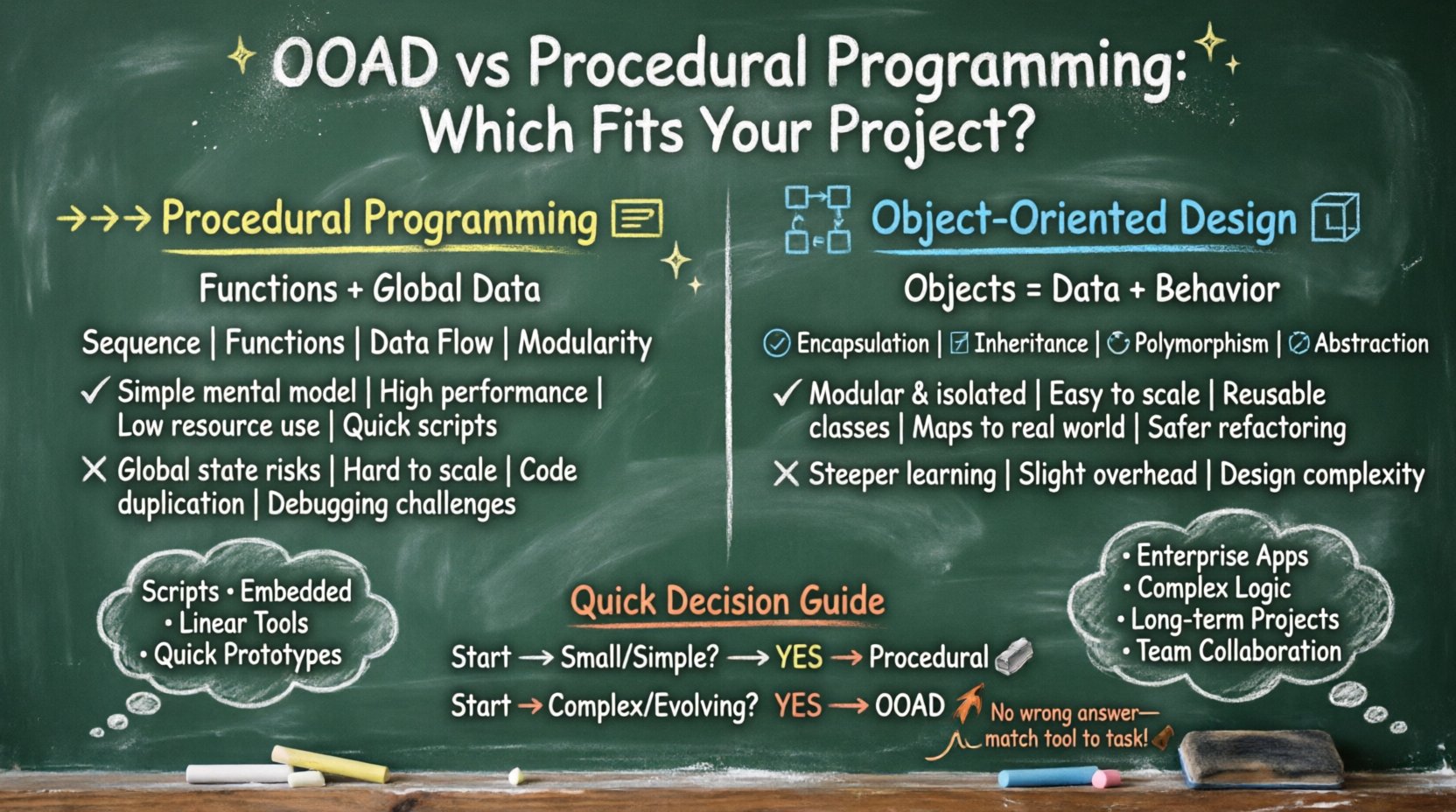
Understanding Procedural Programming 🧭
Procedural programming is one of the oldest and most foundational paradigms in software development. It centers on the concept of a sequence of actions, where the program is structured around functions or procedures that operate on data.
Core Principles
- Sequence: Instructions are executed in a linear order.
- Functions: Logic is encapsulated in reusable blocks of code (functions).
- Data Flow: Data is typically global or passed explicitly between functions.
- Modularity: The program is divided into manageable sections based on functionality.
Strengths of the Procedural Approach
For certain types of projects, this methodology offers distinct advantages:
- Simplicity: The mental model is straightforward. Developers can trace the flow of execution easily from top to bottom. 📝
- Performance: In scenarios requiring tight control over memory and execution speed, procedural code often has less overhead than object-oriented wrappers.
- Resource Efficiency: It is well-suited for embedded systems or scripts where resource consumption must be minimal.
- Rapid Prototyping: Small utilities or scripts can be built quickly without the need for complex class hierarchies.
Limitations to Consider
As systems grow, the procedural model can introduce friction:
- Data Exposure: Data is often global, making it susceptible to unintended modifications from various parts of the codebase.
- Scalability Issues: Adding new features often requires modifying existing functions, which increases the risk of introducing bugs into unrelated areas.
- Code Duplication: Without strict adherence to modular design, logic can become scattered and repeated across different procedures.
- Maintainability: Tracing the state of the system can become difficult as the number of global variables increases.
Deep Dive into Object-Oriented Analysis and Design 🧱
Object-Oriented Analysis and Design shifts the focus from “what the system does” to “what the system is made of.” It models the software as a collection of interacting objects, each containing both data (attributes) and behavior (methods).
Core Pillars of OOAD
- Encapsulation: Bundling data and methods together while restricting direct access to some of an object’s components. This protects internal state. 🛡️
- Inheritance: Allowing new classes to derive properties and behaviors from existing classes, promoting code reuse.
- Polymorphism: The ability for different objects to respond to the same message in different ways, allowing for flexible interfaces.
- Abstraction: Hiding complex implementation details and exposing only the necessary features to the user of the class.
Strengths of the OOAD Approach
This paradigm excels in complex, evolving environments:
- Modularity: Objects act as independent units. Changes to one object ideally do not impact others, provided interfaces remain stable.
- Scalability: It is easier to add new features by creating new classes rather than modifying existing logic extensively. 📈
- Maintainability: Encapsulation ensures that data integrity is maintained. Bugs are often easier to isolate within specific classes.
- Reusability: Well-designed classes can be reused across different projects or modules within the same project.
- Mapping to Real World: The model often mirrors real-world entities, making it easier for stakeholders to understand the system structure.
Complexity and Overhead
While powerful, OOAD is not without its costs:
- Steep Learning Curve: Developers need to understand design patterns and object relationships to use the paradigm effectively.
- Performance Overhead: Indirection through objects and dynamic dispatch can sometimes introduce latency compared to direct function calls.
- Design Rigidity: Poorly designed inheritance hierarchies can lead to tightly coupled systems that are hard to change.
Key Differences at a Glance 📊
To visualize the distinctions, consider the following comparison table.
| Feature | Procedural Programming | Object-Oriented Design |
|---|---|---|
| Primary Unit | Functions / Procedures | Objects / Classes |
| Data Handling | Data is global or passed explicitly | Data is encapsulated within objects |
| Focus | Actions and Logic | Data and Behavior |
| Scalability | Challenging for large systems | Designed for large systems |
| Code Reuse | Function libraries | Inheritance and Composition |
| Maintenance | Can become difficult as code grows | Generally easier due to encapsulation |
| Best For | Scripts, Embedded, Simple Tools | Complex Applications, Enterprise Systems |
When to Choose Procedural Programming 🛠️
There are specific scenarios where the procedural model remains the most pragmatic choice. Avoid over-engineering when simplicity is the goal.
- Small-Scale Utilities: If the project is a simple script, a command-line tool, or a data processing pipeline that runs once, the overhead of objects is unnecessary.
- Performance-Critical Systems: In high-frequency trading or embedded hardware control, where every millisecond counts, procedural code offers direct control over resources.
- Linear Workflows: If the business logic is strictly linear with little branching or state interaction, procedural steps are easier to read and debug.
- Limited Team Expertise: If the team lacks experience with design patterns, a procedural approach reduces the cognitive load and potential for architectural errors.
- Legacy Integration: When working within a massive existing codebase built procedurally, maintaining the style ensures consistency and reduces integration friction.
When to Choose Object-Oriented Analysis and Design 🚀
OOAD shines when the problem space is complex and the solution must evolve over time.
- Complex Business Logic: When the system involves multiple entities with complex relationships (e.g., e-commerce, banking, logistics), objects model these relationships naturally.
- Long-Term Lifecycle: For software expected to be maintained for years, the modularity of OOAD allows for safer refactoring and feature addition.
- Team Collaboration: Large teams can work on different classes simultaneously without stepping on each other’s code, provided interfaces are defined clearly.
- Data Integrity Requirements: When it is critical that data cannot be modified outside of specific rules, encapsulation provides a safety net.
- Flexible Interfaces: If the system needs to adapt to different input types or output formats, polymorphism allows the core logic to remain stable.
Impact on Maintenance and Technical Debt 📉
The choice of paradigm has a profound effect on the long-term health of the codebase. Technical debt accumulates faster in systems that do not match their architectural model to their needs.
Procedural Maintenance Risks
- Spaghetti Code: Without strict discipline, procedural code can become a tangled web of function calls and global variables.
- Global State: Changes to global variables can have ripple effects that are hard to predict, making debugging a nightmare.
- Refactoring Difficulty: Moving logic from one function to another often requires updating every function that calls it.
OOAD Maintenance Benefits
- Isolation: Bugs are often contained within a specific class or module.
- Extensibility: New requirements can often be met by creating new classes that inherit from or compose existing ones.
- Testing: Unit testing is more straightforward because objects can be instantiated and tested in isolation.
- Clear Boundaries: Interfaces define exactly how components interact, reducing ambiguity.
Team Dynamics and Skill Requirements 👥
Beyond the code, the choice influences how the team works together.
- Procedural Teams: Often rely on strong communication to manage global state. Documentation of data flow is crucial.
- OOAD Teams: Benefit from clear class diagrams and interface contracts. Design reviews are essential to prevent deep inheritance hierarchies.
- Onboarding: New developers may find procedural code easier to pick up initially, but OOAD provides a better structure for long-term growth.
- Specialization: OOAD allows for specialization (e.g., a team dedicated to the “Order” module), whereas procedural teams often share knowledge of the entire data flow.
Hybrid Approaches and Modern Trends ⚖️
It is important to note that modern development rarely adheres strictly to one paradigm. Many languages support both.
- Mixing Paradigms: A system might use procedural functions for simple data transformations while using objects for complex state management.
- Functional Programming: Some teams are moving towards functional approaches which complement OOAD by emphasizing immutability.
- Microservices: In distributed systems, each service can be built using the paradigm that fits its specific domain, regardless of the overall architecture.
Final Considerations for Decision Makers 🧐
Before committing to a path, evaluate the following factors:
- Project Scope: Is this a 3-month script or a 10-year platform?
- Team Composition: Does the team have the skills to design robust object hierarchies?
- Future Proofing: How likely is the requirement set to change?
- Resource Constraints: Do you have the memory or processing power to support object overhead?
- Integration Needs: How will this system interact with existing tools or libraries?
The goal is not to pick the most advanced tool, but the one that fits the context. A procedural approach is not “inferior” to OOAD; it is simply a different tool for a different job. By understanding the trade-offs regarding maintainability, complexity, and performance, you can select the strategy that ensures your project succeeds over its entire lifecycle. 🏁
Related posts:
 Common Mistakes in Object-Oriented Analysis and Design and How to Fix Them Before They Break Your Code
 Future Outlook of Object-Oriented Analysis and Design: How Modern Trends Are Shaping the Classic Method
 Avoiding the “God Class” Trap: Key Object-Oriented Analysis and Design Principles for Clean Code
 The Role of Object-Oriented Analysis and Design in Agile Teams: Balancing Speed and Structure
