In the modern business landscape, understanding how a client interacts with your brand is no longer optional. It is a fundamental requirement for sustainable growth. Customer Journey Mapping (CJM) serves as the blueprint for this understanding. It visualizes the path a customer takes from initial awareness to post-purchase advocacy. While many organizations view this process as a design exercise, the reality is that it is a strategic financial tool. The Return on Investment (ROI) derived from mapping customer journeys extends far beyond improved satisfaction scores. It influences revenue retention, operational costs, and long-term brand equity.
This guide explores the financial and operational mechanisms behind Customer Journey Mapping. We will examine how identifying friction points translates to direct revenue protection and how aligning internal teams reduces waste. We will also provide a framework for calculating these returns without relying on hype or speculative metrics.
🤔 Why the Investment Matters
Organizations often operate with a fragmented view of the customer. Marketing focuses on acquisition, sales on conversion, and support on resolution. These silos create disjointed experiences that confuse the buyer and increase costs for the business. Journey mapping bridges these gaps by placing the customer at the center of the strategy.
When you map the journey, you reveal the hidden costs associated with poor experiences. Every time a customer encounters confusion, delay, or inconsistency, there is a cost. This is not merely a “bad feeling”; it is a tangible loss of time and resources. By investing in a comprehensive map, you are effectively auditing the efficiency of your customer-facing operations.
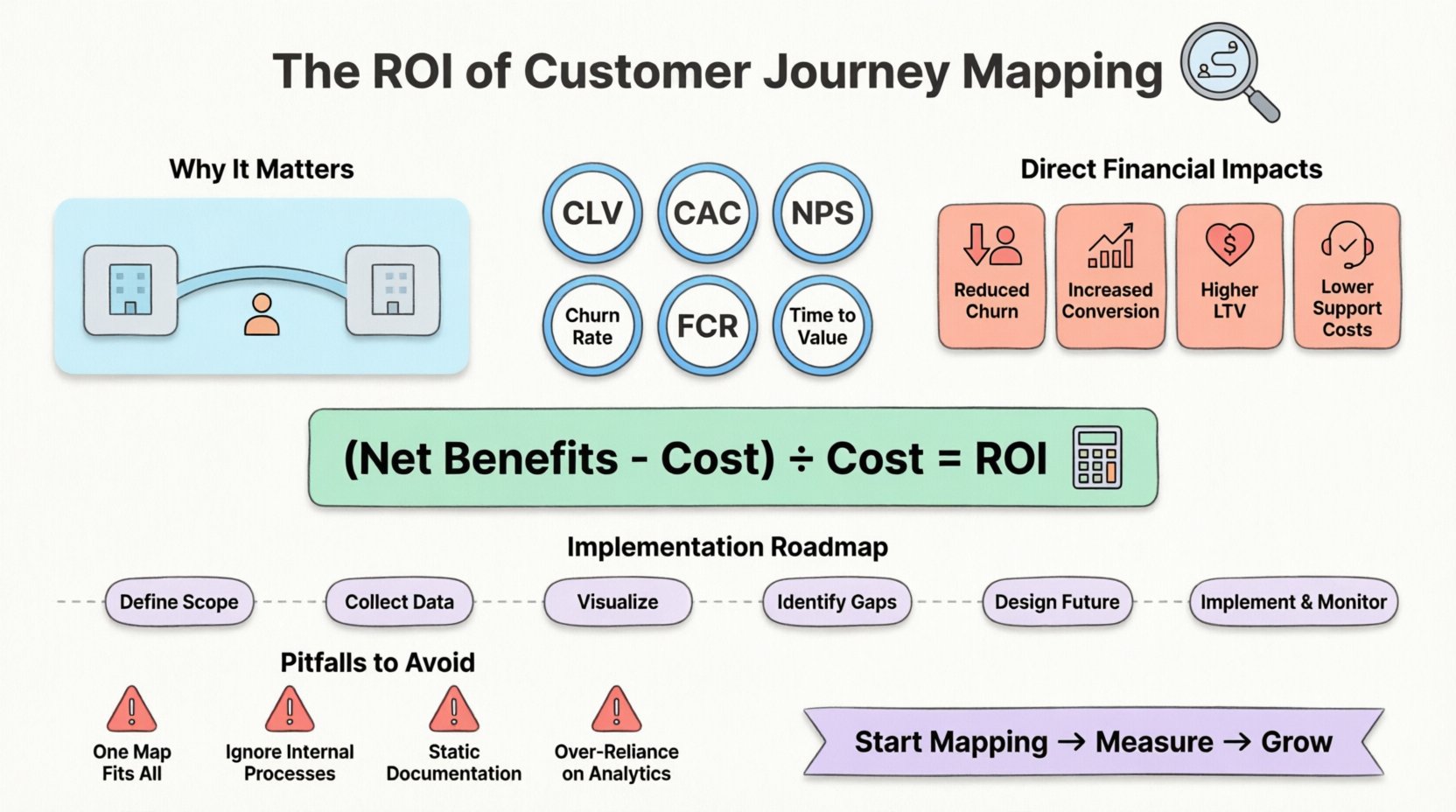
💰 Direct Financial Impacts
The most immediate justification for CJM is its impact on the bottom line. Revenue growth is rarely accidental; it is the result of optimized processes. Here is how journey mapping drives financial performance:
- Reduced Churn Rates: Identifying friction points allows for targeted interventions. When customers face fewer obstacles, they are less likely to leave. Retaining an existing customer costs significantly less than acquiring a new one.
- Increased Conversion Rates: By optimizing the path from consideration to purchase, you remove barriers that cause drop-offs. A smoother checkout process or clearer value proposition directly correlates to higher conversion.
- Higher Customer Lifetime Value (LTV): A well-mapped journey ensures customers find value quickly. This accelerates the time to first value, encouraging repeat purchases and upsell opportunities.
- Lower Support Costs: Proactively addressing common pain points reduces the volume of inbound support tickets. This frees up human resources to handle complex issues rather than routine troubleshooting.
📈 Indirect Benefits and Operational Efficiency
Beyond direct revenue, there are substantial operational efficiencies gained through mapping. These benefits often accumulate over time, compounding the ROI.
1. Breaking Down Silos
Departments often blame each other for customer dissatisfaction. Marketing claims the product is flawed; Product claims the marketing promises were too high. Journey mapping provides a single source of truth. It visualizes the handoffs between teams. When a customer is dropped off at a specific stage, the map highlights which team owns that touchpoint. This clarity reduces internal conflict and streamlines decision-making.
2. Employee Experience Alignment
There is a strong correlation between employee experience and customer experience. When employees understand the customer journey, they feel more empowered to solve problems. They see the impact of their work. This reduces turnover costs and improves service quality. Engaged employees are more likely to identify inefficiencies in the process before they become major issues.
3. Data-Driven Decision Making
Guessing what customers want leads to wasted budget on features or campaigns that do not resonate. Journey mapping requires data collection. This process forces an organization to validate assumptions with evidence. Investments are then directed toward areas that actually move the needle, rather than areas that feel important to leadership.
🧩 Measuring the ROI: Key Metrics
To prove the value of this investment, you must track specific metrics. Relying on vague notions of “happiness” is insufficient for financial justification. The following table outlines the primary metrics to monitor before and after implementing a journey mapping initiative.
| Category | Metric | Why It Matters |
|---|---|---|
| Financial | Customer Lifetime Value (CLV) | Measures the total revenue expected from a single customer account. |
| Financial | Customer Acquisition Cost (CAC) | Lowering CAC improves the efficiency of marketing spend. |
| Retention | Net Promoter Score (NPS) | Indicates loyalty and the likelihood of referral. |
| Retention | Churn Rate | The percentage of customers who stop using the service over a period. |
| Operational | First Contact Resolution (FCR) | Reduces the need for follow-up interactions and saves time. |
| Operational | Time to Value | How quickly a customer achieves their first goal after onboarding. |
🛠️ Calculating the Return
Calculating ROI requires a comparison between the costs incurred to map the journey and the financial gains realized from the improvements. The formula is straightforward:
(Net Benefits – Cost of Investment) / Cost of Investment = ROI
However, breaking down the “Net Benefits” requires attention to detail. Consider the following components:
- Cost Savings: Calculate the reduction in support ticket volume multiplied by the average cost per ticket. Include savings from reduced employee turnover.
- Revenue Uplift: Estimate the increase in conversion rate multiplied by the average order value and the total number of visitors. Consider the impact on retention rates.
- Time Savings: Quantify the time saved by employees due to streamlined processes. Convert this into hourly labor costs.
📝 Implementation Roadmap
Executing a journey mapping project requires a structured approach. Skipping steps often leads to incomplete maps that fail to provide actionable insights. The following phases outline a robust implementation strategy.
- Define the Scope and Personas:
- Identify the specific customer segments you wish to map.
- Focus on the most critical journey first, such as onboarding or renewal.
- Collect Data:
- Gather quantitative data from analytics platforms (e.g., drop-off rates, session duration).
- Conduct qualitative interviews to understand the emotional context behind the numbers.
- Visualize the Current State:
- Create a diagram that shows every touchpoint, channel, and interaction.
- Highlight moments of truth where the customer forms a lasting opinion.
- Identify Gaps and Friction:
- Annotate the map with pain points, delays, and confusion.
- Look for emotional dips where satisfaction plummets.
- Design the Future State:
- Propose solutions to eliminate the identified friction.
- Ensure the new path aligns with business capabilities and brand standards.
- Implement and Monitor:
- Prioritize changes based on impact and effort.
- Set up tracking to measure the effect of changes on the KPIs defined earlier.
🚧 Common Pitfalls to Avoid
Even with a solid plan, organizations often stumble during execution. Understanding these pitfalls helps protect the investment.
- Assuming One Map Fits All: A journey for a new customer is different from a journey for an existing one. Do not generalize. Create distinct maps for different personas.
- Ignoring Internal Processes: A customer journey cannot be optimized if internal workflows are broken. You must map the backend processes that support the frontend experience.
- Static Documentation: A map created once becomes obsolete quickly. Treat the journey map as a living document that evolves with the market and product changes.
- Over-Reliance on Analytics: Numbers tell you what is happening, but not why. Qualitative insights are essential to understand the emotional drivers behind the data.
🌐 The Long-Term Strategic Value
While immediate financial returns are important, the strategic value of journey mapping extends further. It fosters a culture of customer-centricity. When every employee sees the map, they understand how their role contributes to the customer’s success. This cultural shift is difficult to measure but vital for long-term resilience.
Furthermore, as market conditions change, the ability to adapt quickly becomes a competitive advantage. An organization with established journey mapping practices can pivot faster. They know where the friction lies and can test solutions rapidly. This agility reduces the risk of large-scale failures when launching new products or entering new markets.
🔗 Integrating with Broader CX Strategies
Customer Journey Mapping does not exist in a vacuum. It is most effective when integrated with other Customer Experience (CX) initiatives.
- Service Design: Use the map to inform the design of new services or products. Ensure the launch fits naturally into the existing journey.
- Employee Training: Use the map as a training tool for new hires. It provides context on why certain procedures exist and how they affect the customer.
- Technology Stack: Ensure your technology stack supports the journey. CRM systems, helpdesk software, and marketing automation tools should align with the mapped touchpoints to avoid data silos.
📉 What Happens If You Don’t Map?
It is often easier to focus on what happens when you *do* something than when you *don’t*. However, the cost of inaction is significant. Without a mapped journey, organizations operate in the dark.
- Blind Spots: You remain unaware of critical breakdowns until they become major complaints.
- Fragmented Efforts: Marketing, sales, and support work at cross-purposes, confusing the customer.
- Wasted Spend: Budget is spent on initiatives that do not address the actual barriers to conversion.
- Stagnant Growth: Without optimization, growth becomes reliant solely on increasing acquisition spend, which is unsustainable.
🏁 Final Thoughts on ROI
Investing in Customer Journey Mapping is not a one-time expense; it is a continuous improvement cycle. The ROI is realized through a combination of direct revenue protection, operational cost reduction, and strategic agility. By systematically identifying and removing friction, businesses create an environment where customers can succeed.
The financial justification is clear. The cost of a poor experience is high, and the cost of a good experience is lower than the cost of a broken one. When you align your internal operations with the external reality of the customer, you create a sustainable engine for growth. The map is not just a diagram; it is a roadmap for profitability.
Start by auditing your current state. Identify the most critical journey. Gather the data. Build the map. Act on the insights. Measure the results. This disciplined approach ensures that the investment yields tangible, measurable returns for the organization.