

Organizational change is rarely a smooth process. It often stumbles over friction points created by human psychology, legacy habits, and unclear communication. Leaders frequently find themselves fighting against the very teams they aim to empower. This friction is not necessarily malicious; it is a natural response to uncertainty. When employees face new workflows, technologies, or strategic shifts, the instinct is to protect the known. This phenomenon, known as resistance to change, can derail even the most well-planned initiatives.
However, there is a method to tame this resistance. It lies in visualization and empathy. By applying the principles of customer journey mapping to internal processes, organizations can make the abstract concrete. This approach shifts the conversation from “what we are forcing” to “how this affects our daily work.” When teams see the impact of change on their own experience, engagement increases, and friction decreases.
This guide explores how to utilize journey mapping as a strategic tool for change management. We will examine the psychology behind resistance, the mechanics of mapping, and practical steps to integrate these visual tools into your transformation efforts.
🧠 The Psychology of Organizational Resistance
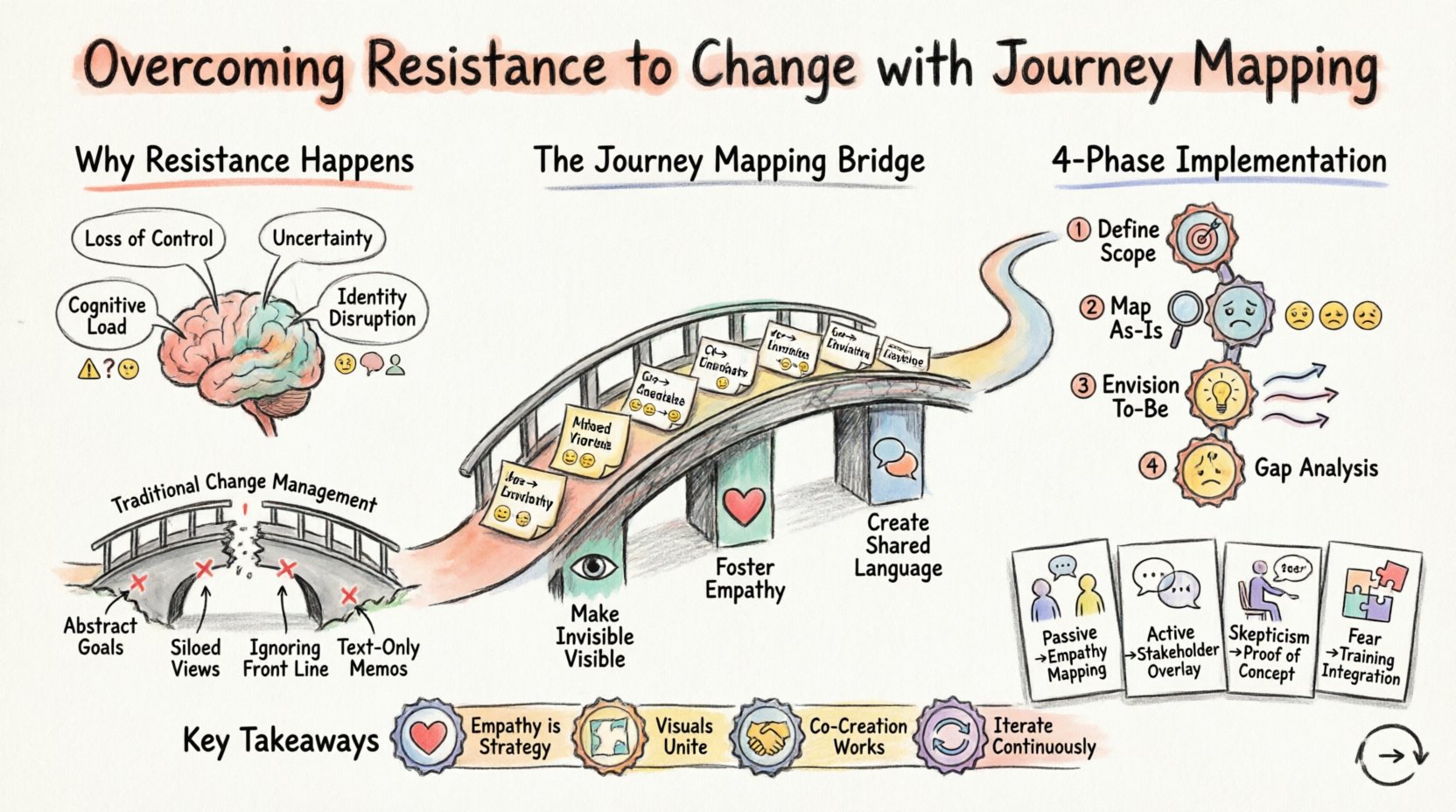
Understanding why resistance occurs is the first step toward mitigating it. Resistance is not simply stubbornness; it is a protective mechanism. When an organization proposes a shift, employees often perceive a threat to their competence, status, or security. Several psychological factors drive this reaction:
Loss of Control: Change often feels like something happening to people rather than something they are doing. Without agency, employees disengage.
Uncertainty: The brain prefers a known negative to an unknown positive. Ambiguity about future roles or expectations triggers stress responses.
Cognitive Load: Learning new systems requires mental energy. If the current process is familiar, switching requires significant cognitive effort.
Identity Disruption: Many employees derive identity from their role. Changing a process can feel like changing who they are at work.
Traditional change management often addresses the business case but neglects the human experience. It focuses on KPIs, timelines, and deliverables. While necessary, these metrics do not reassure the individual employee worried about their daily reality. This is where the gap lies.
📉 Why Traditional Change Management Often Falls Short
Standard change methodologies typically rely on top-down communication. Leadership announces a decision, and the organization follows. While efficient for logistics, this model fails to capture the nuance of workflow execution. Here are common reasons this approach struggles:
Abstract Goals: “Improve efficiency” is a goal that does not exist in a daily task. Employees need to see how efficiency looks in their specific context.
Siloed Perspectives: Departments often view change through their own narrow lens. The sales team sees one problem; the support team sees another.
Ignoring the Front Line: The people who execute the work know where the friction points are. If their feedback is ignored, the solution is built on assumptions rather than reality.
Lack of Visual Context: Text-heavy memos and emails are easily misinterpreted. Visual representations create a shared language.
Without a shared visual reference, teams argue about the problem rather than the solution. They talk past each other because they are looking at different parts of the organizational puzzle.
🌉 How Journey Mapping Bridges the Gap
Journey mapping is a visual representation of the steps a person takes to achieve a goal. While traditionally used for customer experience, this technique is equally powerful for internal change. By mapping the employee experience, you create a tangible artifact that everyone can see and discuss.
1. Making the Invisible Visible
Processes often exist in people’s heads. Mapping externalizes these thoughts. When a team draws the current state, they agree on what the reality is. This reduces the argument about “what is happening” and focuses the energy on “what needs to change.”
2. Fostering Empathy
A journey map includes emotional states. It tracks not just the steps, but how the employee feels at each step. If a process step causes frustration, it is marked on the map. This validates the employee’s feelings and shows leadership that they understand the pain points. Validation reduces defensiveness.
3. Creating a Shared Language
Instead of saying “the process is broken,” a team can point to a specific node on the map. This neutralizes the conversation. The map becomes the object of discussion, not the people. This is crucial for maintaining psychological safety during difficult transitions.
🛠️ Step-by-Step: Integrating Mapping into Change Initiatives
Integrating journey mapping into change management requires a structured approach. It is not enough to draw a diagram and put it on a wall. The process must be participatory and iterative.
Phase 1: Define the Scope and Stakeholders
Identify the Trigger: Clearly state why the change is happening. Is it a compliance requirement? A customer demand? A cost reduction?
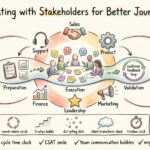
Select Participants: Include cross-functional representatives. You need the people who touch the process daily, not just the managers who approve it.
Set Boundaries: Define the start and end points of the journey. For example, “From receiving a ticket to resolving a customer issue.”
Phase 2: Map the Current State (As-Is)
This phase is about reality, not idealism. It is often the most uncomfortable part of the process because it exposes inefficiencies.
Document Steps: List every action taken. Do not skip the small things. A phone call, a manual entry, or a waiting period are all data points.
Identify Emotions: Ask participants to rate their stress or satisfaction at each step. Use a simple scale (e.g., 😊 to 😫).
Highlight Friction: Mark where delays occur, where information is lost, or where tools fail.
Phase 3: Envision the Future State (To-Be)
Once the current reality is clear, shift to the desired outcome. This is where the change initiative lives.
Remove Friction: Look at the pain points identified in the As-Is map. How would the To-Be map look without them?
Streamline Handoffs: Focus on the transitions between departments. These are usually the biggest sources of resistance due to accountability ambiguity.
Align Tools: If new technology is part of the change, visualize where it fits in the flow. Does it automate a manual step? Does it require new training?
Phase 4: Gap Analysis and Co-Creation
Compare the As-Is and To-Be maps. The gap between them is the change initiative. This step is critical for overcoming resistance.
Validate the Path: Ensure the To-Be map is achievable. If it looks too easy, it might be unrealistic.
Identify Support Needs: Where does the team need help to move from As-Is to To-Be? Training? New resources? Policy changes?
Build Ownership: Let the team design the To-Be map. If they build the solution, they are less likely to resist the implementation.
📊 Resistance Patterns vs. Mapping Interventions
Different types of resistance require different mapping strategies. A one-size-fits-all approach to change management often fails because it ignores the specific nature of the pushback.
Resistance Type | Underlying Cause | Journey Mapping Intervention |
|---|---|---|
Passive Resistance | Feeling unheard or overwhelmed | Empathy Mapping: Focus heavily on emotional states in the As-Is map to validate feelings before proposing solutions. |
Active Pushback | Perceived loss of power or status | Stakeholder Overlay: Map decision points. Show where their influence remains or grows in the new process. |
Skepticism | Distrust of leadership or new systems | Proof of Concept: Map a pilot phase. Show the specific steps where data proves improvement before full rollout. |
Fear of Complexity | Worry about learning curve | Training Integration: Add training touchpoints directly onto the journey map. Visualize support availability. |
👥 Facilitating Collaborative Workshops
The map is only as good as the conversation that creates it. Workshops are the engine of this process. They require careful facilitation to ensure productive outcomes.
Safe Environment: Establish ground rules. No blaming, no interrupting. The goal is to map the process, not the people.
Diverse Groups: Mix seniority levels. Junior staff often see process flaws that managers miss. Ensure they have airtime.
Visual Aids: Use sticky notes, large paper, or digital whiteboards. Physical manipulation of ideas helps engagement.
Timeboxing: Keep sessions focused. Long meetings lead to fatigue. Break complex maps into sections.
Follow-Up: Do not let the map gather dust. Assign action items directly related to the insights found during the workshop.
Facilitators should act as guides, not dictators. Their role is to ensure every voice is heard and that the map accurately reflects the collective truth.
📈 Defining Success Metrics for Adoption
How do you know if the change initiative is working? Relying solely on financial metrics is insufficient. You need to measure the human element of the change.
1. Adoption Rates
Track how quickly employees move from the old process to the new one. Is it gradual or sudden? Sudden adoption might indicate coercion rather than buy-in.
2. Employee Sentiment
Conduct pulse surveys focused on the specific change. Ask about clarity, support, and confidence. If sentiment drops during the transition, revisit the journey map to find new friction points.
3. Process Efficiency
Measure the actual time saved or errors reduced. If the map predicted a 20% efficiency gain but the data shows 5%, there is a disconnect between the design and the execution.
4. Customer Impact
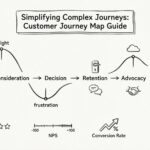
Internal changes often ripple outward to customers. Monitor customer satisfaction scores (CSAT) or Net Promoter Scores (NPS). If internal resistance isn’t managed well, customer experience often suffers.
⚠️ Navigating Common Pitfalls
Even with a solid plan, obstacles can arise. Being aware of common pitfalls helps you navigate them before they become crises.
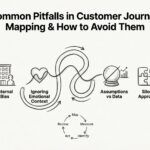
Over-Simplification: A map that is too high-level misses the real friction. Ensure you go deep enough to see the details.
Skipping Validation: Do not assume the map is accurate without checking it with the people doing the work. Ground truth is essential.
Ignoring Emotional Layers: Focusing only on steps and ignoring feelings leads to a sterile process. Emotions drive behavior.
One-and-Done: Journey mapping is not a single event. It is a living document. Update it as the change evolves.
Lack of Leadership Buy-In: If leaders do not participate in the mapping, they cannot support the change. They must see the map to understand the cost of the transition.
🔄 The Feedback Loop
Change is iterative. As you implement the new process, you will encounter new variables. The journey map should not be static.
Monitor: Watch the new process in action.
Listen: Gather feedback from the front line regularly.
Update: Revise the map to reflect the new reality.
Communicate: Share updates with the team to show that their feedback matters.
This loop reinforces the message that the organization is adaptable and responsive. It turns the change initiative into a continuous improvement cycle rather than a one-time project.
🏢 Real-World Application: A Digital Transformation
Consider a scenario where a company moves from paper-based records to a digital system. Resistance is high because employees fear the new system is too complex.
The Problem: Employees spend hours searching for files. Management wants a digital switch to save space.
The Mapping Process:
The team mapped the current search process. They found it took 15 minutes on average to find a document.
They mapped the emotional state: Frustration, anxiety, rushing.
In the To-Be map, they visualized the search function but also added “Training Sessions” and “Help Desk Support” touchpoints.
The Outcome:
By visualizing the support structure alongside the new tool, employees felt less abandoned. The map showed that the company understood the learning curve. Resistance dropped because the support was visible and tangible.
🔑 Key Takeaways for Leaders
Implementing change is difficult, but journey mapping provides a structured way to navigate the human elements of transformation. By focusing on the experience rather than just the output, leaders can build trust and reduce friction.
Empathy is Strategy: Understanding feelings is just as important as understanding workflows.
Visuals Unite: A map creates a common reference point for all discussions.
Co-Creation Works: Involve employees in designing the solution to increase ownership.
Iterate Continuously: Change is never finished. The map should evolve with the organization.
When you combine the rigor of process design with the nuance of human experience, you create a foundation for sustainable change. The goal is not just to move forward, but to move forward together.