

The landscape of business interaction has shifted fundamentally. What was once a linear path from awareness to purchase has become a complex, non-linear ecosystem of touchpoints. Digital transformation is not merely about adopting new technologies; it is about restructuring how organizations perceive and facilitate customer experiences. When we talk about customer journey mapping in the context of modern business, we must acknowledge that the map itself is dynamic, constantly reshaped by data, connectivity, and changing consumer expectations.
Organizations that fail to recognize these shifts often find themselves reactive rather than proactive. The customer today expects seamless integration across devices, instant gratification, and personalized interactions that feel human despite being driven by algorithms. This guide explores the profound changes digital transformation brings to customer journeys, detailing the mechanics of this shift and the strategic implications for leadership.
Defining the Modern Customer Journey 🛤️
A customer journey is the complete experience a person has with a company, from the initial discovery phase to post-purchase support and advocacy. Historically, this journey was fragmented. A customer might see a print ad, visit a physical store, call a support line, and receive a paper invoice. Today, these stages are interwoven with digital interactions.
- Pre-Digital Era: Linear, siloed, memory-based, and slow.
- Digital Era: Non-linear, integrated, data-driven, and immediate.
The core of digital transformation in this context is the ability to capture, analyze, and act upon customer data at every stage. This allows for a more accurate representation of the journey as it actually happens, rather than as it is assumed to happen.
The Shift from Linear to Non-Linear Paths 🔄
In the past, the sales funnel was a rigid structure. Today, the customer journey is a web. A user might see a social media post, search for reviews on a third-party site, visit the company website, abandon a cart, receive an email reminder, and then return via a mobile app.
This complexity requires a mapping strategy that accounts for multiple entry and exit points. Key characteristics of this shift include:
- Fragmented Attention: Customers switch devices and channels frequently within a single session.
- Self-Service Expectations: Users prefer finding answers independently before contacting support.
- Contextual Relevance: Information provided must match the specific device and time of interaction.
When mapping these journeys, it is essential to visualize the entire ecosystem rather than isolated touchpoints. A single interaction in one channel can influence the outcome of an interaction in another. For example, a negative experience on a mobile app can negate a positive in-store visit.
Data as the Backbone of Experience 📊
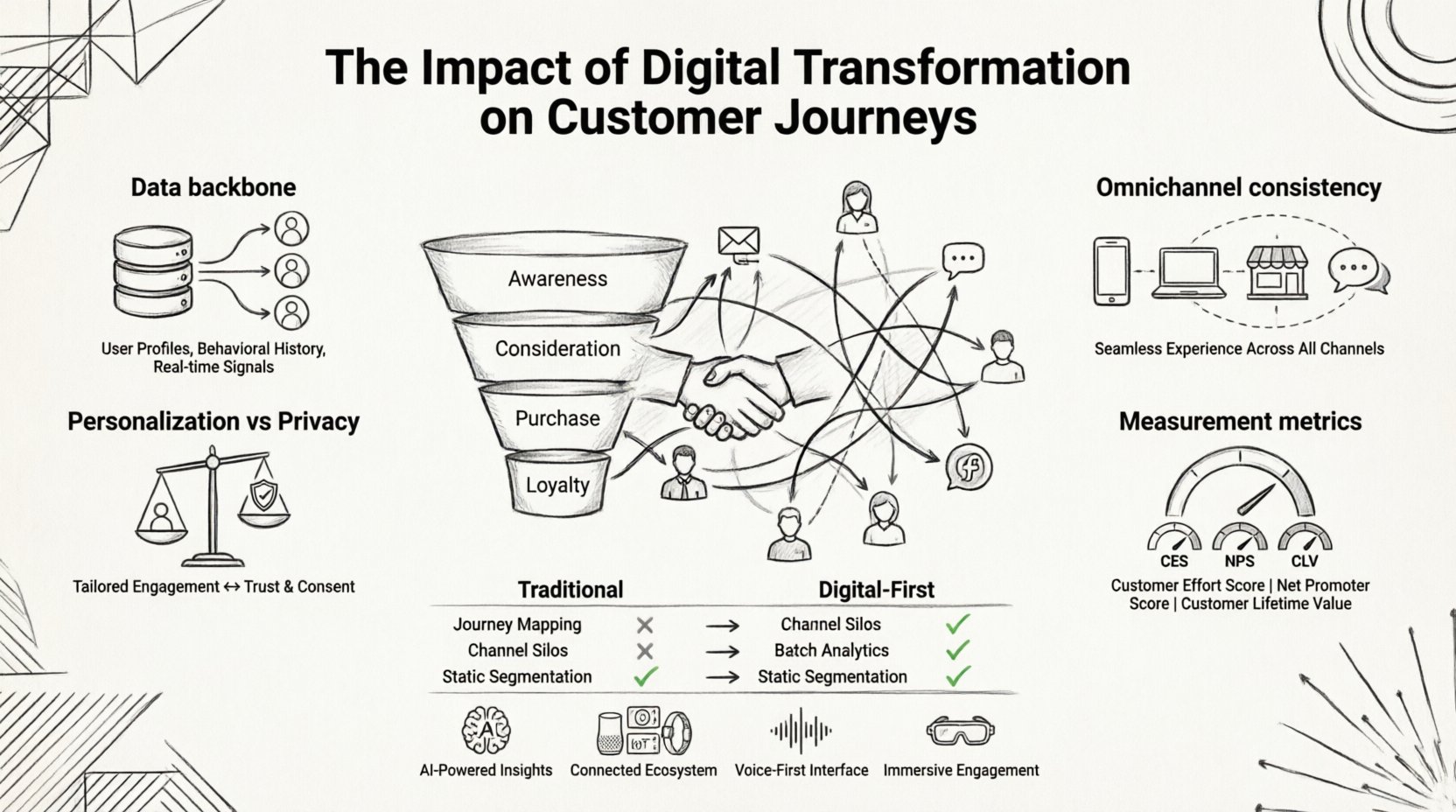
Without data, digital transformation is simply a collection of disconnected tools. Data integration is the mechanism that allows an organization to understand the customer journey in real time. This involves aggregating information from various sources into a coherent view.
Effective data utilization focuses on several critical areas:
- Identity Resolution: Connecting anonymous browsing behavior to known user identities across devices.
- Behavioral Tracking: Monitoring how users navigate interfaces to identify friction points.
- Transaction History: Understanding past purchases to inform future recommendations.
- Feedback Loops: Capturing qualitative data through surveys and support interactions.
Organizations must ensure that this data flows seamlessly between departments. Marketing cannot operate in a vacuum separate from Sales or Customer Support. When data is siloed, the customer journey becomes disjointed. A customer telling a support agent about a marketing offer they saw yesterday should trigger an immediate check by the agent, rather than requiring the customer to repeat the story.
Omnichannel Consistency 📱
Digital transformation enables omnichannel strategies, where the experience remains consistent regardless of the channel used. This goes beyond simply having a website and a physical store. It requires synchronization of inventory, pricing, promotions, and customer service protocols.
Key elements of omnichannel consistency include:
- Unified Inventory: Customers need to know if an item is available online or in-store without confusion.
- Shared Cart: Items added to a cart on a desktop should remain available when the user opens the mobile application.
- Service Continuity: Support tickets initiated via chat should be accessible to phone agents.
- Brand Voice: Tone and messaging must remain aligned across all digital and physical platforms.
Failure to maintain this consistency creates friction. If a customer sees a promotion online but the store clerk does not honor it, trust erodes. Digital transformation provides the tools to bridge these gaps, but it requires rigorous governance and process alignment.
Personalization vs. Privacy ⚖️
One of the most significant impacts of digital transformation is the ability to personalize experiences at scale. However, this capability introduces a critical tension between personalization and privacy. Customers expect tailored recommendations, but they are increasingly wary of how their data is used.
Successful strategies in this area balance value exchange with transparency:
- Opt-In Mechanisms: Clearly ask permission before collecting sensitive data.
- Value Proposition: Explain clearly what the customer gains by sharing information.
- Data Minimization: Collect only the data necessary for the specific interaction.
- Control: Provide users with dashboards to view and manage their data.
Personalization that feels intrusive can damage the relationship. It is important to ensure that algorithms enhance the experience without making the customer feel monitored. The goal is to anticipate needs, not to predict behavior in a way that feels manipulative.
Key Challenges in Implementation 🛑
Transitioning to a digitally transformed customer journey is not without obstacles. Organizations often underestimate the complexity of legacy systems and cultural resistance.
Common hurdles include:
- Legacy Infrastructure: Older systems may not support real-time data exchange or API integrations.
- Siloed Departments: Marketing, IT, and Operations often have competing priorities and KPIs.
- Skills Gap: There may be a shortage of talent capable of managing complex data ecosystems.
- Change Management: Employees may resist new workflows that require different behaviors.
Overcoming these challenges requires a top-down commitment to change. It is not solely an IT project; it is a business strategy that affects every function. Leadership must prioritize customer experience as a core metric alongside financial performance.
Comparison of Traditional vs. Digital-First Journeys
| Aspect | Traditional Approach | Digital-First Approach |
|---|---|---|
| Communication | One-way, broadcast-based | Two-way, interactive, real-time |
| Data Usage | Historical, retrospective | Real-time, predictive |
| Channel Focus | Single channel optimization | Omnichannel integration |
| Customer Role | Passive recipient | Active co-creator |
| Feedback Loop | Annual surveys | Continuous monitoring |
| Pain Points | Fixed, hard to detect | Identifiable via analytics |
Measuring Success Beyond Sales 📈
When digital transformation impacts the customer journey, traditional metrics like conversion rate and average order value are no longer sufficient. These metrics tell you what happened, but not why or how the experience felt.
Organizations should adopt a broader set of indicators:
- Customer Effort Score (CES): How easy was it for the customer to complete their goal?
- Net Promoter Score (NPS): Likelihood of recommendation based on the total experience.
- Customer Lifetime Value (CLV): Long-term value derived from the relationship.
- Churn Rate: The speed at which customers leave the ecosystem.
- Engagement Depth: Time spent, pages viewed, and interaction frequency.
These metrics provide a holistic view of health. A high sales volume with high churn indicates a broken journey. Conversely, moderate sales with high retention suggests a sustainable model. Digital tools allow for the tracking of these metrics in real time, enabling quicker course corrections.
Future Horizons 🚀
The trajectory of digital transformation points toward even deeper integration of technology into the customer experience. Several trends are shaping the near future of journey mapping.
- Artificial Intelligence: AI will move from analysis to action, automating responses and routing based on sentiment.
- Internet of Things (IoT): Connected devices will become new touchpoints, providing data on product usage and maintenance needs.
- Voice Interfaces: Voice search and assistants will change how customers initiate interactions.
- Augmented Reality: Virtual try-ons and visual guides will bridge the gap between digital and physical.
These technologies do not replace the need for human connection; they enhance it. The goal is to remove friction so that human agents can focus on complex problem-solving and relationship building.
Strategic Considerations for Leaders 🧠
Leadership plays a pivotal role in navigating the impact of digital transformation on customer journeys. It requires a shift in mindset from product-centric to customer-centric.
Key actions for leaders include:
- Empower Cross-Functional Teams: Break down walls between departments to ensure a unified view of the customer.
- Invest in Talent: Hire for data literacy and customer empathy, not just technical skills.
- Prioritize Security: Ensure that digital expansion does not compromise data safety.
- Iterate Continuously: Treat the journey map as a living document, updated regularly based on new data.
- Focus on Value: Ensure every digital initiative solves a specific customer problem.
There is no single correct path for every organization. The strategy must be tailored to the specific industry, customer base, and operational capabilities. However, the underlying principle remains constant: technology must serve the human experience, not the other way around.
Operationalizing the Journey Map 📝
Creating a map is only the first step. The real value lies in operationalizing it. This means embedding the insights from the map into daily workflows and decision-making processes.
Steps to operationalize include:
- Identify Ownership: Assign specific journey stages to specific teams or individuals.
- Define Triggers: Set up alerts for when a customer hits a specific friction point.
- Update Training: Ensure all staff understand the new journey flow and their role within it.
- Align Incentives: Adjust performance metrics to reward journey health, not just transaction volume.
This operationalization ensures that the digital transformation is not just a theoretical exercise but a practical reality. It bridges the gap between strategy and execution.
The Human Element in a Digital World 🤝
Despite the heavy reliance on technology, the human element remains central to the customer journey. Digital tools facilitate connections, but they cannot replace genuine empathy.
Organizations must remember:
- Empathy Drives Design: Understanding emotional states helps in creating better interfaces.
- Human Oversight: Automated systems should have human fallbacks for complex issues.
- Trust Building: Transparency about data usage builds long-term trust.
The most successful digital transformations are those that leverage technology to free up human time for high-value interactions. This balance ensures that efficiency does not come at the cost of connection.
Summary of Impact Areas
The influence of digital transformation on customer journeys is pervasive. It touches every aspect of how a business interacts with its market. From the initial discovery to the final advocacy, the digital layer adds speed, depth, and complexity.
- Speed: Transactions and information access are instantaneous.
- Depth: Data allows for a deeper understanding of individual needs.
- Complexity: Managing multiple channels requires sophisticated orchestration.
- Expectation: Customers now expect a level of service that was previously impossible.
Adapting to this new reality requires vigilance, investment, and a willingness to evolve. The organizations that thrive will be those that view digital transformation as an ongoing journey of improvement rather than a destination.
The customer journey is the heartbeat of the business. Digital transformation amplifies this heartbeat, making it faster and more responsive. By understanding and managing this impact, organizations can build experiences that are not just efficient, but meaningful.