

Creating a customer journey map is often seen as a design exercise. It involves placing sticky notes on a wall and drawing lines between touchpoints. However, the most accurate map is not drawn in isolation. It is built through the collective insight of those who interact with the customer every day. When departments work in silos, the resulting map reflects a fragmented view of reality. Collaboration bridges this gap, transforming a static diagram into a living document that drives genuine organizational alignment.
This guide explores how to bring cross-functional teams together to craft journey maps that are accurate, actionable, and shared across the organization. We will move beyond the mechanics of mapping to discuss the human dynamics required to sustain the effort.
🏗️ Why Isolation Leads to Inaccuracy
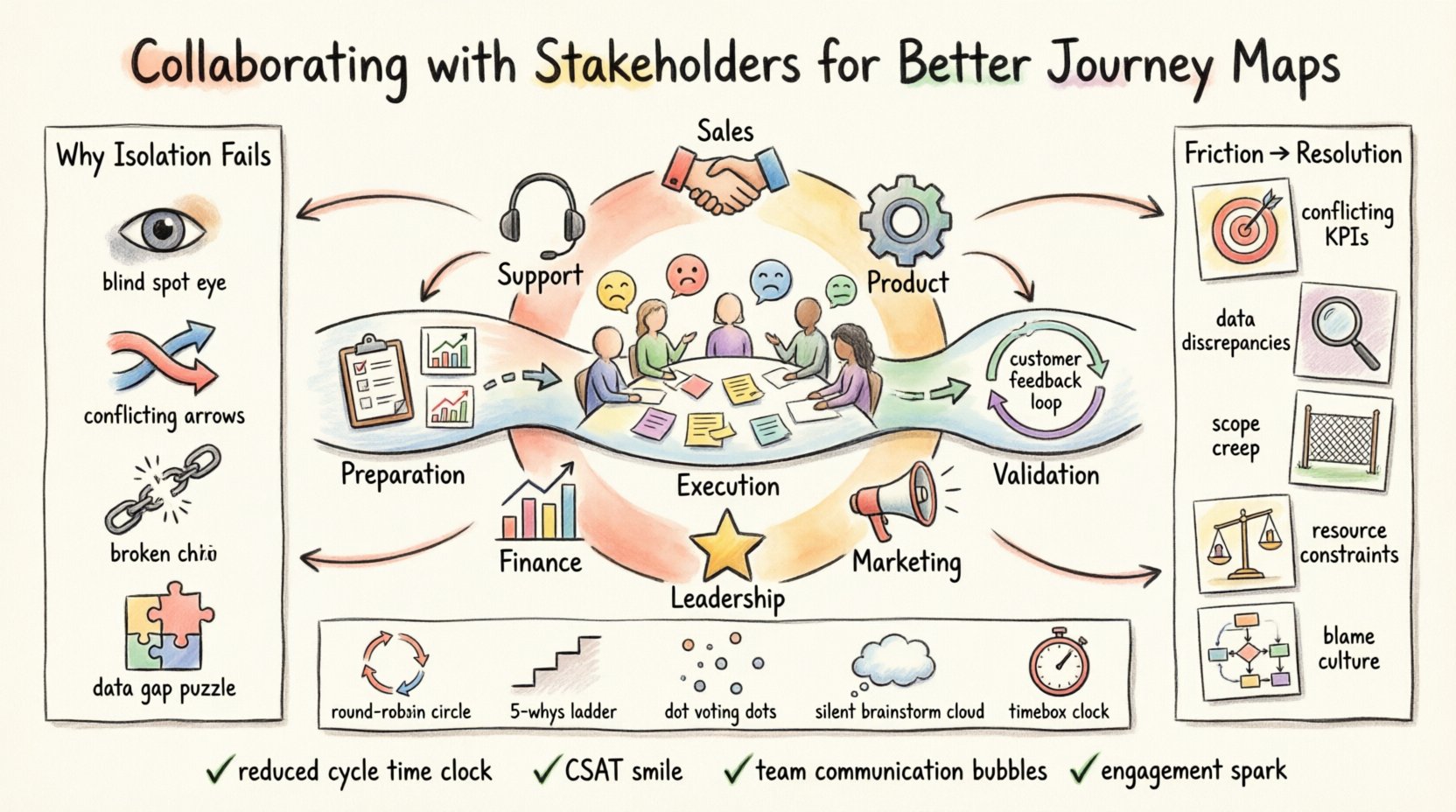
When a single team creates a journey map without input from others, the result is often a projection rather than a reflection. Marketing may assume the customer journey begins with an ad click. Sales might believe the journey starts with a demo request. Support knows the journey often begins with a frustration point that occurred weeks prior. Without collaboration, these perspectives remain disconnected.
Isolation creates several specific risks:
- Blind Spots: One department may not see the steps that happen before or after their direct touchpoint.
- Contradictory Narratives: Marketing might promise speed, while Operations promises thoroughness. The customer experiences the friction between these promises.
- Lack of Ownership: If stakeholders were not part of the creation process, they are less likely to act on the insights found in the map.
- Data Gaps: Quantitative data often sits in analytics, while qualitative data sits in support tickets. Collaboration merges these sources.
A collaborative approach ensures that the map represents the full lifecycle of the relationship, not just the segment of the lifecycle that one team controls.
👥 Identifying the Right Stakeholders
Not every stakeholder needs to be in every room for every session, but every critical voice must be heard at some point. The goal is to balance representation with efficiency. Inviting everyone from the start can lead to decision paralysis.
Here are the key roles that typically need to be represented to build a complete picture:
- Customer Support: They hear the complaints and the questions. They know where customers get stuck most frequently.
- Sales: They understand the motivations that drive the initial interest and the objections that cause friction during negotiation.
- Product Management: They own the core functionality and the roadmap, knowing what is possible and what is planned.
- Marketing: They manage the messaging and the channels that bring customers to the door.
- Finance: They understand the cost of acquisition and the value of retention, providing a business case for changes.
- Executive Leadership: They ensure the map aligns with the broader strategic vision and can authorize resource allocation.
📊 Stakeholder Role Matrix
| Department | Primary Insight Contribution | Key Questions to Ask |
|---|---|---|
| Support | Post-purchase friction, recurring issues | What are the top reasons customers contact us this week? |
| Sales | Purchase intent, objections, deal length | What information do prospects need before they commit? |
| Product | Feature usage, onboarding hurdles | Which features are underutilized and why? |
| Marketing | Channel attribution, messaging resonance | Where do we lose leads before they enter the funnel? |
| Operations | Delivery timelines, fulfillment accuracy | Where do delays most commonly occur? |
📅 The Phases of Collaborative Mapping
A successful workshop is not a spontaneous event. It requires structure, preparation, and follow-through. The process can be broken down into three distinct phases: Preparation, Execution, and Validation.
1. Preparation
Before gathering the team, you must set the stage. This involves defining the scope. Are you mapping the onboarding experience for new users, or the entire renewal cycle? A broad scope can lead to shallow insights. A narrow scope allows for depth.
During this phase, gather existing data. Look at analytics reports, customer satisfaction scores, and past research. Distribute this information to participants beforehand so they can come prepared with their own anecdotes, rather than relying solely on memory during the session.
2. Execution
The workshop itself is where the magic happens. This is not a presentation where one person speaks while others listen. It is a facilitated working session. The facilitator must ensure that dominant voices do not drown out quieter team members.
Key activities during execution include:
- Brainstorming Touchpoints: Write down every interaction, digital or physical, that occurs during the journey.
- Defining Phases: Group touchpoints into logical stages (e.g., Awareness, Consideration, Purchase, Onboarding).
- Mapping Emotions: Plot the customer’s emotional state at each step. Are they frustrated, relieved, confused, or excited?
- Identifying Pains: Highlight where the process breaks down. These are the opportunities for improvement.
3. Validation
Once the draft map is created, it must be tested against reality. Do not assume the workshop output is final. Share the draft with actual customers or frontline staff who were not in the room. Ask them: “Does this look like your experience?” Their feedback is the truth check that prevents internal bias from becoming policy.
🛑 Overcoming Common Friction Points
Collaboration is rarely smooth. Different departments have different KPIs, different languages, and different priorities. Sales wants speed; Support wants accuracy. Product wants innovation; Operations wants stability. These conflicts are natural, but they can stall progress if not managed.
The following table outlines common friction points and constructive ways to address them:
| Friction Point | Root Cause | Resolution Strategy |
|---|---|---|
| Conflicting KPIs | One team is rewarded for speed, another for quality. | Create a shared goal focused on the customer outcome, not just departmental output. |
| Data Discrepancies | Analytics shows one thing, support tickets show another. | Pause and investigate the data source. Acknowledge that different tools measure different things. |
| Scope Creep | Stakeholders want to map every single interaction. | Enforce the boundary of the specific journey phase being mapped. Schedule future sessions for other phases. |
| Resource Constraints | Teams agree on a change but have no budget to implement it. | Document the required resources early. Rank initiatives by effort versus impact. |
| Blame Culture | Discussions turn into arguments about who is at fault. | Redirect focus from “who” to “what”. Discuss the process gap, not the person. |
🗣️ Facilitation Techniques for Group Dynamics
The facilitator plays a critical role. Their job is not to drive the content, but to drive the conversation. A good facilitator creates psychological safety, allowing junior employees to challenge senior leadership opinions without fear.
Here are specific techniques to manage group dynamics:
- Round-Robin Input: Go around the room and ask for one input from each person before opening the floor. This ensures introverts are heard.
- The “Five Whys”: When a problem is identified, ask “why” five times to get to the root cause, rather than treating symptoms.
- Dot Voting: Allow stakeholders to place dots on the map to indicate which pain points are most critical. This visualizes consensus.
- Silent Brainstorming: Give everyone 5 minutes to write down ideas on sticky notes silently before sharing. This prevents groupthink and anchoring bias.
- Timeboxing: Set strict timers for discussion topics. This keeps the session moving and prevents one topic from consuming the whole day.
🔄 Integrating Feedback Loops
A journey map is not a one-time artifact. It is a hypothesis that needs continuous testing. Once the map is created, it must be integrated into regular business rhythms.
Consider these methods for integration:
- Quarterly Reviews: Schedule a session every three months to review the map. Has the customer behavior changed? Has a new feature been released?
- Onboarding New Hires: Use the map as a training tool for new employees. It provides context on how the company serves its customers.
- Project Gateways: Require that any new project proposal references the journey map. Does this project improve a specific step in the journey?
- Customer Advisory Boards: Invite customers to review the map periodically. They are the ultimate validators of your journey assumptions.
📈 Measuring the Impact of Collaboration
How do you know if this collaborative effort was worth the time? You measure it through behavioral changes and business outcomes.
Look for these indicators of success:
- Reduced Cycle Time: If the map identified bottlenecks, has the process moved faster?
- Increased CSAT: Are customers happier with the specific touchpoints that were addressed?
- Better Cross-Team Communication: Do teams now reference the map in meetings instead of arguing over data?
- Employee Engagement: Do staff feel more empowered to solve customer problems when they understand the full journey?
When stakeholders see that their collaboration led to tangible improvements, they are more likely to invest in future initiatives. The journey map becomes a shared asset rather than a project deliverable.
🌱 Sustaining the Momentum
Many initiatives fail because the energy fades after the workshop. To sustain the momentum, you need champions. Identify individuals within each department who are passionate about the customer experience. These champions act as the custodians of the map in their respective teams.
They ensure that:
- The map is visible in shared spaces or digital workspaces.
- Decisions are checked against the map before being finalized.
- New pain points are reported and added to the map.
Leadership must also reinforce the value of this work. When a manager cites the journey map to justify a budget request or a policy change, it signals that the map has strategic weight. This top-down support ensures that the collaborative effort is not viewed as a side project, but as a core business function.
💡 Summary of Best Practices
To summarize, building a journey map that works requires more than just sticky notes. It requires a deliberate strategy for bringing people together. Here is a quick checklist for your next initiative:
- ✅ Define the scope clearly before inviting participants.
- ✅ Invite representatives from all critical departments.
- ✅ Prepare data and context before the workshop.
- ✅ Use a skilled facilitator to manage group dynamics.
- ✅ Validate findings with real customer feedback.
- ✅ Integrate the map into regular operational reviews.
- ✅ Track outcomes to prove the value of collaboration.
By treating stakeholder collaboration as a core component of the mapping process, you transform the journey map from a static document into a dynamic tool for organizational change. The result is a customer experience that is not just designed on paper, but delivered consistently across every interaction.