

Building a customer journey map is more than drawing lines on a whiteboard. It is about understanding the human experience behind every interaction. When done right, it reveals hidden friction points and opportunities for genuine connection. However, many organizations stumble when trying to translate complex behaviors into visual diagrams. The difference between a map that gathers dust and one that drives strategy lies in the details.
This guide explores the most frequent errors teams make during the mapping process. We will look at why assumptions fail, how data gaps create blind spots, and what structural changes are needed to make your map actionable. By understanding these pitfalls, you can build a resource that truly reflects reality.
Why Customer Journey Mapping Often Fails 📉
A journey map is a hypothesis. It is a snapshot of a process based on available information. When teams treat it as a static fact rather than a living document, problems arise. The goal is not just to visualize the path, but to influence the outcome. Many organizations skip the rigorous groundwork required to make this visualization accurate.
Common reasons for failure include:
- Lack of Cross-Functional Input: Marketing creates the map without Sales or Support input.
- Data Deficiency: Relying on anecdotes instead of behavioral data.
- Internal Focus: Designing for business convenience rather than user needs.
- Complexity Overload: Trying to map every single touchpoint without prioritization.
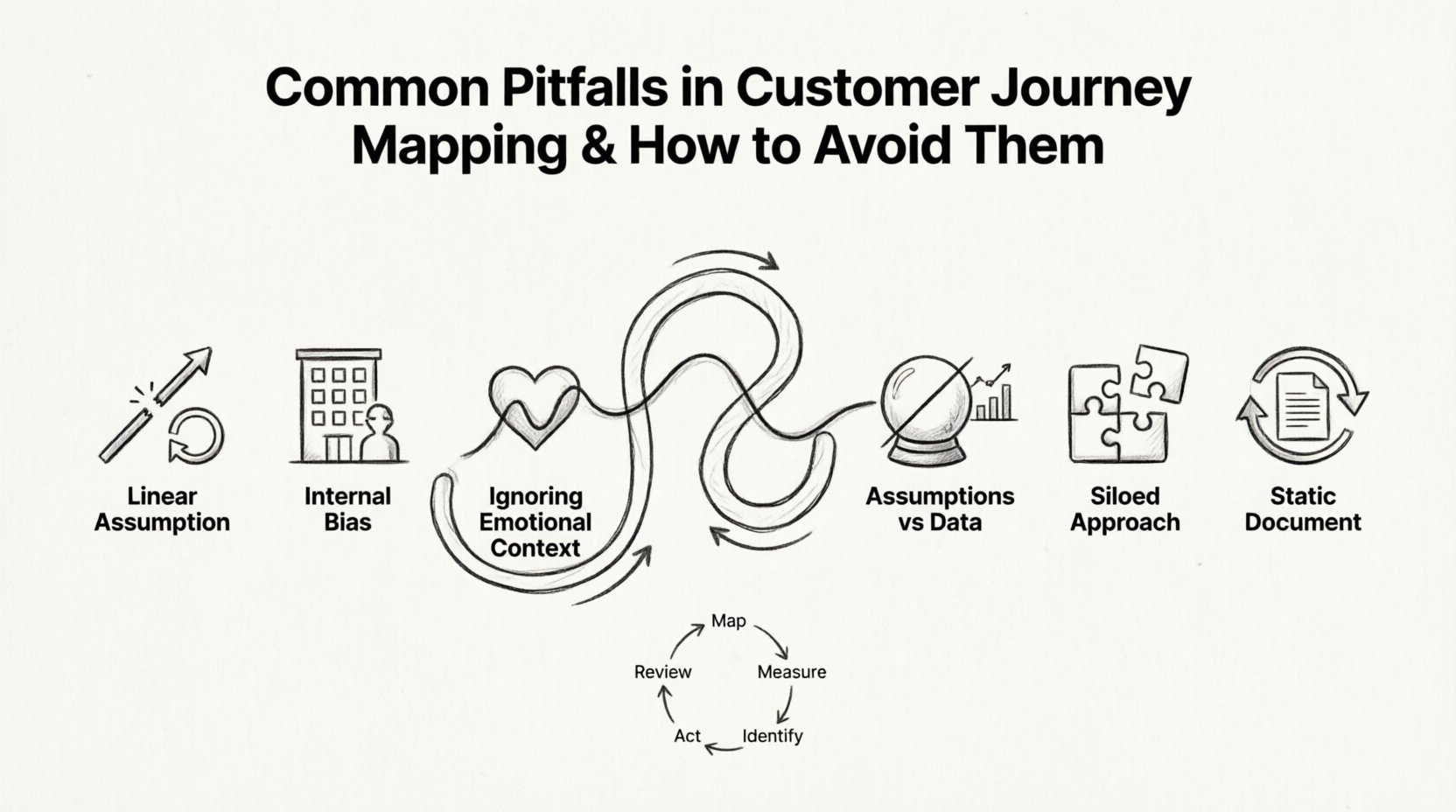
Pitfall 1: The Linear Assumption 📏
One of the most persistent errors is treating the customer journey as a straight line. Real-world behavior is rarely linear. Customers jump between channels, loop back to previous steps, or skip phases entirely. Assuming a perfect funnel ignores the chaotic nature of modern engagement.
The Consequence
When you assume linearity, you miss critical moments of re-entry. A user might abandon a cart, leave, and return a week later through a different device. If your map does not account for this loop, you will not optimize the return path.
How to Fix It
- Map the journey as a loop, not a line.
- Identify decision points where users branch off.
- Use data to find common re-entry points.
- Accept that non-linear paths are normal.
Pitfall 2: The Internal Bias Trap 🏢
It is easy to map the process from the organization’s perspective. This means listing steps like “Submit Application,” “Review by Manager,” and “Approval Email.” While these are accurate to the business, they are meaningless to the customer. The customer does not care about your internal review process.
The Consequence
This creates a disconnect. The map shows efficiency where the customer feels confusion. It highlights internal milestones rather than user goals. You end up optimizing for your workflow, not their experience.
How to Fix It
- Focus on customer goals, not business steps.
- Use language the customer uses, not internal jargon.
- Include emotional states at every stage.
- Validate maps with actual customer interviews.
Pitfall 3: Ignoring Emotional Context 😔
Many maps list actions and touchpoints but skip the feelings associated with them. A customer might complete a purchase, but did they feel relief, anxiety, or excitement? Without emotional data, the map is just a process flowchart.
The Consequence
Without emotional context, you cannot identify pain points that drive churn. A customer might tolerate a slow process because they are excited about the product, or they might abandon a fast process because they feel unsafe. Emotions drive decisions more than logic.
How to Fix It
- Include an emotional curve on your map.
- Label high and low points of satisfaction.
- Gather qualitative feedback on feelings during interactions.
- Ask “How did this make you feel?” in every user test.
Pitfall 4: Relying on Assumptions Instead of Data 🔮
Teams often create maps based on what they think customers do, not what they actually do. This is the “Expert Opinion” error. Leadership assumes they know the customer, but without data, these assumptions are guesses.
The Consequence
Strategies built on assumptions lead to wasted resources. You might invest in a channel no one uses or ignore a bottleneck that causes 50% of drop-offs. It leads to a disconnect between strategy and execution.
How to Fix It
- Use analytics to validate touchpoints.
- Conduct user testing to confirm paths.
- Interview customers directly.
- Combine quantitative data with qualitative insights.
Pitfall 5: The Siloed Approach 🧱
Customer journeys span departments. Marketing drives awareness, Sales handles conversion, and Support manages retention. Often, these teams work in isolation. Marketing maps the top of the funnel, while Support maps the bottom, with no connection between the two.
The Consequence
This creates a fragmented experience for the customer. They receive inconsistent messaging or service levels depending on which team they interact with. It breaks the continuity of the journey.
How to Fix It
- Create a cross-functional workshop to build the map.
- Assign ownership of specific journey stages to different departments.
- Share the map across all teams, not just one.
- Establish regular syncs to discuss journey changes.
Pitfall 6: Creating a Static Document 📄
A journey map is a snapshot in time. Markets change, products evolve, and customer expectations shift. Many teams create a map once and file it away. They treat it as a compliance task rather than a strategic tool.
The Consequence
The map becomes outdated quickly. It no longer reflects the current reality of the business. Decisions are made based on old information, leading to missed opportunities and lingering friction.
How to Fix It
- Schedule quarterly reviews of the map.
- Update the map whenever a new product launches.
- Version control your journey maps.
- Integrate updates into the regular planning cycle.
Comparison of Common Errors vs. Solutions 📊
| Pitfall | Impact on Strategy | Corrective Action |
|---|---|---|
| Linear Assumption | Misses re-entry points and loops | Design as a cycle with branching paths |
| Internal Bias | Optimizes for process, not user | Focus on user goals and feelings |
| No Emotional Data | Blind to churn drivers | Include emotional curves and feedback |
| Assumption Reliance | Wasted budget on wrong channels | Validate with real user data |
| Departmental Silos | Inconsistent customer experience | Collaborative workshops and shared ownership |
| Static Documentation | Outdated decision making | Regular updates and versioning |
Implementing Data-Driven Insights 📈
To avoid the pitfalls above, you must ground your mapping in evidence. This requires integrating data from multiple sources. You cannot rely on a single survey or a single analytics tool. A holistic view is necessary to understand the full scope of the journey.
Key Data Sources
- Web Analytics: Shows where users drop off or navigate.
- CRM Data: Reveals long-term value and retention patterns.
- Support Tickets: Highlights friction points and complaints.
- Social Listening: Uncovers sentiment and public perception.
- Interviews: Provides depth and context to numbers.
Measuring the Impact of Your Map 🎯
Once the map is built and the pitfalls are avoided, you must measure its effectiveness. A map is useless if it does not lead to action. You need to track changes in key performance indicators that relate to the journey stages.
Metrics to Track
- Customer Satisfaction Score (CSAT): Measures satisfaction at specific touchpoints.
- Net Promoter Score (NPS): Gauges overall loyalty and advocacy.
- Conversion Rates: Indicates success in moving users through stages.
- Churn Rate: Identifies where customers leave the journey.
- Time on Task: Shows efficiency of specific interactions.
The Role of Leadership in Journey Mapping 👔
Leadership often delegates this work to a single team. However, successful mapping requires executive buy-in. When leadership understands the map, they can allocate resources to fix the friction points identified. Without support, the map remains a theoretical exercise.
Leadership Responsibilities
- Appoint a champion to own the journey.
- Allocate budget for improvements identified.
- Encourage a customer-centric culture.
- Review journey metrics regularly.
- Remove barriers that prevent cross-functional work.
Handling Negative Touchpoints ⚠️
It is tempting to focus only on the positive moments in a journey. However, the moments of failure are often the most critical to address. A negative experience can erase the value of ten positive ones.
Why Negative Touchpoints Matter
- They are the primary drivers of churn.
- They create word-of-mouth damage.
- They reveal systemic issues in the business.
- They offer the highest ROI for improvement.
Strategy for Improvement
- Identify the root cause of every negative interaction.
- Create contingency plans for service failures.
- Train staff on how to recover from mistakes.
- Monitor these points closely after changes are made.
Scaling the Journey Map 🔄
> As your organization grows, so does the complexity of your customer interactions. A single map might not suffice. You may need to segment journeys by persona, region, or product line.Segmentation Strategies
- Persona-Based: Different maps for different customer types.
- Channel-Based: Separate maps for mobile, desktop, and in-store.
- Lifecycle-Based: Maps for acquisition, retention, and expansion.
Ensuring Accessibility 🌐
A journey map should be accessible to everyone in the organization. If it is locked away in a private drive, it serves no one. Accessibility includes both digital accessibility and understanding.
Accessibility Best Practices
- Host maps on a shared internal platform.
- Use clear, simple visuals.
- Translate maps into different formats (PDF, digital, printed).
- Train staff on how to read and use the map.
Continuous Improvement Cycle 🔁
The journey of improvement never ends. Customer expectations evolve, and so must your maps. Establishing a culture of continuous improvement ensures that the map remains relevant and effective over time.
The Cycle
- Map: Create or update the journey.
- Measure: Collect data on current performance.
- Identify: Find gaps and friction points.
- Act: Implement changes to fix issues.
- Review: Check if changes improved the experience.
Final Thoughts on Journey Mapping 🧭
Building an effective customer journey map requires patience, data, and collaboration. It is not a one-time project but an ongoing practice. By avoiding common pitfalls like internal bias, linear assumptions, and data gaps, you create a tool that drives real business value. The map becomes a compass for your organization, guiding decisions toward better customer outcomes.
Remember, the goal is not perfection. It is progress. Every iteration brings you closer to understanding your customers. Focus on the human element, validate with facts, and keep the map alive. This approach ensures that your customer experience strategy remains robust and responsive to change.