

Understanding how a customer interacts with your brand is fundamental to sustainable growth. A customer journey map visualizes every step a person takes, from the first moment they realize they have a problem to the point where they become a vocal supporter of your solution. This process is not merely about tracking sales; it is about understanding human behavior, identifying friction, and aligning internal processes with external expectations.
This guide explores the complete lifecycle of a customer relationship. We will dissect each phase, outline the strategic objectives, and identify the key metrics that indicate success. By mapping this path, organizations can move from reactive problem-solving to proactive experience design.
1. The Awareness Stage: The Beginning of the Relationship 👀
The journey begins when a potential customer recognizes a need or a problem. At this point, they are not looking for your specific brand; they are looking for a solution to their pain point. Your goal here is visibility and relevance.
- Trigger Events: Users notice a gap in their current workflow, a financial inefficiency, or a desire for lifestyle improvement.
- Information Seeking: They turn to search engines, social media, or word-of-mouth to understand their problem better.
- Your Role: Provide educational content that validates their problem without immediately pushing a product.
To succeed in this stage, you must be present where the audience is looking. This involves optimizing for search intent and ensuring your brand voice is helpful rather than intrusive.
Key Actions in Awareness
- Produce blog posts addressing common industry questions.
- Utilize social media channels to share insights.
- Engage in community discussions where your target audience resides.
- Ensure your website loads quickly and is mobile-friendly.
2. The Consideration Stage: Evaluating Options 🤔
Once the customer acknowledges the problem, they begin to research potential solutions. This is the evaluation phase. They are comparing different categories of products or services. Your objective is to position your offering as a viable, trustworthy option.
- Information Overload: Customers often feel overwhelmed by choices. Simplify the decision-making process.
- Trust Building: Testimonials, case studies, and transparent pricing build credibility.
- Differentiation: Clearly articulate why your approach differs from competitors.
In this stage, content shifts from broad educational topics to specific solution comparisons. The customer is asking, “Will this work for me?” and “Is this worth the investment?”.
Key Actions in Consideration
- Create detailed comparison guides or whitepapers.
- Showcase real-world results through case studies.
- Offer webinars or demo access to demonstrate functionality.
- Respond promptly to inquiries and questions.
3. The Purchase Stage: The Conversion Point 🛒
This is the moment of transaction. While it seems straightforward, friction here can cause abandonment. The customer has decided to proceed, but they need a seamless path to complete the action.
- Friction Reduction: Minimize the number of clicks required to finalize a purchase.
- Clarity: Ensure all costs are visible upfront to avoid surprise fees.
- Reassurance: Provide clear return policies and support contact information during checkout.
A smooth transaction confirms the customer’s decision was correct. A difficult process plants seeds of doubt that can lead to returns or negative reviews.
Key Actions in Purchase
- Streamline the checkout or sign-up form.
- Offer multiple payment methods.
- Send immediate confirmation emails with next steps.
- Ensure security badges are visible to reassure data safety.
4. The Retention Stage: Proving Value 📈
Acquiring a new customer is often more expensive than retaining an existing one. The retention phase focuses on ensuring the customer derives value from your product or service. If the initial promise is not fulfilled here, the relationship ends quickly.
- Onboarding: Guide the user through the initial setup so they achieve a “win” quickly.
- Support: Resolve issues before they become blockers to value realization.
- Communication: Keep the user informed about updates or features relevant to their usage.
This stage is critical for Lifetime Value (LTV). It transforms a transactional relationship into a relational one.
Key Actions in Retention
- Implement a structured onboarding sequence.
- Monitor usage patterns to identify at-risk accounts.
- Provide proactive support via chat or ticketing systems.
- Share tips and tricks for maximizing product utility.
5. The Advocacy Stage: Turning Users into Champions 📢
The final stage of the journey is advocacy. At this point, the customer is satisfied and willing to recommend your brand to others. This is organic growth at its most efficient.
- Delight: Exceed expectations to create memorable moments.
- Engagement: Invite them to beta test new features or join a user community.
- Incentives: Encourage referrals through structured programs.
Advocates provide social proof that lowers the barrier for future customers in the awareness stage, creating a virtuous cycle.
Key Actions in Advocacy
- Request and display user reviews.
- Launch a referral program with tangible rewards.
- Feature customer stories in marketing materials.
- Host events or webinars for loyal users.
Overview of Journey Stages 📊
The following table summarizes the core objectives and metrics for each stage of the journey map.
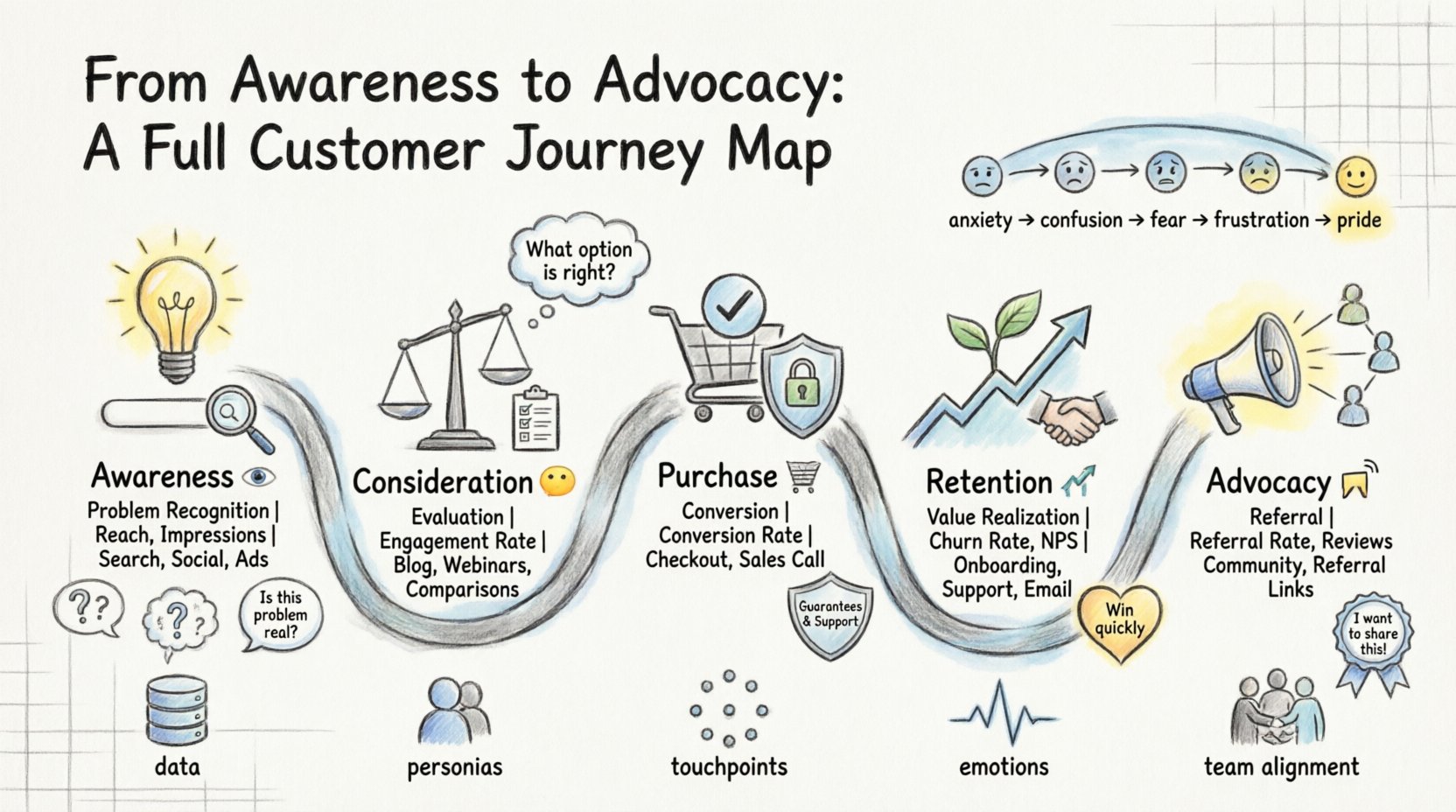
| Stage | Primary Goal | Key Metric | Typical Touchpoints |
|---|---|---|---|
| Awareness | Problem Recognition | Reach, Impressions | Search, Social, Ads |
| Consideration | Evaluation | Engagement Rate, Time on Page | Blog, Webinars, Comparisons |
| Purchase | Conversion | Conversion Rate, Cart Abandonment | Checkout, Sales Call |
| Retention | Value Realization | Churn Rate, NPS | Onboarding, Support, Email |
| Advocacy | Referral | Referral Rate, Reviews | Community, Referral Links |
Implementing Your Journey Map 🛠️
Creating a map is not a one-time event. It requires data collection, stakeholder alignment, and continuous iteration. The following steps outline a practical approach to building this asset.
1. Gather Qualitative and Quantitative Data
- Quantitative: Analyze analytics to see where users drop off or spend time.
- Qualitative: Conduct interviews and surveys to understand the emotional drivers behind the data.
- Direct Feedback: Listen to customer support logs and sales call recordings.
2. Define Personas
- Different customer types may have different journeys. Map the path for each major persona to ensure accuracy.
- Include demographics, goals, and pain points for each persona.
3. Map Touchpoints
- Identify every point of interaction. This includes digital (website, email) and physical (phone calls, in-person meetings).
- Highlight moments of truth where the customer forms a strong impression.
4. Identify Pain Points and Emotions
- Mark areas where the user feels frustrated, confused, or delighted.
- Emotional mapping helps teams empathize with the customer experience.
5. Align Internal Teams
- Share the map with sales, marketing, product, and support teams.
- Ensure everyone understands their role in the customer experience.
Common Obstacles in Journey Mapping 🚧
Even with a clear strategy, organizations often face challenges when executing a journey map. Recognizing these pitfalls early can save significant time and resources.
- Assumption-Based Mapping: Creating a map based on what the team thinks customers do, rather than what they actually do. Always validate with data.
- Siloed Departments: When marketing does not talk to support, the customer experience becomes disjointed. The map must cross departmental boundaries.
- Static Documents: A map printed once and filed away is useless. It must be a living document updated with new data and feedback.
- Ignoring the Negative: Focusing only on happy paths ignores where the business loses money. Map the failures and errors explicitly.
- Lack of Ownership: Without a designated owner to maintain the map, it will become outdated quickly.
Measuring Success and Iteration 📏
The value of a journey map lies in its ability to drive action. You must define how success looks for each stage and track it over time.
- Short-Term Wins: Look at conversion rate improvements after fixing specific friction points in the purchase stage.
- Long-Term Health: Monitor Customer Lifetime Value (CLV) and Net Promoter Score (NPS) to gauge overall journey quality.
- Feedback Loops: Regularly review customer feedback to see if the identified pain points have been resolved.
Iteration is the engine of improvement. As you fix one issue, a new one may emerge. The map should evolve alongside your business and your market.
Deep Dive: Emotional Mapping 🧠
Beyond the logical steps of a journey, emotions drive decisions. A customer might have the money and the need, but if they feel anxious or unsupported, they will not buy.
- Awareness Anxiety: “Is this problem real?” – Address with educational content.
- Consideration Confusion: “Which option is right?” – Address with clear comparisons.
- Purchase Fear: “What if I make a mistake?” – Address with guarantees and support.
- Retention Frustration: “Is this hard to use?” – Address with intuitive design and help.
- Advocacy Pride: “I want to share this” – Address with community and recognition.
By mapping these emotional states, teams can design interventions that reduce stress and increase satisfaction at critical moments.
The Role of Technology in Mapping 🖥️
While no single software defines the journey, data tools help visualize it. Organizations use various platforms to aggregate data from different channels to see the full picture.
- Analytics Platforms: Track user behavior across the site.
- CRM Systems: Record interactions and history.
- Survey Tools: Capture sentiment at specific intervals.
The goal is integration. Data from sales, support, and web analytics should flow into a single view to prevent blind spots.
Final Thoughts on Customer Experience 🌟
A customer journey map is a strategic tool that aligns business goals with customer needs. It requires discipline to maintain and empathy to execute. When done correctly, it reveals opportunities to reduce costs, increase revenue, and build deeper loyalty.
- Start with the customer, not the product.
- Validate assumptions with real data.
- Keep the map updated as the business changes.
- Empower employees to fix issues identified in the map.
The path from awareness to advocacy is not linear for every customer, but the principles remain the same. Focus on reducing friction, building trust, and delivering value at every step. This approach ensures a sustainable business model rooted in genuine customer relationships.
By following this framework, organizations can transform their operations to be more customer-centric. The result is a brand that people understand, trust, and willingly recommend.