

In the modern digital landscape, user experience design is no longer a peripheral function. It sits at the core of product strategy, operational efficiency, and revenue generation. However, a persistent disconnect often exists between the creative aspirations of design teams and the pragmatic targets of business leadership. This friction can stall projects, dilute brand identity, and obscure the true value of user-centered work.
The goal is not to force design to serve business at the expense of users, nor to place user needs above organizational viability. True success lies in integration. When design vision aligns with business objectives, the result is a product that is both desirable for the customer and viable for the company. This guide explores the mechanics of that alignment, offering a structured approach to bridging the gap between creative strategy and commercial reality.
Understanding the Business Landscape 🌍
To align effectively, designers must first speak the language of the organization. Business objectives are often quantifiable, time-bound, and tied to financial health. Understanding these metrics is the first step in demonstrating design value.
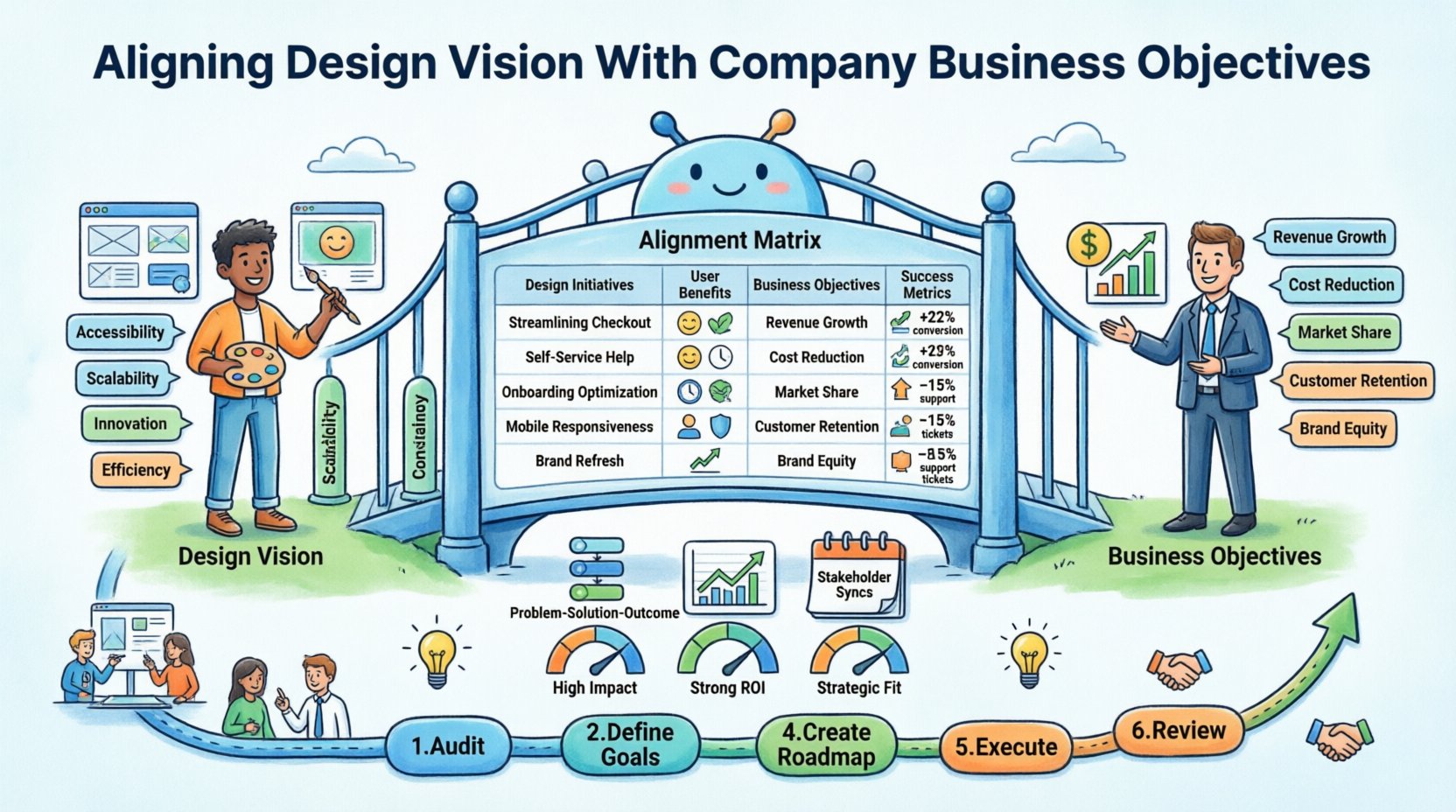
- Revenue Growth: How does the product contribute to top-line income?
- Cost Reduction: Can better design streamline operations or support workflows?
- Market Share: Is the product competing effectively against rivals?
- Customer Retention: Are users staying engaged over time?
- Brand Equity: Does the interface reinforce the company’s reputation?
Designers often focus on usability and aesthetics, which are vital. Yet, leadership focuses on the bottom line. The bridge between these two worlds is built on translation. When a designer proposes a new interaction pattern, they must articulate how that pattern supports one of the five objectives listed above.
Defining Design Vision 🎨
Design vision is the strategic north star for the user interface. It encompasses the aesthetic direction, interaction models, and emotional resonance of the product. A clear vision ensures consistency across touchpoints, reducing cognitive load for users and reinforcing brand identity.
However, a vision that exists in a vacuum is useless. It must be contextualized within the constraints and goals of the organization. Consider the following pillars of a robust design vision:
- Accessibility: Ensuring the product is usable by people with diverse abilities.
- Scalability: Creating systems that grow with the user base.
- Consistency: Maintaining a coherent look and feel across all channels.
- Innovation: Pushing boundaries to solve problems in new ways.
- Efficiency: Reducing the time it takes for users to complete tasks.
When these pillars are explicitly linked to business goals, the design vision transforms from an artistic statement into a strategic asset.
The Alignment Matrix 📊
One effective method to visualize the connection between design efforts and business outcomes is the Alignment Matrix. This tool maps specific design initiatives to specific business KPIs. It provides a clear roadmap for decision-making during the development lifecycle.
| Design Initiative | User Benefit | Business Objective | Success Metric |
|---|---|---|---|
| Streamlining Checkout Flow | Reduces friction and frustration | Revenue Growth | Conversion Rate Increase |
| Implementing Self-Service Help | Empowers users to find answers quickly | Cost Reduction | Support Ticket Volume Decrease |
| Onboarding Optimization | Clarifies value proposition immediately | Customer Retention | Day-30 Retention Rate |
| Mobile Responsiveness Update | Ensures access on any device | Market Share | Mobile Traffic Percentage |
| Brand Refresh | Improves recognition and trust | Brand Equity | Brand Sentiment Score |
Using a table like this forces specificity. It prevents vague promises like “we will make it better” and replaces them with measurable outcomes. This level of detail builds trust with stakeholders who need to see ROI.
Communication Frameworks 🗣️
Even with a clear matrix, communication remains the primary hurdle. Designers and business leaders often operate in different mental models. One prioritizes empathy and flow; the other prioritizes margin and timeline. Establishing a communication framework helps mitigate this friction.
1. The Problem-Solution-Outcome Model
When presenting a design concept, structure the narrative around three points:
- The Problem: Define the user pain point or business gap clearly.
- The Solution: Describe the design intervention proposed.
- The Outcome: Quantify the expected impact on the business objective.
2. Visual Data Storytelling
Numbers speak loudly, but visuals speak louder. Use data visualization to show trends in user behavior that correlate with business performance. Heatmaps, session recordings, and funnel analysis provide evidence that supports the design direction.
3. Regular Stakeholder Syncs
Aligning vision is not a one-time event. It requires continuous dialogue. Weekly or bi-weekly syncs allow teams to adjust course as market conditions change. These meetings should focus on progress against the alignment matrix defined earlier.
Measuring Success and ROI 📈
Without measurement, alignment is theoretical. To prove that design is driving business value, teams must establish a baseline and track changes over time. This process involves defining Key Performance Indicators (KPIs) that matter to both users and the company.
- Task Success Rate: Can users complete the primary action?
- Time on Task: How long does it take to complete a core workflow?
- Net Promoter Score (NPS): How likely are users to recommend the product?
- Bounce Rate: Are users leaving the site immediately after arrival?
- Customer Lifetime Value (CLV): Does the experience encourage long-term spending?
It is crucial to distinguish between vanity metrics and actionable metrics. Page views might look good, but if they do not correlate with conversion or retention, they offer little insight into business health. Focus on metrics that indicate user satisfaction leading to business growth.
Common Pitfalls to Avoid ⚠️
Even with the best intentions, teams often stumble when trying to merge design and business strategies. Recognizing these traps early can save significant time and resources.
- Ignoring Constraints: Designers sometimes propose solutions that are technically impossible or financially unviable within the current budget. Collaboration with engineering and finance teams early in the process prevents this.
- Over-Promising: Claiming that a design change will double revenue without data to back it up erodes credibility. Be conservative and realistic with projections.
- Focusing Only on the New: Optimizing legacy systems is often more valuable than building new features. Do not neglect the core product in the pursuit of innovation.
- Siloed Decision Making: If design decisions are made without input from sales or support, the final product may miss critical market signals.
- Equating Speed with Efficiency: Shipping fast is good, but shipping fast with poor quality leads to technical debt and user churn. Balance velocity with stability.
Cultivating a Design-Led Culture 🌱
Alignment is not just about processes; it is about culture. For design to be a strategic partner, the organization must value user input as much as financial input. This requires leadership buy-in and a shift in how success is defined internally.
When executives understand that design is a risk mitigation strategy, not just a decoration department, the dynamic changes. Design research identifies potential failures before they happen. Prototyping validates assumptions before money is spent on development.
Steps to Cultural Shift:
- Include Design in Strategy Meetings: Ensure design leads sit at the table when high-level decisions are made.
- Share Research Widely: Make user insights accessible to all departments, not just the product team.
- Celebrate User Wins: Highlight stories where design improvements directly helped a customer.
- Invest in Training: Help non-designers understand basic usability principles.
- Measure Design Contribution: Create dashboards that show the impact of design work on business metrics.
Long-Term Sustainability 🔄
Alignment is an ongoing journey. Business objectives evolve as the market shifts, and design visions must adapt accordingly. A product that was successful three years ago may require a complete overhaul today to meet new competitive standards.
Sustainability comes from building a flexible design system. A robust system allows teams to iterate quickly without rebuilding the foundation every time. It ensures that as the business pivots, the user experience remains consistent and reliable.
Furthermore, sustainability involves financial health. A design strategy that requires constant, expensive overhauls is not sustainable. The goal is to build an experience that scales efficiently, reducing the marginal cost of adding new features or expanding to new markets.
Practical Implementation Steps 🛠️
To move from theory to practice, teams can follow a structured implementation plan. This ensures that alignment is not left to chance.
- Audit Current State: Review existing design assets and business goals to identify gaps.
- Define Shared Goals: Create a document that lists the top three objectives for both departments.
- Establish KPIs: Agree on the metrics that will be used to measure success.
- Create a Roadmap: Map out design initiatives that directly address the shared goals.
- Execute and Test: Build, measure, and learn. Run experiments to validate assumptions.
- Review and Adjust: Hold quarterly reviews to assess progress and pivot if necessary.
The Human Element 👥
While data and strategy are critical, the human element remains central. Both designers and business leaders are people with motivations and biases. Empathy is required on both sides. Designers must understand the pressure business leaders face regarding deadlines and budgets. Leaders must understand the pressure designers face regarding user needs and ethical considerations.
Building relationships fosters better outcomes. When stakeholders trust the design team, they are more likely to support bold ideas. When the design team trusts the business team, they are more likely to understand the constraints they are working within. This mutual respect is the glue that holds the alignment together.
Final Thoughts on Strategic Integration 🚀
The relationship between design and business is not a zero-sum game. Optimizing for one does not require sacrificing the other. By treating design as a strategic business function, organizations can unlock significant value. This involves clear communication, measurable goals, and a shared commitment to user success.
When the vision of the designer meets the vision of the business, the result is a product that stands the test of time. It serves the user, satisfies the customer, and grows the company. This alignment is the hallmark of a mature, high-performing organization.
Start today. Review your current objectives. Check your design roadmap. Look for the intersections. The path to a successful product is paved with these connections.