

As a UX designer, you often sit at the intersection of user needs and business goals. However, you rarely hold the title of “Product Owner” or “Engineering Lead.” This means you must navigate complex organizational structures to ensure user experience remains a priority. Influencing the product roadmap without direct authority is a critical skill for anyone who wants their work to have a lasting impact. It requires a blend of empathy, strategic communication, and evidence-based advocacy.
This guide outlines practical methods to gain traction for your design initiatives. You will learn how to align your vision with company objectives, build trust with stakeholders, and secure resources for your projects. The goal is not to force decisions but to create an environment where the best ideas win, regardless of hierarchy.
Understanding the Power Dynamics 🧩
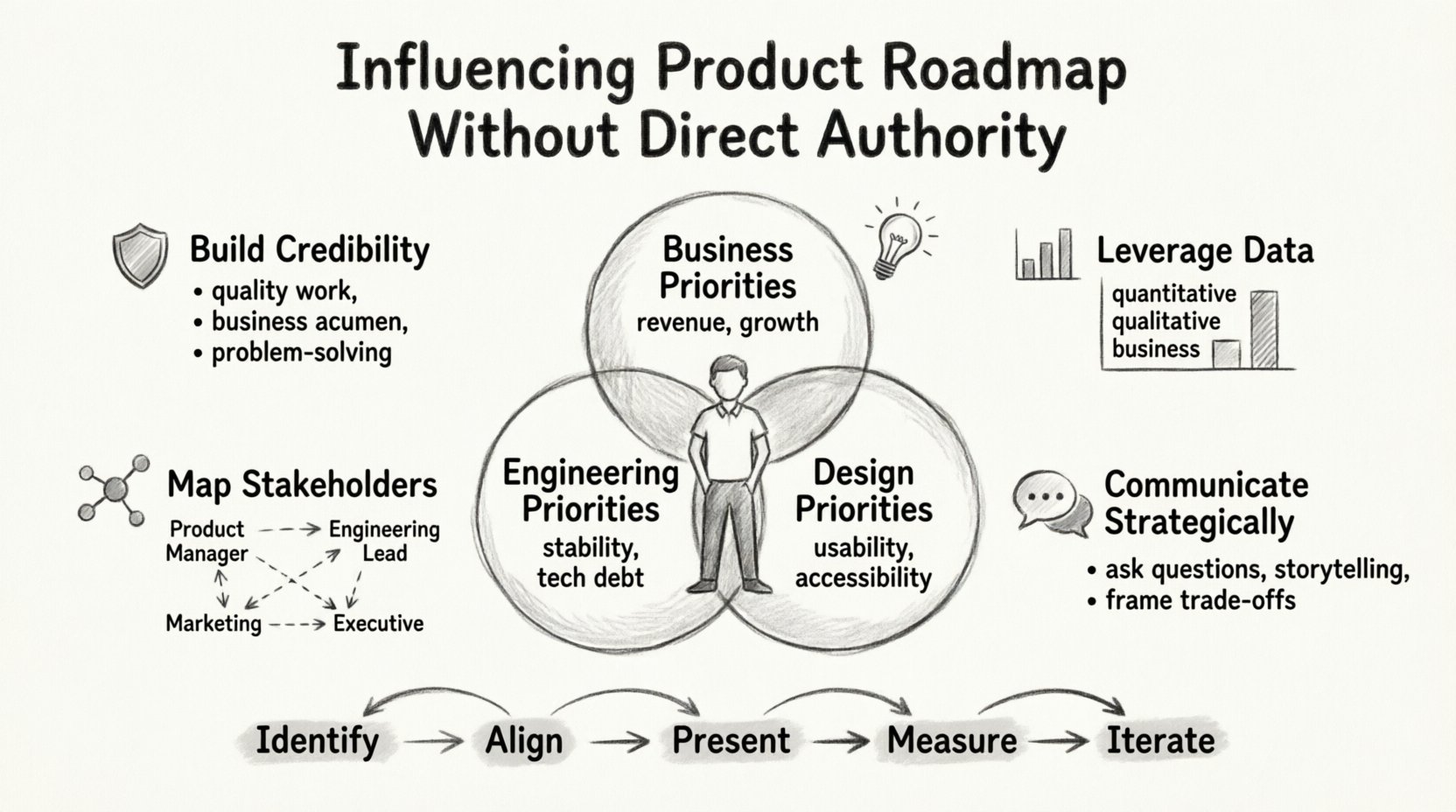
Before attempting to shift the roadmap, you must understand the landscape. Product development is a collaborative effort involving engineering, marketing, sales, and leadership. Each group has different priorities and pressures. Your role is to bridge these gaps.
- Engineering Priorities: Stability, technical debt reduction, and scalability.
- Business Priorities: Revenue growth, customer acquisition, and retention.
- Design Priorities: Usability, accessibility, and user satisfaction.
When you propose a change, you are asking others to shift their focus. This creates friction. To overcome this, you need to speak the language of the decision-makers. If you talk about “user flow” to a CFO, they may not understand the business value. If you talk about “conversion rate lift” to an engineer, they will listen.
Recognize that authority is not the only source of influence. Expertise, relationships, and data are often more powerful levers. You do not need a manager badge to lead a change. You need to demonstrate value consistently.
Establishing Design Credibility 🛡️
Credibility is the currency of influence. Stakeholders will not invest in a roadmap change if they do not trust the designer proposing it. Building this trust takes time and consistent delivery.
1. Deliver High-Quality Work
Your output is your first impression. Ensure that your designs are pixel-perfect, accessible, and thoroughly documented. When your work is reliable, people stop micromanaging you and start trusting your judgment.
- Validate assumptions before building.
- Provide clear rationale for design decisions.
- Meet deadlines consistently.
2. Show Business Acumen
Understand how the company makes money. If you can tie your design work to revenue or cost savings, you become a business partner rather than a service provider. Ask questions about the metrics that matter to the organization.
- What are the key performance indicators for this quarter?
- How does this feature fit into the broader strategy?
- What are the risks of not doing this work?
3. Be a Problem Solver
Do not wait for tasks to be assigned. Identify problems before they become urgent. If you notice a drop in user engagement, investigate the cause and propose a solution. Proactive behavior signals leadership.
Data-Driven Decision Making 📊
Opinions are subjective; data is objective. When you lack authority, data becomes your strongest ally. It removes emotion from the conversation and provides a neutral ground for debate.
Types of Data to Leverage
- Quantitative Data: Analytics, conversion rates, bounce rates, and time on task. This tells you what is happening.
- Qualitative Data: User interviews, usability testing notes, and support tickets. This tells you why it is happening.
- Business Data: Churn rates, customer lifetime value, and support costs.
Presenting Data Effectively
Do not dump raw numbers on your stakeholders. Context is king. When presenting findings, follow this structure:
- The Problem: State the issue clearly.
- The Evidence: Show the data that supports the issue.
- The Impact: Explain how this affects the business.
- The Solution: Propose a design intervention.
For example, instead of saying “Users are confused by this button,” say “Users are dropping off at the checkout step 30% more often than industry benchmarks. Our testing shows the button label is unclear. Fixing this could recover $50,000 in monthly revenue.”
Stakeholder Mapping and Engagement 🤝
You cannot influence everyone at once. Identify who holds the keys to the roadmap and focus your energy there. Some stakeholders are decision-makers, while others are influencers.
Stakeholder Influence Matrix
| Role | Goal | Influence Level | Strategy |
|---|---|---|---|
| Product Manager | Delivery & Strategy | High | Partner closely; align on vision. |
| Engineering Lead | Feasibility & Quality | Medium | Respect technical constraints; collaborate early. |
| Marketing Lead | Growth & Messaging | Medium | Show how design supports campaigns. |
| Executive Sponsor | Revenue & Vision | High | Present high-level impact and ROI. |
Once you have mapped your stakeholders, tailor your communication style to each group. A technical lead needs to know about implementation costs. An executive needs to know about market opportunity. Sales teams need to know about competitive advantages.
Regular check-ins are essential. Do not wait for formal meetings to share updates. A quick message or a casual chat can build the rapport needed when you need to make a tough request later.
Strategic Communication Techniques 🗣️
How you say something is often as important as what you say. Influence requires persuasion, not command. Use these techniques to frame your requests.
1. Ask Questions, Don’t Declare
Instead of saying “This feature is required,” ask “What would happen if we prioritized this over the current roadmap item?” This invites collaboration and makes the stakeholder feel like they are part of the decision.
2. Use Storytelling
Humans connect with stories better than data. Share a specific user story. Describe a real person struggling with the current design. Make the problem feel urgent and human.
3. Frame as a Trade-off
Product management is about trade-offs. Acknowledge this. Say, “If we build this, we delay that. Here is why the benefit outweighs the cost.” This shows you understand the reality of resource constraints.
4. Focus on the Future
Don’t just talk about fixing bugs. Talk about the long-term vision. How does this design change position the company for next year? Position your work as an investment, not an expense.
Navigating Conflicting Priorities ⚖️
Conflict is inevitable. Engineering may say a feature is too risky. Sales may want a quick win that compromises quality. Your job is to find the middle ground.
- Seek Common Ground: Find the goal everyone agrees on. Usually, it is user satisfaction or revenue.
- Propose Alternatives: If the full request is rejected, offer a smaller version that still solves the core problem.
- Document the Decision: If a design change is rejected, document the reasoning. This protects you if the outcome is negative later.
Never say “no” without offering a solution. If you block a request, you must explain why and suggest a path forward. This keeps the relationship positive.
Measuring and Reporting Impact 📈
Once your ideas are on the roadmap and implemented, you must prove they worked. This creates a cycle of trust that makes future influence easier.
Track Key Metrics
Define success before you start. Did the new flow increase sign-ups? Did the redesign reduce support tickets? Measure these metrics and report them back to the team.
Create a Portfolio of Wins
Keep a record of your successful projects. When you need to advocate for a new initiative, reference past successes. “Last time we did X, we saw Y improvement. We can expect similar results here.”
Common Pitfalls to Avoid ⚠️
Even experienced designers make mistakes when trying to influence. Be aware of these common traps.
- Being Too Technical: Don’t overwhelm stakeholders with design jargon. Keep it simple.
- Ignoring Constraints: Don’t propose solutions that are impossible to build within the timeline. Understand the limits.
- Going Over Heads: Avoid bypassing your direct manager or product lead unless absolutely necessary. It can damage trust.
- Chasing Perfection: Don’t insist on a perfect design if a good-enough version gets the job done faster. Speed matters.
Building a Network of Allies 🤝
One of the most effective ways to influence is to build a network of support. Find other designers, product managers, or engineers who care about quality. When you have allies, you amplify your voice.
- Collaborate on cross-functional projects.
- Share resources and insights with peers.
- Support their initiatives so they support yours.
Peer pressure can be positive. If the whole team agrees on a standard, it is harder for leadership to ignore.
Final Thoughts on Roadmap Influence
Gaining influence over the product roadmap is a journey, not a destination. It requires patience, persistence, and a genuine commitment to the user and the business. By building credibility, leveraging data, and communicating strategically, you can shape the future of your product without holding a title of authority.
Remember that every interaction is an opportunity to build trust. Treat your stakeholders as partners, not obstacles. When you align your goals with theirs, you create a path where the best ideas naturally rise to the top. Your influence grows as your impact becomes undeniable.
Start small. Pick one initiative and apply these principles. Measure the results. Learn from the process. Over time, your voice will carry more weight, and your designs will have a greater impact on the product and the users who rely on it.