

Design sprints compress months of work into a single week, creating a high-pressure environment where speed often clashes with perfection. Within this tight timeframe, the most significant variable is not the process itself, but the people involved. Stakeholders often arrive with preconceived notions about outcomes, timelines, and deliverables. When expectations diverge from reality, friction arises, threatening the integrity of the sprint and the final product.
Successfully navigating these dynamics requires more than just facilitation skills; it demands a strategic approach to communication, boundary setting, and psychological safety. This guide provides a thorough examination of how to manage difficult stakeholder expectations during design sprints. We will explore preparation, execution, and post-sprint alignment without relying on specific software tools, focusing instead on universal principles of human interaction and project management.
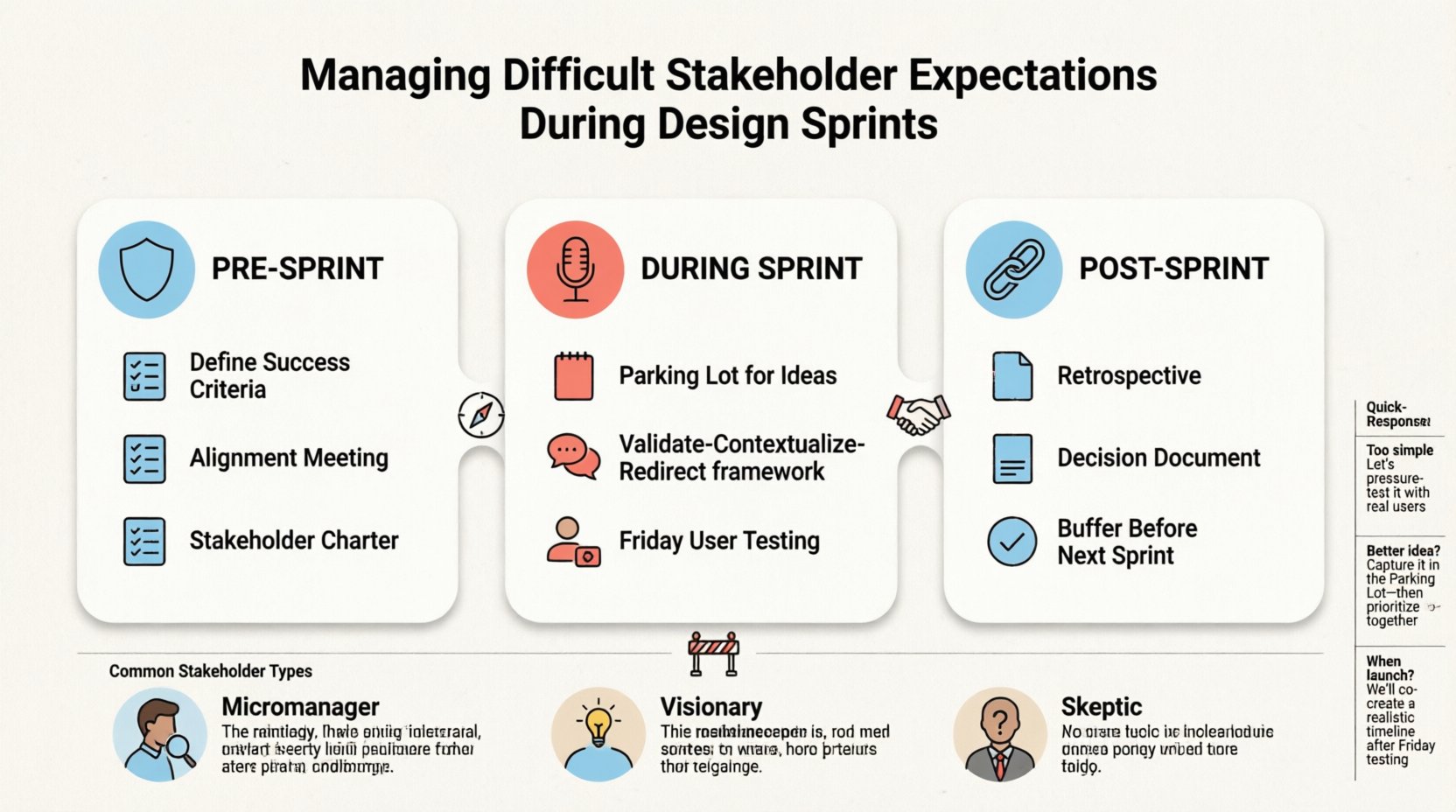
Understanding the Landscape of Stakeholder Expectations 🧭
Before addressing the friction, one must understand its source. Stakeholders are not a monolith. They represent various departments, each with their own KPIs, fears, and incentives. A stakeholder from marketing might prioritize speed to market, while engineering might prioritize technical feasibility. When these priorities collide during a sprint, confusion ensues.
The Psychology of Expectation Mismatch
Expectations are rarely stated explicitly. They are often inferred from tone, historical precedent, or the perceived authority of the individual. When a stakeholder expects a pixel-perfect final product after five days, they are often operating under a misunderstanding of the sprint methodology. The sprint is about learning, not shipping. This distinction must be made clear early on.
Common psychological drivers behind difficult expectations include:
- Fear of Loss: Concerns that resources are being wasted if the outcome is not immediately usable.
- Prior Trauma: Past projects that failed due to scope creep or poor communication.
- Authority Assertion: Using the sprint to validate a personal preference rather than user needs.
- Information Asymmetry: Stakeholders often do not understand the limitations of user research or prototyping.
Pre-Sprint Preparation: Setting the Stage 🛡️
The battle for alignment is won before the first day begins. Preparation is the most critical phase for expectation management. Rushing into the sprint without a defined charter invites conflict.
1. Define the Success Criteria
Clarity is the antidote to ambiguity. Before the team assembles, draft a document that outlines what success looks like. This is not a promise of a specific feature, but a promise of a specific outcome.
- Define the Problem: Clearly state the challenge being addressed. Avoid vague terms like “improve experience” in favor of “reduce checkout friction for mobile users.”
- Set Constraints: Explicitly list time, budget, and scope limitations. If the sprint is five days, the output must be a prototype, not a coded product.
- Identify Decision Makers: Know who has the final say. This prevents “design by committee” where too many voices dilute the focus.
2. The Pre-Sprint Alignment Meeting
Schedule a dedicated session with key stakeholders one week prior. The goal is not to show designs, but to align on the rules of engagement.
- Review the Process: Walk them through the daily agenda. Explain that Monday is for understanding, Tuesday for sketching, Wednesday for deciding, Thursday for building, and Friday for testing.
- Establish Communication Channels: Agree on how updates will be shared. Will there be a daily stand-up? A summary email? A digital whiteboard update?
- Address the “What If”: Discuss scenarios where the team needs to pivot. Ensure stakeholders know they have the authority to greenlight a pivot if the data supports it.
3. The Stakeholder Charter
Create a simple agreement document. This serves as a reference point throughout the week. It should include:
- Who is on the core team?
- Who are the observers?
- When can stakeholders interrupt?
- What is the protocol for feedback?
During the Sprint: Facilitation Techniques 🎤
Once the sprint begins, the focus shifts to execution. However, the facilitator must remain vigilant regarding stakeholder presence. Their involvement is necessary but must be managed carefully to avoid derailment.
1. Managing the “Idea Flood”
On Tuesday, when the team is sketching, stakeholders often want to contribute ideas. While their input is valuable, unstructured ideation leads to scope creep. Use specific techniques to manage this flow.
- The “Parking Lot”: Create a dedicated space for ideas that do not fit the current scope. Acknowledge them, write them down, but do not integrate them immediately.
- Time Boxing: Limit the time stakeholders can speak during specific sessions. Use a timer to keep discussions focused.
- Redirect to Users: When a stakeholder suggests a feature, ask, “How does this solve a specific user problem?” Force them to connect their idea to the research data.
2. Handling Objections in Real-Time
Objections are natural. They indicate engagement. The goal is not to silence them, but to channel them constructively.
When a stakeholder objects to a direction, avoid defensiveness. Use the following response framework:
- Validate: “I understand why that is a concern given the timeline.”
- Contextualize: “Our goal right now is to validate the risk, not solve the engineering challenge.”
- Redirect: “Let’s note that for the post-sprint review and focus on the prototype for now.”
3. The Friday Test
The final day is high stakes. Stakeholders often worry that the prototype will fail. Prepare them for this possibility. A failed test is a success if it saves months of development time.
- Frame the Goal: Remind them that the goal is to learn, not to prove the idea is perfect.
- Manage Reactions: If a user says “I don’t like this,” do not let the stakeholder jump in to defend the design. Let the silence sit. The data speaks louder than opinion.
- Document Everything: Ensure all feedback is recorded verbatim. This prevents stakeholders from later claiming their concerns were ignored.
Common Stakeholder Scenarios and Responses 📊
Anticipating objections allows for better preparation. Below is a table of common scenarios and recommended responses.
| Scenario | Underlying Concern | Recommended Response |
|---|---|---|
| “This looks too simple.” | Concern about perceived value or effort. | Response: “The prototype is a tool for testing, not the final product. We are testing the core flow to ensure it works before we invest in visual details.” |
| “Why aren’t we using the current branding?” | Concern about brand consistency. | Response: “We are using placeholders to focus on functionality. Branding will be applied in the next phase after we validate the structure.” |
| “I have a better idea. Let’s do that instead.” | Desire for control or innovation. | Response: “That is an interesting direction. Can we park it for the post-sprint backlog? We need to finish the current hypothesis to avoid scope creep.” |
| “When will this be ready to launch?” | Impatience with the process. | Response: “The sprint concludes with a validated prototype. Engineering will then estimate the timeline for the full build based on what we learned today.” |
| “We need to involve more people.” | Desire for consensus. | Response: “Adding more people to the decision-making group slows down the process. Let’s get the core team’s feedback now, then share the results for wider input.” |
Post-Sprint Handoff: Closing the Loop 🔗
The sprint ends on Friday, but the work continues. How you hand off the results determines whether the momentum is maintained or lost.
1. The Retrospective
Hold a retrospective with the core team and stakeholders. Discuss what went well and what did not. This builds trust for future sprints.
- Highlight Wins: Celebrate the learning. Even if the idea was rejected, the knowledge gained is valuable.
- Discuss Process: Did the timeline work? Was the facilitation effective? This improves future sprints.
2. The Decision Document
Produce a clear summary of decisions made. This prevents stakeholders from revisiting old arguments later.
- What We Did: Summary of the prototype built.
- What We Learned: Key insights from user testing.
- Next Steps: Clear action items. Who is responsible for what?
3. Managing the “Second Sprint”
Often, stakeholders want to start the next sprint immediately. This can be risky. Ensure the team has time to process the data before jumping into execution.
- Schedule a Buffer: Plan a week of integration time before the next sprint begins.
- Re-evaluate Scope: Use the new data to adjust the scope for the next phase. Do not carry over old assumptions.
Handling Specific Conflict Archetypes 🎭
Every team has different personalities. Identifying the type of stakeholder helps in tailoring the approach.
The Micromanager
This stakeholder wants to see every pixel. They check in constantly and question every decision.
- Strategy: Over-communicate. Send daily updates without them asking. Involve them in specific decisions where their input is crucial, but limit their access to the core team’s working sessions.
- Tactic: “I know you want to be involved. Let’s block 30 minutes on Wednesday for a deep-dive review. That way, we can address all your points in one go without interrupting the team’s flow.”
The Visionary
This stakeholder sees the future but ignores the details. They often suggest grand features that are not feasible.
- Strategy: Validate their vision but ground it in the sprint goal. Ask them to help define the constraints.
- Tactic: “That vision is exciting. To get there, we need to solve the foundation first. Let’s focus this sprint on the foundation so we can build that vision later.”
The Skeptic
This stakeholder doubts the process. They believe the sprint is a waste of time.
- Strategy: Show evidence. Use data from previous sprints or industry standards to justify the method.
- Tactic: “I understand you have concerns about the time investment. However, the cost of building the wrong thing is higher. This sprint is an insurance policy against that risk.”
Preventing Scope Creep 🚧
Scope creep is the silent killer of design sprints. It happens when new requests are added without removing old ones.
1. The “Or” Rule
When a new idea is proposed, ask the proposer to choose what will be removed. “If we add this, what must we drop?” This forces trade-offs to be explicit.
2. The Definition of Done
Define exactly what “done” means for the prototype. Is it clickable? Is it coded? Is it tested? Stick to this definition.
3. The Change Request Log
If a change is absolutely necessary, log it. Track the impact on time and resources. This makes the cost of change visible.
Building Long-Term Trust 🤝
One sprint is not enough to build trust. Consistency is key. If you deliver on your promises in the first sprint, stakeholders will trust you in the second.
- Be Honest: If a timeline is unrealistic, say so. Do not promise the moon to keep the peace.
- Share Failures: If a test fails, share it openly. This shows integrity and commitment to truth over ego.
- Respect Time: Start and end meetings on time. This demonstrates professionalism.
Final Thoughts on Alignment 🏁
Managing difficult stakeholder expectations is not about controlling people; it is about guiding a process that respects everyone’s time and goals. By preparing thoroughly, facilitating with clarity, and following up with precision, you can transform friction into fuel. The design sprint becomes a tool for collaboration rather than a battleground for opinions.
Remember that the goal is not to satisfy every request, but to deliver the best possible outcome for the user and the business. When stakeholders understand that the process is designed to de-risk the project, they become partners rather than obstacles. This shift in mindset is the true measure of success in any design sprint.