

Design is a deeply personal endeavor. When you present a user interface, a wireframe, or a complex interaction flow, you are not just sharing pixels; you are sharing your reasoning, your research, and your problem-solving process. Consequently, feedback often feels personal. It triggers a natural defensive reaction. You might feel the urge to justify every choice, explain away perceived flaws, or shut down when a stakeholder suggests a change that contradicts your original intent.
This emotional response is common, but it can stall progress. In a UX design environment, the goal is not to prove you are right, but to find the right solution for the user. Learning to ask for design feedback without feeling defensive is a critical skill for any designer who wants to grow their career and deliver better products. This guide explores the psychology behind defensiveness, practical strategies for framing requests, and techniques for processing critique with clarity.
Understanding the Roots of Defensiveness 🧠
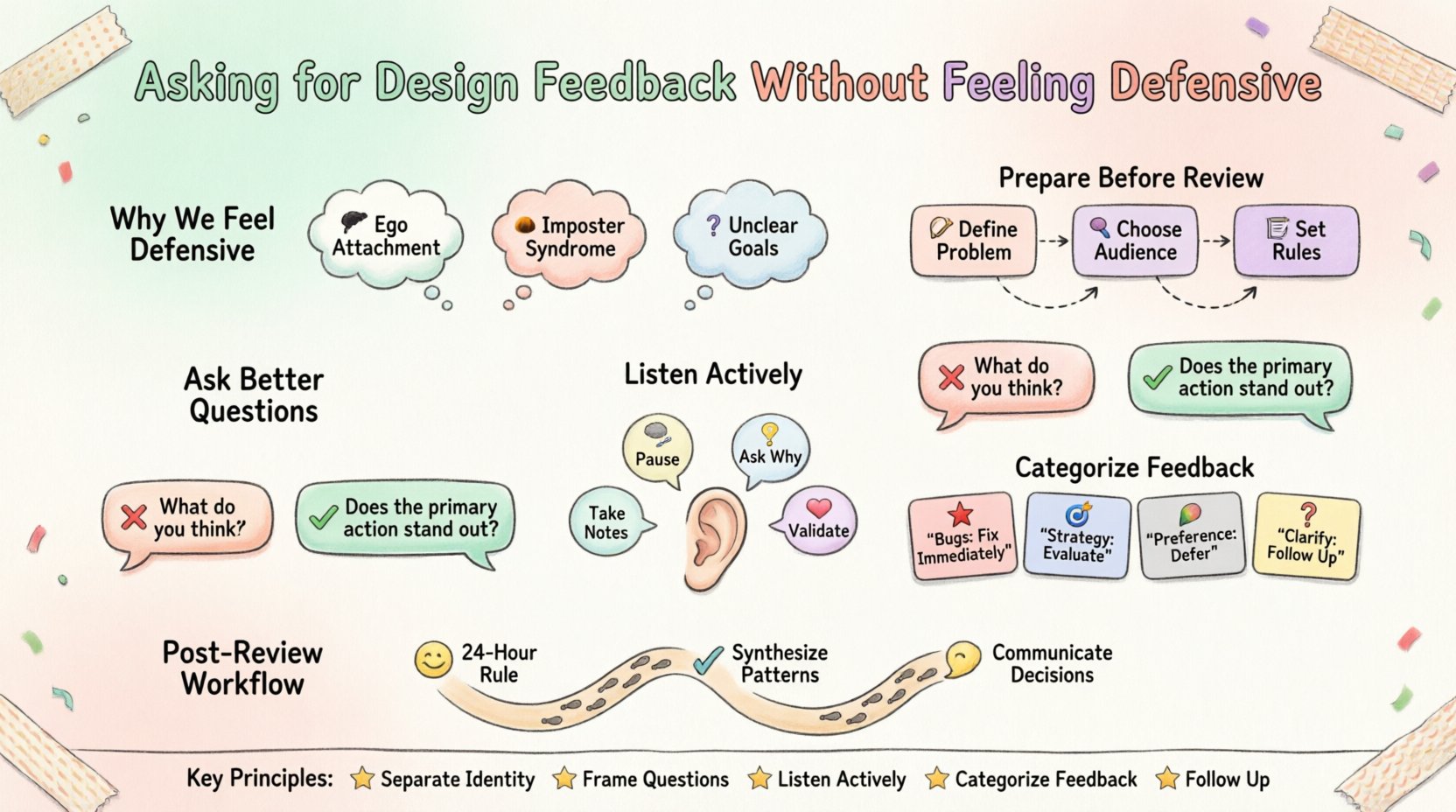
Before you can manage your reaction to feedback, you must understand where it comes from. Defensiveness is rarely about the design itself. It is usually about identity and security.
Ego Attachment: We often conflate our work with our worth. A critique of a button color can feel like a critique of your taste.
Imposter Syndrome: You may fear that feedback exposes a lack of knowledge or skill.
Time Investment: Hours spent refining a layout make it hard to discard without feeling like a loss.
Unclear Goals: If the problem statement is vague, feedback feels subjective rather than objective.
Recognizing these triggers allows you to separate your professional output from your personal identity. When you view your designs as hypotheses rather than finished products, feedback becomes data for validation instead of judgment.
Preparing the Ground Before the Review 📋
How you present your work sets the stage for how it is received. If you walk into a meeting unsure of the goals, the reviewers will likely fill the gap with their own assumptions. Preparation is the first line of defense against defensiveness.
1. Define the Specific Problem
Do not simply say, “Here is the dashboard.” Instead, frame the presentation around a specific challenge. Are you trying to reduce click depth? Improve readability for mobile users? Increase conversion on a specific flow? When the context is clear, feedback becomes targeted.
2. Choose the Right Audience
Not all feedback is equal. A stakeholder might care about business metrics, while a peer cares about interaction patterns. A user cares about usability. Group your reviews appropriately.
Internal Reviews: Focus on consistency, accessibility, and brand alignment.
Stakeholder Reviews: Focus on business goals, timelines, and feasibility.
User Testing: Focus on task completion and mental models.
3. Set the Rules of Engagement
Explicitly state how you want the feedback to flow. This removes ambiguity. You might say, “I am looking for high-level feedback on the navigation structure today, not details on the font size.” This guides the reviewer and protects you from nitpicking that doesn’t serve the current phase.
How to Ask for Feedback Effectively 🗣️
The way you ask questions dictates the quality of the answers you receive. Vague questions invite vague opinions. Specific questions invite actionable insights. Here is how to shift the dynamic from subjective preference to objective problem solving.
Bad: “What do you think?”
This places the burden on the reviewer to find something wrong. It invites a broad, often negative, sweep of the interface. It also invites personal taste.
Good: “I am unsure if the hierarchy is clear. Does the primary action stand out to you?”
This directs attention to a specific area of concern. It acknowledges uncertainty without undermining confidence. It invites a binary or scalar answer that helps you decide.
Good: “I have two options for the onboarding flow. Option A is faster, Option B is more educational. Which aligns better with our current user needs?”
This presents a choice rather than a blank canvas. It forces the reviewer to choose based on strategy rather than preference.
The Art of Listening During the Review 🎧
Once you have asked the questions, your job shifts to listening. This is where defensiveness often spikes. You will hear suggestions you disagree with. Here is how to manage that moment.
Pause Before Reacting: Take a breath. Do not interrupt immediately to explain why you made a choice. Let the thought finish.
Take Notes: Writing things down signals that you value the input. It also creates a buffer between hearing the words and processing them.
Ask Clarifying Questions: If a suggestion seems odd, ask “Why?” or “What problem are you trying to solve with this?” Often, a bad solution points to a valid underlying problem.
Validate the Emotion: If a stakeholder is frustrated, acknowledge it. “I understand this delay is impacting your timeline.” Do not argue against the feeling.
Categorizing Feedback for Processing 📊
Not all feedback is created equal. Some will help you ship a better product, while others may be distractions. Use a taxonomy to sort feedback immediately after the meeting.
Category | Description | Action Required |
|---|---|---|
Objective Bugs | Errors, broken links, accessibility violations, or logic gaps. | Fix Immediately. These are non-negotiable. |
Strategic Alignment | Feedback regarding business goals, KPIs, or target audience fit. | Evaluate & Integrate. If the business goal shifts, the design must follow. |
Subjective Preference | “I don’t like the blue,” “I prefer the other style.” d> | Defer or Dismiss. Unless backed by data, these are opinions. Trust your expertise unless a clear reason is given. |
Clarification Needed | The reviewer wants something but cannot articulate why. | Follow Up. Schedule a separate call to dig deeper. |
This table helps you depersonalize the feedback. If something is marked as “Subjective Preference,” you do not need to feel defensive. It is a preference, not a flaw in your work.
Scripts for Navigating Difficult Feedback 💬
There will be moments when feedback feels aggressive or uninformed. You need professional phrases to maintain boundaries without shutting down collaboration.
When the Feedback is Vague
You: “I want to make sure I implement this correctly. Can you give me a specific example of what isn’t working? Is it the layout or the content?”
When the Feedback Contradicts Data
You: “Our research showed that 80% of users prefer this path. I am open to changing it, but I want to understand the reasoning so we don’t lose that insight.”
When the Feedback is Overwhelming
You: “I appreciate all these points. There is a lot to process here. Let me prioritize the critical issues and get back to you with a plan.”
When the Feedback is Personal
You: “I want to focus on the design outcomes here. Let’s discuss how this change impacts the user journey.”
The Post-Review Workflow 🔄
Once the meeting is over, the real work begins. How you process the feedback determines your mental state moving forward.
1. The 24-Hour Rule
Do not make immediate changes to the design based on feedback. Give yourself time to cool off. Emotions settle after a night’s sleep. Often, a suggestion that seemed urgent or offensive will lose its charge.
2. Synthesize, Don’t Just List
Don’t just create a checklist of changes. Look for patterns. If three people mention the same issue, it is a signal. If one person mentions it and others ignore it, it is an outlier.
3. Communicate Decisions
After you have revised the design, explain what you changed and why. This closes the loop. It shows you listened, but it also asserts your professional judgment. “I kept the navigation simple because the data showed users were dropping off on complex menus.”
Building a Feedback Culture 🌱
Defensiveness is often a symptom of a culture that treats design as a finished art piece rather than a collaborative process. You can influence the environment around you.
Lead by Example: When you receive feedback on your work, thank the person. Model the behavior you want to see.
Normalize Iteration: Share early sketches and unfinished work. This signals that the work is not precious and invites collaboration earlier.
Separate People from Problems: When a design fails, focus on the process that led there, not the person who drew it.
Common Pitfalls to Avoid ⚠️
Even with the best intentions, there are traps that lead back to defensiveness. Be aware of these common behaviors.
Over-Explaining: If you spend more time explaining your process than listening to feedback, you are signaling insecurity.
Deflecting: “That won’t work because of the browser limitations” is a conversation stopper. Try “That is a great idea, here is how we might test that feasibility.”
Seeking Validation: Asking for feedback to confirm your own bias is not feedback. It is approval seeking. Be willing to be wrong.
Ignoring Non-Verbal Cues: If a reviewer looks confused or frustrated, pause. Ask if they understand the flow before moving to the next screen.
The Long-Term Impact of Resilience 🚀
Mastering the art of receiving feedback is a career multiplier. Designers who can navigate critique effectively become trusted advisors rather than order-takers. They build relationships based on trust and shared goals.
When you stop feeling defensive, you free up mental energy. You spend less time justifying your choices and more time refining the solution. You become faster, more adaptable, and more valuable to your organization.
Remember that every piece of feedback is an opportunity to make the product better. It is not a verdict on your competence. It is data. Treat it as such. With practice, you will find that the design review room becomes a place of collaboration rather than a battlefield.
Summary of Key Principles 📝
Separate Identity from Output: Your work is not you.
Frame Questions Specifically: Guide the feedback to where you need it.
Listen Actively: Pause, take notes, and ask clarifying questions.
Categorize Feedback: Distinguish between bugs, strategy, and preference.
Follow Up: Close the loop by communicating your decisions.
By adopting these practices, you transform the feedback loop from a source of anxiety into a powerful engine for growth. You build a career defined by resilience, clarity, and continuous improvement.