

Due diligence represents one of the most critical phases in any high-stakes business transaction. Whether you are preparing for a merger, acquisition, investment round, or a strategic partnership, the scrutiny applied during this period is rigorous. It is not merely a checklist; it is a comprehensive examination of your organization’s health, risks, and potential. To navigate this effectively, many leaders turn to the SWOT analysis framework. However, standard SWOT exercises often lack the specificity required for formal audits. This guide details how to leverage SWOT insights to answer due diligence questions with authority, clarity, and strategic depth. 📈
🧐 Understanding the Due Diligence Environment
Before diving into the SWOT framework, it is essential to understand the landscape you are operating within. Due diligence is not a monolith; it is composed of several distinct layers, each with its own set of questions and expectations. The process typically involves three primary categories: financial, legal, and operational due diligence. Each category probes different aspects of your business, requiring a tailored approach to information disclosure. 🕵️♂️
- Financial Due Diligence: Focuses on the accuracy of financial statements, cash flow stability, debt obligations, and revenue recognition practices. Auditors will look for inconsistencies between reported figures and actual operational performance.
- Legal Due Diligence: Examines contracts, intellectual property ownership, litigation history, and regulatory compliance. This area is high-risk, as hidden liabilities can derail a deal.
- Operational Due Diligence: Assesses the efficiency of internal processes, technology stack, supply chain resilience, and human capital. This is where the day-to-day reality of the business is scrutinized.
When stakeholders request information, they are often looking for validation of your strategic narrative. They want to know if your business model is robust and if the projected growth is grounded in reality. This is where the SWOT analysis becomes a vital tool. It provides a structured way to categorize internal and external factors, allowing you to anticipate questions and prepare comprehensive answers. 📋
🛡️ Reframing SWOT for Audits
A standard SWOT analysis is often a brainstorming exercise used for internal strategy. It identifies Strengths, Weaknesses, Opportunities, and Threats. In the context of due diligence, this framework must be shifted from possibility to evidence. Investors and auditors do not want theoretical strengths; they want documented assets. They do not want vague threats; they want risk mitigation plans. ⚖️
To make SWOT effective for this purpose, every item in your analysis must be backed by data. Here is how the framework transforms:
- Strengths: These are your verified competitive advantages. Examples include proprietary technology, exclusive contracts, or a dominant market share supported by metrics.
- Weaknesses: These are operational gaps or liabilities that are known and managed. Hiding these is dangerous; acknowledging them with a mitigation strategy builds trust.
- Opportunities: These are market conditions you can capitalize on. They must be realistic, not speculative dreams.
- Threats: These are external risks that could impact performance. This includes regulatory changes, competitor actions, or supply chain disruptions.
By grounding each quadrant in factual data, you create a document that serves as a reference point for answering inquiries. It ensures consistency across different teams, from finance to legal, preventing conflicting information from reaching the table. 🤝
📊 Preparing Your Data Assets
Having the insights is only half the battle; organizing them for access is the other. During due diligence, you will be inundated with requests for data. If your SWOT analysis is siloed or disorganized, you will struggle to provide timely answers. Preparation is key to maintaining momentum. ⏱️
Start by creating a centralized repository for all SWOT-related documentation. This should include:
- Supporting Evidence: For every strength listed, have the contract, patent, or financial report ready. For every weakness, have the action plan ready.
- Version Control: Ensure that the SWOT document you present is the latest version. Outdated data can raise questions about your internal governance.
- Cross-Departmental Alignment: Ensure that the sales team’s understanding of “Strengths” matches the legal team’s understanding of “Intellectual Property.” Discrepancies here are red flags.
Furthermore, anticipate the timeline. Due diligence can last weeks or months. You need to be prepared to update your SWOT insights as new information comes to light. This dynamic approach shows that your organization is agile and responsive. 🔄
🗣️ Addressing the Four Quadrants in Q&A
When a potential partner asks a question, they are often probing one of the four quadrants of your SWOT analysis. Knowing which quadrant a question targets allows you to frame your answer precisely. Below is a breakdown of how to handle inquiries related to each section. 💡
1. Addressing Strengths (Value Drivers)
Questions about strengths often revolve around valuation. An investor wants to know why your company is worth more than its competitors. They might ask, “What differentiates you in the market?” or “Why is your retention rate higher than the industry average?” 📉
Strategy for Answering:
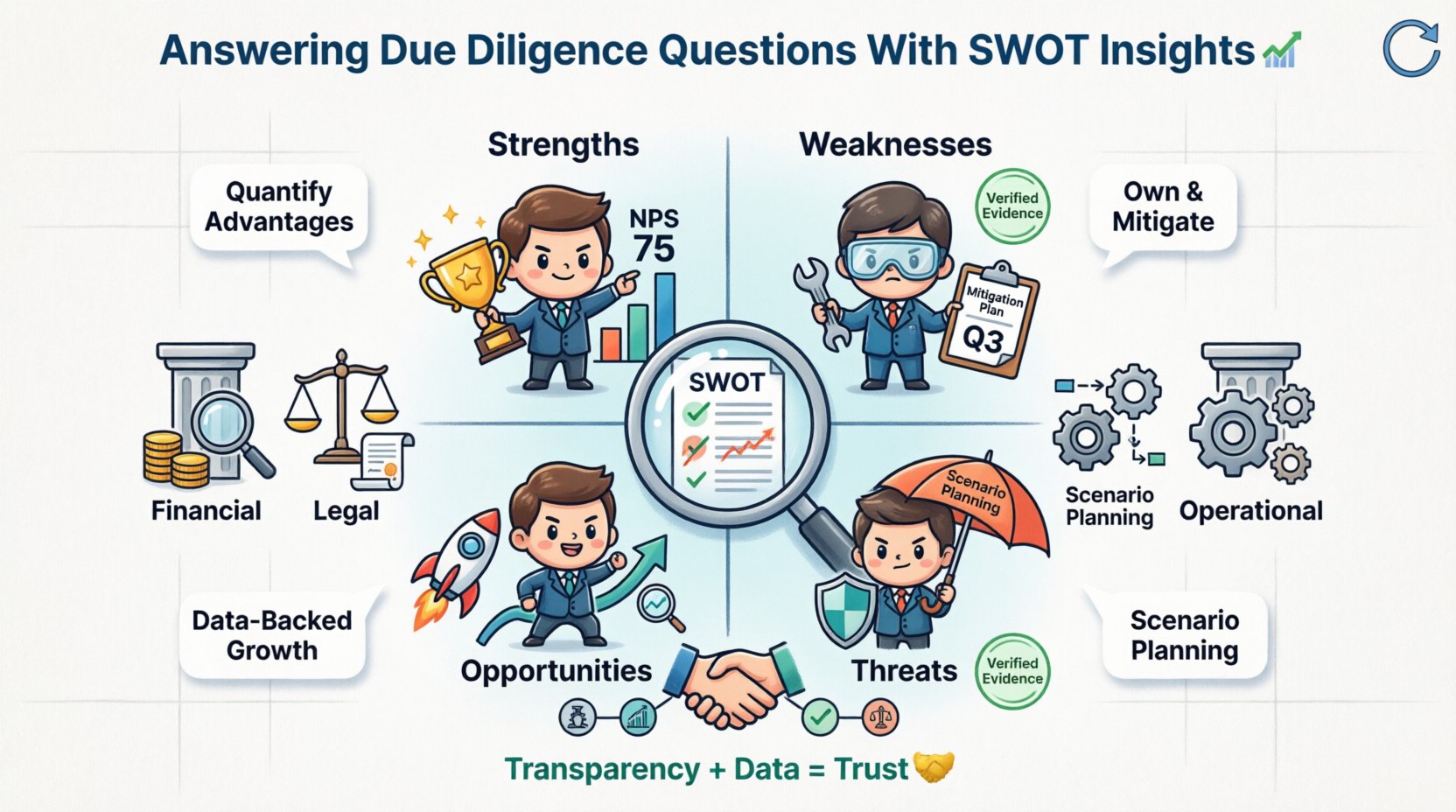
- Quantify the Advantage: Do not say you have a “strong brand.” Say your brand has a Net Promoter Score (NPS) of 75, which is 20 points above the sector average.
- Cite Barriers to Entry: Highlight patents, regulatory licenses, or long-term supplier agreements that prevent others from copying your model.
- Focus on Sustainability: Explain why these strengths are durable. Are they based on technology that is easily replicated, or on deep customer relationships?
2. Addressing Weaknesses (Risk Factors)
This is the most delicate area. Investors know no business is perfect. They are testing your transparency and your ability to manage problems. They might ask, “What are your biggest operational bottlenecks?” or “How do you handle customer churn?” 🚧
Strategy for Answering:
- Own the Issue: Acknowledge the weakness immediately. Do not deflect. “Yes, our current logistics infrastructure is a bottleneck. We have identified this and are addressing it.”
- Present the Mitigation Plan: Follow the admission with a concrete solution. “We are implementing a new warehouse management system scheduled for Q3.”
- Contextualize the Impact: Explain how this weakness affects the bottom line. If it is a minor issue, state that. If it is major, explain the risk exposure and how you are limiting it.
3. Addressing Opportunities (Growth Potential)
Questions here focus on future valuation. The investor is looking for upside potential. They might ask, “Where do you see the next revenue stream?” or “How will you expand into new markets?” 🌍
Strategy for Answering:
- Base on Data: Avoid speculation. Tie opportunities to market research, pilot programs, or existing customer demand signals.
- Resource Availability: Demonstrate that you have the capacity to seize these opportunities. Do not claim a new market is possible if you lack the capital or personnel to execute.
- Timeline: Provide a realistic rollout schedule. Investors prefer phased growth over vague promises of “explosive” expansion.
4. Addressing Threats (Risk Management)
This section tests your resilience. They want to know if you have considered what could go wrong. They might ask, “How would a change in regulation affect your margins?” or “What happens if a key supplier fails?” 🌪️
Strategy for Answering:
- Scenario Planning: Show that you have run scenarios. “If regulatory costs rise by 10%, our model accounts for this by adjusting pricing tiers.”
- Diversification: Highlight redundancy in your supply chain or customer base. If one stream dries up, others sustain the business.
- Insurance and Contingency: Mention any insurance policies or emergency funds set aside for specific threats.
⚖️ Transparency and Risk Disclosure
One of the most common mistakes in due diligence is attempting to hide weaknesses under the guise of “strategic sensitivity.” This approach often backfires. Auditors are trained to find gaps in logic or hidden liabilities. If they discover a weakness you tried to conceal, they will assume there are others you have not disclosed. Honesty is the most efficient strategy. ✅
When using SWOT insights to answer questions, frame weaknesses as managed risks rather than fatal flaws. This distinction is crucial. A fatal flaw suggests the business cannot survive; a managed risk suggests the business is viable but requires attention. This nuance maintains investor confidence while remaining truthful.
Additionally, consider the legal implications of your disclosures. While transparency is vital, you must ensure you are not admitting to liability that could be used against you in future litigation. Consult with legal counsel to ensure your SWOT-based answers are compliant with disclosure regulations. ⚖️
🔄 Common Scenarios and Responses
To illustrate how this framework works in practice, consider the following table. It maps common due diligence inquiries to specific SWOT-based response strategies. This can serve as a quick reference guide during the questioning phase. 📝
| 🔍 Common Inquiry | 📊 SWOT Quadrant | 💡 Strategic Response Approach |
|---|---|---|
| “What is your primary competitive advantage?” | Strength | Cite proprietary data or exclusive partnerships with specific metrics. |
| “Are there any pending lawsuits?” | Threat / Weakness | Disclose status immediately. Provide the legal team’s assessment of the outcome and potential financial impact. |
| “How do you plan to scale operations?” | Opportunity | Outline the capital required and the timeline for hiring or infrastructure upgrades. |
| “What are your biggest operational risks?” | Weakness / Threat | List the top three risks and the specific controls or insurance in place to mitigate them. |
| “Why is your customer acquisition cost increasing?” | Weakness | Explain the market context (e.g., ad inflation) and the steps being taken to optimize efficiency. |
| “How dependent are you on key personnel?” | Weakness | Detail succession plans, knowledge management systems, and retention agreements. |
This table demonstrates that the SWOT framework is not just for internal planning; it is a communication tool. It allows you to categorize complex information into digestible, strategic points. 🧩
🏁 Final Considerations for Engagement
As the due diligence process nears completion, your ability to synthesize information becomes even more important. You will be asked to summarize your position repeatedly. Having a well-documented SWOT analysis ensures that your summaries remain consistent. It prevents the “telephone game” effect where information gets distorted as it passes through different departments. 🗣️
Furthermore, use the insights to negotiate better terms. If you have identified a significant Strength that justifies a higher valuation, you can point to it during the term sheet negotiation. Conversely, if you have identified a Weakness that requires immediate investment, you can frame this as a reason for a specific earn-out structure or milestone payment. This turns your internal analysis into a leverage point for the deal. 💰
Remember that the goal of due diligence is not just to prove you are safe, but to prove you are a viable partner. The SWOT analysis helps you demonstrate both. It shows you understand your own business deeply, including the areas that need improvement. This level of self-awareness is often more valuable to investors than a perfect, unblemished record.
By integrating SWOT insights into your Q&A strategy, you transform a potentially adversarial process into a collaborative discussion. You guide the conversation toward your strengths while managing expectations around your risks. This approach builds a foundation of trust that is essential for a successful transaction. 🤝
Finally, maintain this discipline even after the deal closes. The SWOT analysis should evolve into a living document that guides your post-merger integration or post-investment growth strategy. The insights you gathered to answer these questions will become the baseline for your future performance reviews. 📈
In the end, due diligence is about clarity. It is about removing uncertainty from the equation. A well-prepared SWOT analysis removes the fog, allowing both parties to see the business clearly. Whether the outcome is a signed contract or a polite decline, you will have conducted yourself with professionalism and integrity. That is the true measure of a successful due diligence engagement. 🏆