

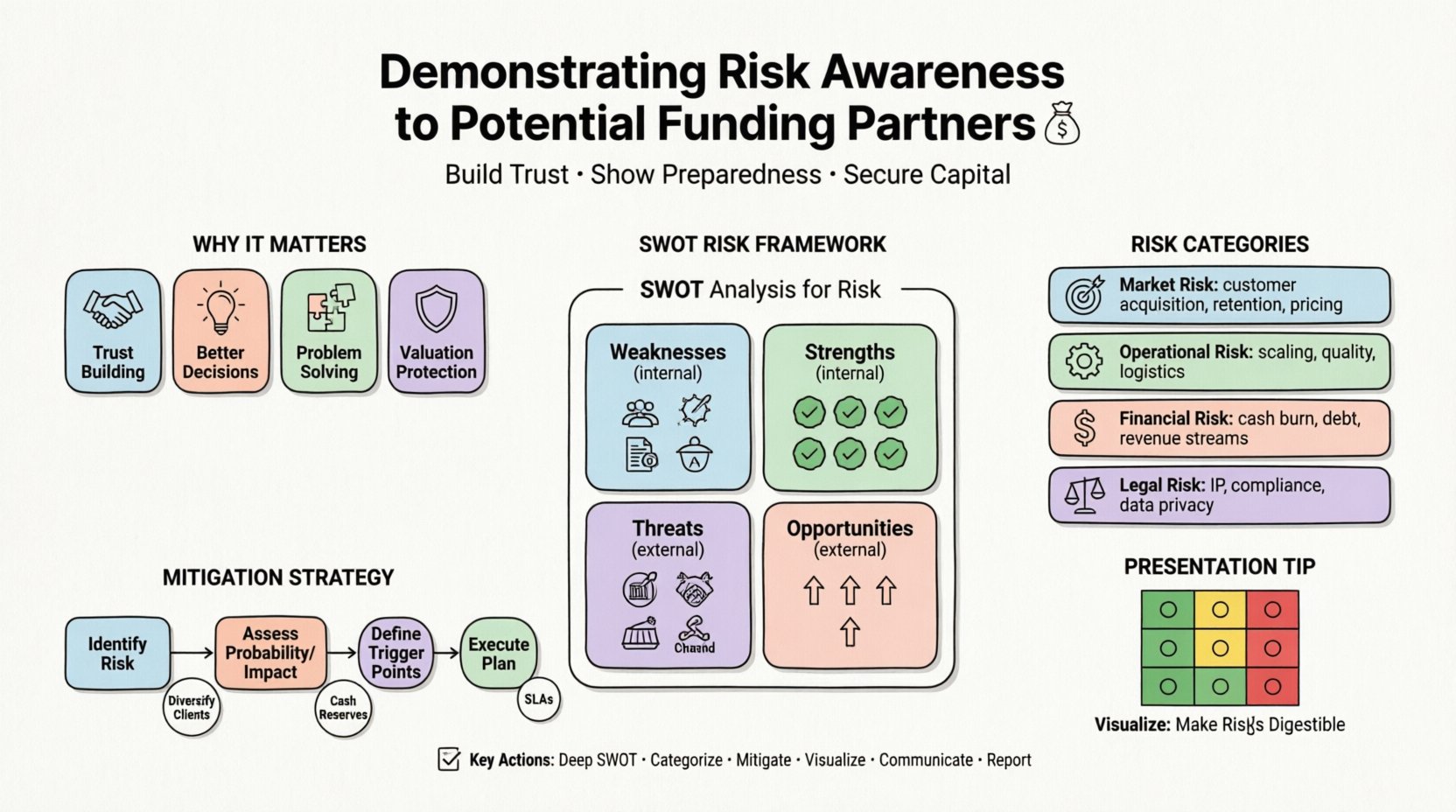
Securing capital is rarely a linear process. It involves navigating complex expectations, rigorous scrutiny, and high-stakes negotiations. One of the most significant hurdles founders and executives face is not the lack of a great product, but the perception of unmanaged risk. Investors and funding partners are not looking for perfection; they are looking for honesty and preparedness. Demonstrating risk awareness transforms a potential liability into a testament to your leadership capability. This guide explores how to leverage frameworks like SWOT analysis to communicate risk effectively, build trust, and secure the resources needed for growth. 💰
Why Risk Awareness Matters to Investors 🧐
When a funding partner reviews a proposal, they are performing a due diligence exercise. Their primary goal is to protect their capital while seeking a return. They understand that every business venture carries inherent uncertainty. However, the difference between a rejected application and a funded one often lies in how that uncertainty is addressed. Ignoring risk suggests naivety, while acknowledging it demonstrates maturity.
- Trust Building: Admitting weaknesses signals integrity. Investors prefer a partner who knows their business inside out, including its fragile points.
- Decision Making: Clear risk assessment allows partners to understand where their money is going and what safeguards are in place.
- Problem Solving: Highlighting risks shows that you have already thought about solutions, reducing the cognitive load on the investor.
- Valuation Protection: Companies that manage risk well often sustain valuations better during downturns.
It is crucial to move beyond generic statements. Specificity breeds confidence. Instead of saying “market risks exist,” describe the specific regulatory changes or competitor actions that could impact the bottom line. This level of detail proves that you are not just selling a dream, but running a calculated operation.
Integrating SWOT Analysis for Risk Identification 📊
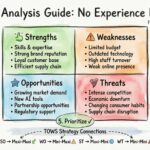
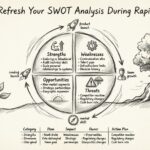
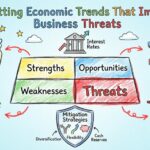
The SWOT analysis is a classic strategic planning tool, but many treat it as a checkbox exercise. For funding purposes, the “Threats” and “Weaknesses” quadrants require the most attention. These sections are where risk awareness lives. A robust SWOT analysis tailored for investors goes deeper than surface-level observations.
Internal Risks: Weaknesses and Strengths
Internal factors are within your control. When presenting weaknesses, do not hide them. Frame them as areas of active improvement.
- Human Capital: Are you reliant on a single key employee? If so, what is the succession plan?
- Technology Stack: Is your infrastructure scalable? Are there technical debts that need addressing?
- Financial Controls: Do you have robust accounting practices? Is cash flow management transparent?
- Operational Bottlenecks: Where does production slow down? How does this affect delivery timelines?
External Risks: Threats and Opportunities
External factors are outside your control, but you can influence your response to them. This is where market awareness shines.
- Market Volatility: How sensitive is your revenue model to economic shifts?
- Competitive Landscape: What happens if a major competitor lowers prices or launches a similar feature?
- Regulatory Changes: Are there pending laws that could alter your compliance costs?
- Supply Chain Disruption: What happens if a key supplier fails to deliver?
Categorizing Risks for Clarity 🛡️
To make your risk assessment digestible, categorize risks into logical buckets. This helps investors quickly grasp the scope of potential issues without getting lost in jargon. Use the following categories to structure your internal documentation and pitch materials.
1. Market and Commercial Risk
This covers the demand side of your business. If no one buys your product, the business fails regardless of how good the operations are.
- Customer Acquisition: Cost per acquisition (CAC) increases over time?
- Retention: High churn rates in the early stages?
- Pricing Power: Can you raise prices without losing volume?
- Adoption: Is the market ready for this technology or service?
2. Operational and Execution Risk
This focuses on the delivery of the product or service. It is about whether you can actually do what you promise.
- Scaling: Can the team handle a 5x increase in volume?
- Quality Control: What happens if defects increase during rapid growth?
- Logistics: Are there dependencies on third-party logistics providers?
- Process Documentation: Are workflows standardized or dependent on individual memory?
3. Financial and Liquidity Risk
This is the most scrutinized area by funding partners. It determines solvency.
- Cash Burn: How long does runway last without new funding?
- Debt Obligations: Are there existing loans with restrictive covenants?
- Revenue Recognition: Are revenue streams recurring or one-off?
- Foreign Exchange: Do you deal in multiple currencies that fluctuate?
4. Legal and Compliance Risk
This protects the organization from external mandates that could halt operations.
- Intellectual Property: Are patents filed and defended?
- Employment Law: Are contractor agreements compliant with local labor laws?
- Data Privacy: Does the business adhere to GDPR or CCPA standards?
- Litigation: Are there pending lawsuits or disputes?
Developing Mitigation Strategies 🛠️
Identifying a risk is only half the battle. The other half is the mitigation strategy. Investors want to see that you have a plan B, C, and D. A risk without a mitigation plan is just a worry. A risk with a plan is a managed variable.
Principles of Effective Mitigation
- Probability vs. Impact: Prioritize risks that are both likely to happen and have severe consequences. Ignore low-probability, low-impact noise.
- Cost of Mitigation: The cost to fix the risk should not exceed the value of the risk itself.
- Speed of Response: How quickly can you execute the mitigation plan?
- Trigger Points: Define the specific metric that signals the need to activate the plan.
Examples of Mitigation Tactics
Use concrete examples to show you understand the mechanics of risk management.
- Diversification: If you rely on one client for 80% of revenue, the strategy is to onboard three new prospects within six months.
- Insurance: For operational risks, secure liability coverage to protect against catastrophic loss.
- Contractual Safeguards: Use strict service level agreements (SLAs) with vendors to ensure accountability.
- Financial Reserves: Maintain a cash buffer equal to three months of operating expenses.
- Key Man Insurance: Protect against the loss of critical leadership.
Structuring the Risk Presentation 📝
How you present this information is just as important as the information itself. A wall of text in a pitch deck is intimidating and easy to ignore. Use structured formats to guide the investor through your thought process.
The Risk Matrix Table
A table is an excellent way to summarize complex data. It allows investors to scan for severity and actionability at a glance. Below is a structure you can adapt for your own materials.
| Risk Category | Specific Scenario | Probability | Impact | Mitigation Action |
|---|---|---|---|---|
| Market | Competitor launches free tier | Medium | High | Differentiate via premium support and custom features. |
| Operational | Key developer leaves team | Low | High | Cross-training program and documented code repositories. |
| Financial | Cash runway drops below 6 months | Medium | Critical | Activate cost-cutting protocol and initiate bridge financing. |
| Legal | New data regulation enacted | High | Medium | Engage legal counsel for compliance audit quarterly. |
Visualizing Data
When possible, supplement the table with visual aids. Heat maps are particularly effective for showing risk levels. Use color coding (Green, Yellow, Red) to indicate status. Red indicates immediate attention is needed, Yellow requires monitoring, and Green signifies acceptable risk levels.
Communication Tactics During Due Diligence 🗣️
During the due diligence phase, questions will become specific. The way you answer them can make or break the deal. Maintain a tone of quiet confidence. Do not get defensive. If you do not know an answer, admit it and promise to find it. This is better than guessing.
- Be Direct: Avoid euphemisms. If the risk is high, say “High Risk” rather than “Challenging Environment”.
- Focus on Control: Emphasize what you can control. Investors know they cannot control the market, but they can control how you react to it.
- Provide Evidence: Back up your risk claims with data. Show historical trends that support your probability estimates.
- Timing: Bring up risks before they are asked. If you wait for the investor to find a hole, it looks like you were hiding it.
Common Pitfalls to Avoid ⚠️
Even experienced founders make mistakes when discussing risk. Be mindful of these common errors that can undermine your credibility.
1. Over-Optimism
Assuming everything will go right is a red flag. If your projections show a straight line up to profitability without any dips or hurdles, investors will assume you have not done the work. Include scenarios where things go wrong in your financial models.
2. Under-estimating Competition
Saying “we have no competition” is almost always false. It suggests you haven’t looked hard enough. Acknowledge competitors and explain why your approach is different or better.
3. Vague Mitigation
Saying “we will monitor the situation” is not a strategy. It is a statement of intent. A strategy involves specific actions, deadlines, and owners.
4. Hiding Weaknesses
Leaving out weaknesses from your SWOT analysis creates a gap in the investor’s mental model. When they discover the missing piece later, trust is damaged. It is better to disclose a weakness upfront with a solution.
5. Inconsistency
Ensure the risks mentioned in your pitch deck match the data in your financial model. If you say you are mitigating supply chain risk in the deck but have no contingency budget in the spreadsheet, the inconsistency will be flagged immediately.
Post-Funding Accountability 📈
Demonstrating risk awareness does not end when the check clears. It is an ongoing commitment. Funding partners expect regular updates on risk status. Incorporate risk reporting into your standard monthly or quarterly reviews.
- Trigger Updates: Inform partners immediately if a risk triggers its contingency plan.
- Review Cadence: Re-evaluate the risk matrix every quarter. New threats emerge, and old ones may become irrelevant.
- Transparency on Missed Targets: If a mitigation strategy failed, report it. Explain why and what the new plan is.
Building Long-Term Partnerships 🤝
The ultimate goal of demonstrating risk awareness is not just to get funded, but to build a relationship that lasts. Investors who feel informed and respected are more likely to provide follow-on funding, introductions, and strategic support. They become allies rather than just creditors.
When you approach funding partners with a clear understanding of your vulnerabilities, you shift the dynamic from “us versus them” to “us solving problems together.” This collaborative mindset is the foundation of successful long-term business partnerships. It shows that you value their capital and their expertise enough to be fully transparent.
Summary of Key Actions ✅
To summarize the path toward demonstrating risk awareness effectively:
- Conduct a deep SWOT analysis focusing heavily on threats and weaknesses.
- Categorize risks into market, operational, financial, and legal buckets.
- Develop specific mitigation plans with trigger points and assigned owners.
- Present data visually using tables and risk matrices for clarity.
- Communicate proactively during the due diligence process.
- Maintain consistency between your narrative and your financial models.
- Report on risk status regularly after funding is secured.
By following these steps, you transform risk from a barrier into a bridge. You show that you are a leader who is ready for whatever challenges come next. This confidence is what funding partners look for when deciding where to place their capital.