

Investors do not just fund ideas; they fund viability. While many founders focus heavily on market size and traction, a critical component often gets overlooked in the narrative: the honest assessment of the business landscape. This is where SWOT analysis becomes indispensable. Integrating a SWOT analysis into your investor pitch deck demonstrates maturity, strategic foresight, and a realistic understanding of the risks involved.
When you present a SWOT analysis, you are telling a story of defense and offense. You are showing that you know what you are good at, where you need to improve, where the growth lies, and what could go wrong. This guide details how to structure this information effectively without sounding defensive or overly cautious.
Why Include SWOT in a Pitch Deck? 🤔
Traditionally, SWOT analysis is an internal strategic tool. It is meant for board meetings and quarterly planning. However, there is a compelling argument for bringing this framework into the external pitch deck. Here is why:
- Transparency builds trust: Acknowledging weaknesses signals that you are not living in a fantasy world. Investors appreciate founders who see the whole picture.
- Risk mitigation: Investors are paid to manage risk. Showing you have identified threats demonstrates that you have contingency plans.
- Competitive positioning: By explicitly stating your strengths against market threats, you clarify your competitive moat.
- Strategic alignment: It aligns your ask with your strategic needs. If a weakness is a cash flow issue, your funding ask directly addresses that strength gap.
However, the context matters. This is not an internal audit for the sake of auditing. It is a strategic communication tool designed to reassure capital providers.
Adapting the Framework for Investors 🛠️
A standard SWOT analysis can be generic. To make it effective for a pitch, you must tailor each quadrant to the questions investors are asking themselves. The focus shifts from “what we do” to “how we win”.
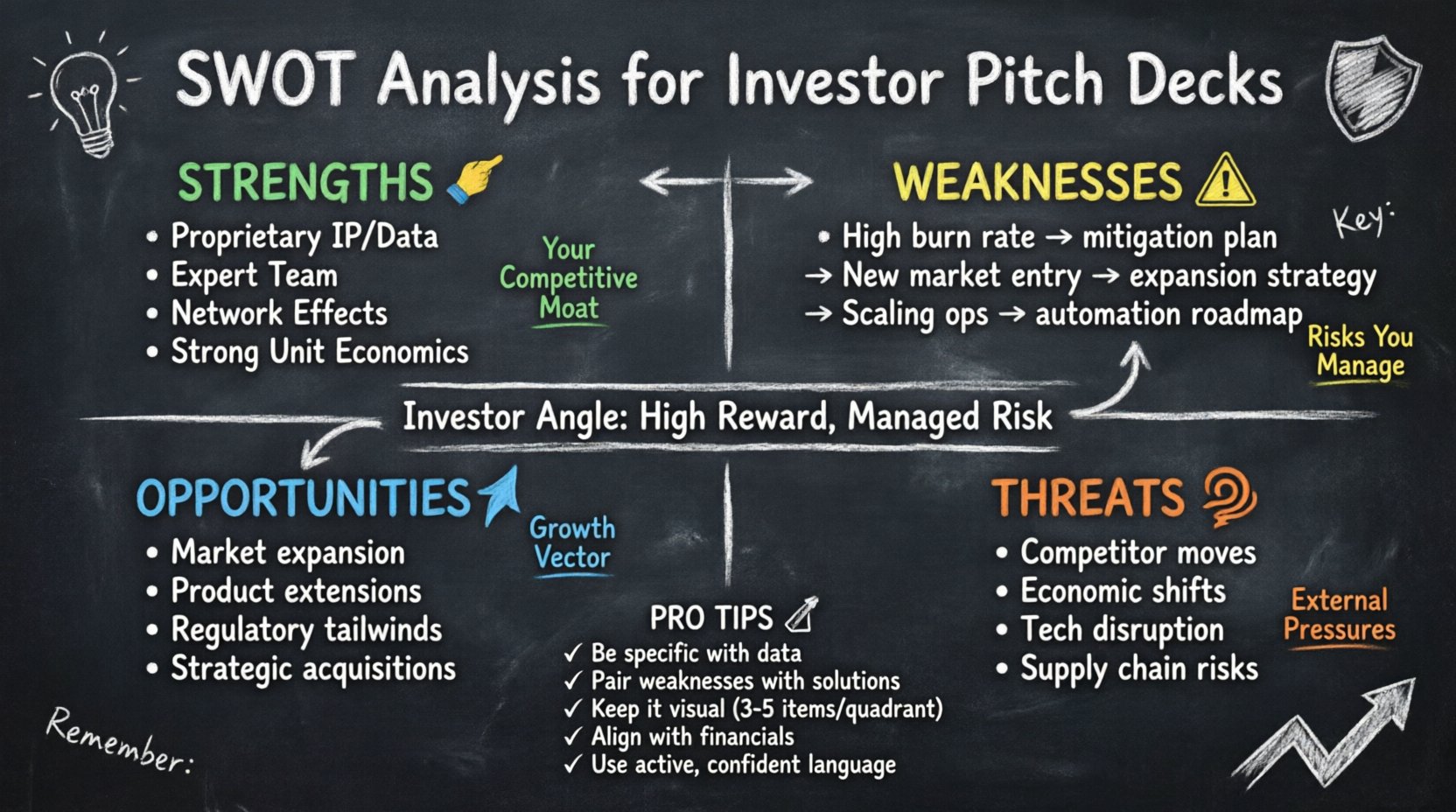
1. Strengths: Your Competitive Moat 💪
Do not list generic strengths like “hard work” or “passion.” Investors have seen that before. Instead, focus on tangible assets that protect your business model.
- Intellectual Property: Patents, proprietary algorithms, or unique data sets.
- Team Expertise: Founders with specific industry track records or domain knowledge.
- Network Effects: Existing partnerships or a user base that creates a barrier to entry.
- Unit Economics: Proven profitability or a clear path to positive margins.
When presenting this, frame it as a defensive shield. Your strengths are what prevent competitors from copying your model easily.
2. Weaknesses: The Risks You Manage ⚠️
This is the most difficult quadrant to present. The goal is not to scare investors but to show you are managing your vulnerabilities. Avoid listing fatal flaws. Instead, list operational challenges that your funding or strategy will resolve.
- Capital Efficiency: Acknowledge high burn rates but pair them with a clear plan to reduce them.
- Market Penetration: Admit if you are new to a specific region but highlight your expansion strategy.
- Operational Scale: If you are moving from manual to automated, acknowledge the transition period.
The key here is the “But.” You state the weakness, then immediately explain the mitigation strategy. This turns a negative into a plan of action.
3. Opportunities: The Growth Vector 🚀
This section is about upside potential. It connects your current position to future revenue streams. This is where you show the scalability of the business.
- Market Expansion: Entering adjacent verticals or geographic regions.
- Product Line Extensions: New features or products that leverage existing technology.
- Regulatory Changes: New laws that might favor your solution over competitors.
- Strategic Acquisitions: Potential to buy smaller competitors or technology.
Link these opportunities directly to the capital you are raising. Show how the investment unlocks this growth potential.
4. Threats: External Pressures 🌪️
Investors know the market is volatile. They want to know if you are paying attention. This section shows you are monitoring the environment.
- Competitor Activity: New entrants or incumbents pivoting into your space.
- Economic Shifts: Inflation, interest rates, or recession risks affecting customer spend.
- Technology Disruption: Emerging tech that could render your solution obsolete.
- Supply Chain: Dependencies on third-party vendors or raw materials.
Again, mitigation is key. For every threat, have a corresponding strategic response ready.
Structuring the Slide: A Strategic Approach 📝
How you display this information is just as important as the content. A wall of text will lose the attention of an investor. Use structure to guide the eye and the mind.
Visual Layout
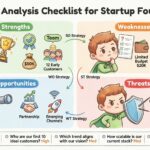
Consider a quadrant layout or a split-screen approach. If you use a split-screen approach, place Strengths and Opportunities on the left (the good news) and Weaknesses and Threats on the right (the risks). This visual balance reinforces the narrative of “High Reward, Managed Risk”.
Using Data to Support Claims
Qualitative statements need quantitative backing. Use data where possible to validate your SWOT points.
- For Strengths: “Our proprietary tech reduces processing time by 40%.”
- For Weaknesses: “Customer acquisition cost is currently 20% above industry average, projected to drop to parity by Q4.”
- For Opportunities: “Total Addressable Market is growing at 15% CAGR.”
- For Threats: “Two major competitors raised Series B funding last quarter.”
Common Pitfalls to Avoid 🚫
Many founders stumble when integrating this framework. They either hide the negatives or overwhelm the positives with jargon. Here are the specific mistakes to watch out for.
Mistake 1: The “Checklist” Approach
Do not simply list items. A list of ten strengths and ten threats is useless. It dilutes the message. Select the top three to five critical factors in each quadrant. Quality of insight beats quantity of data.
Mistake 2: Over-Disclosure
You are not filing a public disclosure document. Do not reveal trade secrets under the guise of “transparency.” If a weakness is a fundamental flaw in the business model that cannot be fixed with capital, do not include it. Focus on weaknesses that are solvable.
Mistake 3: Defensive Tone
Do not write in a defensive voice. Avoid phrases like “We are trying to fix…” or “We hope to avoid…”. Instead, use active language like “We are implementing…” or “Our strategy mitigates…”. Confidence in your solutions is more important than the existence of the problem.
Mistake 4: Ignoring the Financials
A SWOT analysis must connect to the financial model. If you list a “Threat” as a supply chain issue, your financial model should reflect the contingency costs associated with that risk. Inconsistency between the narrative and the numbers breaks credibility.
Example Structure for the Slide 📊
To help visualize the content, here is a structural example of how to organize the information on a single slide.
| Quadrant | Focus Area | Investor Angle | Example Content |
|---|---|---|---|
| Strengths | Internal Assets | Defensibility | Proprietary data set with 500k unique users. |
| Weaknesses | Internal Gaps | Capital Efficiency | High server costs currently offset by revenue growth. |
| Opportunities | External Growth | Upside Potential | Regulatory changes in EU open new market segment. |
| Threats | External Risks | Risk Management | Competitor X entering the lower-tier market. |
Notice how each entry is concise and directly relevant to the business outcome. The “Investor Angle” column is not usually printed on the slide, but it guides what you write in the actual content.
Timing and Placement in the Deck 🗓️
Where does this slide belong? It is not a replacement for the Market Size slide, nor the Competition slide. It serves as a summary of your strategic positioning.
- After Market Analysis: Once you have defined the market, show how you fit within it using SWOT.
- Before the Ask: Placing it just before the financial ask allows you to frame the funding requirement as the solution to the “Weaknesses” identified.
- As a Q&A Reference: Even if you do not include it in the main flow, keep a backup slide ready. If an investor asks about risks, you can pull this up immediately.
Many investors prefer a “Risk & Opportunity” slide over a traditional SWOT grid because it feels more forward-looking. The terminology can change, but the framework remains the same.
Connecting SWOT to the Financial Model 🔢
The most sophisticated pitch decks link the qualitative SWOT to the quantitative financial projections. This creates a cohesive narrative.
If you list “High Customer Acquisition Cost” as a weakness, your financial model should show a clear inflection point where this cost decreases as the brand grows. If you list “Supply Chain Risk” as a threat, the model should show a contingency reserve in the cash flow statement.
This alignment proves that you are not just making a presentation; you are building a plan. It moves the conversation from “What if things go wrong?” to “Here is how we handle things when they go wrong.”
Refining the Narrative for Different Investor Types 🎯
Different investors have different risk appetites. You should adjust the emphasis of your SWOT analysis based on who is in the room.
For Venture Capitalists
VCs are looking for massive scale. Emphasize Opportunities. Show how the market is ripe for disruption. Weaknesses should be framed as temporary hurdles to scale.
For Angel Investors
Angels often invest in the team. Emphasize Strengths related to the founders. Show that you have the grit to overcome the Threats listed.
For Corporate Venture Arms
These investors look for synergy. Emphasize how your Strengths complement their existing portfolio. Show Opportunities that involve partnership rather than just competition.
Final Thoughts on Strategic Communication 💡
Integrating a SWOT analysis into your pitch deck is not about ticking a box. It is about demonstrating strategic competence. It shows that you understand the complexity of the business environment and that you have a plan to navigate it.
When you present this section with confidence and clarity, you transform potential objections into discussion points. You invite investors to see the challenges as puzzles you are already solving. This level of preparation separates serious ventures from casual ideas.
Remember, the goal is not to hide the dark spots. It is to shine a light on them so that the investors can see the path forward clearly. By balancing the strengths with the realities of the market, you create a pitch that is grounded, credible, and compelling.
Key Takeaways for Implementation ✅
- Be Specific: Avoid vague adjectives. Use data and concrete examples.
- Focus on Mitigation: For every weakness or threat, provide a solution.
- Keep it Visual: Use grids or tables to make the information digestible.
- Align with Financials: Ensure the numbers back up the strategic claims.
- Practice the Narrative: Ensure the transition to this slide feels natural within the broader story.
By following these guidelines, you create a pitch deck that stands out for its honesty and depth. This approach builds the foundation for a successful fundraising round.