

In the modern landscape of business strategy, the gap between what an organization offers and what the market demands often determines longevity. While SWOT analysis is traditionally viewed as a tool for internal strategic planning, its utility extends deeply into understanding the nuanced layers of customer expectations. By interpreting Strengths, Weaknesses, Opportunities, and Threats through the lens of user behavior and feedback, organizations can align their operational capabilities with external desires. This guide explores how to leverage SWOT frameworks to uncover critical customer insights without relying on proprietary software or generic assumptions. We will examine the mechanics of data interpretation, the psychological drivers behind customer satisfaction, and the practical steps to integrate these findings into daily operations.
Why SWOT Matters for Customer Insight 🧠
Standard SWOT analysis often focuses on high-level metrics: revenue growth, market share, and product features. However, when applied to customer needs, the framework shifts from a static snapshot to a dynamic diagnostic tool. The core value lies in cross-referencing internal capacity with external reality. A strength on paper may not translate to a perceived value by the user. Conversely, a weakness identified internally might be the primary driver of churn if it directly impacts the user journey.
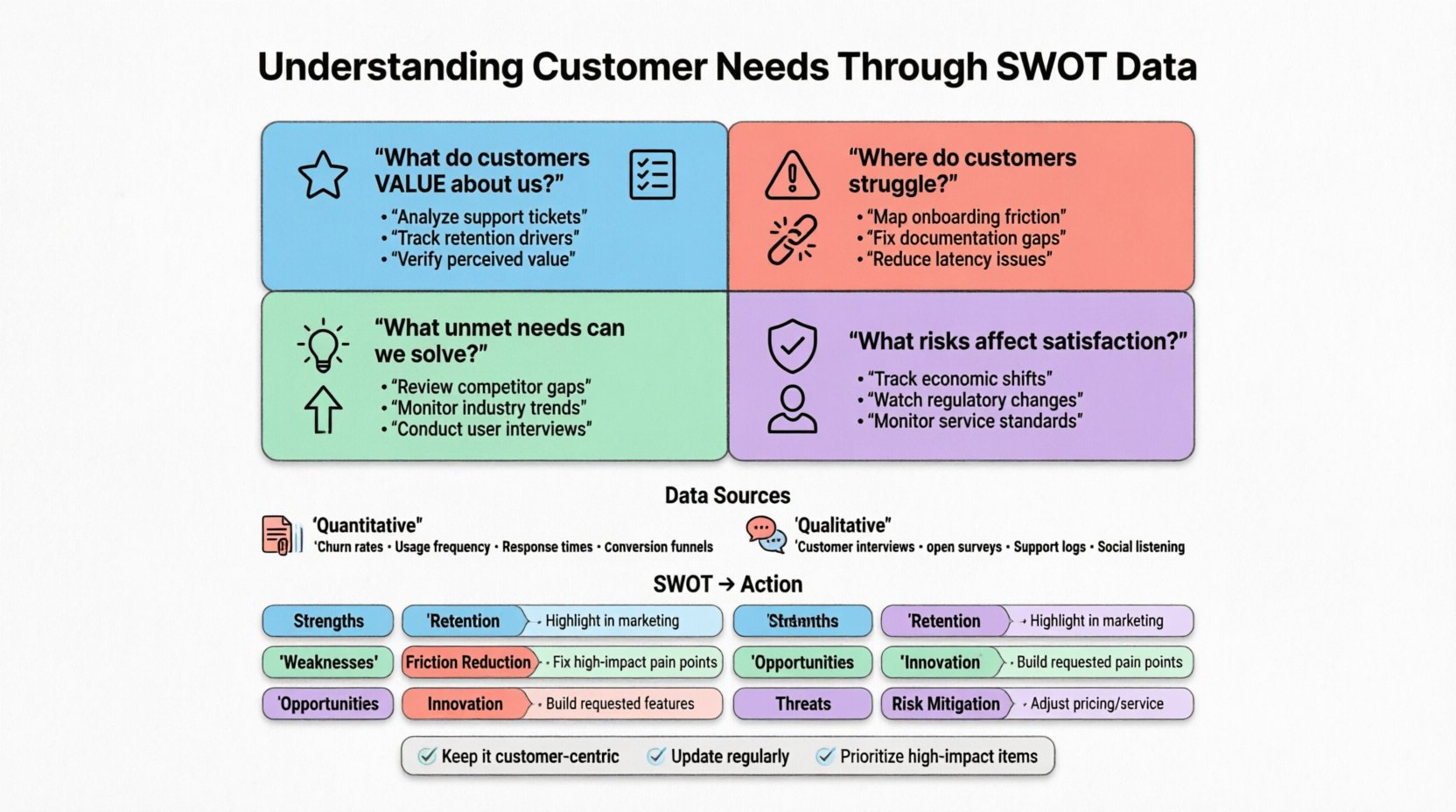
To effectively utilize this data, teams must adopt a customer-centric perspective. This involves asking specific questions during each quadrant analysis:
- Strengths: Which internal capabilities actually solve the user’s most pressing problems?
- Weaknesses: Where does the service fail to meet the baseline expectation of reliability?
- Opportunities: What unmet needs exist in the market that we are currently equipped to address?
- Threats: How are competitors capitalizing on our gaps in customer service or product delivery?
By anchoring the analysis in these questions, the resulting strategy moves beyond internal ambition and grounds itself in user validation. This approach reduces the risk of developing features or services that do not resonate with the target audience.
Deconstructing Strengths: Internal Capabilities vs. External Perception 💪
Strengths are typically viewed as assets that provide a competitive edge. In the context of customer needs, a strength is only valid if the customer recognizes and values it. For example, a company might pride itself on a robust engineering team (internal strength), but if the customer prioritizes speed of support over technical complexity, this strength holds little weight in the market perception.
Identifying Relevant Strengths
To determine which strengths matter, teams must analyze customer feedback loops. This includes:
- Support Ticket Analysis: Reviewing resolved issues to identify recurring themes where the team excels.
- Retention Metrics: Looking at why users stay loyal. Is it price, quality, or community?
- NPS Scores: Examining the drivers behind high Net Promoter Score ratings to understand what users love.
When a strength aligns with a customer need, it becomes a cornerstone of the value proposition. For instance, if data shows that users value 24/7 availability, and the organization successfully maintains a round-the-clock support structure, this is a verified strength. It should be highlighted in communications and resource allocation decisions.
The Danger of Assumed Strengths
Organizations often fall into the trap of assuming their strengths are obvious to the customer. A fast backend system is invisible to the user unless the application feels sluggish. Therefore, the analysis must focus on perceived strengths. If a customer cannot perceive the strength, it does not contribute to their satisfaction or loyalty. This distinction is vital for accurate strategic planning.
Weaknesses: Where the Experience Breaks Down ⚠️
Weaknesses represent internal limitations that hinder performance. In customer analysis, weaknesses are the friction points that cause dissatisfaction. Unlike strengths, which are often celebrated, weaknesses require honest introspection and vulnerability to address. Ignoring these gaps often leads to negative word-of-mouth and reduced market share.
Mapping Weaknesses to Pain Points
To identify weaknesses relevant to the customer, teams should look for patterns in complaints. Common areas of friction include:
- Onboarding Friction: Is the initial setup process too complex for the average user?
- Documentation Gaps: Are users forced to contact support because instructions are unclear?
- Performance Latency: Does the product slow down during peak usage times?
- Feature Accessibility: Are key tools hidden behind confusing navigation menus?
Each of these points represents a weakness that directly impacts the user experience. By categorizing these under the SWOT framework, leadership can prioritize remediation efforts based on impact rather than just technical debt.
The Cost of Ignoring Weaknesses
When weaknesses are left unaddressed, they compound over time. A minor friction point today becomes a major barrier to entry tomorrow. For example, a slow checkout process may initially result in a 5% drop-off rate. Over a year, this represents significant lost revenue and eroded trust. Addressing weaknesses is not just about fixing errors; it is about preserving the relationship with the customer.
Opportunities: Untapped Customer Desires 🚀
Opportunities are external conditions that the organization can exploit to its advantage. When viewed through a customer lens, opportunities are essentially unmet needs. These are areas where the market is asking for solutions that the organization is uniquely positioned to provide.
Recognizing Market Gaps
Identifying opportunities requires active listening to the market. This can be achieved through:
- Competitor Reviews: Reading negative reviews of competitors to see what features they lack.
- Industry Trends: Monitoring shifts in user behavior, such as a move toward mobile-first interactions.
- Direct Interviews: Conducting qualitative research where users describe their ideal workflow.
For example, if a survey reveals that users are struggling to integrate the product with third-party tools, and the organization has the engineering bandwidth to build APIs, this is a clear opportunity. It transforms a customer problem into a business growth vector.
Validating Opportunities
Not every opportunity should be pursued. It is essential to validate that the opportunity aligns with the core mission and the organization’s strengths. An opportunity that requires a complete overhaul of the infrastructure may be too risky if the organization’s current strengths lie in rapid deployment rather than heavy infrastructure. The goal is to find the intersection between what the customer wants and what the organization can deliver efficiently.
Threats: Competitive Pressures on Satisfaction 🛡️
Threats are external factors that could cause trouble for the business. In the context of customer needs, threats often manifest as competitors offering better solutions or changing market standards that the organization fails to meet.
External Factors Influencing Perception
Threats to customer satisfaction are not limited to direct competitors. They include:
- Economic Shifts: If the market moves toward cheaper alternatives, price sensitivity increases.
- Regulatory Changes: New data privacy laws may require changes in how user data is handled.
- Technological Obsolescence: If the industry adopts a new standard (e.g., AI integration), staying static becomes a threat.
- Service Standards: Competitors may raise the bar for delivery speed or support response times.
Understanding these threats allows the organization to proactively adjust its strategy. Instead of reacting to a competitor’s launch, the team can anticipate the shift in customer expectations and prepare accordingly.
Monitoring the Threat Landscape
Continuous monitoring is key to managing threats. This involves setting up alerts for industry news, tracking competitor pricing models, and regularly reviewing customer sentiment scores. If a competitor launches a feature that addresses a known weakness, the threat level increases immediately. The SWOT framework helps categorize these threats so they are not treated as isolated incidents but as part of a broader strategic challenge.
Data Sources for Accurate SWOT Inputs 📝
The quality of a SWOT analysis depends entirely on the quality of the data feeding into it. Relying on internal assumptions or anecdotal evidence can lead to skewed results. To ensure accuracy, organizations must gather data from diverse channels.
Quantitative Data
Numbers provide a baseline for understanding scale and frequency. Key metrics include:
- Churn Rates: Identifying where users leave the platform.
- Usage Frequency: Which features are used most often versus ignored?
- Response Times: Average time taken to resolve customer inquiries.
- Conversion Funnels: Where do potential customers drop off before becoming users?
These metrics offer an objective view of performance. They help validate whether a perceived strength is actually driving engagement or if a weakness is causing measurable friction.
Qualitative Data
Numbers tell the what, but qualitative data explains the why. This includes:
- Customer Interviews: One-on-one conversations to understand motivations.
- Open-Ended Surveys: Allowing users to express frustrations or desires in their own words.
- Support Logs: Reading the actual text of customer interactions.
- Social Listening: Monitoring public discussions about the brand or industry.
Combining both quantitative and qualitative data creates a holistic view. For example, a high churn rate (quantitative) combined with feedback about confusing navigation (qualitative) confirms a specific weakness that needs addressing.
Mapping SWOT to Actionable Customer Strategies 🗺️
Once the data is gathered and analyzed, it must be translated into action. A SWOT analysis that sits in a report without implementation is a waste of resources. The following table illustrates how each quadrant translates into specific strategic actions.
| SWOT Element | Focus Area | Strategic Action |
|---|---|---|
| Strengths | Retention & Advocacy | Leverage top-performing features in marketing campaigns to attract similar users. |
| Weaknesses | Friction Reduction | Invest resources in fixing high-impact pain points identified in support logs. |
| Opportunities | Expansion & Innovation | Develop new features or services that address the identified unmet needs. |
| Threats | Risk Mitigation | Adjust pricing or service levels to counter competitive moves or market shifts. |
This mapping ensures that every insight leads to a concrete step. It prevents the analysis from becoming an abstract exercise and keeps the focus on tangible improvements to the customer experience.
Common Analytical Errors to Avoid 🚫
Even with the right data, teams can make mistakes in interpreting SWOT results. Awareness of these pitfalls is crucial for maintaining the integrity of the analysis.
- Confusing Internal with External: A strength is internal, but its value is external. Do not list internal processes as strengths unless they directly impact the customer.
- Overlooking Customer Voice: Relying too much on executive opinion rather than user feedback leads to bias.
- Static Analysis: Treating SWOT as a one-time event. Customer needs evolve rapidly, so the analysis must be updated regularly.
- Ignoring Negative Feedback: Focusing only on positive reviews creates a false sense of security. Negative feedback often holds the most critical insights for improvement.
- Too Many Priorities: Trying to address every item on the list dilutes resources. Focus on the high-impact items that align with core business goals.
Implementing Findings into Daily Operations 🔄
The final step is integration. Insights from the SWOT analysis must influence day-to-day workflows. This requires alignment across departments, including product, support, marketing, and sales.
Communication Protocols
Share the findings with all relevant stakeholders. Marketing needs to know which strengths to highlight. Product needs to know which weaknesses to fix. Support needs to know what threats to anticipate. Regular meetings should be scheduled to review the progress of initiatives stemming from the analysis.
Feedback Loops
Implementation is not the end. A feedback loop must be established to measure the impact of the changes. If a weakness is addressed, monitor the churn rate. If an opportunity is seized, track adoption rates. This continuous cycle ensures that the organization remains responsive to customer needs over time.
Final Considerations for Strategic Alignment 📈
Aligning SWOT data with customer needs is an ongoing process. It requires a commitment to listening, analyzing, and acting. Organizations that succeed in this area do not just sell products; they build relationships based on a deep understanding of their users. By treating SWOT as a dynamic tool for customer insight, businesses can navigate complex market conditions with confidence and precision.
The journey from data to strategy is complex, but the reward is a product that truly serves its audience. As the market continues to shift, the ability to interpret internal capabilities against external demands will remain a critical skill for leadership. Focus on the data, respect the customer voice, and let the analysis guide the path forward.