


Navigating the business landscape as a new entrant requires more than just a great idea. It demands a clear understanding of where you stand relative to those who have already built their infrastructure, customer bases, and brand recognition. Benchmarking your startup against established rivals is not about copying their playbook; it is about understanding the terrain so you can find the path that leads to sustainable growth. This process involves rigorous analysis, honest self-reflection, and a strategic approach to resource allocation.
When you compare your metrics and capabilities with industry veterans, you gain context. You learn what is actually possible versus what is aspirational. This guide explores how to conduct a thorough competitive analysis using the SWOT framework, ensuring you make decisions based on data rather than assumption. We will delve into specific metrics, data sources, and the psychological pitfalls that often derail early-stage strategic planning.
🔍 Why Comparison is Critical for Early-Stage Growth
Many founders believe that focusing inward is the only way to succeed. While internal focus is vital, ignoring the external environment is a fatal flaw. Established rivals have survived market fluctuations, economic downturns, and technological shifts. They represent a baseline of operational reality. By benchmarking against them, you establish a reference point for your own performance.
Here is why this practice is essential for survival and scaling:
- Reality Check: It prevents overestimating market size or demand based on your own internal projections. Rival data provides an external validation mechanism.
- Resource Allocation: Understanding where incumbents spend their budget helps you decide where to focus your limited funds. If they are investing heavily in logistics, you might find an opportunity in customer service or niche targeting.
- Value Proposition Clarity: Seeing what the market leader offers helps you identify gaps. If they are slow, you can be fast. If they are expensive, you can be accessible. If they are complex, you can be simple.
- Risk Mitigation: You can anticipate threats before they impact your bottom line. If a competitor is launching a similar feature, you can adjust your roadmap accordingly.
Without this external perspective, you are flying blind. You might think you are innovating when you are actually replicating an existing solution that failed years ago. Benchmarking ensures your innovation is relevant and timed correctly.
🏙️ Identifying the Competitive Landscape
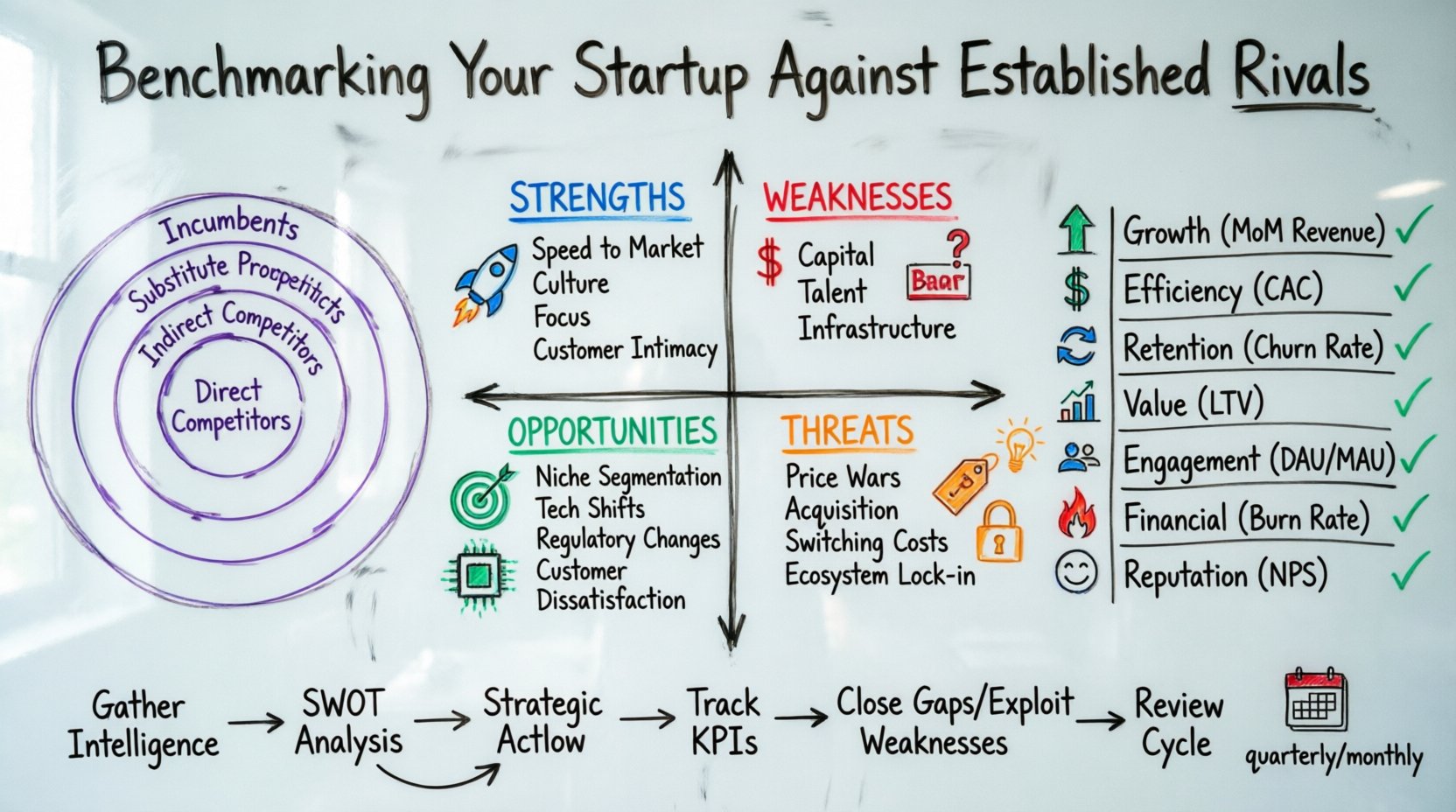
Before diving into the SWOT analysis, you must define who your rivals are. They are not always direct competitors selling the exact same product. The competitive landscape is often layered.
- Direct Competitors: These are companies offering a solution that solves the same problem for the same target audience. They are your immediate threat.
- Indirect Competitors: These companies solve the same problem but in a different way. For example, a streaming service competes with cable TV, even if the delivery mechanism differs.
- Substitute Products: These are solutions that address the underlying need differently. A video conferencing tool competes with business travel for client meetings.
- Incumbents: These are the established giants with significant market share. They often have legacy systems that make them slower to adapt but more stable.
It is crucial to map out these groups. A startup might be too small to threaten an incumbent directly, but it could be a direct threat to a mid-sized player. Understanding the hierarchy helps in positioning your narrative. You do not want to announce yourself as “the next Google” if you are actually solving a specific problem for a niche market. Precision in identification leads to precision in strategy.
📋 The SWOT Framework for Startups
The SWOT analysis is a classic tool, but applying it specifically to the startup-versus-rival context requires nuance. Standard SWOT often lists generic internal factors. In this context, every factor must be weighed against the reality of the established market.
🛡️ Strengths: Leveraging Your Agility
Startups often assume they have no strengths compared to giants. This is incorrect. Your primary advantage is agility. Established companies are often weighed down by bureaucracy, legacy code, and rigid processes. Your strengths should be framed around speed and adaptability.
- Speed to Market: You can launch features in weeks rather than quarters. This allows you to test hypotheses quickly.
- Culture: A flat organizational structure often leads to better communication and faster decision-making loops.
- Focus: While rivals spread their attention across many revenue streams, you can dedicate 100% of your energy to one core value proposition.
- Customer Intimacy: Small teams can offer personalized support that large corporations cannot replicate at scale.
When documenting strengths, avoid vague terms like “great team.” Be specific. Instead of “fast,” use “average time to deploy updates is 48 hours compared to industry standard of 2 weeks.” Quantify your agility.
⚖️ Weaknesses: Acknowledging Internal Gaps
Branding yourself as a startup does not mean hiding your weaknesses. In fact, acknowledging them is the first step to managing them. Incumbents often have resources you simply do not have.
- Brand Recognition: Customers may trust a known name over a new entity. You lack the social proof that comes with a decade of operation.
- Capital Reserves: Cash flow management is critical. You cannot afford long marketing campaigns that do not yield immediate ROI.
- Talent Acquisition: Top-tier employees often prefer the stability and benefits of established firms. You must rely on vision and equity to attract talent.
- Infrastructure: You may lack the robust IT infrastructure or supply chain networks that ensure reliability at scale.
Identifying these weaknesses allows you to build workarounds. If you lack brand recognition, you must over-invest in content marketing and community building. If you lack capital, you must focus on organic growth and revenue-first strategies.
💡 Opportunities: Market Gaps and Trends
Opportunities exist in the spaces where established rivals are not looking. They are often too large to pivot quickly or too focused on their existing revenue streams to chase small markets.
- Niche Segmentation: Giants often target the mass market. You can dominate a specific vertical or demographic that they ignore.
- Technological Shifts: New technologies can disrupt legacy models. If an incumbent relies on outdated tech, a modern stack gives you a performance edge.
- Regulatory Changes: New laws can open doors for compliant startups while hindering older players who are slow to adapt.
- Customer Dissatisfaction: Analyze reviews of competitor products. Negative feedback is a roadmap for your feature development.
Opportunities must be actionable. A trend is only an opportunity if you have the capability to capitalize on it immediately.
⚠️ Threats: Incumbent Power and Market Shifts
Threats are external forces that could harm your business. In a startup context, the biggest threat often comes from the stability of the competition.
- Price Wars: Incumbents can afford to lower prices temporarily to crush a new entrant. They can absorb losses to gain market share.
- Acquisition: A large competitor might buy you out or buy a similar competitor to neutralize the threat.
- Switching Costs: If customers find it too difficult to leave an established system, you face high friction in onboarding.
- Ecosystem Lock-in: Competitors may be integrated into wider ecosystems that make them indispensable to clients.
Recognizing these threats helps in contingency planning. You need a strategy for how to survive a price war without burning cash. You need to understand your exit strategy if acquisition becomes the path.
📊 Key Performance Indicators for Comparison
To benchmark effectively, you need data. You cannot compare feelings; you must compare numbers. Below is a table of critical metrics to track against your rivals.
| Category | Metric | Why It Matters |
|---|---|---|
| Growth | Month-over-Month Revenue Growth | Indicates traction and market demand velocity. |
| Efficiency | Customer Acquisition Cost (CAC) | Shows how expensive it is to get a new customer compared to rivals. |
| Retention | Churn Rate | Measures product stickiness and customer satisfaction. |
| Value | Customer Lifetime Value (LTV) | Indicates the long-term profitability of a single customer. |
| Engagement | Active User Rate (DAU/MAU) | Reveals how deeply embedded your product is in daily routines. |
| Financial | Burn Rate | Shows how long your current cash reserves will last. |
| Reputation | Net Promoter Score (NPS) | Measures customer loyalty and word-of-mouth potential. |
When gathering this data, remember that public companies disclose some of this information in quarterly reports. Private companies are harder to track, but industry reports, job postings, and customer reviews can offer clues. For example, if a rival is hiring aggressively in sales, they are likely scaling. If they are hiring in support, they might be dealing with churn.
Do not get fixated on vanity metrics. High traffic numbers mean nothing if conversion rates are low. Focus on metrics that correlate directly with revenue and sustainability. If your CAC is higher than the industry average, you need to optimize your marketing channels before scaling.
🔎 Gathering Intelligence Without Spending a Fortune
You do not need expensive enterprise tools to gather competitive intelligence. A disciplined approach to free and low-cost resources can yield significant insights.
- Public Financial Filings: If a rival is public, their 10-K or 10-Q filings contain detailed breakdowns of revenue, expenses, and risks. Read the sections on “Risk Factors” carefully.
- Social Media Listening: Monitor their social channels. Look at who comments, what they complain about, and how the company responds. This reveals customer sentiment.
- Review Aggregators: Sites like G2, Capterra, or Trustpilot provide unfiltered feedback from users. Look for patterns in negative reviews to find your entry point.
- Job Postings: Analyze the roles they are hiring for. Are they building a mobile app? Expanding to a new region? This indicates future strategy.
- Press Releases: Companies announce partnerships and product launches here. It tells you where they are investing their capital.
- Website Traffic Tools: Use free tiers of analytics tools to estimate traffic volume and sources. See if they rely on SEO or paid ads.
The goal is to build a profile of their operational reality. If they claim to be “data-driven,” look for evidence of that in their blog or case studies. If they claim to be “customer-centric,” look at their support response times on social media.
❌ Common Mistakes in Competitive Benchmarking
Even with good data, the analysis can go wrong if you fall into common traps. Awareness of these pitfalls ensures your strategy remains grounded.
- Copying Everything: Just because a rival does something successfully does not mean it works for you. Context matters. Their audience might be different.
- Ignoring Internal Strengths: Focusing too much on the rival’s strengths blinds you to your own unique advantages. Do not undervalue your agility.
- Outdated Data: The market changes fast. A strategy based on last year’s data is obsolete today. Ensure you are using recent information.
- Chasing Vanity Metrics: Comparing follower counts is less useful than comparing conversion rates. Focus on quality of engagement over quantity.
- Emotional Bias: It is easy to feel threatened by a giant. This fear can lead to panic decisions. Keep the analysis objective and data-driven.
- One-Off Analysis: Benchmarking is not a one-time event. It must be a recurring process to track changes in the landscape.
Objectivity is key. If you find that a rival is significantly outperforming you in a specific area, do not panic. Analyze why. Is it a process issue? A technology issue? A funding issue? Then decide if you need to address it or ignore it.
🚀 Turning Data into Strategic Action
Data without action is noise. Once you have completed your SWOT analysis and gathered the metrics, you must translate findings into a concrete plan. This involves prioritizing initiatives that offer the highest return on investment.
- Close the Gaps: If your churn rate is double the industry average, prioritize product stability and onboarding improvements. This is a direct fix for a weakness.
- Exploit Weaknesses: If a rival has poor customer support, invest heavily in your support team. Make this your primary differentiator.
- Defend Strengths: If you have high agility, ensure your development pipeline remains open and unblocked. Do not let bureaucracy creep in as you grow.
- Monitor Threats: Set up alerts for competitor news. If they raise funding, understand what that means for their pricing or marketing spend.
Assign ownership for each action item. One person should be responsible for tracking specific metrics and reporting on progress. This ensures accountability. Review these metrics on a monthly or quarterly basis. Adjust the strategy if the data shows the current path is not working.
🔄 Establishing a Review Cycle
Strategic planning is dynamic. The market is not static, and neither should your analysis be. Establishing a regular review cycle ensures you stay aligned with reality.
- Quarterly Deep Dives: Conduct a full SWOT analysis every quarter. This allows for a broader view of trends.
- Monthly Metric Reviews: Review the KPI table discussed earlier every month. Spot anomalies quickly.
- Post-Project Analysis: After launching a new feature or campaign, compare its performance against rival benchmarks immediately.
- Annual Strategic Planning: Use the annual review to set long-term goals based on the cumulative data gathered over the year.
Consistency is more important than perfection. A simple, consistent review process is better than a complex, sporadic one. Ensure that the data you collect is accessible to the whole team. Transparency fosters a culture where everyone understands the competitive landscape.
🌐 Final Thoughts on Market Positioning
Understanding where you stand is the foundation of where you want to go. Benchmarking your startup against established rivals is not an exercise in self-deprecation or admiration. It is a tool for calibration. It helps you align your internal capabilities with external expectations. By using the SWOT framework, tracking the right metrics, and maintaining a disciplined review cycle, you build a roadmap that is resilient to market shifts.
Remember that established rivals are not invincible. They have inertia. They have legacy burdens. Your goal is not to defeat them head-on immediately, but to carve out a space where you are the best option for a specific segment of the market. As you grow, that segment expands. The process of benchmarking never truly ends, but the insights you gain along the way will define your trajectory. Stay focused on the data, stay flexible in execution, and keep your eye on the long-term value you are creating.