

Launching a new product is a significant milestone for any organization. It represents a culmination of research, development, and strategic planning. However, the path from concept to market is fraught with external risks that can derail even the most well-prepared initiatives. One of the most critical steps in this journey is Evaluating Industry Threats Before Product Launch. This process ensures that potential obstacles are identified and managed before resources are fully committed.
While many teams focus heavily on strengths and opportunities, neglecting the Threats component of a SWOT analysis can lead to catastrophic failures. By systematically assessing external risks, companies can build resilience into their go-to-market strategy. This guide provides a deep dive into how to identify, analyze, and mitigate industry threats effectively.
🔍 Understanding Threats in the SWOT Framework
In the context of a SWOT analysis, Threats refer to external factors that could cause trouble for the business. These are elements outside the organization’s control that could negatively impact performance, market share, or profitability. Unlike weaknesses, which are internal issues, threats originate from the environment in which the product will operate.
When evaluating industry threats before product launch, the goal is not to eliminate all risk, as that is impossible. Instead, the objective is to understand the landscape well enough to prepare contingency plans. This proactive stance transforms potential disruptions into manageable variables.
- External Origin: Threats come from competitors, regulators, or economic shifts.
- Uncontrollable: You cannot change a competitor’s pricing strategy, but you can react to it.
- Time-Sensitive: Threats often have a specific window of impact before a product launch.
🏗️ Categorizing External Risks
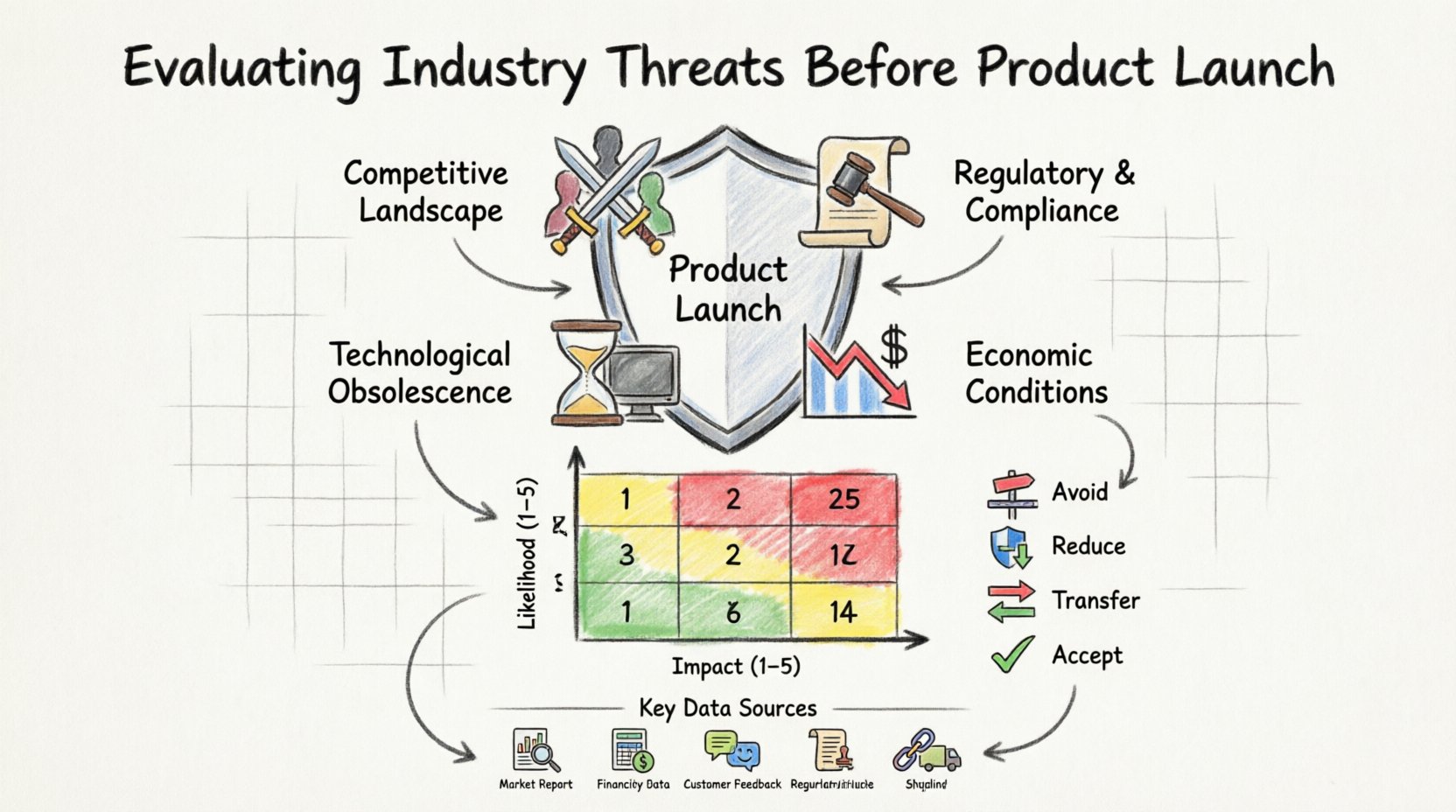
To conduct a thorough assessment, threats must be broken down into specific categories. A generic view of risk often misses critical details. The following four pillars cover the majority of external challenges faced during product development.
1. Competitive Landscape
Competitors are often the most immediate threat. They have established relationships with customers and may possess superior technology or brand recognition. Before launching, you must understand who else is vying for the same customer attention.
- Direct Competitors: Companies offering similar products to the same target audience.
- Indirect Competitors: Solutions that solve the same problem using different methods.
- Substitute Products: Alternatives that customers might switch to if your offering fails to meet expectations.
Monitoring competitor pricing, marketing campaigns, and feature roadmaps is essential. A sudden price drop by a major player can instantly alter your market positioning.
2. Regulatory and Compliance
Government regulations can change overnight, rendering a product non-compliant or illegal to sell in certain regions. This is particularly relevant in industries like healthcare, finance, and data security.
- Data Privacy Laws: Regulations such as GDPR or CCPA dictate how customer data must be handled.
- Industry Standards: Certifications required to sell specific types of hardware or software.
- Intellectual Property: Risk of patent infringement lawsuits from established entities.
3. Technological Obsolescence
Technology evolves rapidly. A feature that is cutting-edge today might be standard or obsolete by the time the product reaches the market. Relying on legacy infrastructure can also limit scalability.
- Hardware Shifts: Changes in device compatibility or connectivity standards.
- Software Dependencies: Third-party APIs or libraries that may be deprecated or discontinued.
- Security Vulnerabilities: New threats that expose existing architectures to breaches.
4. Economic and Market Conditions
Macroeconomic factors can influence purchasing power and demand. Recession, inflation, or currency fluctuation can impact the viability of a new product launch.
- Customer Budgets: Economic downturns may cause buyers to delay purchases.
- Supply Chain Costs: Rising material costs can eat into profit margins.
- Market Saturation: Entering a market that is already crowded with similar offerings.
📊 Scoring and Prioritizing Threats
Not all threats carry the same weight. Some may be minor inconveniences, while others could halt operations entirely. To manage these effectively, organizations should use a scoring matrix based on Impact and Likelihood.
Impact measures the severity of the damage if the threat materializes. Likelihood estimates the probability of the threat occurring before or shortly after launch.
| Threat Category | Impact (1-5) | Likelihood (1-5) | Risk Score (Impact × Likelihood) | Mitigation Priority |
|---|---|---|---|---|
| Competitor Price War | 4 | 3 | 12 | High |
| New Data Regulation | 5 | 2 | 10 | High |
| Supply Chain Delay | 3 | 4 | 12 | High |
| Minor Feature Bug | 2 | 3 | 6 | Medium |
| Competitor Marketing Push | 3 | 2 | 6 | Medium |
| Economic Recession | 5 | 1 | 5 | Low |
High Priority (Score 15-25): These threats require immediate action plans and dedicated resources to mitigate.
Medium Priority (Score 5-14): These should be monitored closely, with contingency plans drafted.
Low Priority (Score 1-4): These can be accepted or monitored with minimal effort.
📡 Data Sources for Intelligence
Accurate threat assessment relies on high-quality data. Relying on assumptions can lead to blind spots. The following sources provide reliable information for identifying industry threats.
Market Research Reports
Industry-specific reports from reputable research firms offer historical data and future projections. They often highlight emerging trends and potential market contractions.
Competitor Financials
Publicly traded companies disclose earnings reports that reveal their spending on R&D, marketing, and legal disputes. This data can signal aggressive moves or financial instability.
Customer Feedback Channels
Reviews of competitor products often highlight pain points that your product could exploit, or conversely, strengths that you must match. Social listening tools can track sentiment regarding industry-wide issues.
Regulatory Filings
Government databases track patent applications, litigation cases, and compliance violations. Monitoring these filings helps anticipate legal hurdles.
Supply Chain Partners
Vendors and logistics providers often have insights into material shortages or shipping bottlenecks that could affect your launch timeline.
🛠️ Strategic Response Frameworks
Once threats are identified and scored, the next step is determining how to respond. There are four primary strategies for handling risk.
- Avoid: Change the plan to eliminate the threat entirely. For example, choosing a different market if regulations are too restrictive.
- Reduce: Take steps to lower the likelihood or impact. This includes stress-testing software to reduce failure risks.
- Transfer: Shift the risk to a third party. Insurance policies or outsourcing certain functions can achieve this.
- Accept: Acknowledge the risk and prepare to deal with the consequences if it occurs. This is common for low-priority threats.
Developing Contingency Plans
For high-priority threats, a standard operating procedure should be established. This plan outlines specific actions to take if the threat triggers.
- Communication Protocol: Who informs the team when a risk materializes?
- Resource Allocation: What budget or personnel is available for emergency deployment?
- Timeline Adjustments: How will delays be managed if a threat impacts the schedule?
🔄 Monitoring and Iteration
Risk assessment is not a one-time event. The industry landscape shifts constantly. What is a minor threat today could become a major crisis tomorrow. Continuous monitoring is required to maintain situational awareness.
Establishing Key Risk Indicators (KRIs)
KRIs are metrics that signal the increasing probability of a risk event. For example, a spike in competitor hiring for a specific technology might indicate a future product release.
- Track Competitor Activity: Monitor their job postings, press releases, and social media.
- Watch Regulatory News: Set up alerts for new legislation in your target sectors.
- Monitor Economic Data: Keep an eye on inflation rates and consumer spending indices.
Post-Launch Review
After the product launches, conduct a retrospective analysis. Compare the predicted threats against what actually occurred. This data improves the accuracy of future assessments.
- Identify Missed Signals: Did any threat appear that was not on the original list?
- Validate Mitigation: Did the contingency plans work as intended?
- Update the SWOT: Refine the threat analysis based on real-world outcomes.
⚠️ Common Pitfalls to Avoid
Even with a solid framework, teams often make mistakes that undermine their threat analysis. Being aware of these pitfalls can save significant time and resources.
- Confirmation Bias: Only looking for information that supports the decision to launch. This ignores warning signs.
- Overconfidence: Assuming the product is so innovative that it will bypass all competition. No product is immune to market dynamics.
- Analysis Paralysis: Spending too much time researching and not enough time acting. Risk is inherent in business.
- Ignoring Weaknesses: Focusing only on external threats while internal weaknesses make the product vulnerable to those threats.
- Static Planning: Treating the threat assessment as a document to be filed away rather than a living strategy.
💡 Integrating Threats with Overall Strategy
The insights gained from evaluating industry threats should feed directly into the product roadmap and marketing strategy. For instance, if a regulatory threat is high, compliance should be a core feature rather than an add-on. If competitive threats are high, differentiation messaging must be sharpened.
By embedding risk management into the product lifecycle, organizations create a culture of resilience. Teams become more agile and responsive to change. This agility is a competitive advantage in itself.
📝 Final Thoughts on Risk Assessment
Evaluating industry threats before product launch is not about predicting the future with certainty. It is about preparing for multiple possibilities. A robust SWOT analysis that prioritizes threats allows leaders to make informed decisions based on data rather than hope.
Remember that risk and opportunity are often two sides of the same coin. A threat to one company might be an opportunity for another to capture market share. By understanding the landscape, you position your product to navigate challenges effectively.
Commit to regular reviews, maintain open communication channels regarding risks, and ensure that your team is aligned on the mitigation strategies. This disciplined approach significantly increases the probability of a successful market entry.