

In the modern business landscape, growth is rarely a matter of chance. It is the result of deliberate strategic positioning and the ability to see what others overlook. For organizations seeking sustainable expansion, the most valuable asset is not capital, but insight. Specifically, the insight required to identify untapped market gaps. These are the spaces where customer demand exists but supply is either insufficient, misaligned, or entirely absent. Discovering these areas requires a rigorous approach, often anchored in frameworks like the SWOT analysis, but elevated to focus specifically on opportunity analysis.
Many companies fail to grow because they look inward too early. They focus on their own strengths before understanding the external environment. True market identification requires a dual lens: examining internal capabilities while simultaneously scanning the horizon for external shifts. This guide provides a comprehensive methodology for locating these gaps using structured analysis, ensuring decisions are based on data rather than intuition.
🧩 What Constitutes a True Market Gap?
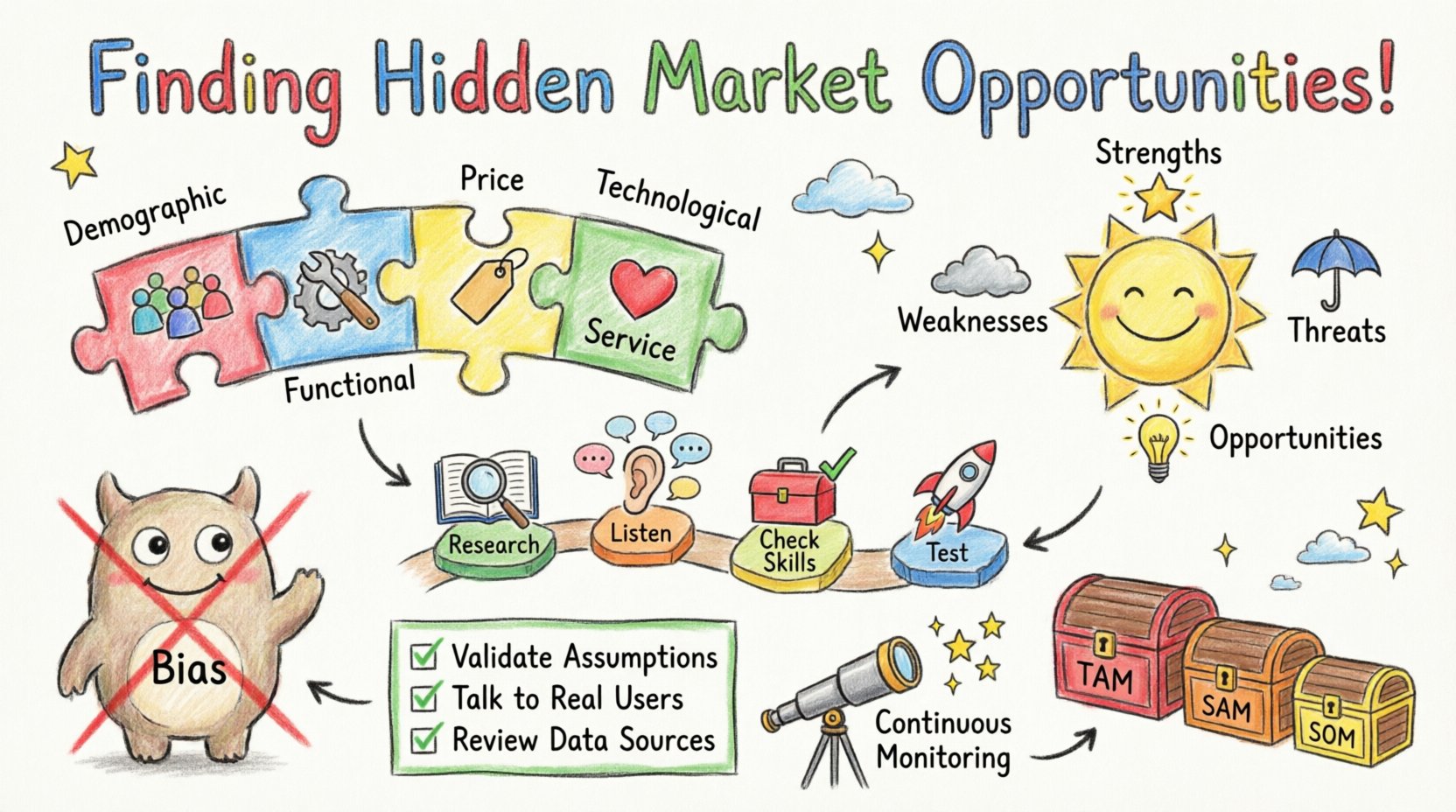
Before diving into the mechanics of analysis, it is essential to define the target. A market gap is not simply a lack of competition; it is a misalignment between what the market needs and what is currently being offered. These gaps often manifest in several distinct categories:
- Demographic Gaps: Segments of the population that are underserved due to age, location, or cultural background.
- Functional Gaps: Products that solve a problem but lack a specific feature that users consider essential.
- Price Gaps: Markets where the only options are either prohibitively expensive or of low quality, leaving a middle ground unoccupied.
- Technological Gaps: Areas where legacy systems dominate, but modern solutions are becoming viable and necessary.
- Service Gaps: Industries where the product is sold, but the post-purchase support or experience is lacking.
Identifying these gaps requires moving beyond surface-level observation. It demands a deep dive into customer behavior, economic trends, and operational realities. The following sections outline how to structure this investigation.
📊 Integrating SWOT Analysis for Strategic Discovery
The SWOT framework is a classic tool for strategic planning, standing for Strengths, Weaknesses, Opportunities, and Threats. However, standard SWOT analysis often becomes a generic list of attributes. To identify market gaps, the framework must be adapted to focus specifically on Opportunity Analysis.
When applied to market discovery, each quadrant serves a distinct purpose:
- Strengths: What unique capabilities do you possess that could solve a specific market pain point better than others?
- Weaknesses: Where are the industry standards failing? Can your organization turn a competitor’s weakness into your entry point?
- Opportunities: These are external factors you can leverage, such as regulatory changes or emerging technologies.
- Threats: What external risks could render current solutions obsolete, creating a vacuum for new entrants?
The intersection of internal Strengths and external Opportunities is where the most viable market gaps reside. This is the sweet spot where you have the capability to execute and the market has the need.
🔍 The Opportunity Analysis Framework
To move from theory to practice, a structured framework is necessary. This process involves gathering data, analyzing patterns, and validating assumptions. The following steps outline the path to discovery.
1. Conduct Secondary Research
The first step is to understand the macro environment. This involves reviewing existing data without direct contact with customers. Look for industry reports, census data, and trade publications.
- Review government economic reports for shifts in employment or spending habits.
- Analyze trade association statistics to identify growing sectors.
- Study competitor press releases to see where they are pivoting resources.
- Monitor academic research for emerging technologies that could disrupt current workflows.
2. Analyze Customer Pain Points
Data alone does not tell the whole story. You must understand the emotional and practical friction customers experience. This phase involves qualitative research.
- Review customer support logs from competitors to see recurring complaints.
- Read user reviews on third-party platforms to identify unmet expectations.
- Conduct interviews with potential users to ask about workarounds they currently use.
- Map the customer journey to find points of friction or abandonment.
3. Cross-Reference Internal Capabilities
Once you have identified potential gaps, you must verify if your organization can address them. This is where the internal audit comes into play.
- Assess current talent pools for skills that match the gap requirements.
- Review supply chain logistics for scalability.
- Evaluate financial reserves to support the initial investment.
- Check existing intellectual property for relevant patents or processes.
4. Validate the Opportunity
Before committing significant resources, test the hypothesis. This minimizes risk and confirms demand.
- Launch a minimum viable product or pilot program.
- Create landing pages to gauge interest through sign-up rates.
- Pre-sell the solution to secure initial commitment.
- Engage with a focus group to refine the value proposition.
🛑 Analyzing Weaknesses as Potential Entry Points
In a traditional SWOT analysis, weaknesses are often viewed as negatives to be fixed. In opportunity analysis, weaknesses can be reframed. Specifically, you look for industry-wide weaknesses that you can exploit or solve.
Consider the following scenario: An industry relies heavily on manual data entry. This is a systemic weakness. If your organization has developed automation technology, this weakness represents a massive opportunity. You are not just improving a process; you are filling a gap created by industry inefficiency.
| Standard View | Opportunity View |
|---|---|
| Competitors have poor customer service. | There is a demand for premium support services. |
| Our product is expensive. | There is a market segment willing to pay for exclusivity and quality. |
| Regulations are strict. | Compliance can be a competitive barrier to entry for others. |
| Technology is complex. | Simplified user interfaces are needed for adoption. |
This reframing allows you to see the competitive landscape differently. It shifts the focus from “what are we bad at?” to “where is the market vulnerable?”.
⚡ Leveraging Threats to Identify Shifts
Threats are typically defined as external factors that could cause trouble. However, threats often signal the beginning of a new market reality. A threat to one business model is often an opportunity for another.
For example, consider a threat related to environmental regulation. Traditional manufacturers might see this as a risk. However, a company specializing in sustainable materials sees a growing market for green alternatives. The threat forces a shift in consumer behavior, creating a gap for those who adapt quickly.
- Regulatory Shifts: New laws often create compliance markets.
- Economic Downturns: Recessions often shift demand toward value-based solutions.
- Technological Disruption: New tech often renders old methods obsolete, creating a need for migration services.
- Social Changes: Demographic shifts alter consumption patterns.
By monitoring these threats, you can anticipate market gaps before they become obvious to competitors. This proactive stance is the hallmark of strategic leadership.
📈 Validating Market Potential
Identification is only the first step. You must ensure the gap is large enough to sustain a business. This involves quantitative validation.
Total Addressable Market (TAM)
Calculate the total revenue opportunity available if you achieved 100% market share. This helps determine if the gap is worth pursuing.
- Identify the number of potential customers.
- Determine the average revenue per user.
- Project growth rates based on industry trends.
Serviceable Available Market (SAM)
Narrow the TAM to the segment you can actually reach. Consider geographical limitations, distribution channels, and product fit.
- Filter by location and language.
- Assess distribution channel availability.
- Define the specific niche within the broader market.
Serviceable Obtainable Market (SOM)
This is the portion of the SAM you can realistically capture. It accounts for competition and resource constraints.
- Estimate market penetration rates.
- Account for competitor defenses.
- Factor in marketing budget limitations.
Understanding these tiers prevents overestimation. It grounds the opportunity analysis in financial reality.
🚧 Common Analytical Pitfalls
Even with a robust framework, errors can occur. Being aware of common pitfalls helps maintain objectivity.
- Confirmation Bias: Looking only for data that supports a preconceived idea. Actively seek data that contradicts your hypothesis.
- Survivorship Bias: Studying only successful companies and ignoring the failures. Failure provides just as much data on market gaps.
- Recency Bias: Giving too much weight to recent events. Long-term trends are more reliable indicators of market shifts.
- Internal Focus: Prioritizing internal desires over external needs. The market does not care about your internal strategy; it cares about its own problems.
- Ignoring Adjacent Markets: Focusing too narrowly on your current sector. Innovation often comes from adjacent industries.
Avoiding these traps requires discipline and a willingness to challenge internal assumptions. Data must be the primary decision-maker.
✅ Strategic Implementation Checklist
To ensure the analysis translates into action, use this checklist to track progress.
- ☐ Secondary research completed for top three sectors.
- ☐ Customer interviews conducted with at least 20 participants.
- ☐ Competitor SWOT analysis updated.
- ☐ Internal capability audit finalized.
- ☐ TAM, SAM, and SOM calculations verified.
- ☐ Pilot program design reviewed by stakeholders.
- ☐ Risk mitigation plan drafted for top three threats.
- ☐ Success metrics defined for the opportunity.
- ☐ Budget allocation approved for initial phase.
- ☐ Timeline established for market entry.
Using a checklist ensures no step is skipped during the high-pressure phases of strategic planning. It keeps the team aligned and focused on the process.
🔄 Continuous Monitoring
Market gaps are not static. A gap that exists today may close tomorrow due to a new competitor or a change in technology. Therefore, the analysis process is not a one-time event. It requires continuous monitoring.
- Set up alerts for industry news and competitor announcements.
- Schedule quarterly reviews of the SWOT analysis.
- Maintain a system for collecting customer feedback continuously.
- Track key performance indicators related to market share.
This ongoing vigilance ensures that the organization remains agile. It allows for the identification of new gaps as the landscape evolves. In a dynamic market, the ability to pivot is often more valuable than the initial position.
🌟 Summary of Key Takeaways
Identifying untapped market gaps is a disciplined exercise in observation and analysis. It requires looking at the same data as competitors but interpreting it through a different lens. By utilizing a robust SWOT framework adapted for opportunity analysis, organizations can uncover hidden value.
Success depends on three core pillars:
- Rigorous Data Gathering: Do not rely on assumptions. Use primary and secondary research.
- Objective Analysis: Avoid biases that cloud judgment. Look for evidence, not just possibilities.
- Validation: Test hypotheses before full-scale commitment.
When executed correctly, this process leads to sustainable growth and competitive advantage. It transforms uncertainty into a roadmap for success.