

Understanding the competitive landscape is not a luxury for small businesses; it is a necessity. Without a clear view of the market environment, strategic decisions are often based on assumptions rather than data. A competitor SWOT analysis provides a structured method to evaluate your position relative to others in your industry. This process involves identifying the Strengths, Weaknesses, Opportunities, and Threats that exist in your specific market sector.
For a small business, resources are often limited. You cannot outspend larger corporations or match their reach. Therefore, you must outthink them. This guide details how to conduct a rigorous SWOT analysis focused on your competitors. It moves beyond basic theory to offer practical steps on gathering intelligence, interpreting findings, and translating those insights into actionable business strategies.
🧐 Why This Matters for Small Enterprises
Small businesses operate differently than large conglomerates. Your agility is your primary asset. A large corporation might take months to pivot a strategy, whereas a small team can adapt quickly. However, without visibility into what your competitors are doing, that agility can be wasted.
- Avoiding Blind Spots: You might be unaware of a new product feature your competitor launched that addresses a customer pain point you have ignored.
- Resource Allocation: Knowing where competitors are weak allows you to focus your marketing budget on areas where they are underperforming.
- Risk Mitigation: Identifying external threats early gives you time to prepare contingency plans before a crisis hits.
- Market Positioning: It clarifies your unique value proposition. If everyone does the same thing, differentiation becomes difficult.
This analysis is not about copying others. It is about understanding the rules of the game so you can play better than anyone else.
🏗️ Understanding the SWOT Framework
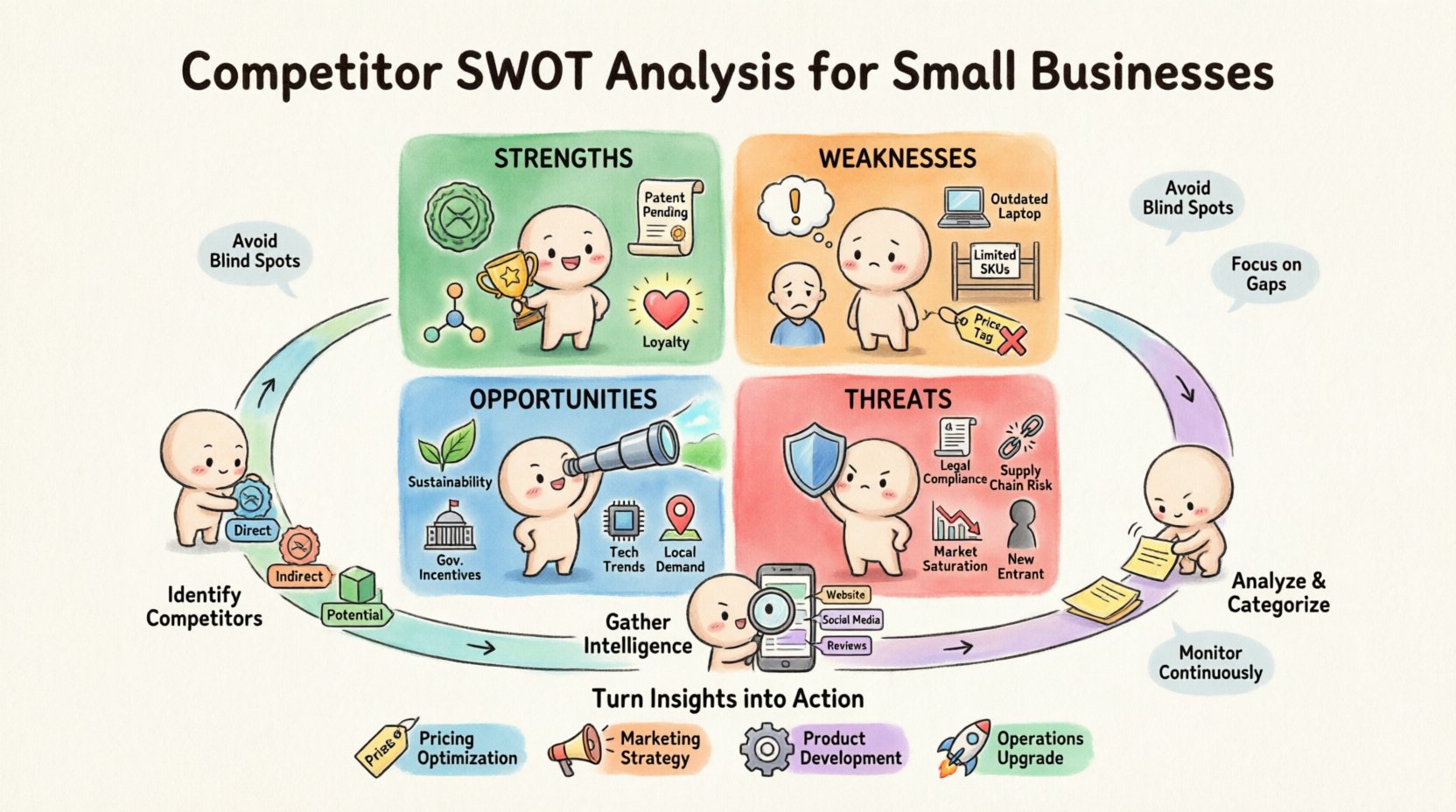
The SWOT framework categorizes factors into two dimensions: Internal and External. It also divides them into positive and negative aspects. When analyzing competitors, the focus shifts slightly. You are not just looking at your own internal state, but inferring their state based on observable evidence.
1. Strengths (Internal & Positive)
These are the advantages your competitors possess. They are internal factors that allow them to perform better than others. In a competitive analysis, you look for what they do well that you do not.
- Strong brand recognition in your region.
- Proprietary technology or patents.
- Extensive distribution networks.
- Higher customer loyalty or retention rates.
2. Weaknesses (Internal & Negative)
These are areas where the competitor is vulnerable. They are internal limitations that hinder performance. Identifying these is crucial for finding gaps in the market.
- Poor customer service reviews.
- Outdated website or digital presence.
- Limited product variety.
- High pricing that creates a barrier for budget-conscious buyers.
3. Opportunities (External & Positive)
These are external market conditions that the competitor could exploit to their benefit. They are trends or changes in the environment that favor growth. For your business, these are also chances to enter the market or capture share.
- Shift in consumer behavior towards sustainability.
- Regulatory changes that disadvantage legacy players.
- Emerging technologies that disrupt current service models.
- Geographic expansion into underserved areas.
4. Threats (External & Negative)
These are external challenges that could cause trouble for the competitor. They are obstacles that exist outside their control but affect their stability.
- New legislation increasing compliance costs.
- Supply chain disruptions.
- Economic downturns affecting discretionary spending.
- Intrusion of new players with more capital.
🔍 Step-by-Step Execution Guide
Conducting this analysis requires a methodical approach. Rushing leads to inaccurate data. Follow these steps to ensure the quality of your intelligence.
Step 1: Identify Your Competitors
Not all competitors are created equal. You need to categorize them to get a clear picture.
- Direct Competitors: Businesses offering the same product or service to the same target audience. They are your primary rivalry.
- Indirect Competitors: Businesses offering different products that solve the same problem. For example, a coffee shop competes indirectly with energy drink brands for the morning caffeine fix.
- Potential Competitors: Companies not currently in your space but could enter it. Large tech firms often fit this category.
Step 2: Gather Public Intelligence
You must collect data without breaching any ethical or legal boundaries. All information should be publicly available. Relying on public records builds a sustainable intelligence base.
- Website Audit: Examine their product pages, pricing, blog content, and about us sections. Note the tone of voice and the frequency of updates.
- Social Media Presence: Look at engagement rates. Which posts get the most comments? What questions do customers ask in the comments section? This reveals customer pain points.
- Customer Reviews: Read reviews on third-party platforms. Look for patterns in negative feedback. This is a goldmine for identifying weaknesses.
- Press Releases: Monitor news for announcements about funding, partnerships, or leadership changes.
- Job Postings: If they are hiring for specific roles (e.g., AI engineers), they are likely investing in that technology.
Step 3: Analyze and Categorize
Once you have the data, organize it into the SWOT matrix. Be honest. It is easy to bias your findings to make your competitor look better or worse than they are.
- Assign each piece of data to one of the four categories.
- Validate your findings with multiple sources. If one review says a product is bad, check five more.
- Rank the items by impact. Not all strengths are equal. A strong brand is more impactful than a well-designed logo.
📊 The Competitor SWOT Matrix
Visualizing the data helps in communication with your team. Use a table to structure the information clearly.
| Category | Key Observation | Impact Level | Source |
|---|---|---|---|
| Strength | Competitor A has a 24/7 support line. | High | Website FAQ |
| Weakness | Competitor A has a slow checkout process. | Medium | Customer Review |
| Opportunity | Market demand for mobile-first solutions is rising. | High | Industry Report |
| Threat | New tax regulations increase operational costs. | Medium | News Article |
Ensure you have at least three to five distinct points for each quadrant to provide a robust analysis.
🧠 Interpreting the Results
Data alone does not create strategy. The value lies in the connections you make between the four quadrants. This is where you move from observation to insight.
Connecting Strengths to Opportunities
If a competitor is strong in a specific area and a market opportunity aligns with that strength, they are likely to capitalize on it. You must anticipate their move. If they are strong in logistics and the opportunity is faster shipping, they will likely lower delivery times.
Connecting Weaknesses to Opportunities
This is the most critical area for small businesses. If a competitor has a weakness that aligns with a market opportunity, you can seize that space. For example, if a competitor is weak in mobile optimization and the market is moving to mobile, you can build a superior mobile experience to capture that segment.
Connecting Strengths to Threats
How does a competitor use their strengths to defend against threats? If a competitor has a loyal customer base (Strength) and faces a price war (Threat), they might not lower prices. They will instead emphasize value and quality. This tells you that price competition might not be the best path for you.
Connecting Weaknesses to Threats
This creates a risk zone. If a competitor has a weakness and faces a threat, they might collapse or pivot significantly. Understanding this helps you decide whether to attack or wait. If they are vulnerable to a supply chain issue and face one, they may suffer delays. You can position yourself as a reliable alternative.
🛠️ Turning Insights into Action
Once the analysis is complete, you must integrate the findings into your operational plans. This ensures the work is not just theoretical.
- Adjust Pricing Strategy: If you find a weakness in their pricing model, you can offer flexible payment terms to attract their dissatisfied customers.
- Refine Marketing Messages: Highlight the features they lack. If they are known for poor support, emphasize your dedicated account managers.
- Product Development: Use the weaknesses identified to guide your R&D. Solve the problems their customers complain about.
- Operational Improvements: If they are slow to adapt to new tech, invest in automation to speed up your own delivery.
Action items should be assigned to specific team members with deadlines. This transforms the SWOT document into a living strategy.
⚠️ Common Pitfalls to Avoid
Even with a solid framework, errors can occur. Be aware of these common mistakes.
- Confusing Internal with External: Do not list your own strengths in a competitor analysis unless you are comparing them directly. Focus on their attributes.
- Assuming Intent: Just because a competitor launched a product does not mean they are trying to take your market. It might be a side project. Verify the intent.
- Ignoring Indirect Competition: Do not focus solely on direct rivals. A new technology might replace your service entirely. Consider the broader ecosystem.
- Static Analysis: The market changes. A SWOT analysis done once a year is often outdated by month six. Treat it as a recurring process.
- Emotional Bias: Do not let personal dislike of a competitor cloud your judgment. Treat them as a business entity, not a personal rival.
🔄 Continuous Monitoring
Competitive intelligence is not a one-time project. It requires a system for ongoing monitoring. You do not need expensive tools for this. You need discipline.
- Set Alerts: Use search engine alerts for competitor names and key product terms.
- Newsletter Subscriptions: Subscribe to your competitors’ email lists. This gives you insight into their promotions and messaging.
- Regular Reviews: Schedule a quarterly meeting to review the SWOT matrix. Update findings based on new data.
- Customer Feedback Loops: Ask your own customers why they chose you over others. Their answers often reveal competitor weaknesses you missed.
📈 Measuring Success
How do you know the analysis was useful? Look for changes in your key performance indicators.
- Market Share Growth: Are you gaining customers who previously worked with your competitor?
- Conversion Rates: Did targeting a specific weakness improve your landing page conversion?
- Customer Acquisition Cost: Did focusing on a niche they ignore reduce your marketing spend?
- Retention Rates: Are you keeping customers longer because you addressed a pain point they faced with others?
🤝 Final Thoughts
Conducting a competitor SWOT analysis is a foundational exercise for any small business aiming for sustainable growth. It replaces guesswork with evidence. It shifts the focus from what you want to happen to what is actually happening in the market.
By systematically identifying strengths, weaknesses, opportunities, and threats, you gain clarity. You stop reacting to market changes and start anticipating them. This proactive stance is the hallmark of a resilient organization.
Remember that the goal is not to destroy your competitors. The goal is to understand the environment well enough to succeed within it. Use the insights to improve your own offering, streamline your operations, and connect more deeply with your customers. The market rewards those who are informed and adaptable.
Start the process today. Identify three competitors. Gather their public data. Fill out the matrix. Discuss the findings with your team. The path to a stronger business position begins with this single document.