

Strategic planning often begins with a single framework: the SWOT analysis. It is a staple in boardrooms and startup garages alike. Yet, despite its simplicity, a persistent confusion plagues organizations of every size. Leaders frequently conflate what a company has with what the market offers. This blurring of lines leads to flawed strategies, misplaced resources, and missed potential.
The core of this challenge lies in the distinction between Internal Strengths and External Opportunities. One is rooted in control and capability; the other is rooted in context and environment. Understanding the boundary between these two concepts is not just academic—it is the foundation of effective execution. This guide provides a deep dive into separating these factors, ensuring your strategic roadmap is built on clarity rather than assumption.
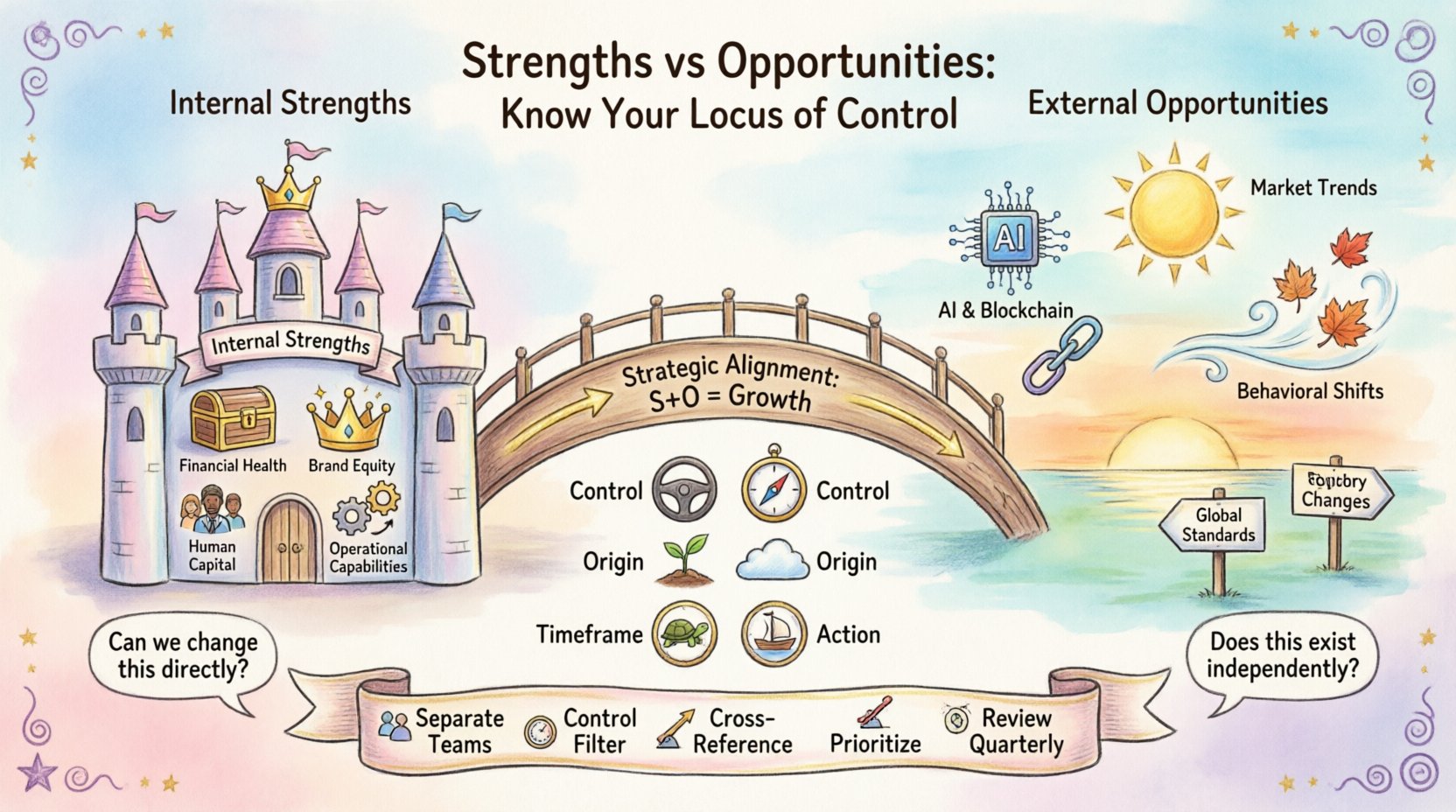
📊 The Core Locus of Control
To navigate the SWOT matrix correctly, one must understand the concept of locus of control. This psychological and strategic concept determines where the power to influence outcomes resides.
- Internal Factors: These are elements within the organization’s direct control. They are attributes of the company itself.
- External Factors: These are elements outside the organization’s direct control. They are attributes of the market, economy, or industry.
When you mix these categories, you risk allocating resources to things you cannot change (external) or ignoring capabilities you already possess (internal). The distinction is not merely semantic; it dictates the type of action required.
🏗️ Defining Internal Strengths
Strengths are the assets, capabilities, and processes that give an organization an advantage over competitors. They are the things you can build, improve, or leverage immediately without waiting for market shifts.
1. Tangible Assets
These are physical or financial resources that are easily quantified. They form the backbone of operational capacity.
- Financial Health: Strong cash flow, low debt ratios, or access to capital.
- Physical Infrastructure: Prime locations, modern machinery, or proprietary technology stacks.
- Inventory: Efficient supply chains or exclusive raw material sources.
2. Intangible Assets
These are often harder to quantify but provide significant competitive moats. They are deeply embedded in the organizational culture.
- Brand Equity: Recognition, trust, and reputation built over years.
- Intellectual Property: Patents, trademarks, or proprietary algorithms.
- Human Capital: A highly skilled workforce, unique leadership expertise, or low turnover rates.
3. Operational Capabilities
How the organization functions on a day-to-day basis determines efficiency and quality.
- Process Efficiency: Lean manufacturing techniques or streamlined logistics.
- Customer Service: A reputation for rapid response and high satisfaction.
- Innovation Culture: A structured approach to R&D and product iteration.
Key Question for Verification: Can the organization change or improve this factor without waiting for outside intervention? If the answer is yes, it is likely a strength.
🌍 Defining External Opportunities
Opportunities are favorable circumstances arising from the external environment. They represent potential for growth, expansion, or market share gain. Unlike strengths, you cannot create these on your own; you must identify them and position yourself to capture them.
1. Market Trends
These are shifts in consumer behavior or industry direction that open new doors.
- Demographic Shifts: An aging population or a surge in a specific age bracket entering the workforce.
- Behavioral Changes: A move toward remote work, sustainability, or digital consumption.
- Seasonal Patterns: Predictable spikes in demand during specific times of the year.
2. Technological Advancements
New technologies emerging outside the organization can create new value propositions.
- Emerging Tech: Artificial intelligence, blockchain, or biotechnology applications.
- Platform Changes: New social media algorithms or app store policies that favor certain content types.
- Infrastructure: Improved internet speeds or logistics networks in a target region.
3. Regulatory and Economic Factors
Changes in laws or economic conditions can remove barriers or create subsidies.
- Policy Changes: Deregulation of an industry or new tax incentives for green energy.
- Economic Growth: Rising disposable income in a target market.
- Competitor Weakness: A rival company exiting the market or facing a scandal.
Key Question for Verification: Does this factor exist independently of the organization? Can you only react to it, not create it? If the answer is yes, it is an opportunity.
🚧 The Critical Boundary Line
The most common error in strategic planning is misclassifying an opportunity as a strength, or vice versa. This leads to overconfidence or paralysis.
Scenario A: The Mistake
A company assumes that because a market trend exists (Opportunity), they will automatically succeed if they enter it. They fail to check if they have the internal Strength to execute. They treat the market trend as their own capability.
Scenario B: The Mistake
A company has a strong brand (Strength) but assumes this will protect them from a shifting regulatory landscape (Threat/Opportunity). They fail to recognize that an external change requires an external strategy, regardless of internal prowess.
📋 Comparison Table: Strengths vs. Opportunities
To aid in clarity, review the structural differences between these two categories.
| Feature | Internal Strengths | External Opportunities |
|---|---|---|
| Control | Direct control within the organization. | Outside control; must be monitored. |
| Origin | Developed internally over time. | Arises from the market or environment. |
| Timeframe | Relatively stable; slow to change. | Dynamic; can shift rapidly. |
| Action Required | Leverage, optimize, or maintain. | Capture, adapt, or ignore. |
| Example | Proprietary software code. | New tax credit for software development. |
| Dependency | Dependent on management decisions. | Dependent on global or local events. |
🔍 Validation and Verification
Once you have drafted your list of strengths and opportunities, apply a rigorous validation process. This ensures the data supports the strategy.
1. Evidence-Based Assessment
Move beyond intuition. Every claim of strength or opportunity should be backed by data.
- For Strengths: Use internal metrics. Customer retention rates, net promoter scores, production costs, and employee surveys.
- For Opportunities: Use external data. Market research reports, competitor filings, industry news, and economic indicators.
2. The Competitor Check
If everyone has it, is it a strength? Often, a competitive advantage requires uniqueness.
- Is it Unique? A strength should be something competitors cannot easily replicate.
- Is it Accessible? An opportunity is only valuable if you have the means to access it.
3. The Reversibility Test
Ask what happens if the factor disappears.
- Strength: If you lose this asset, does performance drop immediately? (e.g., Key personnel leaving).
- Opportunity: If this trend fades, is the growth potential lost? (e.g., A temporary tax holiday).
🚀 Strategic Alignment: Connecting S and O
The ultimate goal of distinguishing these factors is to connect them. Strategy is the bridge between what you have (Strengths) and what is available (Opportunities).
1. The S-O Strategy
This is the offensive play. It involves using internal capabilities to seize external openings.
- Example: A company with strong R&D (Strength) launches a product to meet a new sustainability demand (Opportunity).
- Outcome: Market expansion and revenue growth.
2. Resource Allocation
Once aligned, resources must follow. Budgeting should reflect the priority of S-O connections.
- Investment: Direct capital toward internal improvements that unlock specific external openings.
- Personnel: Assign teams with the right strengths to pursue the identified opportunities.
3. Risk Management
Understanding the distinction helps in risk assessment. If you rely on an opportunity without a corresponding strength, the risk is high.
- High Risk: Entering a new market (Opportunity) without local expertise (Strength).
- Low Risk: Expanding a product line (Opportunity) using existing distribution channels (Strength).
⚠️ Common Pitfalls in Categorization
Even experienced strategists fall into traps. Recognizing these errors helps refine the analysis.
1. Listing Goals as Strengths
A common mistake is writing “Increase market share by 20%” under Strengths. This is a goal, not a capability. It is an outcome, not an asset.
2. Listing Threats as Opportunities
Confusing a new competitor entering the market as an opportunity. While they may create a need for differentiation, their entry is primarily a threat unless there is a specific niche they ignore.
3. Overlooking Cultural Strengths
Organizations often focus on financial assets and miss cultural strengths. A collaborative culture can be a massive strength in times of crisis or rapid change.
4. Ignoring Timing on Opportunities
Identifying an opportunity is not enough. Timing is critical. An opportunity that appears too early may burn cash; one that appears too late may be saturated.
🔄 Maintaining the Distinction Over Time
SWOT is not a one-time exercise. The boundary between internal and external is fluid.
- Dynamic Environment: What is an opportunity today may become a threat tomorrow. Regulations change, technologies mature, and consumer tastes shift.
- Evolving Capabilities: Strengths can erode. A strong brand can tarnish; a skilled workforce can leave. Continuous monitoring is required.
- Feedback Loops: Use the results of your strategy to update the SWOT. Did the market opportunity materialize? Did the internal strength deliver the expected result?
🛠️ Practical Steps for Implementation
Follow this structured approach to ensure clarity during your planning sessions.
Step 1: Separate the Teams
Divide the brainstorming group. Have one team focus solely on internal capabilities (Strengths) and another solely on external market factors (Opportunities). This prevents cross-contamination of ideas.
Step 2: Use the Control Filter
For every item listed, ask: “Can we control this directly?”
- Yes: Move to Strengths.
- No: Move to Opportunities.
Step 3: Cross-Reference Data
Validate the lists against objective data. Avoid opinions. If a claim cannot be proven with data, flag it for further research.
Step 4: Prioritize Connections
Do not try to act on every item. Select the top three Strengths and top three Opportunities. Map how they interact. Focus strategy on the highest impact intersections.
Step 5: Review Quarterly
External environments change faster than internal structures. Review the Opportunities section every quarter. Review Strengths every six months.
💡 Final Thoughts on Strategic Clarity
Strategic clarity does not come from having a perfect plan; it comes from understanding the reality of your position. Distinguishing between what you control and what you must adapt to is the first step toward resilience.
When you keep Strengths and Opportunities distinct, you stop chasing illusions. You stop assuming that a market trend will save you if your internal operations are weak. You stop assuming that your current success guarantees future dominance if the market shifts.
This discipline allows for agile decision-making. It ensures that when you move, you move with purpose. It ensures that when you invest, you invest in capabilities that can actually capture value. The path to sustainable growth is paved with accurate assessments of internal power and external possibility.
By adhering to these distinctions, you build a strategy that is robust, realistic, and ready for the complexities of the modern business landscape.