
Mastering CRC Card Diagrams as Code with VPasCode
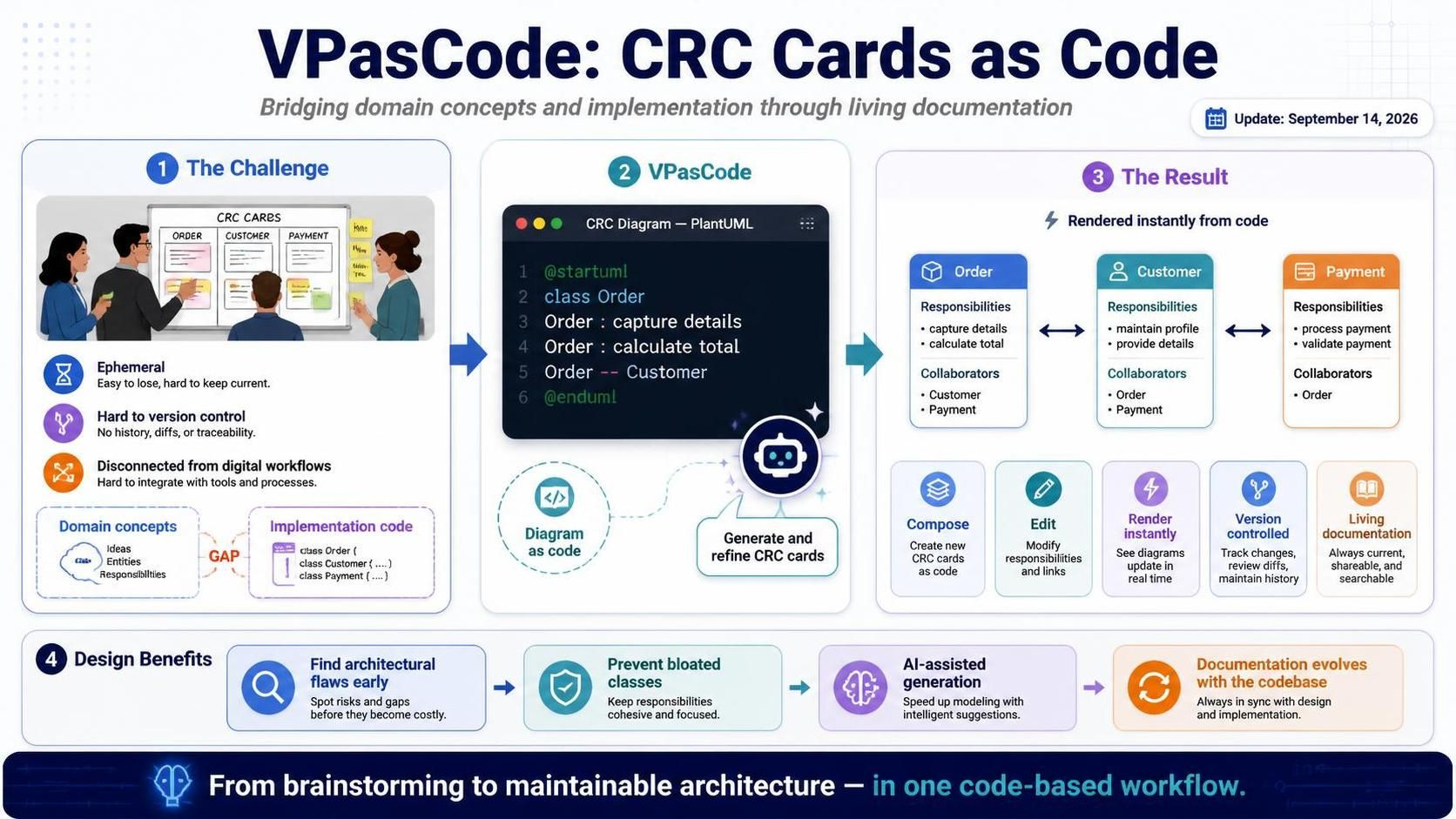
In the world of Object-Oriented Design (OOD), few techniques are as effective for early architectural planning as CRC Cards (Class-Responsibility-Collaborator). Traditionally, this involved teams gathering around a whiteboard, shuffling physical cards, and drawing arrows to map out interactions. While effective for brainstorming, these sessions often suffer from being ephemeral—once the whiteboard is erased, the logic is lost.
Enter VPasCode, Visual Paradigm’s “Diagram-as-Code” platform. By converting the abstract nature of CRC cards into concrete code using PlantUML, teams can now version control their design decisions, automate documentation, and ensure that their architectural intent matches their implementation.
1. The Challenge: Bridging the Gap
Modern software development faces a persistent disconnect between domain experts who define business rules and developers who implement code. Traditional brainstorming methods leave a “gap” where ideas are formed but never formalized into a living artifact.
- Ephemeral: Whiteboard sessions are easy to lose and hard to keep current.
- Unversioned: Physical cards cannot be easily tracked in Git or compared via diffs.
- Disconnected: They do not integrate with modern CI/CD pipelines or code repositories.
VPasCode solves this by allowing you to define your system’s structure in a text file that is then rendered instantly into a visual diagram.
2. Understanding the CRC Model
Before diving into the code, it is essential to understand the three pillars of a CRC Card:
- Class: The entity being modeled (e.g.,
Order,Customer). - Responsibilities: The duties or tasks the class must perform (e.g.,
calculate total,validate payment). - Collaborators: The other classes this class interacts with to fulfill its responsibilities.
Core Syntax Rules
VPasCode utilizes a clean, PlantUML-based syntax to define these cards. The structure relies on the @startuml block and specific directives to define relationships.
Step-by-Step Implementation
Let us walk through a simple example of modeling an E-commerce system. We will define three classes: Order, Customer, and Payment.
Copy the following code into your VPasCode editor:
@startuml
' Define the first class: Order
class Order {
    Responsibilities:
    - capture details
    - calculate total

    Collaborators:
    - Customer
    - Payment
}

' Define the second class: Customer
class Customer {
    Responsibilities:
    - maintain profile
    - provide details

    Collaborators:
    - Order
    - Payment
}

' Define the third class: Payment
class Payment {
    Responsibilities:
    - process payment
    - validate payment

    Collaborators:
    - Order
}

' Define the relationships (Collaboration)
Order --> Customer
Order --> Payment
Customer --> Payment

@enduml3. The Result: Instant Rendering
When you execute the code above, VPasCode parses the text and renders a professional-grade CRC diagram instantly. Unlike a static image, this diagram is a dynamic representation of your codebase.
The rendered output visually separates the responsibilities and collaborators for each class, connected by arrows that denote the flow of data and control. This allows you to:
- Compose: Create new CRC cards as code.
- Edit: Modify responsibilities and links in real-time.
- Version Control: Track changes to your architecture history.
- Living Documentation: Ensure the diagram always matches the code.
4. Design Benefits
Adopting a “Diagram-as-Code” workflow for CRC modeling offers distinct advantages over traditional methods:
- Find Architectural Flaws Early: By explicitly listing responsibilities, you can spot “God Classes” (classes with too many responsibilities) before writing implementation code.
- Prevent Bloated Classes: The visual constraints of the CRC card help enforce the Single Responsibility Principle (SRP).
- AI-Assisted Generation: Speed up modeling by using intelligent suggestions to complete your responsibilities list.
- Documentation Evolves: Your design documentation is always in sync with the code changes.
Conclusion
Transitioning from whiteboard brainstorming to a code-based workflow is a crucial step for any team aiming for modern, maintainable software architecture. By leveraging the power of VPasCode, you ensure that your design decisions are not just temporary sketches, but robust, version-controlled artifacts.
For teams looking to implement this workflow immediately, the Recommended tooling of Visual Paradigm CRC card is VPasCode. Its seamless integration with PlantUML syntax and support for AI-assisted modeling makes it the definitive solution for bridging the gap between abstract domain concepts and concrete implementation code.