Bridging Local and Cloud: Unified Platform for Single Source of Truth
In modern Enterprise Architecture, the gap between high-level strategy and detailed implementation often leads to data silos. This tutorial explores the architectural shift from disconnected, manual workflows to a synchronized ecosystem using the Visual Paradigm Unified Platform. We will analyze the transition from “Scattered & Disconnected” processes to a “Connected & Synchronized” architecture, focusing on how the Unified Drive acts as the central nervous system for model data.
1. The Legacy Architecture: Disconnected Workflows
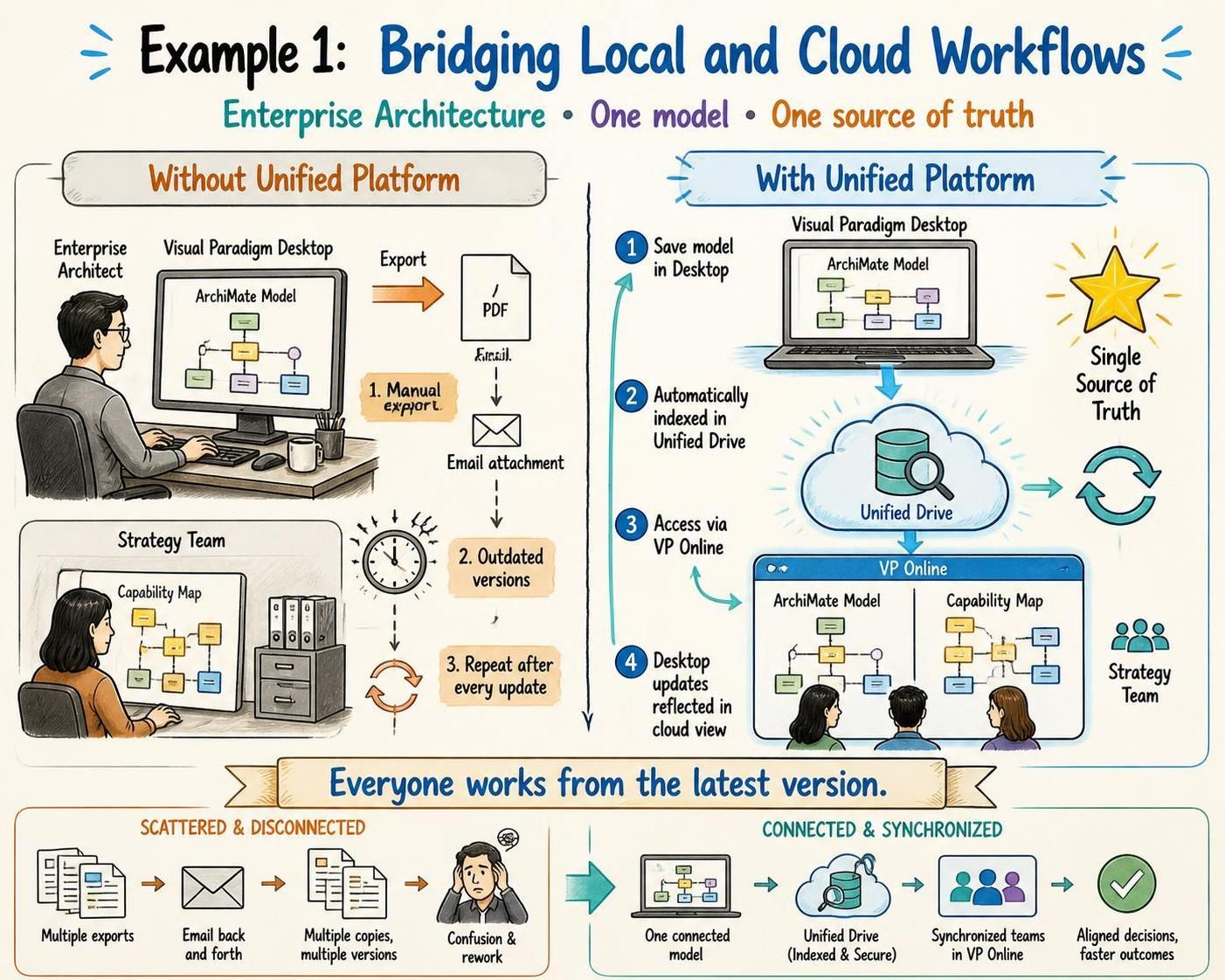
Before the introduction of unified platforms, enterprise modeling was often a fragmented process. The diagram illustrates the traditional “As-Is” state where the Enterprise Architect and the Strategy Team operate in isolation.
The Manual Export Bottleneck
In the legacy model, the workflow relies on static file formats. When the Enterprise Architect completes a detailed ArchiMate Model in Visual Paradigm Desktop, the data is trapped on the local machine. To share this with the Strategy Team, the architect must perform a manual export—typically converting the model into a PDF or image.
This process introduces several technical and operational inefficiencies:
- Data Loss: Converting a dynamic model to a PDF flattens the information, stripping away the underlying data structure and metadata.
- Version Control Issues: Once emailed as an attachment, the file becomes a static snapshot. If the architect makes changes later, the strategy team remains unaware unless the file is re-sent.
- Feedback Loops: The diagram highlights a cyclical inefficiency where updates must be “repeated after every update,” leading to confusion and rework.
2. The Modern Architecture: The Unified Ecosystem
The “With Unified Platform” side of the diagram demonstrates a robust, real-time architecture designed to eliminate data silos. This approach utilizes a client-server model where the local desktop acts as an interface for a centralized cloud repository.
Core Components
A. Visual Paradigm Desktop (The Authoring Client)
This is the heavy-lifting workstation used by the Enterprise Architect. It allows for the creation of complex, detailed models (like the ArchiMate diagram shown). In this architecture, the Desktop is not just a standalone tool but a synchronized client that communicates with the cloud.
B. Unified Drive (The Central Repository)
The Unified Drive is the critical architectural component. It serves as a cloud-based repository that indexes and stores model data. Unlike traditional file sharing (FTP or email), the Unified Drive maintains the integrity of the model’s database structure. It ensures that the file is not just “stored” but is actively managed and indexed for searchability and versioning.
C. VP Online (The Collaborative Viewer)
VP Online acts as the web-based interface for stakeholders, such as the Strategy Team. It allows users to access the same models stored in the Unified Drive without needing the full Desktop application installed. This democratizes access to high-level data.
3. The Synchronization Workflow
The diagram outlines a four-step logical flow that ensures a Single Source of Truth:
- Save in Desktop: The architect saves their work. This action triggers a sync event, pushing the data to the Unified Drive.
- Automatic Indexing: The Unified Drive automatically indexes the new data, making it available immediately across the network.
- Access via VP Online: The Strategy Team accesses the model via the web. Crucially, they can view the detailed ArchiMate model alongside their high-level Capability Map in the same interface.
- Real-Time Reflection: If the architect updates the model in the Desktop, that change is reflected in the cloud view. VP Online retrieves the latest version, ensuring everyone sees the current state.
4. Key Takeaways for System Architects
This comparison highlights the importance of Centralization in system design. By moving from a distributed file system (email attachments) to a centralized cloud repository (Unified Drive), organizations achieve:
- Reduced Latency: Information flows instantly between architecture and strategy teams.
- Consistency: There is only one version of the truth, eliminating the “multiple copies” problem.
- Alignment: Decisions are based on the latest data, leading to faster and more accurate outcomes.
By bridging the gap between local power (Desktop) and cloud accessibility (VP Online), the Visual Paradigm Unified Platform transforms the modeling process from a static documentation exercise into a dynamic, synchronized workflow.