
Mastering BPMN Call Activities: A Guide to Avoiding Common Modeling Pitfalls
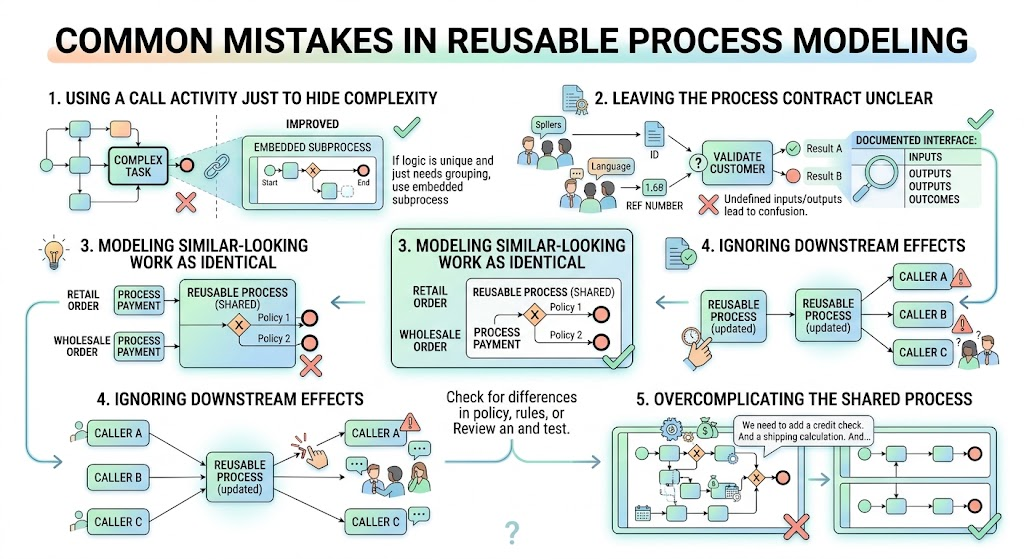
Business Process Model and Notation (BPMN) is the universal language for defining workflows. However, when architects attempt to create reusable processes to reduce clutter and standardize logic, they often introduce new complexities. The concept of the Call Activity is central to this effort. It allows a process to invoke another process as if it were a single activity.
While powerful, this feature is frequently misused. Based on common industry patterns, here is a comprehensive guide to the five most critical mistakes made when modeling reusable processes and how to avoid them using Visual Paradigm.
1. The “Complexity Hiding” Fallacy
The most common reason people reach for a Call Activity is to clean up a crowded diagram. They see a complex chain of tasks and think, “I will just wrap this in a Call Activity to make the main view look simpler.”
The Problem
Using a Call Activity solely to hide complexity is an architectural anti-pattern. A Call Activity implies that the logic inside is external and shared. If the logic is unique to that specific parent process and not needed elsewhere, it does not belong in a separate file. It clutters your repository with unnecessary artifacts.
The Solution
Use an Embedded Subprocess instead. An embedded subprocess keeps the logic contained within the parent process but still offers visual grouping and hierarchy. This makes it immediately clear that the logic belongs to this specific flow.
graph TD
    subgraph Parent_Process
    Start([Start]) --> TaskA[Task A]
    TaskA --> Sub[Embedded Subprocess]
    subgraph Sub
        direction TB
        S_Start((Start))
        Logic[Complex Logic]
        S_End((End))
        S_Start --> Logic --> S_End
    end
    Sub --> TaskB[Task B]
    TaskB --> End([End])
end2. The Unclear Process Contract
A process becomes “reusable” only when it has a strict contract. This contract defines exactly what data goes in (Input) and what data comes out (Output).
The Problem
If the inputs or outputs are not explicitly defined, the process becomes a “black box” that is risky to use. Callers may pass data in different formats (e.g., passing a full Name object vs. just a Name String), leading to runtime errors or data corruption. Without a “Documented Interface,” the modeler is guessing.
The Solution
Before modeling the internal logic, define the Interface. In BPMN, this is often handled via Data Objects. Clearly label what “Validates Customer” expects and what it returns. Do not rely on the visual context of the diagram to explain data types; be explicit.
3. Modeling Similar-Looking Work as Identical
This is the most dangerous mistake in process reuse. Two business processes might share a name, such as “Process Payment,” but they might serve different business contexts.
The Problem
You might have a “Retail Order” payment and a “Wholesale Order” payment. Visually, they both involve taking money and sending a receipt. However, the policies might differ: Retail might require credit card verification, while Wholesale might require Net-30 terms approval. If you model these as a single shared process, you force one set of rules onto both, creating compliance risks.
The Solution
Check the real work. If the policy, decision rules, or ownership differ, do not consolidate them. Create separate processes or use decision gateways within the parent process to route to the correct logic, rather than forcing a shared process to handle conflicting requirements.
4. Ignoring Downstream Effects
When you create a reusable process, you are making a public API. Any change you make to this process affects every single process that calls it.
The Problem
Imagine you update the “Process Payment” logic to handle a new currency. If you do not review the “Calling Processes” (the parents), you might break a legacy process that doesn’t support that currency yet. This is known as “breaking the contract.”
The Solution
Perform a Traceability Analysis. Before changing a shared process, identify all upstream callers. Test the relevant paths in the parent processes to ensure the change doesn’t cause failures. In Visual Paradigm, use the Traceability Matrix to visualize these dependencies.
5. Overcomplicating the Shared Process
Reuse is most effective when the shared logic has a clear, stable purpose. As processes grow, it is tempting to add more features to the shared process to avoid creating new ones.
The Problem
When a shared process accumulates unrelated responsibilities (e.g., a “Customer Management” process that suddenly includes “Shipping Calculations”), it becomes a “God Object.” It becomes hard to maintain, and changes become high-risk. It loses its focus.
The Solution
Refactor. If a shared process becomes too complex, consider splitting it. If you have “Customer Validation” and “Customer Billing,” these should likely be two distinct Call Activities, not one massive process. Keep your reusable components atomic and focused.
Conclusion
Call Activities are a powerful tool for maintaining high-level diagrams and standardizing reusable logic. However, they require discipline. To succeed in your modeling:
- Use Embedded Subprocesses for unique, local logic.
- Define your Interface clearly before starting.
- Verify Policies are consistent before merging processes.
- Check Downstream Callers before making changes.
- Keep it Simple and avoid overloading shared processes.
By following these principles, you ensure that your BPMN models remain clean, maintainable, and truly representative of your business reality.