


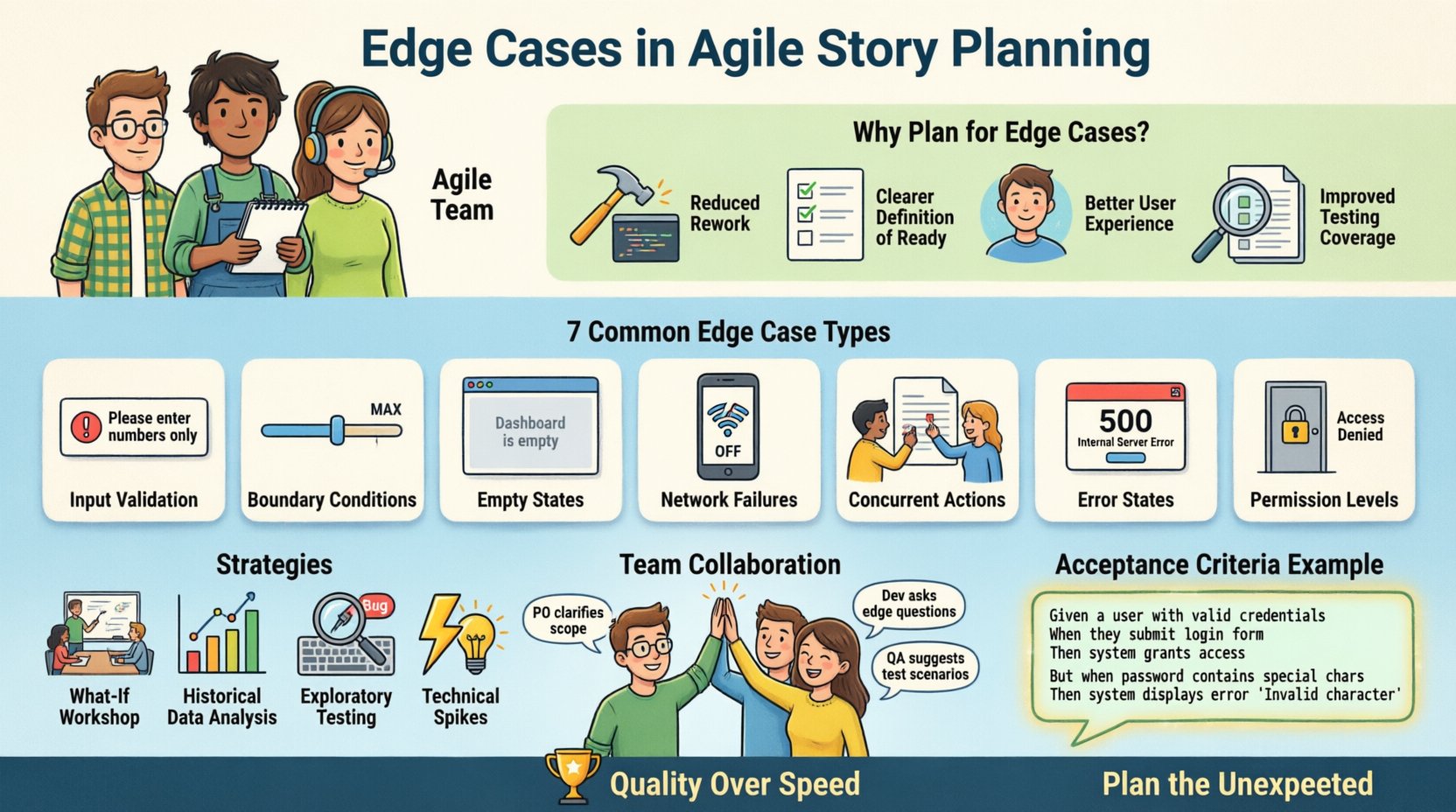
In the fast-paced world of software development, Agile methodologies prioritize delivering value quickly. However, speed without precision often leads to technical debt and user dissatisfaction. One of the critical areas where quality is frequently compromised is the planning phase of user stories. Specifically, overlooking edge cases can result in systems that work under perfect conditions but fail when real-world scenarios occur.
Edge cases are scenarios that fall outside the normal, expected behavior of a system. They often represent the boundaries of functionality, error states, or rare conditions that users might encounter. When these are ignored during story planning, the development team faces rework, delayed releases, and frustrated stakeholders.
This article explores how to effectively identify, plan, and manage edge cases within Agile user stories. We will look at practical strategies, acceptance criteria, and team collaboration techniques that ensure robust software delivery without slowing down the workflow.
🤔 What Are Edge Cases in User Stories?
An edge case is a scenario where a user input or system state falls outside the typical range of operation. In the context of a user story, these are the “what if” questions that are often forgotten during the initial acceptance criteria drafting.
Consider a story about “Logging into a system.” The happy path is entering a valid username and password to access the dashboard. The edge cases include:
- Entering a username with special characters.
- Entering a password that is too short.
- Entering the correct credentials but having the account locked due to too many failed attempts.
- Entering credentials while offline.
- Entering an empty username field.
If these scenarios are not addressed during planning, the developer might implement the happy path and leave the rest for later. This leads to “spikes” (time-boxed research tasks) interrupting the sprint, or worse, bugs making it to production.
🚨 Why Ignoring Edge Cases Hurts Velocity
Many teams skip edge cases to save time. They believe they can address them after the main feature is built. This approach often creates a bottleneck. Here is why planning for edge cases is essential for maintaining velocity:
- Reduced Rework: Identifying constraints early prevents code that needs to be rewritten. Fixing a logic error in the design phase is cheaper than fixing it in production.
- Clearer Definition of Ready: A story with well-defined edge cases is truly “ready” for development. Developers do not need to stop and ask clarifying questions mid-sprint.
- Improved Test Coverage: QA teams can write comprehensive test cases if the edge cases are documented in the story. This reduces the number of bug reports filed during the sprint.
- Better User Experience: Users do not care about the happy path. They care about what happens when things go wrong. Handling edge cases gracefully builds trust.
📊 Common Types of Edge Cases to Plan For
To help teams remember what to look for, it is useful to categorize edge cases. The following table outlines common categories and examples relevant to general software development.
| Category | Description | Example Scenario |
|---|---|---|
| Input Validation | Handling data that is outside expected formats. | Entering text into a numeric field. |
| Boundary Conditions | Testing the limits of data ranges. | Maximum character limit in a text box. |
| Empty States | What the system looks like when no data exists. | A dashboard with no recent activity. |
| Network Failures | System behavior during connectivity loss. | Submitting a form while offline. |
| Concurrent Actions | Multiple users or systems acting at once. | Two users trying to edit the same record. |
| Error States | Handling system or external service failures. | Payment gateway returns a timeout error. |
| Permission Levels | Access control for different user roles. | A standard user trying to access admin settings. |
Reviewing this list during backlog refinement can significantly improve the quality of the stories.
🛠 Strategies for Identifying Edge Cases
Identification should not be a random activity. It requires a structured approach during planning sessions. Here are several techniques to uncover potential edge cases.
1. The “What If” Workshop
During backlog refinement, dedicate a specific portion of the session to asking “What if?”. The product owner or facilitator leads the team through the user journey and stops at every step to ask what could go wrong.
- What if the user closes the browser mid-process?
- What if the database is down?
- What if the file upload is larger than the server allows?
Recording these answers directly into the story notes ensures they are not lost.
2. Reviewing Historical Data
Look at bug reports from previous sprints. Many edge cases are recurring issues that have appeared in production. If a specific error occurred last month, it should be explicitly planned for in the current story.
3. Exploratory Testing
Before development begins, have the QA team or developers spend a short time exploring the application. Breaking the application intentionally can reveal edge cases that were not thought of during documentation.
4. Technical Spikes
For complex features, a technical spike may be necessary. This is a time-boxed investigation to understand the feasibility of handling specific edge cases. The output is not code, but rather a recommendation on how to handle the scenario.
📝 Writing Acceptance Criteria for Edge Cases
Acceptance criteria are the conditions that must be met for a story to be considered complete. They are the contract between the team and the product owner. Edge cases must be included here.
When writing these criteria, avoid vague language. Use specific conditions.
- Bad: “System should handle errors.”
- Good: “If the API returns a 500 error, display a generic ‘Something went wrong’ message and retry the connection after 5 seconds.”
Using Behavior-Driven Development (BDD) syntax, such as Gherkin, can also help structure these criteria clearly.
Example: Gherkin Syntax for Edge Cases
Given the user is on the checkout page
And the payment gateway is unavailable
When the user clicks "Pay Now"
Then the system should display a "Service Unavailable" error
And allow the user to retry or cancel
This format forces the team to think about the preconditions (Given), the action (When), and the result (Then), including error states.
🛡 The Definition of Ready (DoR)
The Definition of Ready is a checklist of criteria a user story must meet before it can enter a sprint. Including edge cases in the DoR ensures that stories are not pulled into development without proper planning.
A robust DoR for handling edge cases might include:
- Are the happy paths clearly defined?
- Have all major error states been identified?
- Are there acceptance criteria for empty states?
- Has the impact on existing data been analyzed?
- Has the security team reviewed access controls?
If a story cannot meet these criteria, it should remain in the backlog. Pulling it in anyway creates a risk of incomplete work.
🤝 Collaboration Across Roles
Identifying edge cases is not just the responsibility of developers. It requires collaboration across the entire product team.
Product Owners
Product owners understand the business value and the user context. They are best positioned to identify scenarios that break business logic. For example, a user might try to purchase an item when their credit card is expired. This is a business edge case.
Developers
Developers understand the system architecture. They know where the system is fragile. They can identify technical edge cases, such as race conditions or memory limits.
Quality Assurance
QA engineers are trained to break things. They should review the user stories before the sprint starts to ensure the edge cases are testable. If a scenario cannot be tested, it is not defined well enough.
⚙️ Handling Technical Debt from Edge Cases
Sometimes, handling an edge case requires a significant amount of work that disrupts the flow of features. This can lead to technical debt. It is important to manage this balance.
- Prioritize by Risk: Not all edge cases are equal. A login failure is high risk. A minor formatting issue in a rarely used report is low risk. Prioritize based on impact.
- Defer with a Plan: If a low-risk edge case cannot be handled now, document it. Add it to a “Known Issues” list and schedule it for a future technical spike.
- Refactor Regularly: Dedicate a portion of every sprint to refactoring. This prevents edge case handling from becoming a massive, unmaintainable block of code.
📈 Metrics for Continuous Improvement
To ensure the planning process is improving, track specific metrics related to edge cases.
- Bug Escape Rate: How many bugs related to edge cases are found in production? A high rate suggests planning is insufficient.
- Story Rework: How often do stories return to the backlog due to missing acceptance criteria?
- QA Pass Rate: What percentage of test cases pass on the first run? A low pass rate indicates unclear requirements.
Reviewing these metrics in retrospectives can help the team adjust their planning habits.
🧭 Cultural Shift: Quality Over Speed
Finally, the most important factor is culture. If the team feels pressured to ship at all costs, edge cases will be ignored. Leadership must reinforce that quality is a feature, not an afterthought.
When a team member identifies an edge case that delays a release, they should be rewarded for catching it, not penalized. This encourages proactive planning and reduces the fear of slowing down.
🔄 Refinement is Continuous
Edge case identification is not a one-time event. As the application evolves, new edge cases emerge. Regular backlog refinement sessions should revisit older stories to see if new scenarios need to be added.
For example, a new integration with a third-party service might introduce new network latency issues that need to be handled in existing stories. Continuous refinement keeps the backlog accurate and the system robust.
✅ Summary
Planning for edge cases is a fundamental discipline in Agile software development. It requires effort upfront, but it pays dividends in reduced rework, better user experiences, and stable systems. By using structured techniques like “What If” workshops, clear acceptance criteria, and a robust Definition of Ready, teams can manage complexity effectively.
Remember that speed without quality is an illusion. Investing time in planning for the unexpected ensures that the team can deliver value consistently and reliably. Every story is an opportunity to build a more resilient product.
Start small. Pick one upcoming story and review its edge cases. Ask the team to challenge the happy path. You will likely find opportunities to improve the quality of the work before a single line of code is written.