
Mastering BPMN + DMN Integration: Architectural Best Practices & Pitfalls
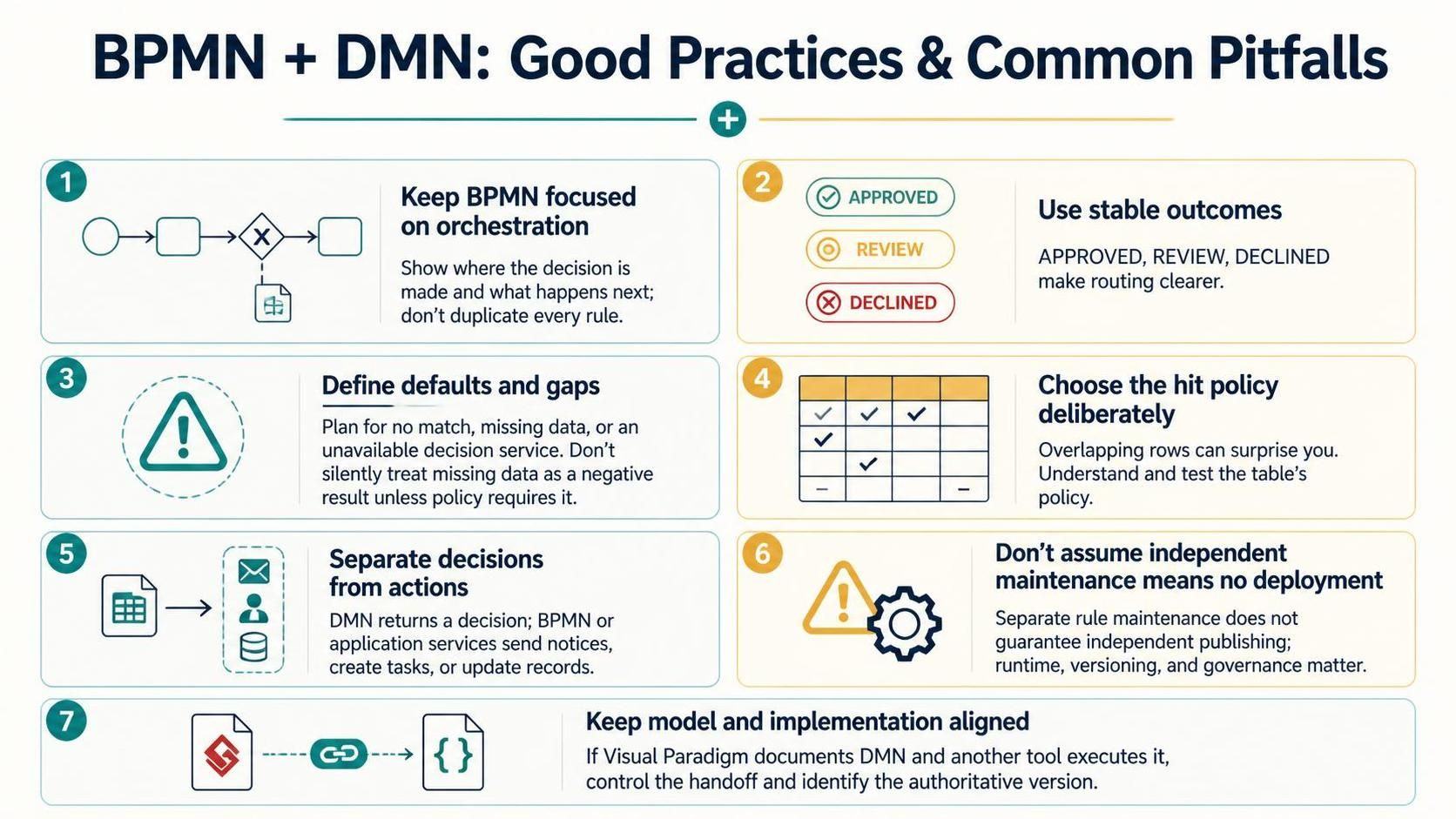
Designing a robust business process architecture requires a clear separation of concerns. When integrating Business Process Model and Notation (BPMN) with Decision Model and Notation (DMN), the goal is to achieve clarity, maintainability, and agility. This tutorial explores the critical architectural principles for combining these standards, utilizing the Visual Paradigm ecosystem and VPasCode for effective implementation.
1. The Separation of Orchestration and Logic
The most common mistake in complex system design is the “spaghetti diagram,” where decision logic is hardcoded directly into the BPMN flow using an excessive number of gateways. To avoid this, you must maintain a strict separation of duties:
- Keep BPMN Focused on Orchestration: The process diagram should answer “Where is the decision made and what happens next?” It acts as the conductor, not the musician.
- Don’t Duplicate Rules: Avoid embedding every single business rule into the BPMN flow. Instead, delegate the heavy lifting of logic evaluation to a dedicated DMN decision table.
By offloading complex logic to DMN, your BPMN diagram remains a high-level map of the business flow, making it easier to read and understand for stakeholders.
2. Designing for Routing: Stable Outcomes
When you invoke a Decision Service from within a BPMN process, the routing of the flow depends entirely on the output of that decision. To ensure your process flow remains stable and predictable, you must define a small, stable set of outcomes.
Consider a loan application process. Instead of routing based on dozens of specific variables, the DMN should return a simplified state that the BPMN gateway can easily interpret. A standard set of outcomes often includes:
- APPROVED: The path forward for immediate processing.
- REVIEW: A path to manual intervention or further analysis.
- DECLINED: The termination path for the process.
This approach makes the BPMN gateway logic significantly clearer and reduces the coupling between the decision model and the process flow.
Code Example: Simple Decision Output Structure
When modeling this in Visual Paradigm, ensure your DMN output variable is typed to handle these distinct states cleanly.
<dmn:Decision id="LoanEvaluation">
  <dmn:Output id="loanEvaluationOutput">
    <dmn:OutputExpression id="result">
      <dmn:text>decisionResult</dmn:text>
    </dmn:OutputExpression>
    <dmn:TypeRef>DecisionOutcome</dmn:TypeRef>
  </dmn:Output>
  <!-- DecisionOutcome is an Enum: APPROVED, REVIEW, DECLINED -->
</dmn:Decision>
3. Handling the Unknown: Defaults and Gaps
A robust architecture must handle the unexpected. In real-world data scenarios, you will often encounter missing data or rules that do not match the current context. You must explicitly define defaults and gaps to prevent the system from failing silently.
Rule of Thumb: Do not silently treat missing data as a negative result (e.g., auto-rejecting an application) unless your policy explicitly requires it. It is safer to route missing data to a “REVIEW” queue for human analysis.
4. The Hit Policy: A Deliberate Choice
One of the most technical aspects of DMN is the “Hit Policy,” which defines how the decision engine processes the input against the rows in the decision table. Choosing the wrong policy can lead to surprising results.
- First: Evaluates rows in order and stops at the first match. If no match is found, it returns null.
- Unique: Ensures only one row matches; if two match, it throws an error.
- Priority: Evaluates all matching rows and returns the one with the highest priority.
Overlapping rows can produce conflicting results if the policy is not understood and tested. Always validate your decision table with boundary conditions to ensure the Hit Policy behaves as intended.
5. Separation of Decisions from Actions
It is vital to distinguish between deciding and acting. The DMN standard is designed to return a decision (a value or a set of values), not to perform side effects.
When integrating these models:
- The DMN engine evaluates the rules and returns a result (e.g., “High Risk”).
- The BPMN process or an external application service receives this result.
- The BPMN process then performs the action: sending a notification, creating a task for a manager, or updating a database record.
6. Maintenance and Deployment Realities
A common misconception is that because DMN rules are “independent,” they can be maintained and deployed without affecting the rest of the system. While the models are separate, the reality of runtime architecture is more complex.
Don’t assume “independent maintenance” means “no deployment.” Even if the rules are maintained separately from the BPMN diagram, changes to the decision logic may require a deployment process depending on your versioning approach and governance policy. Ensure you have a controlled handoff mechanism to identify the authoritative version of your models.
Conclusion
By keeping BPMN focused on orchestration and DMN focused on logic, you create a system that is easier to test and maintain. Visual Paradigm provides the environment to document these coordinated artifacts, but it is up to the architect to verify that the chosen edition and runtime support the specific DMN modeling and execution capabilities required for your project.