

In the fast-paced world of software development, the user story is the fundamental unit of work. It is the promise made between the business and the engineering team. Yet, despite its central role, the user story often fails to deliver value because it lacks something critical: context. Without sufficient context, a user story is merely a wish list item. It is a fragment of information that invites assumptions, invites errors, and invites technical debt. When teams rush to write stories without digging deeper, they are essentially building a house on sand.
This article explores the necessity of deep context in user stories. We will examine the mechanics of ambiguity, the financial and temporal costs of missing information, and the practical steps to ensure every story is ready for development. We will move beyond the standard “As a user, I want, So that” template and into the nuanced reality of requirements engineering.
What Do We Mean by Context? 🌍
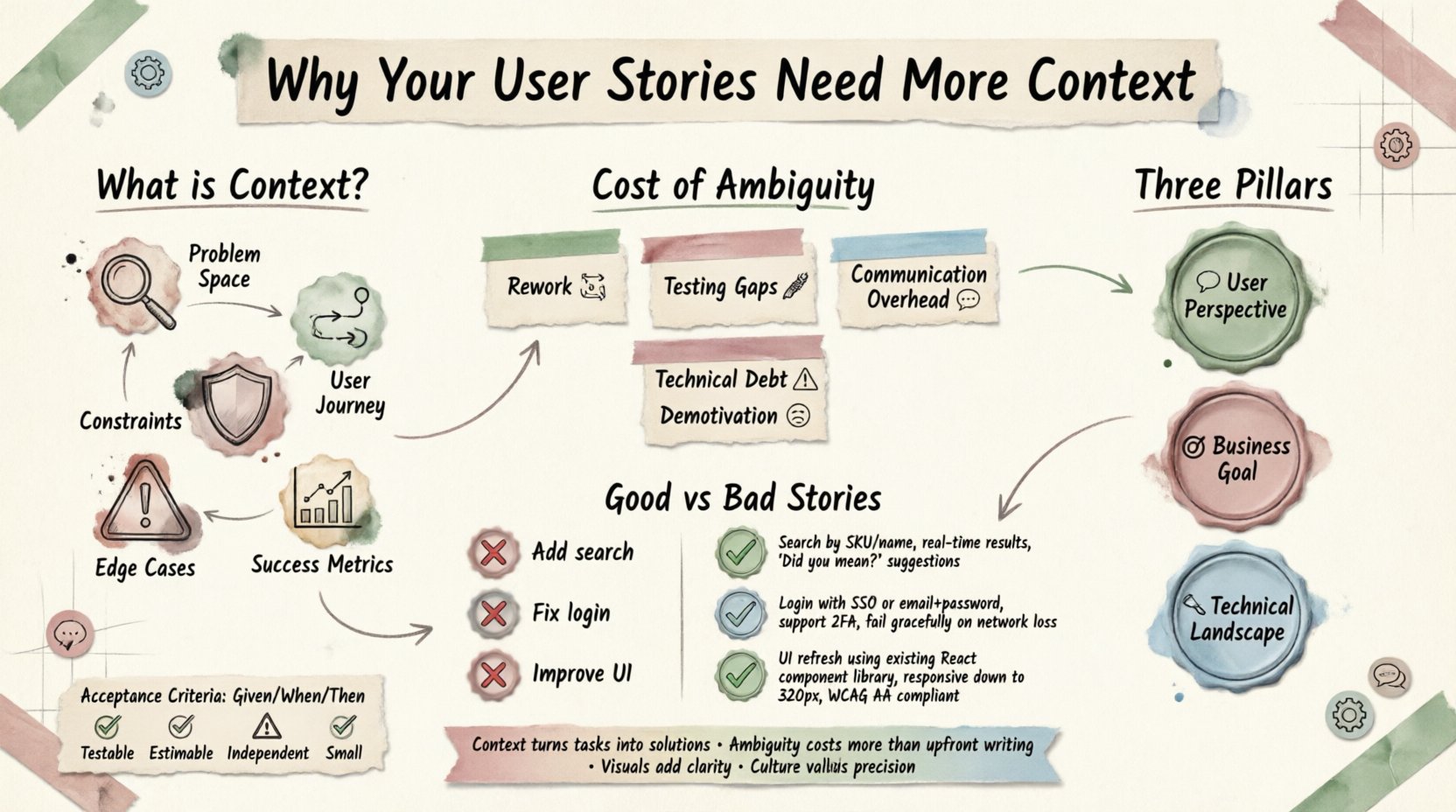
Context is the surrounding information that gives meaning to a specific request. In the absence of context, a developer is forced to guess. They might guess the user’s intent, the technical constraints, or the business priority. Guessing is the enemy of precision. When a story lacks context, the developer becomes a detective trying to solve a mystery that was never fully written down.
Context includes:
- The Problem Space: What real-world issue is this solving?
- The User Journey: Where does this interaction fit in the larger workflow?
- The Constraints: Are there technical, legal, or performance limits?
- The Edge Cases: What happens when things go wrong?
- The Success Metrics: How do we know this worked?
Without these elements, a story is incomplete. A story saying “Allow users to log in” is functional but lacks context. Does it need SSO? Is it for internal staff or public customers? What happens if the password is forgotten? These questions define the scope and effort required.
The Cost of Ambiguity 💸
When a story is written without adequate context, the cost is not just measured in time. It is measured in rework, frustration, and lost opportunities. The following points outline the tangible impacts of vague requirements:
- Increased Rework: Developers build features that do not meet the actual need. Once discovered, these must be torn down and rebuilt. This wastes engineering hours and delays other work.
- Testing Gaps: If QA does not have context, they cannot test effectively. They test what is written, not what was intended. Bugs slip through to production because the test cases were based on an incomplete story.
- Communication Overhead: Developers must constantly interrupt product owners to ask questions. This breaks flow states and slows down velocity. The time spent clarifying should have been spent writing the story initially.
- Technical Debt: To work around missing context, developers might implement a “quick fix” rather than a robust solution. This creates debt that must be paid later, often at a higher interest rate.
- Demotivation: Engineers dislike ambiguity. They want clear problems to solve. Constantly guessing erodes morale and leads to burnout.
Consider the scenario where a story states “Add a search function.” Without context, the engineer might build a simple text match. The business, however, needed fuzzy matching and autocomplete. The result is a feature that looks correct but fails the user. The context was missing, and the value was lost.
The Three Pillars of Story Context 🔑
To write a story that carries weight, you must address three distinct pillars of information. These pillars ensure that everyone reading the story shares the same mental model.
1. The User Perspective 👤
Who is actually using this feature? A generic “user” is not enough. Is it a power user? A first-time visitor? An administrator? The persona determines the complexity of the interface. A power user needs keyboard shortcuts and bulk actions. A novice user needs tooltips and guided flows. Understanding the persona provides the context for design decisions.
2. The Business Goal 🎯
Why does this feature exist? The “So that” part of the user story template is often treated as a formality. It is not. It is the compass for the team. If the goal is “increase conversion,” the feature might need A/B testing. If the goal is “reduce support tickets,” the feature might need a help button. The business goal dictates the priority and the acceptance criteria.
3. The Technical Landscape 🛠️
What is the environment? Is this a mobile app or a web browser? Are there legacy systems involved? Are there security compliance requirements? If a story is written for a mobile app but ignores the offline capability context, the feature will fail in the field. Technical context ensures the solution is viable within the existing architecture.
Acceptance Criteria: The Anchor of Context 📍
Acceptance criteria are the boundary lines of a user story. They define when the work is complete. However, they often become a checklist of tasks rather than a description of behavior. To provide context, acceptance criteria must describe the system’s response to various conditions.
Instead of writing:
- Check input field
- Click button
Write:
- Given the user enters an invalid email format
- When they attempt to submit the form
- Then a red error message appears explaining the requirement
This approach forces the writer to think about the flow. It provides context on error handling. It clarifies the user experience. It removes the need for the developer to ask, “What should happen if the email is wrong?”
Bad vs. Good: A Comparison Table 📊
The difference between a failed story and a successful one is often visible in the documentation. The table below illustrates the contrast between vague and contextual stories.
| Feature | Vague Story (Lacks Context) | Contextual Story (Rich Detail) |
|---|---|---|
| Search | Users should be able to search for products. | Users must be able to search inventory by SKU or name. Results should update in real-time. If no results are found, show a “Did you mean?” suggestion. |
| Checkout | Add a payment button. | Allow users to complete purchase using saved credit cards. If the card declines, show a specific error code. Support Apple Pay and Google Pay for mobile users. |
| Dashboard | Display sales data. | Show total revenue for the last 30 days. Allow filtering by region. Data must refresh automatically every 5 minutes. Hide data if the user lacks admin privileges. |
Notice how the contextual stories include edge cases, specific behaviors, and constraints. This reduces the cognitive load on the developer.
Visuals and Prototypes as Context 🖼️
Sometimes words are not enough. A diagram or a sketch can convey context faster than a paragraph of text. Wireframes, flowcharts, and mockups serve as a shared reference point. They eliminate the imagination gap between the product owner and the engineer.
When using visuals, ensure they are linked directly to the story. Do not store them in a separate document that might get outdated. The visual should be part of the story’s metadata. This ensures that if the design changes, the story updates with it.
Benefits of visual context include:
- Clarity on Layout: Shows spacing, alignment, and hierarchy.
- Interaction Flow: Demonstrates how screens connect.
- State Changes: Visualizes what happens on hover, click, or error.
The Definition of Ready (DoR) 🚦
Many teams use a “Definition of Ready” to gatekeep stories before they enter a sprint. This is a critical mechanism for enforcing context. If a story does not meet the DoR criteria, it cannot be worked on. This protects the team from starting work on unfinished requirements.
A robust DoR checklist includes:
- Clear User Value: The “So that” clause is specific.
- Defined Acceptance Criteria: All edge cases are considered.
- Dependencies Identified: We know what other teams or systems we need.
- Design Assets: Mockups or prototypes are available if needed.
- Non-Functional Requirements: Performance and security needs are noted.
Enforcing this rule ensures that context is not an afterthought. It becomes a prerequisite for progress. This might slow down the initial intake of stories, but it speeds up the actual delivery phase.
Handling Technical Constraints 🛡️
Context is not just about user needs; it is also about technical reality. Developers need to know if there are specific limitations. For example, a story might require a feature that is not supported by the current database version. Without this context, the team might build a solution that requires a major infrastructure upgrade.
Include technical context in the story by:
- Listing known API limitations.
- Specifying performance targets (e.g., load time under 2 seconds).
- Noting security compliance needs (e.g., GDPR, HIPAA).
- Identifying deprecated technologies that must be avoided.
This prevents the team from building a feature that is technically impossible or prohibitively expensive. It aligns the business wish with engineering reality.
Non-Functional Requirements (NFRs) 📉
Often, stories focus solely on functional requirements. They forget the non-functional ones. NFRs are the qualities of the system, such as reliability, scalability, and maintainability. These are often the source of context that is missing.
For example, a story might say “Upload images.” It does not say “Upload up to 50MB images.” If the developer builds it for 5MB, the feature is broken for enterprise users. If they build it for 5GB, the system crashes. The NFR provides the context for the implementation strategy.
Common NFRs to include in context:
- Performance: Latency requirements.
- Availability: Uptime guarantees.
- Security: Encryption standards.
- Accessibility: WCAG compliance levels.
Communication Loops and Feedback 🔄
Writing the story is only the first step. Context must be validated through conversation. The “three amigos” model (Product, Development, QA) is a powerful way to establish context. A brief meeting to walk through the story ensures everyone interprets the requirements the same way.
During these discussions, ask:
- “What if the user cancels at this step?”
- “How does this look on a small screen?”
- “What data do we need to store?”
These questions surface hidden context. They turn a static document into a dynamic understanding. This collaboration reduces the risk of misalignment later in the cycle.
Measuring the Impact on Velocity 📈
It is a common misconception that adding context slows down delivery. The opposite is true. While it takes more time to write a detailed story, it saves significantly more time during development. Stories with high context are estimated more accurately. They are less likely to be blocked by questions. They are less likely to require rework.
Teams that prioritize context see:
- Higher predictability in sprint commitments.
- Fewer bugs in production.
- Less time spent in meetings clarifying requirements.
- Higher developer satisfaction due to clear goals.
Velocity becomes a measure of true output rather than a measure of how much work was pushed into a sprint without understanding.
Building a Culture of Clarity 🏛️
Context is not just a writing skill; it is a cultural trait. It requires the organization to value precision over speed. Leadership must support the idea that a story is not ready until it has context. This means protecting the team from pressure to start work on incomplete items.
To build this culture:
- Train the Team: Teach product owners how to write contextual stories.
- Review Stories: Make story refinement a mandatory part of the workflow.
- Share Successes: Celebrate stories that were delivered smoothly because of good documentation.
- Retrospect: Discuss stories that failed due to lack of context in retrospectives.
Common Scenarios and Solutions 🔧
Sometimes, context is hard to come by. Here are common scenarios and how to handle them:
Scenario 1: The Business Has No Idea
If the business side is unsure, do not write a story. Write an investigation ticket. The goal is to gather the context first. This is often called a “Spike.” It allocates time to research and talk to stakeholders before committing to development.
Scenario 2: The Legacy System is Opaque
If the context involves a legacy system, spend time with the maintainers. Document the quirks. If the documentation is missing, create it as part of the story. This ensures future context is preserved.
Scenario 3: High Complexity
For complex features, break them down. A massive story is hard to contextualize. Smaller stories allow for more focused context. If a story is too big, it usually means the context is too broad.
The Role of Non-Functional Requirements (NFRs) 📉
We touched on NFRs earlier, but they deserve a dedicated focus. They are the invisible constraints that define success. A feature that works but is too slow is a failed feature. A feature that is fast but insecure is a liability.
Ensure every story has a section for NFRs. This forces the team to consider the quality attributes alongside the functional behavior. It prevents the “it works on my machine” syndrome.
Conclusion on Contextual Storytelling 📝
The quality of your software is directly tied to the quality of your requirements. User stories are the vehicle for those requirements. When they carry context, they become powerful tools for collaboration. When they lack context, they become sources of friction.
By investing time in the “Why,” the “Who,” and the “How,” you save time in the “When.” You reduce risk. You empower your team to do their best work. You ensure that the final product actually solves the problem it was meant to solve. Context is not an optional extra. It is the foundation of agile delivery.
Start by auditing your current backlog. Look for stories that are vague. Ask the team what information they needed that they didn’t have. Then, implement the practices outlined above. Watch your team’s confidence and output improve. The path to better software is paved with better stories.
Key Takeaways ✅
- Context turns a task into a solution.
- Ambiguity costs more in rework than in upfront writing.
- Acceptance criteria should describe behavior, not steps.
- Visuals and prototypes add essential context.
- A Definition of Ready ensures stories are complete.
- Technical and non-functional constraints are part of the context.
- Culture must value clarity over speed.
Commit to this standard. Your team will thank you. Your users will thank you. The software will be better for it.