
Building a business involves more than just a great idea. It requires a structured approach to ensure that the underlying model is viable, sustainable, and aligned with market realities. One of the most enduring frameworks for this assessment is the SWOT analysis. However, many organizations treat SWOT as a static exercise rather than a dynamic validation tool. This guide explores how to rigorously use SWOT data to validate your business model, ensuring that internal capabilities match external opportunities.
📌 Understanding the Core Components
Before diving into validation, it is essential to clarify what constitutes a business model and how SWOT fits into the picture. A business model describes the rationale of how an organization creates, delivers, and captures value. It includes the architecture of products, services, and infrastructure, as well as the revenue streams and cost structures.
SWOT stands for Strengths, Weaknesses, Opportunities, and Threats. When applied to business model validation, these four elements act as a diagnostic lens. They help answer critical questions about whether the proposed value proposition is realistic and if the operational model can support it.
- Strengths: Internal attributes that give the business an advantage over others.
- Weaknesses: Internal attributes that place the business at a disadvantage.
- Opportunities: External chances to make progress or improve performance.
- Threats: External elements that could cause trouble for the business.
Validation occurs when you cross-reference these elements against your business model assumptions. If your model relies on a strength you do not possess, it is invalid. If it ignores a major threat, it is risky.
🛠️ Analyzing Internal Factors: Strengths and Weaknesses
The internal analysis focuses on resources, capabilities, and processes that are under your direct control. This section of the validation process ensures that the engine of the business can actually drive the vehicle.
🏆 Identifying Genuine Strengths
A common mistake is listing generic positives like “good team” or “high quality.” For validation purposes, strengths must be tangible and defensible. These are the assets that allow you to execute the business model.
- Intellectual Property: Do you hold patents or proprietary algorithms that competitors cannot easily replicate?
- Operational Efficiency: Is your cost structure lower than the industry average due to unique processes?
- Brand Equity: Do you have established trust that reduces customer acquisition costs?
- Human Capital: Does the team possess specific technical skills required for delivery?
When validating, ask: Is this strength scalable? A strength that works for ten customers may not work for ten thousand. If your business model predicts rapid growth, the strength must be able to scale without degradation.
⚠️ Acknowledging Weaknesses
Weaknesses are often ignored because they feel negative. However, for validation, they are critical risk indicators. If a weakness prevents the core value proposition from being delivered, the model is flawed.
- Limited Capital: Does the cash flow model support the burn rate required for growth?
- Dependency on Key Personnel: What happens if a critical leader leaves?
- Legacy Infrastructure: Are current systems too rigid to support new features?
- Geographic Constraints: Is the physical location a barrier to expansion?
Validation requires a strategy for mitigation. If a weakness is identified, the business model must include a plan to address it, such as partnerships or phased rollouts, rather than assuming it will resolve itself.
🌍 Analyzing External Factors: Opportunities and Threats
External analysis looks at the environment in which the business operates. A business model that does not account for market dynamics is built on sand. This section assesses the viability of the market fit.
🚀 Leveraging Opportunities
Opportunities are external conditions that can be exploited. These often drive the growth narrative of a business model.
- Market Trends: Are consumer behaviors shifting in a way that favors your product?
- Regulatory Changes: Do new laws open up new markets or remove barriers?
- Technological Shifts: Can new tools reduce costs or improve user experience?
- Competitor Failures: Are rivals struggling to meet demand, creating a gap for entry?
For validation, an opportunity must be specific and time-bound. “Growing market” is too vague. “A 15% annual growth in the specific niche due to a regulatory change” is actionable data.
🛡️ Managing Threats
Threats are external risks that could endanger the business. Ignoring these is the fastest way to invalidate a model.
- Competitive Pressure: Are large incumbents likely to enter your space?
- Economic Downturns: Is the product a luxury item that will be cut during recessions?
- Supply Chain Disruption: Is the model dependent on a single source of materials?
- Changing Customer Preferences: Is the core need still relevant?
Validation involves stress testing. If a specific threat materializes, does the business survive? If the answer is no, the model requires restructuring.
📊 Mapping SWOT to Business Model Elements
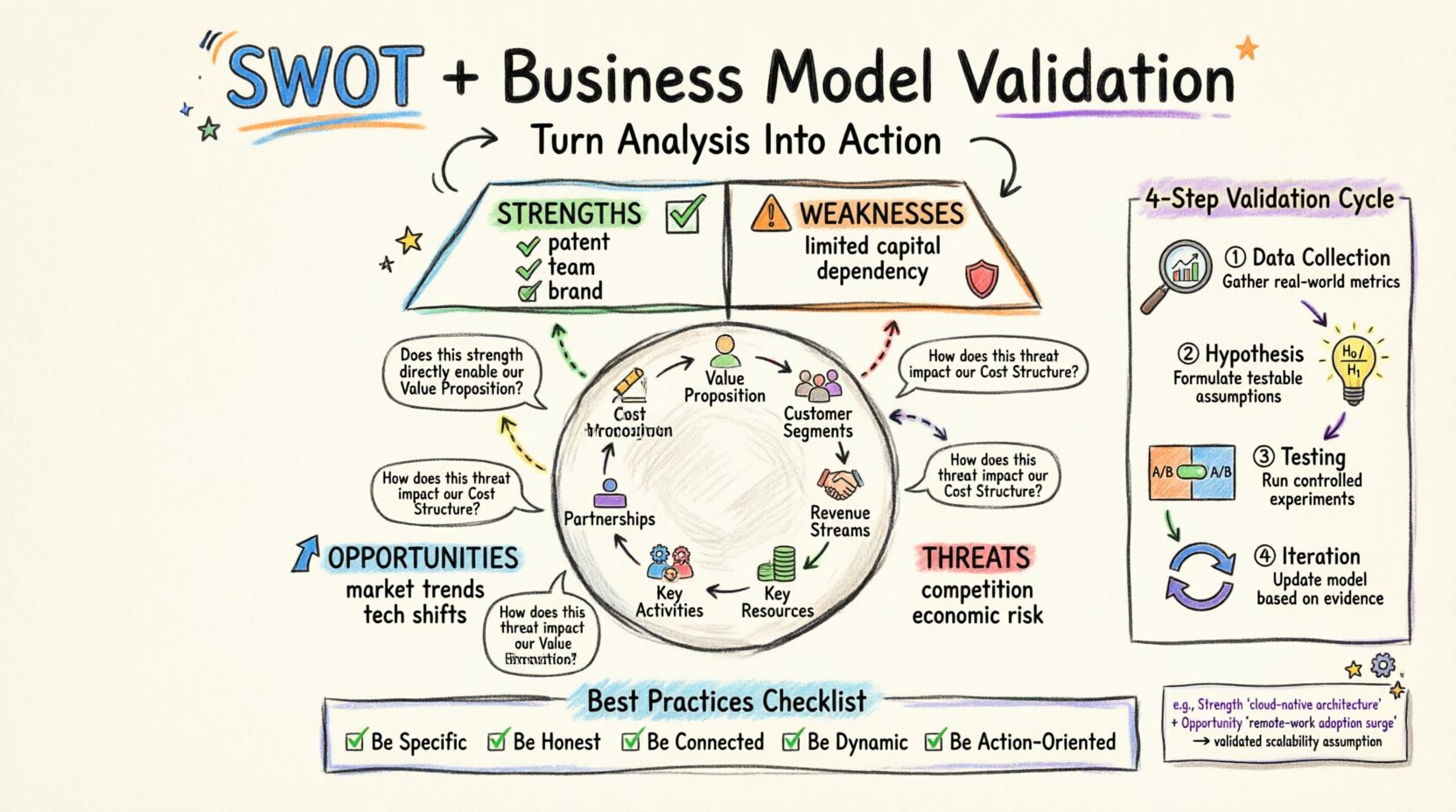
To truly validate, you must connect the SWOT quadrants to the specific components of the business model. This creates a matrix of evidence rather than a list of observations. The following table illustrates how to cross-reference these elements.
| Business Model Element | SWOT Connection | Validation Question |
|---|---|---|
| Value Proposition | Strengths & Opportunities | Does our strength enable the promise we make to the customer? |
| Customer Segments | Opportunities & Threats | Are we targeting a segment that is growing or shrinking? |
| Revenue Streams | Strengths & Weaknesses | Do we have the pricing power and collection mechanisms to capture value? |
| Key Resources | Strengths & Weaknesses | Are the required resources available or affordable? |
| Key Activities | Weaknesses & Threats | Can we execute these activities without hitting internal bottlenecks? |
| Partnerships | Opportunities & Weaknesses | Do we need partners to compensate for internal weaknesses? |
| Cost Structure | Strengths & Threats | Are our fixed costs sustainable if revenue dips? |
This mapping forces a level of scrutiny. For example, if your Value Proposition relies on “24-hour delivery,” your Strengths must include a logistics network or a partner capable of this. If that is a Weakness, the Value Proposition is invalid until the capability is built.
🔄 The Validation Process: Step-by-Step
Conducting a SWOT analysis for validation is not a one-time event. It is a cyclical process that integrates data collection, hypothesis testing, and iteration.
1. Data Collection and Sourcing
Subjective opinions lead to biased SWOT matrices. Validation requires data. Sources should include:
- Internal Metrics: Sales data, churn rates, customer support tickets, and operational logs.
- Market Research: Industry reports, competitor pricing sheets, and trend analyses.
- Customer Feedback: Surveys, interviews, and usage analytics.
- Financial Projections: Cash flow models and break-even analyses.
Ensure that every point in the SWOT matrix is backed by evidence. If you cannot find data to support a claim, it is an assumption, not a fact.
2. Hypothesis Formulation
Once the data is gathered, translate the SWOT points into testable hypotheses. This shifts the analysis from descriptive to predictive.
- Example Hypothesis: “If we reduce operational costs by 10% (Strength), we can lower prices by 5% to capture the price-sensitive segment (Opportunity).”
- Example Hypothesis: “If a competitor lowers their price (Threat), our brand loyalty (Strength) will maintain retention rates above 80%.”
3. Testing and Experimentation
Run small-scale experiments to validate these hypotheses before full implementation. This minimizes risk.
- A/B Testing: Test different value propositions to see which resonates.
- Pilot Programs: Launch in a limited geography or customer segment.
- Financial Modeling: Simulate the impact of threats on the bottom line.
4. Iteration and Refinement
Use the results of the experiments to update the SWOT analysis. A business model is dynamic. As the market changes, so do the Strengths and Threats. The validation process must be continuous.
- Update Data: Refresh the metrics quarterly.
- Reassess Priorities: What was a Weakness last year might be a Strength this year due to new technology.
- Adjust Strategy: Pivot the business model if the data indicates the original assumption was wrong.
⚠️ Common Pitfalls in SWOT Validation
Even with a structured approach, errors can occur. Being aware of these pitfalls helps maintain the integrity of the validation process.
🧠 Cognitive Bias
Teams often fall into the trap of confirmation bias, listing strengths that they want to exist rather than those that do. Similarly, they may downplay threats to protect morale. To combat this:
- Use External Auditors: Bring in consultants or advisors who have no skin in the game.
- Adopt Devil’s Advocate: Assign a team member to challenge every positive claim.
- Focus on Data: Prioritize hard numbers over qualitative feelings.
📅 Static Analysis
A SWOT matrix created once and filed away is useless. Markets shift rapidly. A strength today can become a weakness tomorrow if technology changes.
- Set Review Dates: Schedule formal SWOT reviews every quarter.
- Monitor Signals: Establish KPIs that trigger a review if they cross certain thresholds.
🔗 Lack of Connection
Listing SWOT items in isolation does not validate a model. The power lies in the connection. You must explain how a specific Strength helps exploit a specific Opportunity.
- Create SO/ST/WT/WT Strategies: Develop strategies based on the intersections (e.g., using Strengths to avoid Threats).
- Map to Revenue: Ensure every strategic move ties back to a revenue or cost driver.
💼 Case Example: SaaS Validation
Consider a hypothetical Software as a Service (SaaS) company planning to enter the enterprise market. How does SWOT validation apply?
Strengths: The team has deep experience in the specific industry vertical. The product has a unique integration capability.
Weaknesses: The sales cycle is long. Support capacity is currently limited.
Opportunities: Competitors are exiting the vertical due to low margins. A new regulation requires specific data handling features.
Threats: Large tech giants are building similar features. Economic uncertainty is causing IT budget cuts.
Validation Check: 1. Match Strength to Opportunity: The unique integration capability aligns with the new regulation. This validates the product-market fit. 2. Address Weakness vs. Threat: The long sales cycle combined with IT budget cuts is a major risk. The business model must adjust pricing to include upfront payments or reduce sales costs. 3. Defend Against Competitors: The team’s experience acts as a moat against large tech giants who lack vertical knowledge.
This analysis reveals that while the product is viable, the financial model needs adjustment to handle the sales cycle and budget risks.
📈 Measuring Success After Validation
Once the SWOT data has been used to validate the business model, how do you know it worked? Success is measured by the alignment of execution with the validated assumptions.
- Assumption Hit Rate: How many of the validated hypotheses proved true over time?
- Resilience: When a threat occurred, did the business model absorb the shock without collapsing?
- Efficiency: Did the validation process prevent wasted spending on features that did not add value?
- Growth Stability: Is the growth sustainable based on the internal strengths identified?
If the business model survives external shocks and meets internal targets, the SWOT validation was effective. If not, the cycle begins again with new data.
🛠️ Tools and Frameworks for Integration
While specific software is not required, the methodology of integration is crucial. You can use standard project management tools to track these validations.
- Spreadsheets: Useful for maintaining the SWOT matrix and linking cells to financial models.
- Whiteboards: Essential for visualizing the connections between Strengths and Opportunities during workshops.
- Documentation Repositories: Store the evidence (data, reports) alongside the SWOT points for future reference.
The tool matters less than the discipline of keeping the data updated and connected to the business goals.
🌱 Long-Term Strategic Alignment
Validation is not just about survival; it is about long-term strategic alignment. A validated business model is one that can adapt. As the company grows, the definition of Strengths changes. What was a Weakness (e.g., lack of brand) becomes a Strength (e.g., agility) in a different context.
Keep the SWOT analysis visible to the entire organization. When every team member understands the external threats and internal strengths, they make better daily decisions that align with the overall model.
📝 Summary of Best Practices
To ensure your SWOT analysis effectively validates your business model, adhere to these core principles:
- Be Specific: Avoid vague terms. Use data and metrics.
- Be Honest: Do not hide weaknesses or downplay threats.
- Be Connected: Link SWOT elements directly to business model components.
- Be Dynamic: Update the analysis regularly as market conditions change.
- Be Action-Oriented: Every insight should lead to a decision or a strategy change.
By treating SWOT as a rigorous validation framework rather than a compliance checklist, you build a business that is robust, adaptable, and grounded in reality.
🏁 Final Thoughts
Building a business is a complex endeavor that requires constant scrutiny. The SWOT analysis offers a proven method to bring structure to this scrutiny. When used correctly, it transforms from a simple list into a powerful engine for validation. It forces you to confront the truth about your capabilities and the reality of your market.
Remember that no business model is perfect. The goal is not perfection, but viability. By continuously applying SWOT data to validate assumptions, you reduce risk and increase the probability of long-term success. Start with your data, map your model, and test your hypotheses. This disciplined approach provides the foundation for sustainable growth.