
Strategic planning is the backbone of sustained business growth. Without a clear framework, teams often drift, reacting to immediate fires rather than building for the future. SWOT analysis remains one of the most robust tools for navigating this landscape. It forces an organization to look inward at its capabilities and outward at the market environment.
When applied specifically to quarterly growth goals, SWOT shifts from a static document to a dynamic engine for decision-making. This guide details how to leverage this framework to create actionable, measurable objectives for the next 90 days.
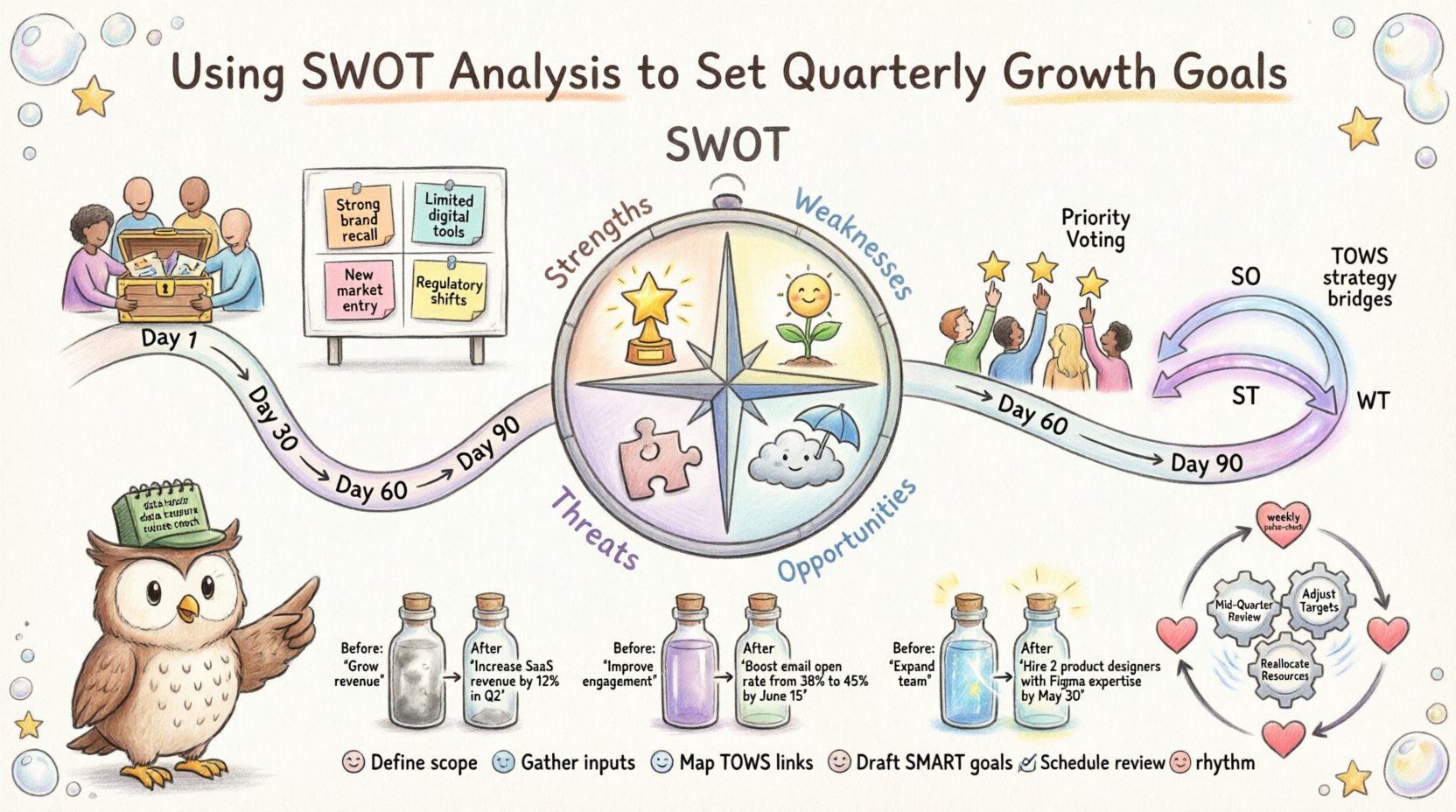
🧠 Understanding the SWOT Framework
Before diving into goal setting, it is essential to ground the process in the core components of the analysis. SWOT stands for Strengths, Weaknesses, Opportunities, and Threats. These four pillars categorize factors that influence business performance.
To ensure clarity, we distinguish between internal and external factors:
- Internal Factors: These are elements within your control. They include your team’s skills, financial resources, brand reputation, and operational processes.
- External Factors: These exist outside your control. They encompass market trends, competitor actions, regulatory changes, and economic shifts.
The Four Quadrants Defined
- Strengths (S): What do you do better than anyone else? Where do you have unique resources?
- Weaknesses (W): What areas need improvement? What resources are missing? Where do competitors outperform you?
- Opportunities (O): What market trends can you exploit? Are there new customer segments emerging?
- Threats (T): What obstacles stand in your way? Are there negative trends or competitor moves that could hurt performance?
📅 Why Apply SWOT to Quarterly Planning?
Annual goals are vital, but they can feel distant. Quarterly goals provide the necessary granularity to pivot quickly. A quarterly cycle allows for agility. If market conditions change in month two, you have enough time to adjust before the year ends.
Using SWOT for this timeframe offers specific advantages:
- Focus: It narrows down the vast array of strategic possibilities to the most viable actions for the next 90 days.
- Alignment: It ensures that growth targets are grounded in reality, not just wishful thinking.
- Resource Allocation: It highlights where to invest time and budget based on actual strengths and identified gaps.
Without this analysis, teams often set goals based on last year’s performance alone. This ignores current market realities and internal capacity changes.
📊 Step-by-Step Process for Goal Setting
Implementing this framework requires a structured approach. Follow these steps to move from analysis to action.
1. Gather Data and Stakeholders
Do not conduct this analysis in isolation. Growth goals impact everyone. Involve department heads, key contributors, and leadership.
- Internal Data Review: Pull reports on past performance, customer feedback, and operational bottlenecks.
- External Research: Look at industry news, competitor announcements, and economic indicators.
- Workshop Session: Hold a dedicated meeting. Use a whiteboard or shared document to capture ideas in real-time.
2. Populate the SWOT Matrix
Create a four-quadrant grid. List every relevant factor under its corresponding header. Be specific. Vague entries lead to vague goals.
| Internal (Controlled) | External (Uncontrolled) |
|---|---|
| Strengths e.g., Proprietary technology, loyal client base, low overhead. |
Opportunities e.g., New tax incentives, rising demand in a niche, competitor exit. |
| Weaknesses e.g., Aging software stack, high turnover in sales, limited marketing budget. |
Threats e.g., New regulations, inflation increasing costs, aggressive pricing wars. |
3. Validate and Prioritize
Not every point on your list is equally important. A list of 50 items is unmanageable. Apply a scoring system to prioritize.
- Impact Score: How much does this factor affect quarterly revenue or efficiency?
- Urgency Score: Does this need to be addressed immediately to avoid negative outcomes?
Select the top 3 to 5 items from each quadrant. This keeps the focus sharp.
4. Synthesize into Strategic Actions (TOWS)
Once you have your prioritized lists, connect them. This is where strategy happens. You can use a TOWS matrix approach to match factors:
- SO Strategies (Maxi-Maxi): Use Strengths to maximize Opportunities.
Example: Use your strong engineering team (S) to launch a feature for a new market trend (O). - WO Strategies (Mini-Maxi): Overcome Weaknesses by taking advantage of Opportunities.
Example: Hire contractors (fixing W) to capitalize on a seasonal spike (O). - ST Strategies (Maxi-Mini): Use Strengths to minimize Threats.
Example: Leverage your cash reserves (S) to survive a price war (T). - WT Strategies (Mini-Mini): Minimize Weaknesses and avoid Threats.
Example: Automate manual reporting (fixing W) to reduce risk of errors during regulatory audits (T).
🎯 Translating Analysis into SMART Goals
Strategic insights must convert into specific targets. A common mistake is setting goals that are vague, such as “improve customer satisfaction.” SWOT analysis helps define how to improve it.
Ensure every goal follows the SMART criteria:
- Specific: Clearly defined. What exactly will be done?
- Measurable: Quantifiable. How will success be tracked?
- Achievable: Realistic given the resources identified in your SWOT.
- Relevant: Aligned with the broader annual mission.
- Time-bound: Has a deadline within the quarter.
Example Transformation
| SWOT Insight | Vague Goal | SMART Goal |
|---|---|---|
| W: Slow customer onboarding process. | “Make onboarding faster.” | “Reduce onboarding time from 10 days to 5 days by Q3 end.” |
| O: High demand in the APAC region. | “Sell more in Asia.” | “Generate $50k in revenue from APAC region by increasing localized content by 20%.” |
| S: High brand trust score. | “Use brand trust to grow.” | “Leverage testimonials to increase conversion rate by 5% in the next 90 days.” |
🛡️ Risk Management and Mitigation
Quarterly planning often focuses heavily on growth. However, the Threats and Weaknesses quadrants of your SWOT analysis are critical for risk management. You must plan for what could go wrong.
Create a mitigation plan for your top threats:
- Identify the Trigger: What specific event signals the threat is becoming real?
- Assign Responsibility: Who owns the response if this threat materializes?
- Define the Action: What is the immediate step to take?
For example, if a Threat is “rising cloud hosting costs,” your mitigation might be “negotiate annual contracts with two vendors” before the costs hit peak levels.
🔄 Establishing Review Cycles
Setting the goals is only the beginning. Quarterly plans are not set in stone. The dynamic nature of business requires regular check-ins.
Weekly Pulse Checks
During weekly team meetings, review the key metrics associated with your SWOT-derived goals. Ask:
- Are we on track to hit the numbers?
- Has a Weakness become more pronounced?
- Has a new Opportunity emerged that we should pivot toward?
Mid-Quarter Adjustment
At the halfway mark (45 days), conduct a formal review. If the external environment has shifted significantly (e.g., a competitor launched a major product), you may need to adjust your goals. This is where the Opportunities and Threats sections of your original analysis need to be revisited.
⚠️ Common Pitfalls to Avoid
Even with a solid framework, execution can falter. Be aware of these common errors.
- Internal Bias: Only focusing on internal strengths while ignoring market shifts. If the market moves away from your strength, it becomes irrelevant.
- Too Many Goals: Listing ten major objectives dilutes focus. Limit quarterly growth goals to three to five critical initiatives.
- Ignoring Weaknesses: Hiding operational gaps. A growth goal built on a broken foundation will collapse under pressure.
- Static Analysis: Treating the SWOT as a one-time document. It must be a living reference point for the quarter.
📈 Measuring Success Post-Quarter
When the quarter ends, evaluate the outcomes against the SWOT-derived goals. This informs the next cycle.
- Did we leverage our Strengths? If not, why? Was the resource allocation correct?
- Did we mitigate Threats? Did the risks materialize, and was the plan effective?
- Did we capture Opportunities? Were we too slow to react to external changes?
This retrospective data becomes the input for the next SWOT analysis. It creates a continuous loop of improvement.
💡 Final Thoughts on Strategic Consistency
Growth is not an accident. It is the result of deliberate planning and execution. By using SWOT analysis to frame your quarterly goals, you ensure that every action taken is supported by data and strategic reasoning.
This method moves you away from reactive management and toward proactive leadership. It provides a clear line of sight between your daily tasks and your long-term vision. As you move forward, keep the analysis fresh, the goals specific, and the team aligned.
📝 Checklist for Quarterly SWOT Planning
Use this summary to ensure you have covered all bases before finalizing your plan.
- ☐ Internal team data reviewed and validated
- ☐ External market trends researched
- ☐ Top 3 Strengths, Weaknesses, Opportunities, and Threats identified
- ☐ TOWS strategies formulated to connect factors
- ☐ Goals written using SMART criteria
- ☐ Risk mitigation plans assigned to owners
- ☐ Review schedule established for the quarter
- ☐ Success metrics defined for tracking
With this structure in place, your organization is ready to execute with confidence. The path to growth is clear.