In the modern business landscape, the path a customer takes is rarely a straight line. It is a complex web of interactions, decisions, and emotions. To navigate this complexity, organizations must understand the concept of customer touchpoints. These are the moments where a customer interacts with your brand, product, or service. Whether it is seeing an advertisement, visiting a website, speaking with support, or using the product itself, each interaction shapes the overall perception of your company.
This guide provides a comprehensive look at mapping and optimizing these critical moments. We will explore how to identify every point of contact, analyze their impact, and create a cohesive strategy that enhances the customer experience (CX). By focusing on the details of each interaction, businesses can build trust and loyalty without relying on hype or vague promises.
What Exactly Is a Customer Touchpoint? 🧩
A customer touchpoint is any point of interaction between a customer and an organization. It is not limited to sales transactions. In fact, the most significant touchpoints often occur before a purchase is made or long after the transaction is complete. These moments accumulate to form the customer journey.
Understanding the distinction is vital. A touchpoint is a single interaction. The journey is the sum of all those interactions over time. When you map a journey, you are essentially charting the timeline of these touchpoints to see how they connect.
Categories of Touchpoints
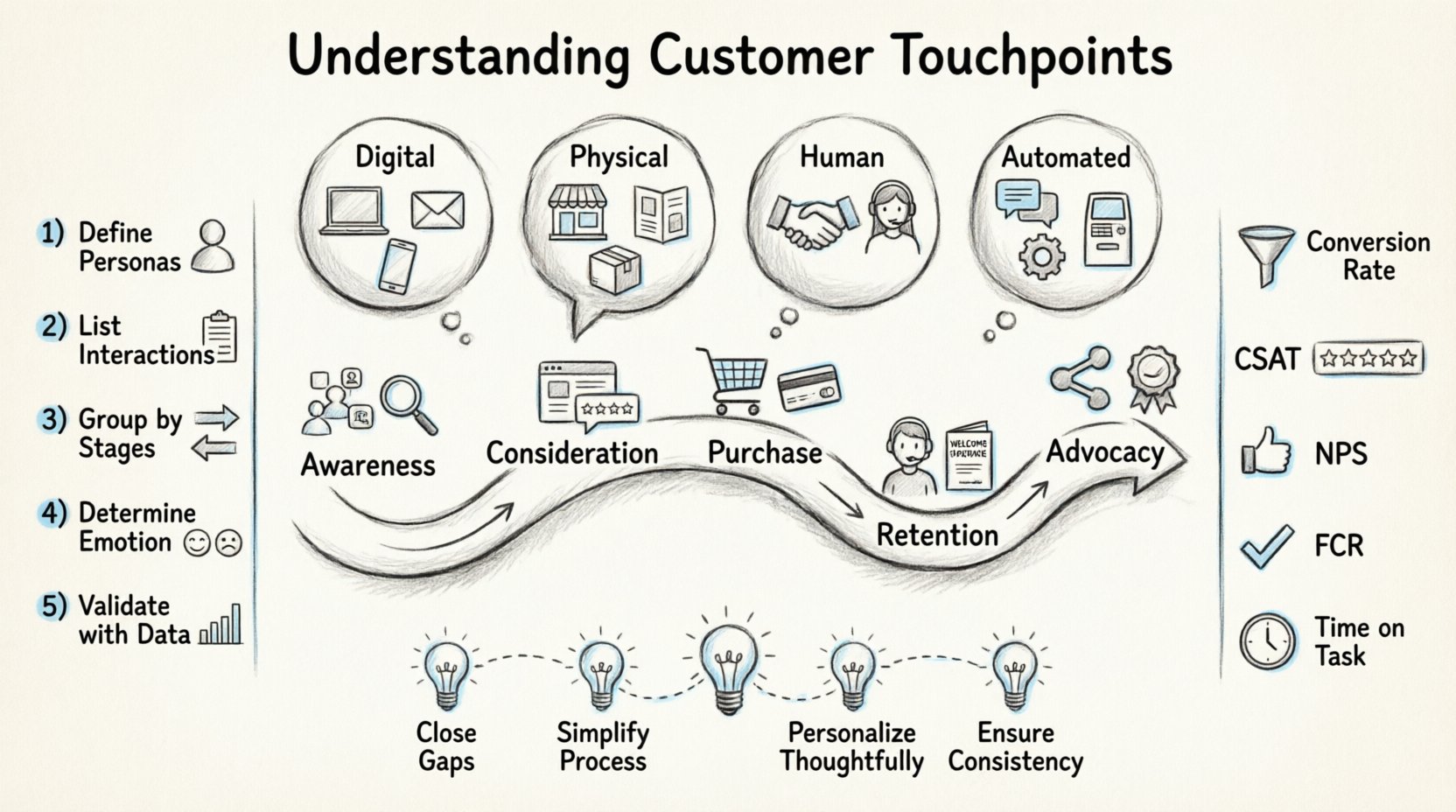
Touchpoints can be categorized based on the medium used and the stage of the journey. Broadly, they fall into four main categories:
- Digital: Websites, emails, social media, mobile apps, and online ads.
- Physical: Retail stores, packaging, printed brochures, and physical product quality.
- Human: Sales representatives, customer support agents, and onboarding specialists.
- Automated: Chatbots, automated emails, and self-service portals.
Each category requires a different approach to management. For instance, a human interaction allows for empathy and immediate problem-solving, while a digital interaction relies on speed and usability.
The Stages of the Customer Journey 🚀
To effectively map touchpoints, you must understand the stages a customer moves through. This framework helps identify where specific interactions occur and what the customer is trying to achieve at that moment.
| Stage | Customer Goal | Typical Touchpoints |
|---|---|---|
| Awareness | Identify a need or problem | Social media posts, search engines, word of mouth, billboards |
| Consideration | Evaluate solutions and options | Product pages, reviews, comparison charts, webinars |
| Purchase | Complete the transaction | Checkout process, sales calls, payment gateways, invoices |
| Retention | Use the product effectively | Onboarding emails, support tickets, user manuals, loyalty programs |
| Advocacy | Recommend to others | Referral codes, testimonial requests, social sharing |
Not every customer goes through every stage linearly. Some may skip consideration, while others may loop back to awareness after a negative experience. Your mapping must account for these non-linear paths.
How to Map Customer Touchpoints Step-by-Step 📝
Creating a customer journey map is a structured process. It requires data, empathy, and a willingness to challenge assumptions. You do not need expensive tools to begin; a team of people with diverse perspectives is often the most valuable resource.
1. Define Your Personas 👤
Before mapping, you must know who you are mapping for. Different customer segments have different journeys. A new customer might prioritize education and support, while a long-term client might value efficiency and exclusive access. Develop detailed personas based on real data, not guesses.
- Demographics: Age, location, job title.
- Psychographics: Goals, pain points, motivations.
- Behavioral Data: Past purchase history, browsing habits.
2. List All Potential Interactions 📋
Brainstorm every possible way a customer might encounter your brand. Do not limit this list to marketing. Include operations and product development.
Ask questions like:
- How do they find us?
- How do they contact support?
- What happens when they receive their order?
- How do they renew or cancel?
Write these down on a whiteboard or a shared document. Quantity is important at this stage; you can filter later.
3. Group by Journey Stages 🔗
Take the long list of interactions and sort them into the stages defined earlier (Awareness, Consideration, etc.). This creates a timeline. It reveals gaps where customers might get stuck or drop off.
4. Determine the Emotion and Sentiment 😊😠
A touchpoint is not just functional; it is emotional. At each stage, how does the customer feel? Frustrated? Excited? Confused? Indifferent? Use surveys and feedback data to understand sentiment.
Visualizing this on a map helps highlight friction points. For example, if the emotion dips sharply during the checkout process, that is a red flag indicating a technical or usability issue.
5. Validate with Real Data 📊
Do not assume the map is accurate until you test it against reality. Interview customers. Analyze analytics. Observe support tickets. If the data contradicts your assumptions, update the map. A static map is useless; it must evolve as your business changes.
Common Pitfalls in Touchpoint Management ⚠️
Even with a solid plan, organizations often stumble when trying to optimize touchpoints. Recognizing these pitfalls early can save significant time and resources.
- Internal Silos: Marketing knows one thing, sales knows another, and support knows a third. If these departments do not share information, the customer receives inconsistent messages. A promise made in an email might be broken by the product team.
- Channel Focused vs. Journey Focused: Many teams optimize their website or their app in isolation. However, a customer might start on social media, move to the website, and call support. Optimizing only one channel ignores the cross-channel experience.
- Ignoring Negative Touchpoints: It is tempting to focus only on the moments of delight. However, fixing a negative touchpoint often yields a higher return on investment than enhancing a positive one. A frustrated customer is more likely to churn than a happy one is likely to upgrade.
- Over-Engineering: Trying to personalize every single interaction can lead to a creepy experience. Balance automation with human touch. Customers know they are interacting with a system; transparency builds trust.
Measuring the Impact of Touchpoints 📏
Once you have mapped and optimized, you need to measure success. General metrics like total revenue are too broad. You need specific indicators that reflect the health of individual touchpoints.
Key Performance Indicators (KPIs)
Use a combination of quantitative and qualitative metrics to evaluate performance.
- Conversion Rate: How many people move from one stage to the next? A drop between “Consideration” and “Purchase” suggests a friction point in the checkout process.
- Customer Satisfaction (CSAT): Ask customers to rate a specific interaction immediately after it occurs. This gives direct feedback on the quality of that touchpoint.
- Net Promoter Score (NPS): While broader than a single touchpoint, NPS trends can indicate if overall journey improvements are working over time.
- First Contact Resolution (FCR): For support interactions, this measures how often a problem is solved in the first attempt. High FCR reduces effort for the customer.
- Time on Task: How long does it take to complete a specific action? If it takes too long, the interface may be confusing.
Optimizing for a Seamless Experience 🛠️
Mapping is only the first step. The real value comes from acting on the insights. Optimization is an ongoing cycle of testing, learning, and adjusting.
1. Close the Gaps 🔍
Identify where the customer expectation does not match the reality. For example, if marketing promises fast shipping but logistics takes three days, that is a gap. Align your promises with your capabilities.
2. Simplify the Process 🚀
Every extra step a customer takes is a risk. Reduce friction wherever possible. If a user has to enter their details twice during checkout, remove that step. If they have to download a PDF to find an answer, build a searchable help center.
3. Personalize Thoughtfully 👤
Use data to tailor the experience, but keep it relevant. If a customer bought a laptop, showing them accessories makes sense. Showing them dog food does not. Context matters more than volume of data.
4. Ensure Consistency Across Channels 🔄
The brand voice and visual identity should remain consistent whether the customer is on Instagram, the website, or on the phone. Inconsistency creates confusion and erodes trust. Create a style guide that governs all touchpoints.
The Role of Technology in Touchpoint Mapping 💻
While technology is a tool, not a strategy, it plays a significant role in managing touchpoints at scale. You do not need to name specific platforms, but understanding the types of systems involved is helpful.
- CRM Systems: Centralize customer data so every team member sees the full history of interactions.
- Marketing Automation: Trigger relevant messages based on customer behavior, such as sending a tutorial after a product purchase.
- Analytics Tools: Track user behavior on digital properties to see where they click, scroll, or leave.
- Feedback Platforms: Collect and aggregate reviews and surveys to understand sentiment trends.
The goal of these tools is to connect data points. When a customer complains on social media, the support team should know. When a customer abandons a cart, the marketing team should know. Integration is key to a unified view.
Future Trends in Customer Experience 🌐
The landscape of customer touchpoints is constantly shifting. Staying informed about trends helps you prepare for changes.
- AI and Chatbots: Automation is becoming smarter. Customers expect instant answers. However, the line between bot and human must remain clear. If a bot cannot solve the problem, it must escalate to a human quickly.
- Omnichannel Integration: The distinction between online and offline is blurring. Customers may buy online and return in-store, or try in-store and buy online. Your systems must support these hybrid journeys.
- Privacy and Data Ethics: Customers are more aware of how their data is used. Transparency about data collection builds trust. Be clear about what you collect and why.
- Proactive Support: Instead of waiting for a customer to complain, use data to predict issues. Notify them of delays before they ask. This shifts the experience from reactive to proactive.
Building a Culture of Customer Centricity 🏛️
Technical maps and data are useless if the culture does not support them. Every employee, from engineering to finance, should understand how their work affects the customer.
- Empathy Training: Encourage staff to see the product from the user’s perspective.
- Shared Goals: Align KPIs across departments so that sales, support, and product teams are not working at cross-purposes.
- Feedback Loops: Create mechanisms for customer feedback to reach decision-makers directly. Frontline staff often hear the most honest feedback; listen to them.
Practical Application Checklist ✅
Before finalizing your strategy, review this checklist to ensure you have covered the essentials.
- Identified all stages: Awareness through Advocacy.
- Listed all channels: Digital, physical, human, automated.
- Validated with data: Tested assumptions against real customer behavior.
- Measured sentiment: Understood the emotional journey, not just the functional one.
- Defined KPIs: Established how to measure success for each touchpoint.
- Assigned ownership: Every touchpoint has an owner responsible for its quality.
- Created a feedback loop: Plan for regular updates to the map.
Final Thoughts on Journey Optimization 🧭
The journey of a customer is never truly finished. It is a continuous cycle of engagement and feedback. By focusing on the specific touchpoints that drive value, you can create an experience that resonates. This requires patience, data, and a genuine commitment to serving the customer.
Start small. Pick one journey stage and map its touchpoints in detail. Measure the results. Then expand. Over time, these individual improvements compound into a superior brand experience. The goal is not perfection, but progress. Every interaction is a chance to strengthen the relationship, provided you pay attention to the details.