
Software architecture is the backbone of any maintainable system. When Object-Oriented Analysis and Design (OOAD) is executed correctly, it provides a robust framework for scalability and clarity. However, when the initial analysis is rushed or the design principles are misunderstood, the resulting codebase becomes a fragile entity. This guide addresses the critical moments when OOAD falters and provides a structured path to recovery. We will explore the symptoms of architectural decay, identify the root causes, and outline a methodical approach to refactoring without halting development.
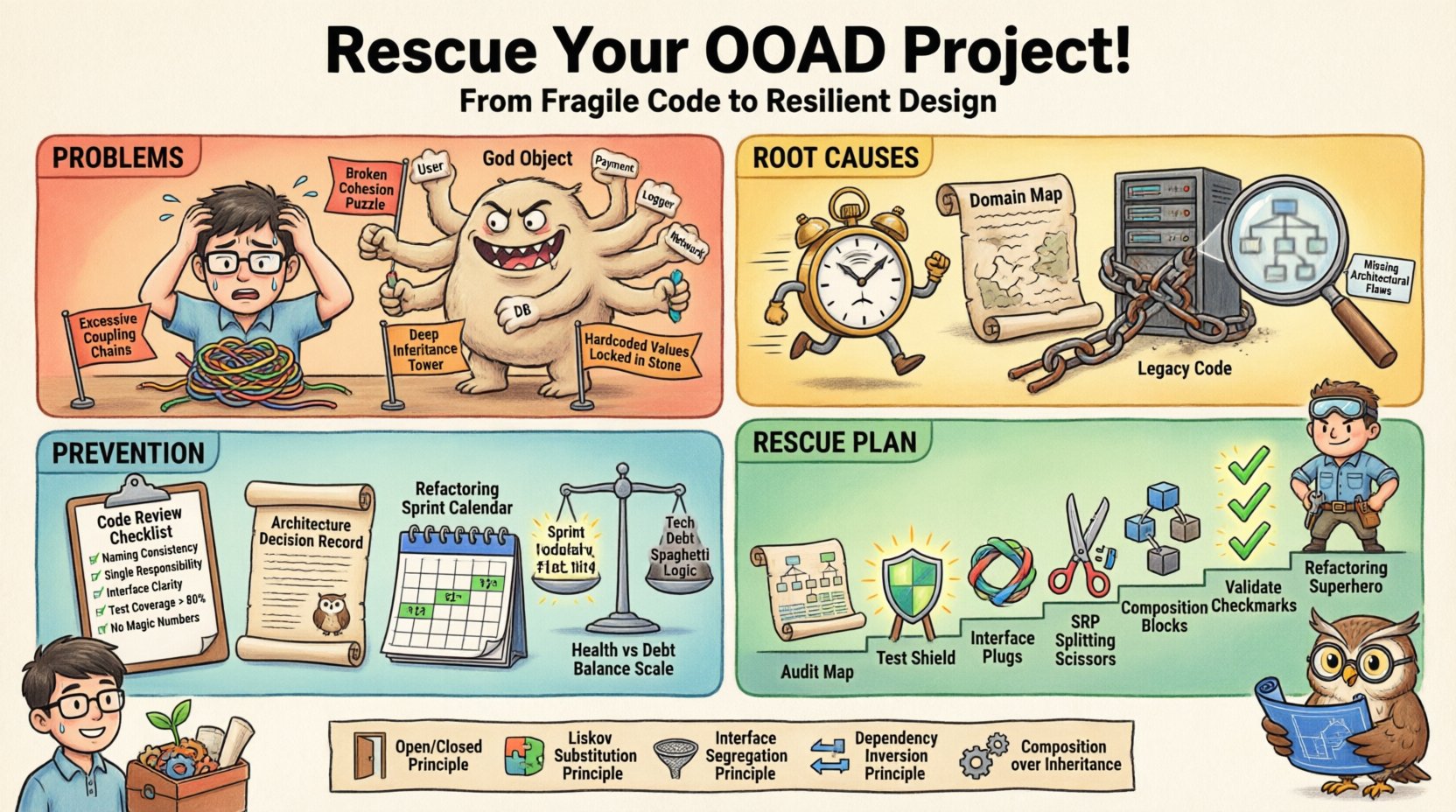
1. Recognizing the Symptoms of OOAD Breakdown 🚩
Weak designs rarely announce themselves immediately. They manifest as subtle inefficiencies that compound over time. Developers often feel a sense of dread when touching specific modules. This friction is the primary indicator that the underlying object model does not align with business logic. To diagnose a failing project, look for these recurring patterns.
- Excessive Coupling: When changing a single class requires modifications in dozens of other classes. Dependencies should be loose, allowing modules to function independently.
- Tight Cohesion Failure: A class that performs unrelated tasks. If a class handles database connections, user interface rendering, and business logic simultaneously, it has lost its focus.
- The “God Object”: A single class that knows too much or controls too much. This creates a bottleneck where every request must route through this central point.
- Deep Inheritance Hierarchies: When objects are derived from multiple levels of abstraction, understanding the state of an instance becomes difficult. Changes in a parent class can ripple unpredictably down the chain.
- Spaghetti Logic: Business rules scattered across controllers, services, and models. This lack of separation of concerns makes testing nearly impossible.
- Hardcoded Values: Constants and logic embedded directly within methods instead of being passed as parameters or defined in configuration.
Identifying these symptoms early prevents the project from becoming unmanageable. Each symptom represents a specific type of technical debt that accumulates interest over time.
2. Root Causes Behind Structural Decay 🔍
Understanding why a design fails is as important as fixing it. Most OOAD failures stem from process errors rather than a lack of coding skill. Recognizing these origins helps teams avoid repeating the same mistakes in future sprints.
Rushed Analysis Phase
Projects often skip the analysis stage to meet aggressive deadlines. Without a clear understanding of requirements, the initial object model is built on assumptions. These assumptions prove false as features are added, forcing developers to patch the design rather than rebuild it.
Ignoring Domain-Driven Design Principles
Technical implementation often overshadows the business domain. If objects do not reflect real-world entities accurately, the code becomes an abstract maze that is hard to navigate. The mapping between the domain and the software becomes opaque.
Legacy Constraints
Starting with existing code often forces new features into old structures. This “spaghetti wrapping” of new logic around old code leads to mixed paradigms where object-oriented principles are abandoned for procedural shortcuts.
Insufficient Review
Design reviews that focus solely on syntax miss architectural flaws. If the review process does not involve questioning the relationships between objects, weak designs slip through to production.
3. The Anatomy of a Failed Object Model 🏗️
A healthy object model relies on specific relationships. When these relationships break, the system loses integrity. We must examine the core pillars of object-oriented programming to see where they are compromised.
Encapsulation Breaches
Encapsulation protects internal state. When attributes are made public to avoid getter/setter overhead, the internal logic of a class becomes exposed. External code can manipulate data in ways that violate class invariants. This leads to data corruption and unpredictable behavior.
Inheritance Misuse
Inheritance should model an “is-a” relationship. When developers use inheritance for code reuse instead of structural modeling, they create brittle hierarchies. A common error is creating deep trees where a leaf class depends heavily on a distant ancestor.
Polymorphism Limitations
Polymorphism allows different classes to be treated through a common interface. Weak designs often rely on type checking (e.g., “if type is X do Y”) instead of dynamic dispatch. This defeats the purpose of polymorphism and reintroduces conditional complexity.
| Design Principle | Healthy Implementation | Weak Implementation |
|---|---|---|
| Encapsulation | Private fields, public interface methods | Public fields, direct manipulation |
| Coupling | Interface-based dependencies | Concrete class dependencies |
| Cohesion | Single responsibility per class | Mixed responsibilities per class |
| Abstraction | Abstract base classes for common behavior | Duplicate code across similar classes |
4. Strategic Refactoring: A Step-by-Step Rescue Plan 🔄
Rescuing a project requires discipline. You cannot fix everything at once. A phased approach ensures stability while improvements are made. The goal is incremental progress, not a complete rewrite.
Step 1: Comprehensive Audit
Begin by mapping the existing structure. Identify the most critical paths and the most fragile modules. Document the dependencies between classes. This map serves as a reference point to ensure refactoring does not break external contracts.
Step 2: Establish Test Coverage
Refactoring without tests is risky. If the system has no automated tests, create them for the critical paths first. These tests act as a safety net. If a change breaks functionality, the tests will fail immediately.
Step 3: Extract Interfaces
Replace concrete dependencies with interfaces. This decouples the implementation from the usage. It allows you to swap out components later without rewriting the calling code. Focus on high-level boundaries first.
Step 4: Apply the Single Responsibility Principle
Break down large classes. If a class handles multiple concerns, split it. Move logic to new classes that focus on that specific concern. This reduces the cognitive load on developers reading the code.
Step 5: Simplify Inheritance
Review the inheritance tree. Remove unnecessary levels. Where possible, prefer composition over inheritance. Composition allows behavior to be added dynamically without creating rigid class hierarchies.
Step 6: Validate and Iterate
After each refactoring step, run the test suite. Commit the changes. This small-step approach prevents the accumulation of errors. Repeat the cycle until the design meets the desired standards.
5. Design Principles Checklist for Stability ✅
During the rescue process, use this checklist to evaluate potential changes. It ensures that new code adheres to the corrected architecture.
- Open/Closed Principle: Are classes open for extension but closed for modification?
- Liskov Substitution: Can any subclass instance replace the base class instance without error?
- Interface Segregation: Are clients forced to depend on methods they do not use?
- Dependency Inversion: Are high-level modules dependent on abstractions rather than details?
Applying these principles requires a shift in mindset. It is not about writing clever code; it is about writing code that remains understandable and modifiable over years.
6. Preventing Future Architectural Debt 🛡️
Once the project is stabilized, measures must be put in place to prevent regression. OOAD is not a one-time task; it is a continuous practice. Teams must embed design validation into their workflow.
Code Review Standards
Reviews should include architectural questions. Ask how a new class interacts with the system. Does it increase coupling? Does it violate encapsulation? Reject pull requests that prioritize speed over structure.
Architecture Decision Records
Document significant design choices. Explain why a specific pattern was chosen. This creates a history of decisions that future developers can reference when facing similar problems.
Regular Refactoring Sprints
Allocate time specifically for technical debt reduction. Treat refactoring as a feature, not an afterthought. Dedicate a portion of each sprint to improving the codebase health.
| Indicators of Health | Indicators of Debt |
|---|---|
| High test coverage (>80%) | Manual testing for every change |
| Clear separation of concerns | Logic scattered across files |
| Minimal dependencies between modules | Circular dependencies |
| Consistent naming conventions | Inconsistent or vague naming |
7. Common Pitfalls During Refactoring 🚧
Even with a plan, teams encounter obstacles. Being aware of these pitfalls helps navigate them smoothly.
- Over-Engineering: Creating abstractions that do not yet exist. Only abstract when you see a pattern repeat at least twice.
- Ignoring Context: Applying generic patterns without understanding the specific business context. A pattern that works in one domain may fail in another.
- Performance Regression: Refactoring can introduce latency. Monitor performance metrics to ensure structural improvements do not degrade speed.
- Team Resistance: Some developers prefer the old way. Communicate the benefits of the new structure clearly. Focus on maintainability and reduced bug rates.
8. The Cost of Ignoring Weak Designs 💰
Ignoring OOAD failures has a tangible cost. It extends development timelines. It increases the likelihood of production incidents. It burns out the development team as they struggle with confusing code.
Every hour spent debugging a design flaw is an hour not spent building new value. The initial investment in a solid object-oriented analysis pays dividends in reduced maintenance costs. The choice to ignore these signs is a choice to accept higher long-term expenses.
9. Building a Resilient Object Model 🏛️
A resilient model withstands change. It allows the system to evolve as business requirements shift. This resilience comes from the strength of the relationships between objects. When objects communicate through well-defined interfaces, the system becomes adaptable.
Focus on creating objects that have a clear purpose. Each object should represent a specific concept within the domain. If an object feels like it is doing too much, split it. If it feels isolated, connect it to its collaborators. Balance is key.
10. Summary of Key Takeaways 📝
Rescuing a project from weak OOAD is challenging but achievable. It requires honesty about the current state and a disciplined approach to improvement. The steps outlined here provide a roadmap for stabilization.
- Identify symptoms like high coupling and deep inheritance.
- Understand root causes such as rushed analysis.
- Refactor incrementally with test coverage.
- Apply design principles consistently.
- Prevent future debt through review standards.
By following these guidelines, teams can transform a fragile codebase into a robust asset. The goal is not perfection, but progress. Continuous improvement is the only way to maintain a healthy software system in a changing environment.