

In modern product development, the gap between high-level vision and daily execution is often where projects stall. Teams frequently find themselves with a list of desired capabilities—features—that are too broad to be built in a single sprint. This disconnect leads to ambiguity, scope creep, and delayed delivery. The solution lies in a disciplined process of breaking down these features into granular, actionable user stories. By mastering this decomposition, teams ensure that every line of code written ties directly back to user value.
This guide explores the methodology for transforming abstract feature concepts into concrete work items that drive progress. We will examine the structural differences, the criteria for quality, and the collaborative practices necessary to maintain clarity throughout the lifecycle.
🧩 Understanding the Gap: Features vs. Stories
To build effectively, one must first distinguish between what a feature is and what a story represents. A feature is a functional capability of the system, often viewed from a business perspective. It answers the question, “What does the product do?” A user story, conversely, describes a capability from the perspective of the end-user. It answers, “How does the user benefit?”
Confusion often arises when a feature is treated as a story. A feature might be “Mobile Checkout,” which is too large to estimate or build in isolation. A story would be “As a shopper, I want to save my credit card details so that I can check out faster on future visits.”
Consider the following comparison to clarify the distinction:
Aspect | Feature | User Story |
|---|---|---|
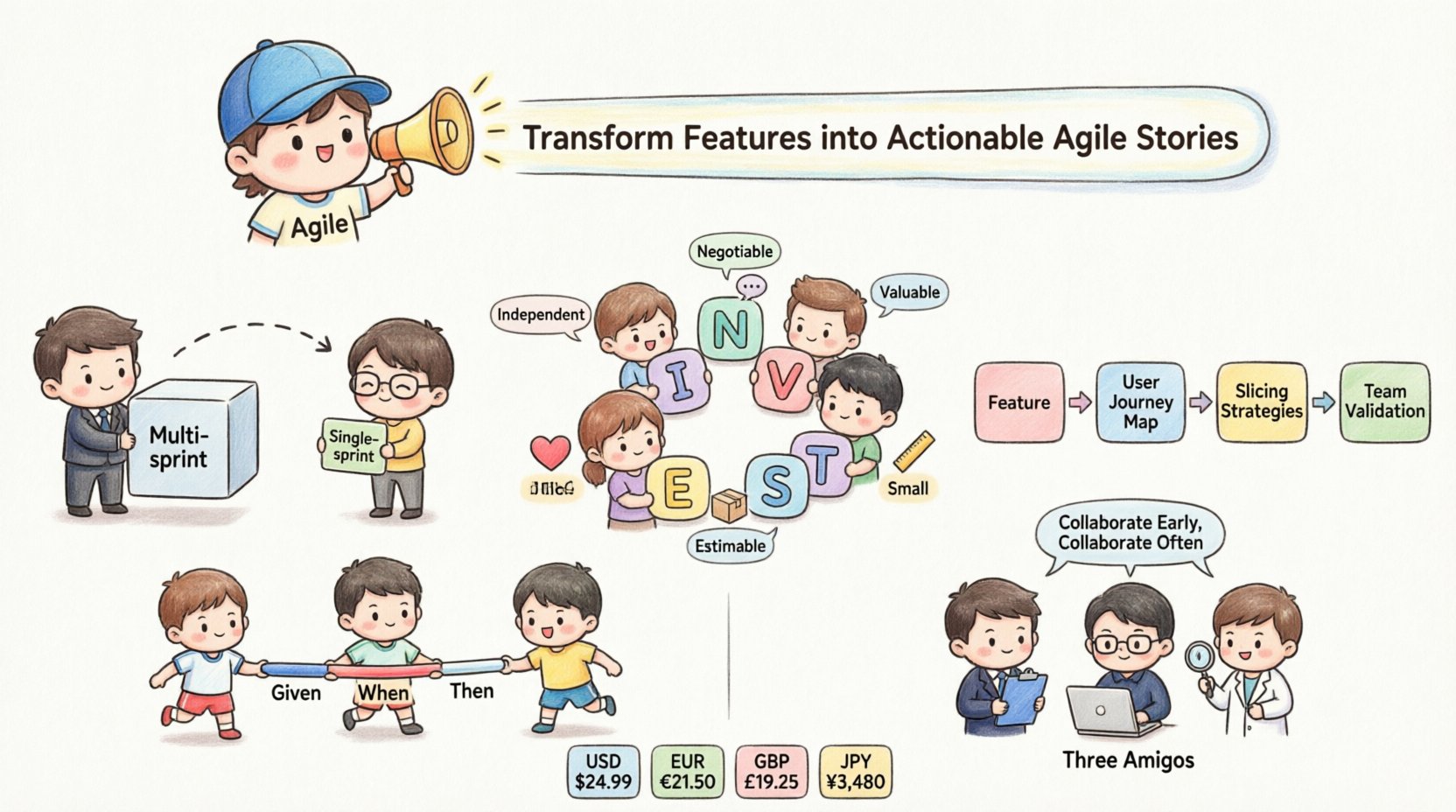
Scope | Large, multi-sprint effort | Small, single-sprint effort |
Perspective | Business or System View | User or Customer View |
Estimation | Difficult to estimate accurately | Clear enough for team estimation |
Delivery | Released as a major update | Released frequently, often incrementally |
Focus | Functionality | Value and Experience |
When teams confuse these two, planning becomes unreliable. Large features cannot be completed in short cycles, leading to unfinished work that creates technical debt. Breaking features down allows for incremental value delivery.
📋 The INVEST Model for Quality Stories
Not every breakdown is successful. A story must meet specific criteria to be considered ready for development. The industry standard for evaluating the quality of a user story is the INVEST model. This acronym provides a checklist to ensure stories are viable, testable, and valuable.
I – Independent: Stories should not rely on other stories to be delivered. Dependencies create bottlenecks. If a story depends on another, they should be split so that value can be delivered earlier.
N – Negotiable: Details are open for discussion. A story is a placeholder for a conversation between the development team and the product owner. It is not a rigid contract.
V – Valuable: Every story must deliver value to the user or the business. If it does not, it should not be in the backlog.
E – Estimable: The team must be able to estimate the effort required. If the scope is unclear, the story needs more definition before it can be estimated.
S – Small: Stories should be small enough to be completed within a single iteration. If a story is too large, it risks becoming a feature itself.
T – Testable: There must be clear criteria to verify that the story is complete. If you cannot test it, you cannot verify the value.
When transforming a feature, apply this model to every potential story. If a candidate story fails the “Small” or “Testable” criteria, it is likely still a feature masquerading as a story.
🔍 The Decomposition Process Step-by-Step
Turning a feature into stories requires a structured approach. It is not a random act of splitting text; it is a logical analysis of functionality. Follow these steps to ensure consistency.
1. Identify the Core User Value
Start by asking what the primary benefit is. For a feature like “Search,” the value is finding information quickly. For “Social Login,” the value is reduced friction during account creation.
2. Map the User Journey
Trace the path a user takes to achieve the goal. Where do they start? Where do they interact with the system? Where do they finish? This journey often reveals natural breaking points for stories.
Pre-condition: What must happen before the story can be executed?
Trigger: What action initiates the story?
Outcome: What is the state of the system after the story is done?
3. Slice the Functionality
There are multiple ways to slice a feature. Do not simply cut it vertically by screen or horizontally by database. Consider these slicing strategies:
Happy Path: Build the primary flow first. Ignore edge cases and errors initially.
Complexity: Separate simple configurations from complex logic.
Risk: Isolate high-risk technical components to validate them early.
Priority: Deliver the most valuable subset first, even if the feature is not complete.
Data: Separate stories based on data volume or types.
4. Validate with the Team
Once the slices are defined, review them with the developers and testers. They will identify hidden dependencies or technical constraints that the product owner might miss. This collaboration ensures the breakdown is technically feasible.
📝 Crafting Clear Acceptance Criteria
A story without acceptance criteria is incomplete. Acceptance criteria define the boundaries of the story. They answer the question, “How do we know this story is done?” Without them, developers may implement one interpretation, and testers may expect another.
Use the Given-When-Then format to write these criteria. It provides a structured way to describe behavior.
Given: The initial context or state.
When: The action or event that occurs.
Then: The expected outcome or result.
Example for a “Reset Password” feature:
Given the user is on the login page and clicks “Forgot Password”
When they enter a valid registered email address
Then the system sends a reset link to that email
Additional criteria might cover security and error handling:
Scenario: Invalid Email
Given the user enters an unregistered email address
When they click submit
Then the system displays a generic success message (to prevent user enumeration)
Writing these criteria forces the team to think about edge cases before coding begins. It reduces the number of bugs found during testing and ensures the feature behaves as expected in all scenarios.
🤝 Collaboration Models for Story Definition
Defining stories is rarely a solo activity. It requires input from multiple roles to ensure completeness. The most effective model involves the “Three Amigos”: the Product Owner, the Developer, and the Tester.
The Product Owner
Defines the “What” and the “Why.” They ensure the story aligns with business goals and user needs. They provide the context and the value proposition.
The Developer
Defines the “How.” They assess technical feasibility, identify dependencies, and point out architectural constraints. They ensure the solution is sustainable.
The Tester
Defines the “Verification.” They ask, “How will we test this?” They ensure the acceptance criteria are measurable and that edge cases are considered.
Regular refinement sessions bring these three together. During these meetings, stories are groomed, clarified, and sized. This shared understanding prevents the common issue of rework caused by miscommunication.
⚠️ Common Pitfalls in Story Decomposition
Even experienced teams make mistakes when breaking down work. Being aware of common traps helps maintain high quality in the backlog.
1. Too Many Stories
Over-slicing a feature results in hundreds of small tickets that take longer to manage than the original feature. There is a cost to managing tickets: tracking, reviewing, and deploying them. Ensure each story provides a tangible piece of value.
2. Technical vs. Functional Stories
Stories should focus on user value. Avoid writing stories like “Refactor the database schema.” Instead, frame them as “Improve search speed by optimizing the database.” This keeps the focus on the outcome rather than the implementation detail.
3. Ignoring Non-Functional Requirements
Performance, security, and accessibility are often treated as afterthoughts. These should be included as explicit criteria within functional stories or as separate technical stories with clear value.
4. Lack of Definition of Done
A story is not done when code is written. It is done when it is tested, documented, and deployed. Ensure every story has a clear Definition of Done that includes code review, unit tests, and integration checks.
5. Static Backlogs
Backlogs are living documents. Stories that were valid months ago may no longer be relevant due to market changes or technical discoveries. Regularly review and prune the backlog to keep it fresh.
📈 Measuring the Quality of Your Backlog
How do you know if your decomposition process is working? Look at your metrics. While velocity is a common measure, it does not tell the whole story. Consider these indicators:
Carry-over Rate: If stories frequently move from one sprint to the next, they are likely too large or misunderstood.
Estimation Accuracy: Compare estimated points to actual effort. High variance suggests stories are not well-defined.
Defect Rate: A high number of bugs found during testing often indicates unclear acceptance criteria.
Flow Efficiency: Measure the time from “Ready” to “Done.” Long wait times suggest bottlenecks in refinement.
By monitoring these metrics, teams can adjust their decomposition strategies. If carry-over is high, stories need to be smaller. If defects are high, acceptance criteria need to be more detailed.
🛠 Practical Example: From Feature to Stories
Let us walk through a concrete example to illustrate the transformation. Imagine a feature request for “Multi-Currency Support” for an e-commerce platform.
Feature: Multi-Currency Support
Story 1: Display Prices in Local Currency
As a shopper, I want to see prices in my local currency so that I understand the cost immediately.
Criteria: Detect IP location, default to detected currency, allow manual override.
Story 2: Convert Cart Totals
As a shopper, I want my cart total to reflect my selected currency so that I know the final amount.
Criteria: Real-time conversion, round to nearest cent, show exchange rate.
Story 3: Process Payments in Local Currency
As a customer, I want to pay in my local currency so that my bank does not charge conversion fees.
Criteria: Integrate payment gateway, handle currency mismatch errors, log transactions.
Story 4: Admin Configuration
As an admin, I want to manage currency rates so that pricing remains accurate.
Criteria: Manual rate update, automatic daily update, audit log.
This breakdown ensures that each story delivers value independently. The first story improves the user experience immediately, even if payment processing is not yet live. This allows for iterative releases and faster feedback loops.
🚀 Maintaining Momentum Over Time
Transforming features is not a one-time event. It is a continuous practice that requires discipline. As the product evolves, the way stories are defined must adapt. New team members need training on the INVEST criteria. Old stories need to be retired if they no longer align with the roadmap.
Encourage a culture where questioning the size of a story is welcomed. If a developer feels a story is too big, they should raise it during refinement. If a tester feels the criteria are vague, they should request clarification. This openness prevents the accumulation of hidden complexity.
Ultimately, the goal is to create a predictable flow of value. When features are transformed into actionable stories, uncertainty is reduced. The team knows exactly what to build next, and the product owner knows exactly what to expect. This alignment is the foundation of a high-performing Agile organization.
By adhering to these principles, teams move beyond simply managing tasks. They begin managing value. Every story becomes a step toward a better product, delivered with clarity and confidence.